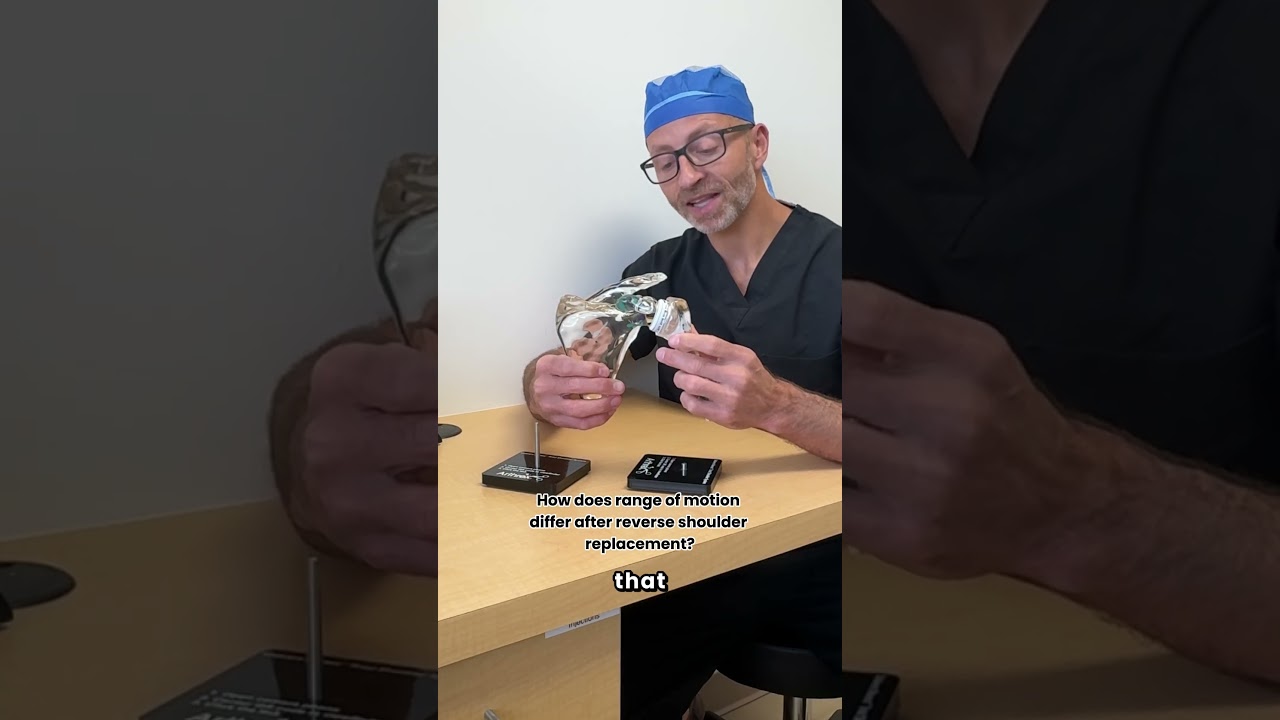
A reverse shoulder replacement trades rotational movement for stability. You'll keep good upward motion but lose the ability to reach behind your back, unlike an anatomic replacement that preserves the shoulder's full range of motion.
Chapters
How does range of motion compare or differ after an anatomic or reverse shoulder replacement? Well, again, there's differences in how the two function. With an anatomic replacement, we restore the anatomy. Normally what a shoulder does is it not only rotates, but there's actually translation that occurs at the joint. So the shoulder is the most mobile joint in the body. With an anatomic, you can restore, maintain that range of motion. With a reverse shoulder replacement, the stability has changed because we're relying on a fixed ball. The joint is semi-constrained. That plastic cup comes around that ball. And what that leads to is, although you have excellent stability, you have a fixed point to rotate around. And because of that, range of motion can be more limited, particularly rotationally. There's typically really good clearance moving up, but there can be rotational restriction. And in particular, what that often leads to is less range of motion behind the back with a reverse replacement compared to an anatomic replacement. So it's important to understand those differences if you're considering an anatomic or reverse shoulder replacement.