Business Over Breakfast Webinar Series with Emory Executive Education, Patrick Noonan & Lynne Segall

This content was created by Patrick Noonan. This content was uploaded by Patrick Noonan. This is a YouTube webinar video (Business Over Breakfast series) recorded August 20, 2020 and hosted by Emory Executive Education. Nicola Barron opens the session; Goizueta faculty Patrick Noonan (Professor Emeritus) and Lynn Siegel (Senior Lecturer) lead the webinar and field audience Q&A and live menti.com polls. The session is the first of a three-part series on problem solving and teamwork in a virtual world, covering: the ‘‘new nature of work,’’ types of problems (puzzles, campaigns, mysteries/wicked problems), the ‘‘double win’’ (high-quality + high-impact work), a structured seven-step problem-solving process, practical tools (3-finger summary, player/stakeholder analysis, issue/answer trees, Pyramid Principle), and guiding principles (be intentional, have the right fight at the right time, use questions, disambiguate, synthesize, KISS, iterate, do the right thing). The format is an instructional webinar with audience interaction (polls and Q&A).
Chapters
Good morning, everybody. I'm Nicola Barron, Chief Corporate Learning Officer at Goizueta Business, responsible for Emory's executive education. I want to welcome you again to our Business Over Breakfast, and this is the start of a new series of 3 webinars where we're going to be talking about problem solving and teamwork in a virtual world. Our goal is to help us understand how do we improve both the problem-solving skills and capabilities and our collaboration and effectiveness. And if you're anything like me, we're facing some very different types of issues and situations due to our teams working remotely. And so the more we can understand about how do we solve problems effectively in this virtual world, the the better. Our faculty guides today are Goizueta Business School professors Patrick Noonan and Lynn Siegel, and it's my pleasure to share a little about each of them. Patrick is Professor Emeritus in the Practice of Information Systems and Operations Management. It's a long title, but he deserves every bit of it. He teaches decision analysis, which draws on both the wisdom and the analytical methodologies of economics, psychology, statistics, sociology, and engineering to provide prescriptions for improving decision-making in business, in the professions, in health sciences, in politics, and in life. Patrick brings a wealth of knowledge based on his extensive global consulting and academic experiences. Lynn Siegel is Senior Lecturer in Organisation Management and is the Associate Dean of Goizueta Impact. That is a project-based experience where MBA students team with organisations to work on real issues. She led an incredible showcase of these projects last week with students projects being presented and with judges from all over the world. The projects were fascinating, including one that focused on predicting where the next pothole in Atlanta would be, which I think for anybody that's living in Atlanta is a very real situation. Not only did she lead the team that moved that showcase from an in-person experience to a virtual one. She also managed to secure Ed Bastian, CEO of Delta, to come and speak. I say all of this because it illustrates Lynn's creative problem-solving skills. So between you— between Lynn and Patrick, I think we're in very good hands for this morning and the next 2 Thursday mornings. Lynn and Patrick are going to kick off the webinar with their thoughts and observations, and Then that will be followed by about 20 minutes of Q&A. Please post your questions in the Q&A box at the bottom of your screen, and the team will do their best to get those all answered by Lynn and Patrick. I hope you— oh, at the end of it, I've got to say this, at the end of this, there'll be a short survey, so please fill that in before you leave this, this webinar. And I look forward to enjoying this morning, and I hope you do too. Thank you very much. Thank you, Lynn and Patrick.
Thank you and good morning. Thank you for the introduction and welcome everyone. Lynn and I are so happy to be here with you today and to spend this, this hour with you. We're actually going to be here for, for 3 sessions. You should be seeing a new, a new slide now that talks about the next 3 weeks. Today we're going to be talking about how to solve the right problem and solving the problem right. Next week we'll really move on to different ways to collaborate on problem solving, and then in our 3rd week we'll be talking about communication. But the overall brief that we have for this next 3 weeks is problem solving in a virtual world. We study problem solving because it's always a good time to upgrade your individual and institutional abilities to solve tough problems, to solve complex problems. And the virtual environment, the changes that we're in now, make it all the more valuable. First of all, we're experiencing a bunch of new, very new, very new, very difficult, very complex sorts of problems. And also, we're being forced off our usual methods. We're being forced off our game. We've got to redesign and rethink what it is that we do. We think it's an excellent time for us to retool and rethink in ways that build some high-quality, high-impact problem-solving techniques. You heard a little bit about us. Let's hear a little bit about you. We've got a new technology that we're, we're trying today too. So what I'd like you to do is go to a browser on your phone. Or on the computer and go to menti.com. If you type in menti.com, what you should get is a prompt that asks for a session number, and today's session code is 76135. And that should take you to our first question. So if you type in 76135, you should then be able to see today's first question. And you should be able to answer it, and somebody's already answered it. We've got a dynamic word cloud. The question is, where are you? So please type it in and hit submit, and we'll see how— we'll see where everybody is. There's a lot of Atlanta, but I know it also— somebody says home. Somebody says in my office. We've got, boy, South Africa and Alpharetta, Decatur and New Jersey, a wide variety of different responses. Puerto Rico and Brookhaven. But also some people who've responded in a different way. They've chosen to respond to the question, where are you, which was intentionally ambiguous, by the way, with where they are within their space, not on the map— home, home office, office, and so forth. That was part of the point. It's nice to know that we have such great geographic distribution of the participants, and we do thank you for joining us, but it's also very telling that and this virtual environment that we work in is that the place on the map is really less important and the nature of geography has changed as a result of the current conditions. Got another question for you too. Thank you for your responses to this one. Here's another question. It's about you and your professional focus. You should now see a new screen on your menti.com that's asking you to check one or more boxes that describe Uh, your focus and your primary roles professionally. Uh, please take a second to enter one or more— check one or more of those boxes, and so we can see what, what kind of, uh, professional, uh, focus we've got in our group today. Looks like consulting has just been overtaken by general management and strategy. It's a close race and a tight race for third with education, so welcome to those of you coming from education. Um, it's a wide variety of different kinds of professional backgrounds and roles, uh, today, and appreciate your, your weighing in. What we're going to talk about today really is applicable across all of these, uh, different kinds of, uh, domains. And the reason is that our focus— our focal point in this is, uh, The nature of work, and the nature of work that we have today, we've been calling it the new nature of work, is one in which we find ourselves— there we go— basically solving problems and answering the question, responding to the request, Figure it out. So the nature of work has been in recent years much more project-focused. It's less routine, less structured. It's more team-oriented. And we often find ourselves in a situation where somebody tells us a situation and what we're asked to do is figure it out. We're not given a lot of direction. We might be given a team that's, that's multifunctional, multi-location. And we have to figure out what to figure out, how to figure it out. And that's the— that's the— what we call the new nature of work, as opposed to an earlier time when things were much more structured. Now, we find people, uh, come to us and they say, well, um, you know, we just acquired a company and we inherited a bunch of new technology intellectual property. What are we supposed to do? We have to figure it out. Or perhaps, uh, our major customer that that buys 80% of our product has told us that they're really thinking about a future of 3D printing. What do we need to do? Figure it out. We're not told exactly what the question is or what it is we're supposed— what problem we're supposed to solve. We're given an itch and we have to figure out what the scratch is. Last week, some— many of you were here for David Nour's workshop, and he used this quote by Alvin Toffler. The illiterate of the 21st century will not be those who cannot read and write, but those who cannot learn, unlearn, and relearn. So Lynn and I have talked about the new nature of work. Well, there's a new, new nature of work. So it's all of those things that we've talked about with the added complication that we have— we're dispersed geographically. The economy has been upended. There's all sorts of new rules that nobody has figured out yet. And many of you are in a position where professionally what your job is each day is to figure it out. Now, figure it out problems come in a number of different forms. One of them is something that Lynn and I like to call puzzles. And what are puzzles? Puzzles are like a puzzle, or maybe like a labyrinth, a maze. These are the kinds of, uh, of problems where you kind of know what the problem looks like. You know what a solution looks like. For example, if you're working a puzzle, if you— if there's no gaps left and there's no extra pieces, you've solved the— you've solved the puzzle, and it looks like something. In a labyrinth, if you're trying to get out, You're out. If you're trying to get into the center, you're in the center. These are ones where you kind of know what the pieces are, you know what a solution looks like. And those may be difficult problems to figure out. But those are not the, the most difficult kinds of problems and the one that we focus on. Another kind of problem might— we might call a campaign. A campaign is one where you've got a lot of moving parts, it might be clear what you need to do. And the steps might be clear. But the big challenge is trying to get people working in coordination with these steps. But again, you kind of know when you're done because the people and the steps of— the people have accomplished the steps and you've been able to piece together a solution. The kind of thing that we're worried about a little bit more is what we call mysteries. These are actually the fun ones. These are the ones where you really have no idea what happened, what the problem is, what kind of investigative work you need to do, or even what a solution looks like. And so these are really the toughest kinds of— the toughest kinds of problems. that we need to work on. And so we like to call the, the figured-out problems for which our problem-solving techniques are most applicable as, as true mysteries. You really don't know a whole lot except something needs to be solved. Let's go back to Menti for a second, and we want to find out a little bit about problems that, that you face, decisions and problems that you need to face in business. So again, if you're just joining us, pull up menti.com on your phone or any, or any browser. And type in this session's code, which is 76135. And what you should then see is our, our, our Menti. That's our results from the last one. Here's a new question for you. What has made the toughest work problems especially tough? And this is in the past. This is pre-COVID. Give us some short answers and you'll see it will scroll. Zoom fatigue already. The unknown unknowns, navigating bureaucracy, lack of resources, the challenges of getting all the pieces, the organizations and the people all together, lack of resources. We can continue to scroll with more answers here. Please enter in your short answers for this.
Personalities.
Okay. Deciding without full information, ambiguity. That's one that we'll actually talk about a little bit, uh, today. Having your work teams engaged and inspired. Okay. Wonderful. These are some, these are some good, uh, good responses and some very familiar ones for us. We study, uh, decision-making and problem-solving in organizations, and there's a lot of recurring themes. There's a couple that have recurred right here. Lack of communication recurs on 2 different columns. The politics and bureaucracy, not enough data, too much data, the role of conflict. Okay, too little focus, conflicting needs and priorities. Excellent. This is wonderful. Thank you so much. So let's go back to our— let's go back to our slides. What do we do about that? Here's what the challenge is. The metaphor we use is we're being— we're given these messes, these problems, and some problems, as you know from your own work experience, are really what we might call wicked, wicked problems. There's, there's no sense of when, when you've actually solved the problem. So there's, there's no clue as to when you, when you've done enough, when to stop. There's nothing to indicate what the right answer is. Maybe there's not even a right answer or right or wrong answer or true or false. It might be just degrees of good and bad. Many stakeholders with different values, different priorities, and different ideas about what the problem is even about. We may have an unlimited, maybe infinite set of possible solutions to choose from. It's not like somebody just gives us which of these 3 different designs or colors is going to be the best one. These are often one-shot problems. We have— we don't have any opportunity to learn by trial and error, and that means every attempt counts a lot. No precedent. These are some very, very difficult problems. And what makes it harder is that what we're asked to do with these problems is, in solving them, is to get from issues to action. We've got to take this tangled bundle of wire and we have to move it to something that's elegant and functional. And what we talk about— there's a long story that goes with this. I'll give you this, just the short one today. Lynn and I talk about these problems as watermelon problems. They're not clear exactly what to do with it, but the one thing you don't want to do Is just throw it to the ground, the smash-and-grab method of problem solving, which is chaotic. It's fast, or it appears to be fast, but it makes a big mess and often requires the addition of duct tape at the end to pull it back together. And so what do we do to solve a problem if we're not going to smash and grab? How can we come up with something that's not— that's elegant in the sense of functional and efficient and has impact?
There we go. Took me a second to unmute. So one of the things that we want to think about when we're thinking about these watermelon problems is what, what are we actually trying to get to at the other, other side of this? What does success look like in our work? And there's a concept that Patrick and I call the double win. And what we're going for is the double win. So the double win starts with high-quality work. If we ask ourselves, what is it that we want others to say about our work on the other side of it when we're finished? We were looking for things like the quotes that you see here on the slide. This showed rigor. I can take this to the bank. You know, the leaders don't have to go check our spreadsheet to make sure that we got— that everything ticked and tied, that They have confidence that we have completed a thorough investigation of the problem. And that's important, but it's not enough. High-quality work is sort of table stakes. What we're going for and what makes it the double win is that it's also high-impact work. High-impact work, our leaders would say, is work that gives them the clarity and the confidence to take action, to move forward. And so that's the double win. It's partly about high-quality work, But what makes it the double win is that it also is high-impact work. It can lead to decision and action. So if that's our bias, if our bias is decision and action, how do we unpack that? How do we— what does it take to get a group of leaders to take action? And when we start working backwards from that, we realize that the very first thing you've got to do, or the most recent thing to get someone to take action, is a communication event. There's, there's an act of convincing the other to move forward. And so you've got to communicate with influence. But just having a shiny box— I think of communication, or, well, the communication has to be grounded in quality problem solving. If it's just communication for communication's sake and it's shiny, I like to think of that as it's all box and no cereal. The box has to be pretty to get someone to buy it, and you've got to have the right messages on it and the right images organized in the right way. And you've got to sell it, but you've got to have good cereal inside the box. And that's the problem solving. And in the context of all of this, you're doing this with a team. Most project work and initiatives today involve multiple people working together. So when we take a step back to say, what does it take to get us to decision and action, it's really these 3 skills around communication, problem solving, and teamwork. So, we can say, where would we look to, to get this sort of— to build these sort of skills? And we can look to some of the management consulting firms out there. Companies pay these firms a lot of money to come in and help them figure it out. And so, you know, Patrick and I have had the opportunity in our careers to work at some of these firms. We have met folks from all of these firms who come and recruit our students at Goizueta. And we've looked at the body of work and how management consultants approach problems as a guideline to say, well, how do you pull these 3 skills together in order to solve these figure-it-out mystery-type problems? Now, we do have a course that spans 2 days' worth of content that we'll be delivering virtually in August if you're interested in going deeper than what we can accomplish in these 3 Business Over Breakfast sessions today and over the next 2 weeks. That'll be over— it'll be 2 days of content spanning 4 days. And we're going to unpack a little bit of the mystique that we hear. If you've ever worked with anyone, and I know we have a lot of consultants here, you hear these sort of mysterious concepts that consultants talk about. MECE, like what's MECE? And so what? And the Pyramid Principle. And we'll go a lot deeper in our 2-day course in August to unpack what some of the mystique is of consulting. Um, but it's not as— it's, it's not as complicated as you— as, um, it one might seem. And we're gonna, um, we're gonna cover some of that, um, today and over the next couple of sessions.
Right, because although there's a lot of mystique around and there's a lot of jargon, um, uh, there really is a toolkit. And one of the things that Lynn and I have learned from our own professional Uh, so, uh, we've learned a lot from other professions, but also kind of scanning the environment in consulting and figuring— we figured out there's a lot of tools that are in the toolkit that are directly applicable, uh, to anybody and very, very widely applicable to people in, in any kind of an organization for solving the problem. But the other thing that we learned is that there's a lot more than just a toolkit. Really, there's problem solving with high impact is a way of doing. You know, if you think about what, what gets us from issues to action, it gets us from the tangle to the solution. What fills that gap is, is fact-based analysis, but it's principles and processes of problem solving that get you there. So we have some guides. There's a toolkit, sure, that's very flexible. It's very adaptable to many situations, but really the higher level skills Are a process for problem solving and some principles of high-quality problem solving that we have observed. So we describe it as a structured problem solving process. That's a term that you'll hear out there in the world as well. It doesn't really matter how many steps or how exactly you cut it. We cut it into a series of 7 steps. The first ones are ones where you're kind of taking the problem apart. And then the second part, we've made more mess than you started with, then you start converging in the diamond. to the right to bring everything back together. And the way we think about it, and good problem solving starts with, at the beginning, with what's the problem really about. And so a good problem solver is going to start by focusing on really defining what is the heart and soul of the problem and getting consensus on that. Some of the tools in the toolkit that might be associated with that are things like the problem statement or the 3-finger summary. Maybe a little player analysis. Lynn's going to talk about those a little bit later today. The next step is to— once you've gotten a good sense of the, the heart and soul of the problem, we need to think about what are all the pieces. We've got to take it apart, break it into manageable, tractable, solvable pieces that we can then in step 3 take the results of, for example, an issue tree or question tree and turn it into work plans where we're really trying to create coherent work plans and get agreement not only internally from the team but externally from the various stakeholders. In the middle of the diamond, we— after having planned the work, we work the plan, and that's when we're using some techniques for project management. We're also trying to pivot from a question-oriented thinking to answer-oriented thinking using some jargon called so what. That's actually a tool, some prompted ways to get creativity and creative solutions and to manage the roles of a team using something called the 6 Thinking hats. Well, then we're done, right? We've got our solution. Nope, not yet. We've got a lot of important work to do. The next step is to stress test the work before you jump from I've got the idea to presenting the final deck. There's a lot of work to think about. How do we make the, the strongest case that we need? And that can use a lot of stress. We can use a lot of stress testing tools. Also something that we call the answer tree. You might have heard of the pyramid principle that plays a big role in this step. We finally communicate our— communicate our answers, communicate our recommendations, and there's a lot of different bits of craft having to do with communication: the multi-purpose deck, answer first, using story-driven slides, and so forth. And then finally, ways to elicit good implementation and good governance of the implementation process. So good problem solving does follow a process. Another way of thinking about that is That's a principle. Have a pro— have a process is actually, is actually a principle. And the first principle we might say is have a process, don't smash the watermelon. But there are other guiding principles that we have discovered, and a real quick overview of them right now would include, let's see, be intentional. Rather than falling forward at every step, make sure that every decision that we make— and we have decisions to make all along the way, whether we're aware of them or not— Are things that we choose as opposed to just acting on habit or acting on convenience. Have the right fight at the right time. Very important one. It's like the locks of a canal. And there's 2 pieces to that. The right fight— we want to be able to build ways to have constructive conflict. But we also want to have sequence discipline where we're fighting about the right issues at the right process so that we don't have destructive conflict or endless looping within the team. Another principle: let questions do the heavy lifting. Questions are not just for getting answers. They can help shape an agenda, make suggestions. They have a lot of functions, and as you'll see, a lot of the tools in the toolkit involve asking really good questions. Disambiguate. Ambiguity is our enemy of any good project team. False consensus, where everybody nods their heads and they think they agree, can be terribly destructive if you then spend a couple of weeks or a couple of months And you come back together and you realize that you were not really in agreement. So tools, forcing devices we call them, that can disambiguate all along the way, keep that ambiguity from seeping into our work. Synthesize is what we call writing the short letter. There's a story about, I think it was Pascal, writing a letter to a friend and he said, I apologize for this long letter. I didn't have time to write the short one. It takes more time and effort to, to synthesize and to get to the point than it does to just to ramble on or to just collect everybody on the team's inputs and then call that collective list, uh, an answer. So we want to be able to synthesize. We want to KISS it. It's not what you think. It's keep it simple. And start. It's an iterative process. Those of you who saw David Nour last week, Um, who was the source of the Toffler quote, also said something, uh, in his— in the context of his talk, um, when you get 80% there, it's time to move, and he also said, um, if you're not embarrassed by even a little by something that you put out there, you probably waited too long to move. You want to be able to keep things simple, move forward, and be— and build in the process of iteration and good problem solving. Do the right thing. Of course, we mean ethical and legal principles, but we also mean Knowing the difference between advocacy and discovery. Advocacy is when somebody starts with an answer and your job is to find support for that answer. These tools really allow us to expand beyond that and to go to discovery, where you start with a question and you craft an approach to investigate that question. So those are the principles of high-impact problem solving. Um, let's do a real quick Menti here. Again, on menti.com, 76135@menti.com. Let's just take a quick little census of people's, of people's principles. So of all these principles, what would you hope to see applied more in your organization, places where you could actually do better? Is it following a process? Is it being intentional? So having the right fight at the right time, the use of good questions to do the heavy lifting, disambiguating, synthesizing, iterating, keep it simple and start doing the right thing, making sure that you don't fall into the trap of just being an advocate and actually truly discovering the answers to questions as opposed to just running with a preconceived solution. Thank you for your, your input. An interesting— so far it looks to me like do the right thing was, was in the lead, but that we see questioning and also keeping it simple and starting. The iteration also appears to be pretty strong. So it looks like across the board, people seem to be the most satisfied with the top one, following a process, but a pretty close Pretty close contest across all of those different principles. Wonderful. Okay. So there is one other piece to this as well. Those are the principles of, of high-impact problem solving, but also another one is play well with others. Obviously, these are people-oriented processes, and to get from issues to To action, to get over that canyon, involves lots of people. There are some other tools in the toolkit that relate to, to people. Some of them are internal to the team, and we have— we recommend that you actually invest in building a high-performance problem-solving team. And some of them are more external to the problem owners, the decision makers, maybe even outside the organization, facilitating high-quality conversations with all the key players. There are some techniques and some art Uh, to that as well. And those are also some essential elements of high-impact problem solving.
We think of these skills as craft skills. And just as the image on the screen illustrates, if you've ever tried to work with pottery before, that first time you throw the clay on the wheel doesn't turn out so well, and you don't get that beautiful work of art the first time. And the same is true for these skills. These skills that we're talking about today are skills that are learned and honed through experience and coaching and practice. They're actually quite easy to understand conceptually. It's the— in the doing and the applying where you really start to build the skills. The good news, though, is these skills are worth investing both in yourself and in your teams. Because they're forever skills, just like honey, which you can eat 3,000-year-old honey, and Twinkies, maybe it's, it's lore. We haven't tested it yet. But the idea is that just like Twinkies and honey, these are skills that have no expiration date. So we believe it's worth investing both in yourself and in your teams. Now, the first time you start trying these skills, it might feel a little rickety getting across that, that canyon that Patrick talked about a few minutes ago. And so we use the bridge metaphor, the bridge analogy of getting across that bridge. And so every time that you apply these skills, you start fortifying the bridge and getting better and better and better at it. And that's part of the building of the craft. And so our goal across these 3 sessions is to get you exposed to these principles and processes and over time give you the chance to apply them so that we can accelerate your growth. help you build your capabilities. So, let's get into a little bit of the, the actual content of how do you make this work. When, um, when we think about the problem-solving process, we actually lump the first 3 steps into a unit, because just as Patrick talked about the KISS principle, keep it simple and start, we have to recognize that there is iteration required. And so, as you move forward in the problem-solving process from defining it to breaking it down to planning the work, you develop new insights about the problem that may require you to go back and rethink exactly how you've framed the problem. But let's jump into step 1. Um, step 1 is about— is helping you figure out what is this problem really all about. And I believe we have a Menti as the next question, or in just a minute. So, um, in a minute we're going to get to a Menti question, and what we want you to think about is What do you have to figure out right at the start, at the very, very beginning? There's a lot you have to figure out at the beginning, but at the very, very, very beginning, what do you— what do you got to figure out first? And so, do we have the Menti question next? All right, great. So if you could go back to Menti, the code is 76135 for those of you who may have joined late. What are those things that need to be resolved at the very beginning of any project? Let's see what comes up here. Okay, great. Desired goal, desired outcome, the goals, the scope, the team, the plan, the people.
What's the—
I like that one about the spider, not the spider web. That's— I haven't heard that one before.
I like that too. And are there more that we can scroll? What does the ideal outcome look like?
Who?
The plan? What's the final result? What's the vision? What's the purpose? What's the driver? Agreement on the problem?
What's the goal?
The scope?
Lynn, this looks like a pretty good, pretty good collection. There's a few of them I note about resources, though, and timelines and so forth. That's, uh, that's actually quite relevant to what, uh, Lynn is going to talk about here with regard to step 1.
Yeah, so it— and there's a lot here about, um, what is the problem all about. Players, team members, great. What problem are we trying to solve, the key question, excellent. So there's a lot here. There's a lot to think about, and especially when you're working in a team, There are a lot of people in the room. There are a lot of ideas. And when I say the room, I mean Zoom room like we're in today. We use Machu Picchu as our metaphor for the problem sometimes as well. There's a lot in the picture. And the question is, what do we need to focus on? What's in the picture and what's out of the picture? Are we looking at what's those ruins in the far back right of the screen? Are we looking at what's in the far, you know, in the foreground on the left? Or what about that llama? What about that llama down near the bottom? Is he the problem? And notice that when we focus our attention, what's in the picture and what's out of the picture really shifts. And so it's like getting that, that frame of deciding not just what's in the picture, but also what's out of the picture. And a lot of you mentioned things like scope. We'd like to offer an idea, and some of you mentioned this in your, in your mentee responses, that what we want to do is get to the central issue. What are we really shooting at? David Knorr last week mentioned the quote from Drucker that it's more important to ask the right question than to get the right answer. And so our offer to you is to start— the very first thing to do is to start with framing your problem as a question, not a description with a long statement. But what is the central issue in the form of a question that we need to address? Because the question you ask is the question that you'll answer. And how you ask that question also matters. The words matter. And if you look at, you know, a sample question that— I think that's the next slide. Oh, 3-finger summary. Sorry. I'm going to get to this one in a minute. So there's a forcing device that we, that we use that helps us get to that central issue. We call it the 3-finger summary. It's really simple, 3 fingers, and the 3 fingers, each finger represents a sentence. This is, this device helps you apply that principle that we discussed earlier in synthesis. So the first finger, we have an index finger on the slide, I like to use the thumb. The first finger is the foreground. This is the— this is what's going on. There's a lot we can say about what's going on, and that's all the background. We intentionally use the word foreground here because we want you to pull to the front what is the most relevant that we need to pull out of the background and put in the foreground and frame that in one sentence. What's going on? Relevant facts. The second finger, or this one, the second finger is the trigger. This is the need for change. It's the burning platform. It's the why now. And the trigger is what sets up the question, because the question is that, that scratch to hit that itch, which is the central issue. What is the key question that we need to resolve here today? So really simple forcing device. You can use it with your teams to say, give me the 3 fingers. What's going on? Why is it an issue? And what's the real central issue that we need to resolve? Now, how you frame the question matters. I was jumping ahead a minute ago. There are a lot of different ways to frame the question, and the words that you choose matter. Are we talking about a switch? Are we talking about an investment? Are we talking about implementation? And look at this example of how, how a question was framed in a survey affected the survey results. So in Britain, they were trying to decide whether or not they should reduce the voting age from 18 to 16. And they sent out a poll. Some of the respondents got the question framed as you see it here on the slide: should we reduce the age from voting from 18 to 16? Other respondents got a different question. It's the same question, but it was worded differently. It was framed differently. What about giving 16- to 17-year-olds the right to vote? And you can see that they got very different responses just based on how the question was framed. So one of the forcing devices you can use in your teams, particularly work— working virtually, is let's make sure we're focused on the right question here and let's get it framed correctly.
One of the other things that, uh, that we like to do during step 1, in addition to getting a good problem statement that is often, uh, well forced by the 3-finger summary, is to begin what we might call a player analysis. The principle of play well with others not only refers to our team but refers to the other external players. It's a good idea to start from the very beginning of a project to understand who they are and, and how— what makes them tick. As Lynn described a few minutes ago, that double win requires, uh, you know, we want people to say we do high-quality work, but we also need high-impact work. That's what gets us asked back. That's what gets us a promotion. That's what gets us onto the next team and the next team. And in order to do that, we have to provide clarity and confidence, and we're going to be judged by others. So Let's start to understand all of the different players, what they consider to be quality, what they consider to be— provide clarity and to give them confidence. And so that starts with a preliminary player analysis. It's a, it's a step, it's a, it's a process that goes through the entire process, but it actually begins in step 1. What we want to do is characterize the players and plan for interacting with them. That's something that we will revise as we go, of course, and as we learn more, but it starts at the very beginning. Well, how does that work? Well, first of all, you have to identify all the players. Players are, are people or institutional pieces that either have a lot of influence on or are influenced by, uh, the project, and they come in many different shapes and sizes. In our experience, we find that teams tend to under-name the players. They tend to under-identify it. Their lists of players are too short, and they miss some important interactions that will— that until it's, until it's too late. To help prompt people to think about those, we remind people that there are, are sponsors. Those are the people who might bring you into a project or might be the, the operational liaisons and sources of information. There's also decision makers who are separate. Who are the decision makers? And those can be implicit or explicit. Who's resolving important resource questions and who's making these decisions? But they could be implicit. Years ago, I was working in consulting at McKinsey and Company, and we had a client in the newspaper business. Turns out, in order to manufacture a newspaper in New York at that time, it took the, the participation of 11 trade unions. Well, by definition, they weren't management, they weren't making explicit decisions, and yet their involvement and whether they were on board with plans to re— you know, to change the printing process, to build a new plant, and so forth, was critical to the success of the project. And so from the very beginning, we had to come up with an engagement plan for the representatives of the trade unions, or the project was not going to succeed. There's also other kinds of stakeholders, and again, um, look carefully and look broadly. Many of these stake— other stakeholders might be external but still quite crucial. So for example, it could involve some of our customers, uh, suppliers, governments or other regulators, trade associations, the news media, the community, the general public, and so forth. So again, think broadly about the players. Then what? Well, now we've got to start to organize them a little bit. And there's a variety of tools that allow us to think about what are the different dimensions of similarity and difference that matter to us. And it's often a fun thing to do, a good fight to have with the team at this time. To build a 2 by 2 and think about the different categories of players. You might start with something like this. This is called the Mendelow grid, where we characterize the different players based on how much power and interest they have. And some are high power, some in high interest, some are— have one but not the other, and so forth. Or rather than the level of interest, we might be more focused on the direction of interest, whether they're positively or negatively inclined to a particular project. Again, the right decision for what the axes are depend on your problem, and that's part of the conflict you need to have to really think about what matters to differentiate these and group these players. We might think about the, the level of influence. Are they influenced by or have influence on the project? Or we might think about the potential to be cooperators or competitors or threats to the project. Again, want to be intentional and think about all the players and start to group them together, and, and, and that helps us figure out how we're going to manage them. We need to remember also that those players have relationships to other parts of your organization, other parts of your supplier or your client organization, They have relationships as well, and we want to make sure we understand what those are. So we want to start to sketch out some kind of a network analysis, maybe a power map, it's sometimes called. So who communicates with, with whom, and who might have influence on whom? Okay. And then what this brings us to, the final thing, and then we'll, we'll pivot here and take your questions here in a moment. Before we move into the next steps of the project, we've thought about the players, we've characterized them in some ways. And we know we want to come up with some kind of a plan for engaging with them. So some kind of a stakeholder management matrix where we list the various players. And then for our columns, we choose the things that might matter to us, including what kind of engagement strategy or engagement approach we have. And in our virtual environment, of course, we've got more choices than ever, but a lot of more confusing ones and a lot of ones that are new to all of us and possibly them. We want to think broadly and intentionally about how we want to communicate With all the players, and we want to do that from the very beginning, starting in step 1. Okay, well, we want to leave some time for questions. We've got a little bit of previews about the, the coming weeks. But that's our overview of how to solve a problem right. It's a structured process that involves processes and principles, so we don't just smash the watermelon, we don't smash and grab, but we apply some principles of problem solving to get impact. And also in step 1, where we think about defining the problem well in the form of a question, the 3-finger summary is a really good head start, and we start our player analysis. Where do we go from here? Let's see if we've got some questions that we might be able to, to answer for you. We do.
Thank you, Lynn and Patrick. Um, the first comment and question states, these are all excellent points, thank you very much. How do you compress the entire process So it can be done quickly.
That's good.
That's good.
Well, um, Lynn, should I take a first, first crack and then, then you can weigh in and you can think about it for a second and then come up with a much better response, uh, to follow me? Well, first of all, there are some problems that are, that are made for speed. There are certain problems where you need a, a pretty good solution fast and you can always iterate. And so there's a lot of problem-solving techniques, so sort of agile and other kinds of product development kinds of techniques that are really designed to fail well. And, and, and the, the central feature is iteration so that you get something very, very, very fast. This process is a little more deliberate, but, but don't be fooled by the, the length of it or the number of steps. Then these steps are, are guideposts for what kinds of fights you need to have at what point. It doesn't mean that you need to spend a week or two or a long period of time on, on each one of them. These things can be These things can be done quickly. The key is to sort them out and to make sure you're fighting about the right things at the right time and using these forcing devices to, to implement the, uh, the principles such as, uh, disambiguation. Lynn, anything to add about speed?
Uh, just an anecdote. I, uh, when we teach this content to our MBAs, they are put in interview situations, um, particularly if they're going into consulting, where they're given a case and they have 45 minutes to solve a problem. And so I, you know, I talk about this problem-solving process as being like an accordion. You can apply all of these steps in a 45-minute case interview. They have a final exam where they have 4 hours to apply this in a team with a case, or you— it might span over several months. And so the idea is, and I think this is why it's portable and modular, is that you can pick and choose the different steps for what you need in the moment. And so it might be that right now what we need is to really use that 3-finger summary to distill the problem. But next week we'll talk a little bit about hierarchies and structuring devices and hierarchies to help you organize your thinking. That's a tool that you might pull out in a team situation where, you know, everyone's just sort of churning on a lot of different ideas. So—
And, and let's not forget, too, that this metaphor that Lynn and I use, in fact, the book that we've been working on We, we think it's gonna be called Don't Smash the Watermelon. Um, you know, there's this illusion of, of speed when you, you jump right in, when you plunge right into the problem, but just let's remember, and you can probably think of some of your own stories, sometimes the huge messes that we make, and what do those messes look like? We solved the wrong problem.
Mm-hmm.
Or we've got different people of a team not coordinating. Um, or we've completely must— misunderstood what the players actually want. Well, what happens then? Well, then you've got to do a lot of rework and you have to do it under bad circumstances because you've just about run out of calendar time. So one of the things that we say is that, is that applying these processes and principles often gets you— you start slowing down in a way actually gets you to a better solution faster because you don't have the stress and the time and the wasted resources of rework.
Yeah, and I'm noticing, Patrick, there's another question that is, what if you discover that the client actually has a different problem? How do you bring that to their attention? And the 3-finger summary is a useful device. The summary is— or the 3-finger summary is the device that gets you to distill it. But in the process of developing the 3-finger summary, there are a lot of questions that you have. This is part of the player analysis that Patrick talked about. There's a, there's a lot of dialogue that happens, and we find that getting that trigger figured out, the need for change, is what drives the question. And so In the process of figuring out the trigger, that's how you can help the client or your key stakeholders— not always a consulting situation— understand that they're focused on the wrong question. Because when you start— when you get the focus on the trigger right, and then it's a hard— sometimes a hard conversation, but an important conversation to have to say, this actually might not be the right question, because if what you're saying that the real pain point is this, That actually gets us to a different question, and that, that can be one of the most powerful dialogues that you can have.
Yeah, I agree. You know, we've all been in that situation where somebody presents us a problem or an opportunity and they don't quite know what it is. They know there's some need for a change or something on their mind, and this part of the dialogue actually is helping the problem owners clarify in their own mind what's going on. And we've seen— Lynn and I have seen People, even the most junior person in the room, do a very artful job of changing the direction of that ship by just applying the 3-finger summary. They don't need to step back and go, by the way, we learned this big process, it's called structured problem solving, here's something called a 3-finger summary. It can be done as quietly as this. You're listening. You're listening to what they're saying. And then you just play it back to them. Here's what I'm hearing. It sounds like And then you hit them with the, the foreground. Um, however, and the, the trigger often uses language like but or however or something like that, this has happened. And so is the, is the question that we need to answer with this project, hmm, and then you lay out that central issue. Then either like, yeah, that's kind of it, except what about, wait a minute, we've got this new intellectual property. Okay, let's revise it. It can be a way to to wrestle in the conversation in a really constructive way without letting people know that you're, you know, that you're channeling them in that way. It can be very, very, very, very useful.
And Patrick, there was a request to put the 3-finger summary slide back up. So that might be helpful. And then a related question, which is, how do you know that you're asking the right question framed the right way?
Okay, are you seeing the 3-finger summary again there?
Thank you.
Well, right, how do you know, how do you know whether it's the right one? Um, I mean, what— who's the arbiter of that, right? I mean, it's the— it's, it's kind of the problem owner, but, uh, you know, as I said, uh, you know, what, what our experience has been is that problem owners don't always, uh, fully understand and can articulate their own, uh, problem. And in my experience years ago when I was consulting, I think it was rare that the that the problem that they presented and described turned— would turn out to be the central issue. So I think it's an iterative process, and it's that dialogue that Lynn talked about, um, because you really do, you know, as we talked about, you, you want to— before you start investing a lot of time and effort doing the work, doing the analysis, we've got a lot of clock time, people, person hours, a lot of calendar time, elapsed time in the year, um, you really want to spend more time making sure you're moving in the right In the right direction. And I think that's an iterative dialogue during these first few steps.
And I think the dialogue is really important. A comment was made in the chat to us that said, wouldn't clients become defensive when we present them with the trigger? How would we— I think that was— and then there was a second thing related to the recording, but wouldn't clients become defensive? I think this is where the principle of let the questions do the heavy lifting really comes into play. Yes, because If— and there's another comment about managing, or a question about managing the politics, particularly if you've got 2 adversaries. Questions are so powerful in those dynamics because you're not then inserting yourselves into some sort of diametrically opposed situation. You're asking questions and you're staying in discovery mode. So this is also where do the right thing principle comes in, where you're staying in discovery mode. Where, where you are exploring. And, and if you can get those right questions, you get the right question well-timed in the right, in the, in the right moment can shift thinking, it can shift perspective, it can, and it can shift paradigms. So think about the questions that you ask those stakeholders because that's how you can avoid some of those personality or interpersonal dynamics that, that are real. Patrick, what would you add to that?
Yeah, I think that's, I think that's great. And one of the things you'd see in the overall body of material that we've been developing here is how these principles just keep popping up over and over. Lynn and I didn't even have them as part of what we were doing when we first started working on this project, but they emerged because we found ourselves saying the same things over and over, which is we're trying to disambiguate here, right fight at the right time. And we realized that these are these overarching principles that were built into these tools. So these questions, and let's, for example, the 3-finger summary, asking people to, to, to develop a 3-finger summary to, to define a project, um, is a way to have right fight at the right time, right? Which is you're getting people to focus, focus in on one thing as opposed to, well, what about data quality issues? Oh, and we're going to have a management change over in the Singapore office. No, no, no, keep, keep all the, you know, herding all of the, the ducks here into one, one sort of question, focusing them, disambiguating. By forcing people to give these 3 points, these 3 one-sentence summaries, you're forcing people to synthesize, you're forcing people to disambiguate, because ambiguity has a hard time hiding in complete thoughts and complete sentences. And so these forcing devices accomplish a lot of these different things. And yet there is, as Lynn said, they're not threatening. They're saying, let's try to craft this together. Is it this? Is it that? And that can be a really powerful tool, even if you are, as I said before, the most junior person in the room. You can have an enormous steering effect.
Yeah. So there's another question in here about framing. Uh, doesn't framing result in biased answers. So you can frame the question for the response you want. How do you frame it neutral? Well, one of the things that, that we recommend is to frame— make sure you don't build a solution into your question. If you build a solution into your question, you're already biasing the team, you're biasing, you're biasing yourself. So I like to encourage teams to think about a binary question. You're never gonna have a binary answer. You're never gonna have just a yes or no answer. But if you can force yourself into a discipline of asking a binary yes/no question, you know, should we do X, then it gets you to the essence of what, what are we— what is that central issue we need to resolve? The answer is going to be very nuanced and broad. But, you know, that's, that's one, that's one way to think about it. Patrick, what else would you add?
Well, sure. And, you know, in our limited time, we can't get to all of it, but, but I will say that from my field, from decision analysis and decision-making, of course, there's, there's a lot of research and a lot of lore about, about the biases that, that creep into everything that we do, and I think understanding what those are and knowing some debiasing techniques, some of which we, we talk about in our work, helps as well. Lynn mentioned one of them: you want to be careful not to build in an answer to the question, because then it's kind of leading. We want to be very careful not to, in our question, not to mention something that people might anchor on as a status quo. There's a status quo bias. There's a sunk cost bias as well. So how can we best, you know, make use of the half a million dollars that we spent on such and such an investment? It builds in an answer and it makes that half a million dollars loom very, very large. So, there's a lot of things that we can even inadvertently do that bring us bias. So, I think the question is not how can we, you know, what do we do to avoid it? I think the question is, we know that we are subject to bias. What are some debiasing techniques we can use to try to get to some neutrality and again, get to the true center of the question without predisposing people to one answer?
Yeah. And then there was a question in here about how often do we need to show results in order to continue to get buy-in while we're working through our timeline, and what are some strategies that help with presenting results? That might be one that we need to hold, and when we come back in 2 weeks, we're going to actually talk a little bit about some communication strategies. But I don't know, Patrick, if you want to just address, like, give a snippet or a teaser for what we might cover in 2 weeks.
Yeah, no, I think that's a, that's a good question. Most of the tools that we talk about are Or kind of face internally, and they're the people who are working the tools, the team. It enables them to have good, good fights. So the 3-finger summary and all of its, in all of its details, a good way to stage the fight within the team. But as Lynn pointed out, and we've been talking about, variations of those are ones that we can use to engage high-quality conversations with problem owners and other kinds of players. And for most of the tools, there's kind of an intensive, detailed, nerdy way that forced the team to do a good job. And there's a softer version of it that kind of is in the background or even in our heads that allow us to have a good structured conversation. And as we go through the materials in the next couple of weeks, we'll see some more, some more examples of that. While, while we're on the subject, let me just quickly point out again, we'll be back Next week to continue, but we're going to talk about remote collaboration using some structuring devices. And so a lot of trees there. You might have heard of issue trees and the pyramid principle. We call them question trees, ways in which to take apart that central issue into smaller questions. What sorts of things do we need to figure out that we can figure out in order to figure out the big question? And also something we call so what, the so what ladder. To move from the data to get out of the weeds and get to recommendations. And then also at the other end, another tree, the answer tree, sometimes called the logic pyramid, to make sure that we've got the logic and evidence to support our recommendation. And then we'll be talking about and demonstrating a couple of ways to do that kind of interaction and that kind of rich fight in a virtual environment. There's actually some pretty good tools coming for that. And then in 2 weeks, as Lynn said, we'll talk about communication, making a case for virtual delivery. A lot of good things about communication, but, but ramped up a little bit for some of the special demands of a virtual environment. Very story-driven, using storyboards to drive our communication, making sure that the story structure and the slide structure play well with each other and thinking about what's on slide and what's off slide. You know, what is actually in that, in a document. And what is lost to the waves after we're done. And then in August, all this material is a lot to cover for breakfast. We do have the course that Lynn mentioned earlier. This is a new virtual format we're very excited about that will give you some opportunities to, in between sessions, to practice and apply these things and really bring in your own problems to the sessions themselves.
Wonderful. Thank you so much, Lynn and Patrick. Excellent, excellent information this morning. And we want to thank you all, our wonderful attendees, for joining us this morning for our Business Over Breakfast webinar series. As Patrick and Lynn have mentioned, and as you can see on your screen, it will do a much more deeper dive into this information with our Approach Problems Like a Consultant. I'm looking for more information on how to register, just some general information on the program. It is located in the chat box. The hyperlink is there for you. But Lynn and Patrick are not going anywhere. So we will be back next Thursday, 9 AM, same time. We're going to continue the conversation. So we look forward to you all joining us. A copy of this recording will be available on the Emory Executive Education LinkedIn page. That link is also located in the chat box as well. And momentarily, we're going to ask for you all to just take about 1 to 2 minutes to fill out a brief survey about your experience today. We thank you all so, so much for joining us this morning, and we look forward to seeing you all next Thursday at 9 AM. Thank you.
More from Patrick
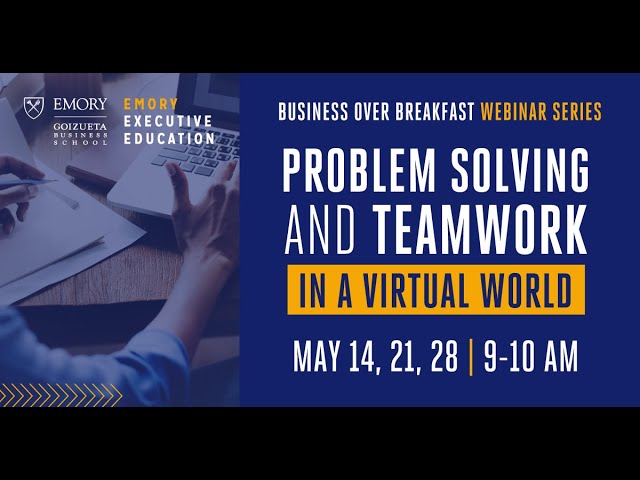
Business Over Breakfast Webinar Series with Emory Executive Education, Patrick Noonan & Lynne Segall

Business Over Breakfast Webinar Series with Emory Executive Education featuring Patrick Noonan

Business Over Breakfast Webinar Series with Emory Executive Education featuring Patrick Noonan
