How to Approach Problems Like a Management Consultant (shortened webinar)

A framework for solving messy, ill-defined problems that consultants call mysteries. The seven-step process starts by defining the core question, then breaks the problem down, plans the work, pivots to insights, stress-tests recommendations, makes the case, and implements change. The key: ask good questions instead of pushing a predetermined answer.
Chapters
What we'll do today is demystify a little bit of the consulting mystique, a lot of which is wrapped up around some special language and some jargon that is used in the field— pyramid principle, MECE, answer first, and so forth— and figure out how to make that make sense in what it is that you all do, whether you're in consulting or you're doing other kinds of jobs. The reason that that works is that the nature of work The nature of work today more and more is that people are asked to figure it out. In other words, as opposed to earlier days when jobs for MBA types in business was a lot more structured and a lot more pre-cut and programmed, much more often these days we're just told or asked to figure it out. There's a problem, there's a situation, figure it out. And our leaders expect us to move from issues, the need to change, to some kind of change, the action. And figuring it out means not only coming up with what a plan for change is, but even figuring out what needs to be changed and what work needs to be done. So figuring it out is not just the what, but it's also the how and the steps for doing analysis and organizing a team. And increasingly across all sorts of work, we're being asked to figure it out. And so figure it out skills are at the root of what we're going to talk about here today. Now, figure it out comes in different forms. Flavors. Some of them we might call puzzles, some we might call campaigns, others are more mysteries. Puzzles, for example, are those things where you kind of know when you're done. You kind of know when something is solved. They've got a discrete endpoint. If you're in the middle of a maze and you get out of the maze, you're done. And you can figure out some algorithms to deal with the specific tricks of that particular puzzle. If it's a jigsaw puzzle, again, you've got a certain number of pieces. When you put them all in there, You're done. And if it looks like the picture on the box, you know you got it right. Those are not what we're talking about. Some problems, some figure-it-outs are more campaigns. You have a pretty good idea of what needs to be done. How to figure it out, the challenges, is more like project management. You've got a lot of people and a lot of tasks that you have to organize over time, but you already go in with a pretty good idea of what needs to be done. That's a different kind of a puzzle than— a different kind of a figure-it-out than we're talking about here. Today we're really focusing on mysteries. These are the hard ones. These are the ones where something's happened, you don't really know what's happened, you don't know what's about to happen, you don't know why, you don't know much of anything except you've got to figure it out. It's hard to know what work to do, what— how to investigate the problem. It's hard to know when you're done. It's hard to know, assess the quality of the solution or the recommendation or your solution to the mystery. So mysteries are the kinds of figure it out that we deal with here. And we want to find some ways, some path to being able to figure things out in a successful way. Now, observing lots of MBA teams and in consulting in my own career, and I've taught about 7,000, I think, MBAs over the past 25 or 30 years, I've seen a lot of teamwork and I've seen a lot of teams in practice. The way it often works when you ask somebody to solve a mystery and you give them a mystery, let's call that mystery the watermelon, they're handed the watermelon, What do they usually do? How is mystery solving usually approached? You've done this, you've probably done this yourselves. There's a lot of what my co-author Lynn Siegel and I called the smash-and-grab method, where the problem is hurled to the ground, breaks into pieces, everybody scoops up a piece that they think they can tackle, people work independently, and then putting it back together, well, it's a little bit of hope and— duct tape to get everything back together. So smash and grab seems like we're making progress. It gets a team going quickly, but it generally leads to pretty messy solutions. What's the alternative to smash and grab? How do we get from the need for change, the issue, over to the change itself, the action? It's as if there's some kind of a chasm between issues and action. And we need to find some way to get between the two, and it's a reasonable question to ask, how do we fill that gap successfully? Let's pause for a second and consider the notion of success in this kind of a, kind of a problem, by the way. Oftentimes success means going for the double win and getting the double win. It means 2 things. One, of course we want to be told and we want to hear about our work, you do high-quality work. High quality is good. It's about being rigorous. It's about being detailed. It's about being accurate and complete, but for high-impact work, we need to do more. And so you— high-quality work is kind of table stakes in consulting and in most of the work that we do in companies. High-impact work is work that actually causes the decision-makers to get clarity and confidence in what they do. It leads to decisions and action. So it addresses and clarifies the right issues, and then it also gives the confidence for decision-makers to take action after having made a decision. Because, of course, no value is created in the real world unless some kind of decision or action is taken. And so for us to have impact, not just to have good quality, but to have impact, we have to be able to make sure decisions and actions take place at the end. Well, this gives us some clues about what kinds of tools or skills we're going to need in order to be able to solve problems like consultants, because consultants don't get paid unless they can repeatedly and reliably get to value-creating decisions. What do we need? One, of course, we need communication skills, influential communication at the end of a process, but also effective communication throughout. 2, we need to have quality problem-solving. The communication has to be about quality, rigorous problem-solving work. And the most challenging projects, the most difficult mysteries, are ones that involve time and team. They're not things that a single person can lock— she can lock herself into her office for one afternoon with a spreadsheet and solve. These are things that generally are sustained efforts over time. And so there's really 3 interlocking sets of skills, and one of the things that management consultants do when they solve problems is they learn how to master a number of those skills, but they don't treat them as separate phases of a project. These are all integrated, and as you'll see, a lot of the processes and principles and tools that we'll talk about integrate communication and project management work and the logic of problem solving. So when Lynn and I are trying to help organizations improve their problem-solving abilities and their ability to solve mysteries successfully, some of the questions we might ask are, what processes do you use? And also, what guiding principles do you apply along the way? What do I mean by that? Let me, let me tell you what we've found is a way to organize or summarize the process, but also to summarize some of the key principles of very successful problem solvers. First of all, the principle of having a process. Having a process is itself a principle. Deciding that you're going to organize things in a particular way and being conscious to the fact that there are processes that we can manage is the first principle. And of course, our advice on that is to don't smash the watermelon. We can think about this as a structured problem-solving process. And it's often referred to by consultants as structured problem solving. It's a process that begins with breaking the problem apart and getting it into small pieces that can be then worked on in the middle of the process, and then different steps and tools that are designed to synthesize things and bring things back together to decisions and action. Lynn and I use a 7-step summary of what that step— what those processes might look like, beginning with one, defining the problem. The focus there is to figure out what the problem is really about, not necessarily what it's been stated to be about, but what is the heart and the soul of the problem. And as you'll see, we recommend summarizing a problem in the form of a key question or a central issue. The next step, step 2, is to break that problem apart. If you define a problem with a central question, break that question into smaller and smaller pieces for 2 purposes. One, to be able to shape, shape the work and drive what work should be done and what work need not be done, but also to get a deeper understanding of all the complexities and the issues. 3, step 3 is to plan the work. This is the point at which we take those issues and use the issues to drive the work. A good work plan comes out of that. Also a good, we might call it a statement of work. One, the work plan is an internal document that really helps guide the work of the team. A statement of work is the document that helps negotiate and set expectations between the project team and the consumers of the work. Step 4, in the middle, is where we pivot. We move from thinking about questions to getting insights and then to answers and actions, and there's a number of different tools and techniques that can help make that pivot successfully. Step 5 is about stress testing. This is the point at which, having come to some preliminary recommendations and conclusions, we assemble the case and we strengthen it before we move into the communication phase. And that, of course, is step 6, as you might guess, where we make the case. How can we provide others with that clarity and confidence to make decisions and take actions? Finally, step 7 is the point at which we start the change, and there are things that we can do to further increase the value that will be created down the road by our work. So here's a principle: be intentional. We see this a lot. Successful consultants, successful problem solvers are very aware of why they're doing what they're doing. Think about this. Suppose you're doing a piece of work and your boss or your client came to you and asked you, why are you doing it that way? Well, what would be the most embarrassing thing that if you were honest you'd have to admit? Probably something like, I've always done it this way, or, well, you know, my colleague taught me to, taught me to do it this way, or I couldn't think of any other way, or maybe even worse, well, it was the easiest or the quickest. What we have to recognize is that virtually everywhere in our problem-solving process, we have process choices. And it's important for us to realize that whether it's the problem-solving, the management of the team and the project, The communication and the persuasion, we always have choices. And so the idea here is, is that each component, each one of those things benefits from our intention. In other words, making careful choices or making choices at all that we're conscious of is usually better than simply falling into a process without thought. In other words, we're actually going to walk instead of falling forward. Another principle is have the right fight. At the right time. It's in 2 pieces. Right fight, it's about constructive conflict. Good problem solving— in good problem solving, teams need to fight it out in some way and really wrestle with to find insights and to find the truth. And so it needs to be good fights, the right kinds of fights. It also has to be at the right time, which means that sequence discipline is, is a very important part of good problem solving. Everything that matters has a right time. To consider, and we can't move forward as a team or even within our own minds if we're trying to do everything at once. And so figuring out what time is it and what sorts of tasks and issues need to be done at this time, and which ones should and which ones could and should be placed further down the road—that's a step four problem. That's a step six problem. Great issue. Let's pin it onto the parking lot, but we're going to get to that in step six. So we can use that, use this deliberate sequence to help us break some of these terrible cycles we sometimes get into. of analysis paralysis, or teams that fight because everybody has their pet issues, all of which may be important, but we have to sort out which ones are step 1 issues, which ones are step 4, and which ones are step 7, and so forth. Right fight, right time. Let questions do the heavy lifting. One of the things that you'll see successful problem solvers and consultants do is they're very, very good at questions. They can ask good questions at the heart of every step of this process. And you'll see that a lot of the tools and techniques involved in consulting in the toolkit are question-based. They really help guide a script of good questioning. And good consultants know that questions do more than just get answers. Questions are very powerful, very versatile tools. They can steer conversations, they can help set agendas, they can plant ideas, they can signal a lot of different thoughts, including also trying to get good answers. And the nice thing about questions is anybody can ask questions. You can be the most junior person on a team in a meeting, and you can raise your hand and you can ask a question that is designed really to just remind people in a way that's appropriate from your position in the team and your role in the organization, remind people of an important process point or an important principle or possibly a piece of work. And you can do it in the form of a It's very, it's very Jedi-like, and it's almost subversive sometimes, but good questioning can do a lot of heavy lifting. The next principle, disambiguate. This is a very important one. So, for example, in visual disambiguation, what do you see here in that shape? Did you see 2 faces looking at each other, or did you see the candlestick? Look, getting clarity in what we do is essential to making any kind of progress, and maintaining it is also important. Ambiguity and confusion are our enemies, and they try to seep in at every point of our work. In fact, one of the worst enemies to good problem solving is false consensus. False consensus would be sort of like, well, Diana is going to do a competitor analysis, and I'll do the market analysis. What did we just agree to? Who knows? We gave each other very ambiguous directions and we agreed to them. The nodding heads around vagueness is a terrible enemy because then people go off thinking they're doing some work. They had it clear in their own head, but then we come back and wait a minute, the work you did didn't correspond to the idea that I had in my head at the time we talked. Well, how do we fix that? We have to get things out of our heads. And make things explicit. And so, as you'll see, a lot of good consulting tools, a lot of good problem-solving tools, are disambiguation, disambiguation tools. They're forcing devices. They force us to make our assumptions explicit so we get them out of our head and we can process them more easily. We can examine them, we can compare them, and we can make sure that we are aligning our ideas. And we also use a lot of complete sentences. Ambiguity has a much harder time hiding in complete sentences. And we show instead of telling. A lot of disambiguation tools go throughout the process. Synthesis is another important tool. It turns out it's a lot easier to just collect everybody's ideas or collect our own thoughts than it is to get to a point. And so processing is a quality assurance step. It's a synthesis. And so rather than just summarizing a problem by taking 7 different bullet points from the 7 different members of our team, or one enormous paragraph, fight about it, synthesize it, boil it down. What is the point that's at the core of that? We often talk about it as writing the short letter. There's an old story attributed to a number of people. I think it goes back to the mathematician Pascal centuries ago, who said he was writing a letter to a colleague, And he said, I apologize that this is such a long letter. I didn't have time to write you a short one. That makes sense, right? Making something compact, making something short takes a lot more time. Why? It's work. It's synthesis. It's part of the problem-solving process. Well, you know what this means. KISS it. Keep it simple. Uh, not so fast. It's not what you think it is. Keep it simple. And start. Keep it simple and start. Good work, good problem-solving work is iterative. You got a loop, you got to take 2 steps forward, 1 step back. Well, what does that mean if we're intentional about it? It means that we expect to return to every step. That means we use it in our planning moving forward. We don't have to get to 100%. We shouldn't demand that we get ourselves to 100% of a step before we move forward. Get it to 80%. You know you're going to come back to this step. And you're going to come back knowing more about the problem further on rather than spinning your wheels. The other thing that this suggests we do is that we do a lot of rough drafts that we expect to crumple up and change. An editor will tell any writer you can't fix an empty page. Get some stuff out on paper, get some stuff into PowerPoint, get some stuff into Excel, and then you know you're going to come back to it. Don't Don't treat that as a disappointment. Treat that as an anticipated part of what you, what you do. And in fact, even inside some of the steps of the process, we're going to find ourselves kissing it. We're going to kiss it. We're going to keep it simple and start, because finished thinking is usually built on unfinished thinking. So do some unfinished thinking, but doing it in an intentional way where we go through loops of generating ideas, organizing them. and then evaluating them and expect that to then trigger more ideas. That's also a good part of problem solving. Do the right thing. Of course, that's a good principle, and it means, of course, ethical and moral behavior should remain central to what it is that we do. But also more, in observing successful problem solvers, there's a courage in both the inquiry and the communication. that is part of doing the right thing, and it turns out to be a good long-term career strategy in my observation. You've got to be careful, you've got to pick your battles, of course, particularly if you're junior in these sorts of things, but courage is an important part of it. But the main thing that people often forget is that there are, there are some problems and some requests of us where we're asked to be discoverers, and there's others where we are asked to be advocates, and we need to know the difference between the two and be conscious of the— of those two different kinds of processes. Here's how I'd summarize those, by the way. Advocacy is really about an answer. Somebody has an answer, and the work that you do is built around finding some kind of way to justify it and sell it, as opposed to discovery. And what's discovery is, is more question-centered. We think, we think about the question And then we do the work, we do the work required to, uh, to find the answer. All right, so in summary, we've got some principles of high-impact problem solving. Follow a process, be intentional, right fight at the right time, let questions do the heavy lifting, disambiguate, synthesize, KISS it, do the right thing. And also, in looking across what consultants do and what makes them good problem solvers. They've got a lot of tools and techniques that are designed to play well with others in 2 different directions. Moving across the canyon from issues to action does require people of a wide variety, and so knowing how to work well with people and organize the human element is also an important set of skills. Some of those play well with others skills are internal. They really having to do with developing the team and developing high-performance problem-solving skills and capabilities within a team. Others of those capabilities are more external in the sense of not necessarily the problem-solving team, but all the various other players. They could be bosses, they could be clients, suppliers, customers, data sources, but people who are outside of the problem-solving work itself. And so there are tools and techniques that a good problem solver will develop having to do with playing well with others in addition.
More from Patrick

Business Over Breakfast Webinar Series with Emory Executive Education, Patrick Noonan & Lynne Segall
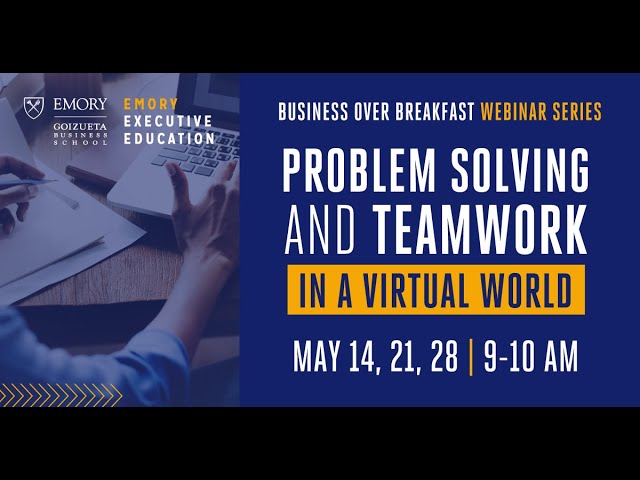
Business Over Breakfast Webinar Series with Emory Executive Education, Patrick Noonan & Lynne Segall

Business Over Breakfast Webinar Series with Emory Executive Education featuring Patrick Noonan

Business Over Breakfast Webinar Series with Emory Executive Education featuring Patrick Noonan