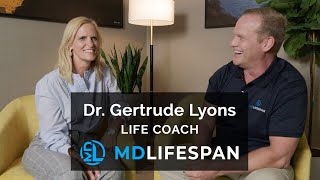
This YouTube interview features Dr. Paul Savage (founder of MDLifespan) and Dr. Gertrude Lyons discussing the role of life coaching in longevity medicine. Dr. Lyons describes 33 years of personal work and 20 years as a professional coach; the conversation emphasizes integrating emotional, mental, and physical health, the necessity of addressing emotions rather than numbing them, and the practical role of coaching within a clinical longevity program.
Questions this video answers
33 years
20 years
Approximately 80% ("virtually 80% of our clients")
Gut health, hormones, and how the person is addressing their own mental health (mindset/approach) — cited as explaining antidepressant use about 94% of the time
Weighing 300 pounds and on seven different medicines
Chapters
I'm Dr. Paul Savage. I'm the founder of MD Lifespan and I'm here today with Dr. Gertrude Lyons. Dr. Lyons and I have known each other for at least a decade now. Interestingly enough, as many of you know, my backstory is that I was very unhealthy. By the time I was in my mid-30s, weighing 300 pounds and on seven different medicines. I went out to seek my own way of getting healthy and actually, actually found longevity medicine and it transformed my life and I actually used that to transform others. But for me it was initially getting my intellect to mature and then the physical part came and then the spiritual part came. But it wasn't until I actually did my emotional growth work that everything fell into place and everything started working so much easier. So I understand from a personal and professional point of view how important having a good relationship with yourself is. Now you've been in the life coaching world for a little bit of time.
Yeah, 20 years professionally, but 33 years personally. And that's really what led me into wanting to become a professional coach was doing my own work. That discovery that.
Doing work on yourself and the internal landscape and everything that that brings up and how life changing it is. At some point I decided I wanted to do that.
And then you went on from the life coaching, actually got your doctorate and life coaching. And that's a very rare thing to have a life coach actually get a doctorate degree in it.
Yeah, no, I had done so much experientially and felt like I had, you know, a significant amount of training just from what I had been doing. But I wanted to get the academics, I wanted to like solidify it all with everything that goes into it and understand it in a way that I thought would translate to supporting my clients more.
I think it's really important that we touch upon for the clients on how important it is about the emotional, the mental, the physical part working together at one time and how when they don't, nothing actually really works.
Well, it doesn't. And I think we've been taught to believe or culturally that emotions, in dealing with those is kind of, kind of a nice add on, but it's so key. And I don't think people realize that we are emotional beings that think and our physiology is made up of our emotions and how much it's all connected.
Matter of fact, I tell clients all the time, you can't overcome your emotions. You have to go at them. You can't, or they'll go after you.
No, you can't numb them. You Can't. You know, we try, right? We try.
We try to do all that favor from everybody. And also, it's interesting, when I Talk to the CEOs and the soccer moms and the women who have careers and children at the same time, it's like, how much of the time are you carving out of the day for you to deal with your emotional health? And we've really gotten away from that, which is one of the great reasons why we're so excited to have Dr. Lyons on our team and why I would say virtually 80% of our clients sees her at least once, if not multiple times. I know. I been under her care for quite a number of years myself, so it's a. It's a worthy endeavor.
No, thank you. And I really appreciate your willingness to, like, bring it into, like, the health care, like, explicitly, not just, oh, let me, you know, prescribe you something, and then you'll feel better. But, nope, you gotta really want to recommend you dig in and do the work.
One of the most interesting things in literature is when you start diving into the use of antidepressants is that 94% of the time, you can find the physiological reason that they're on an antidepressant. And it's either fixing up their gut, fixing up their hormones, or literally just fixing up their mind the way they're addressing their own Health. So, Dr. Lyons, thanks for being part of the team.