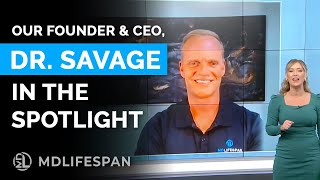
Dr. Paul Savage discusses longevity medicine with host Emily, covering toxin exposure, inflammatory markers like CRP and ESR, and why standard cholesterol panels miss important information. He explains liquid biopsy cancer screening through RGCC Lab Centers, where a negative result gives roughly 84% confidence of no cancer, and introduces therapeutic plasma exchange as a way to reduce toxins.
Questions this video answers
December 29, 2023
Our next guest is a leader in longevity medicine. Now is Dr. Paul Savage.
I've invited back to the podcast, Dr.
Paul Savage, meet Dr. Paul Savage.
His name is Dr. Paul Savage.
So, Dr. Savage, thanks for being here. Let's talk about, we're talking about toxins. So what are the health risks associated with high toxin levels?
Well, you know, Emily, thank you for having me on the show. And I want to tell you in the audience, toxicity is a new smoking. So having been in this field for 30 years, for a long time, I really didn't see people getting a lot of toxin test positive. But in the last 10 years, everyone in the United States that we've tested is positive. The question is which ones and how high? What are your favorite labs people should be running to learn about health Span? What I'm going to really look at is inflammatory markers, things like crp, sed rate. I'm looking at oxidative markers. And people sometimes don't know the difference between oxidation and inflammation. I always say oxidation is the fire that burns and inflammation is the heat that the fire causes. And we can measure those different things. Current cholesterol test that traditional doctors do is the same thing as you telling me how much you weigh. That doesn't tell me anything about how healthy you are. I always say I have a five foot nine guy who's 160 pounds and he's fat. And I have a five foot nine guy who'S 160 pounds and he's muscular. That 160 pounds means nothing. The cholesterol traditional panel means nothing. It has no value, None. The only thing you can take away from the whole cholesterol panel that might have a little bit of information is.
Your triglyceride score as you talk about this. So what is a toxin?
So a toxin is anything that enters the body that is foreign to the body and causes damage. So you can have like a virus or bacteria, could be considered a toxin, organic type of toxin. But what we're really looking at here is over the 150,000 new chemicals that the government has introduced into our environment. And all of these find their way into our water supply, our food supply, and into eventually. Awesome. So I got a bunch of blood work and we're going to talk about rgc. So what, what is that? What are we looking at? So one of the things, you know, having been a doctor for so many years is in longevity medicine, it's not just about what you can do in the areas of nutrition and exercise and hormones and supplements. Part of it Is also about early detection, because as soon as you find things that are going to kill you, the more options you have available to you next. No matter what you're talking about, liquid biopsy refers to the ability to test for all sorts of cancers with a blood sample. Because what really needs to be understood is all the preventative screenings that we do for patients, whether it's mammogram, pap smear, skin exam, colonoscopy, or for guys, a PSA, colonoscopy and skin exam. That only accounts for 30% of the cancers that kill people, 70% of the cancer that get people. We never test. If you don't keep care of the gut, or when you keep care of the gut, the gut will keep care of you. Correct? Right. And it's so influential that it's the simple things. It's the making sure you eat your vegetables, because bacteria eat the vegetables. And you need to maintain the ability to not poison your gut with alcohol and with drugs or antibiotics or a number of different medicines. And we're not saying we're anti medicine, we're just saying understand what the medicine does to your gut. So this company in Greece that I like is called RGCC Lab Centers. And what we do is we send them a sample of your blood, and then they check it for all those markers, and then they put it in through a computer program and it looks for the cell. And if it detects markers or cells, it gives us a report. Now, the best report, obviously, is no markers, no cells. That means you don't have cancer. And the first time you do this test, if you, if it's negative and negative, you have an 84% probability of not having cancer. If you do this test every year, which is what I recommend people do, you do it a second year. If it's negative, negative, it approaches 100% confirmation you don't have cancer.
Being advocate in a treatment called therapeutic plasma exchange, or tpe. So what is TPE and how does it reduce toxins in the body?
So plasma exchange has been in medicine for over 50 years. And the process is kind of like an oil change for the body. What we do is we put the person on an iv, the blood is extracted out. The blood is spun into two components, the plasma, which is the liquid part, and the cells, which are the red blood cells and white blood cells. We return the blood cells to the body with saline, which is salt water, and a protein called albumin. And then we take the plasma and we dispose of it. Within 24 hours, the body generates new, fresh, non toxic, non inflamed, non contaminated plasma. In other words, you build new oil within a day.