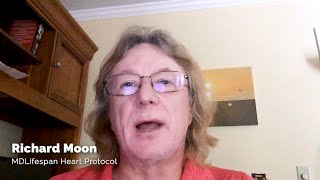
Patient testimonial (Richard Moon) describing his experience with the MD Lifespan Heart Protocol, centering on therapeutic plasma exchange (TPE) plus adjunct infusions. He reports measurable improvements: ~20% reduction in arterial plaque/calcification and a 20% improvement in blood flow after treatment, avoidance of a stent, reduction of specific toxin markers to near undetectable, and subjective improvements (better sleep within ~3 days). He underwent five TPE-based treatments over ~four months and plans follow-up imaging at six months and one year.
Questions this video answers
About 20% (reported over six months).
Five total therapies over four months.
From about 15.8 down to about 13.3 (speaker gave these approximate numbers).
A 20% improvement in blood flow, resulting in no need for a stent.
About four to six weeks.
Chapters
In today's world of medicine, I don't think that there's anything else that can compare to what the MD Lifespan Protocol can do. If you look at my results, and it's pretty solid evidence, in six months, you can take a 20% decrease in arterial plaque, I feel way better. And then when we did the same toxins test that we did before, after, there's virtually no markers that are there, we even went further and did another whole set of lab tests and couldn't find any. Anything that would lend itself to show that I'm still being under attack from those toxins. It's an amazing result. There's not a medicine you can take. There's not a surgery you can have. There's not a chemical that you can use topically. Nothing can do what this protocol does. Hi, my name is Richard Moon, and I went through the MD Lifespan Heart Protocol. So, as a pharmacist, this kind of therapy is groundbreaking in a couple of ways. Like tpe, or therapeutic plasma exchange, has been around forever. We do plasmapheresis on people to collect the items that we use for health care. But actually turning around and trying to clear out the toxins and clear out the bad things in the body, this is one, this is one, if not the only way to really get some of those really distinctive toxins. You just can't get rid of them with, you know, you know, salts or a bath or skin peels or any of those kind of things. You really have to go at the root of it and remove them from the plasma. And the reason it takes so many therapies, I went through five total over four months. You have to pull a little out each time, so you may get 60% out the first time and then another 60% of what's left, so on until you reduce it down. And if you just did a plasmapheresis and just took out a partial of what they would do with the tpe, you don't get the vitamins and all the detox stuff that goes back into the program. So you really need to have the whole package. It's not just giving blood or having a plasmapheresis. You've got to have the extra infusions that go along with it. What brought me to MD lifespan wasn't a particular symptom, but a desire to do better for the future. I. I have. I had in the past a couple of cancers and a heart attack. I wanted to make sure I could stay young as. As long as I can. Well, I've had. I get blood work Done all the time clearly because of, you know, my, my history. But there's nothing that shows up in the blood work until you actually do a toxins test. There's nothing that shows up in a normal CBC Chem 12. None of that stuff shows any of this. So you really have to go seek a specialty test and have that done. And it takes a while to get the results. It was four to six weeks to get the results. I feel like I've got a pretty crappy genetics dealt hand my mi when I was 52. Fortunately it wasn't a major severe mi, but it was still enough to go hey, what's up? And as I've monitored over the past 10 years we've seen a slow increase in the calcification and the buildup in the heart. And I was looking for hard a way to reduce that. This procedure has actually done that. We got a 20% improvement in our calcification scores in plaque and I actually recently had a cardiac catheterization just to double check to see if I would need another stent. And I got a 20% improvement in blood flow and so I'm within normal limits and I don't need a stent. So a 20% result improvement was done with a MRI and what they call a clearly test, right Omnipaque, which is a diet that is used to go take some actually pretty wonderful pictures of the blood vessels. You can actually see where the improvement in the blood vessels was in November when I started and then I think it was the beginning of April when I took the test again and I had the cardiac cath in March. So we will do another clearly test coming up and at the six month mark and then maybe another one at the year to see if there's a continual rebuilding and improvement. But it was a pretty clear and convincing difference between the two and it's quantifiable. I mean you actually do the measurements and it went down from like, I don't know, I can't give you the exact numbers but I want to say like a 15.8 to a 13.3 and that's, that's pretty impressive. I think even the cons consultants that MD Lifespan bounced my case off of were pretty impressed yet. Reducing inflammation in the body is literally the buzzword of the 21st century. But it is a reality that it, that we cannot avoid. We are overexposed to toxins in our life and some of them are self inflicted and some of them we have no control over. Diabetes and type 2 diabetes. Ramp up your Inflammation in your body greatly. And every time we have a pizza, we're asking our body to help repair the damage that carbohydrate excess has done or the insulin excess has done. So that's one part of inflammation, things that we can control. Then there's the other part. I mean, it's not just pesticides, but it's smog, it's stress, and everybody has stress, whether it's money or business or relationship stress. So all of those things contribute to chemical markers in the body that damage the actual cells that are in charge of repairing your body. And that's as simple as it can be. It's like taking the mechanic out of the auto garage. You know, you're bringing in a broken car and you're asking it to be fixed, but you got nothing else to fix it with. So you really have to take it and some steps and put back the things that you need to and get rid of the things that are continuing to insult your body. Now, the MD Lifespan Protocol has some things that help that there's a couple of items that go back in that help speed up repair or aid in repair. And a couple of them are medications that have got a pretty good documented history and a couple of them are newer. But the bottom line is if you put the five or seven things all together, you're giving yourself the best chance at repairing the systems that are there. The idea that any protocol is difficult or hard to do or painful, certainly a fear going into probably trying to do something. The hardest things that I had to do were to travel to MD Lifespan's clinic and get it done. Like I said, the technicians were so good. I mean, if you are really afraid of getting a blood draw, then you've got to overcome that. But other than that, that's really what it is. You got to sit there, have some great conversations. If you wanted to, I could have watched television for an hour and a half. But the hardest thing was traveling to and from. Once you get over that and you make a joy out of that, make sure you plan a good dinner or meet up with some friends. It takes all the pain and stress out of that. So it's really pretty easy to do. I think one of the questions for people is how will I feel after I do this? And how can I tell? After about three days, I knew that I was sleeping better and I could feel that I woke up better. I travel quite a bit for a living, so I'm aware when I'm getting dragged down by my environment. And this made It a lot easier to bounce back into cope. So I think there was an added benefit. It wasn't one I was looking for, but I'm certainly not unhappy with it at all. So the changes that I've wound up making to my personal controllable environment are actually pretty subtle but fairly major if you think about it. I got rid of all the plastic and Teflon. The pots are gone. I've gone back to steel got or stainless steel. I mean there's still some stuff in there, but that's not nearly as bad. I don't drink out of plastic bottles or cups anymore. I don't have plastic bowls, right. I don't when I get drinks, when I go out, I ask for glass. So all of those little things to keep away from the plastics I think are the easiest thing once you've had a heart attack or once you've had cancer, it never leaves your throat thoughts, it never does. Every little hiccup, every little ditch that you feel on your side, you, you, you're second guessing. And one of the reasons I did this protocol is I put an investment in myself and my future to stay healthy as long as I can and be as well as I can right up until the end. So no amount of money in the world is worth not being healthy. That's why I made the investment. I know it's not insignificant, but it's absolutely justifiable to feel good and walk around and feel comfortable and healthy and happy.