Toxin Removal for Heart Disease: Dr. Paul Savage on PlasmaXchange | MDLifespan at AAMP 2025
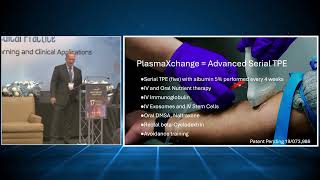
Dr. Paul Savage presents a protocol using plasma exchange to remove toxins like microplastics, PFAS, and heavy metals linked to heart disease. Testing of 3,000 people found most carry multiple toxins. His multi-step treatment reduced toxins by an average of 68.2% and improved inflammatory markers and plaque in a case study.
Chapters
Together, please. Thank you. Thank you. Yeah. I'm Dr. Paul Savage. It's a pleasure to be here today. I'm really grateful for Jeremy and Dr. Anderson for inviting me to talk about something that I think you're going to find to be one of the most transformational advances in medicine that I've seen in the last 30 years. We're going to start talking about toxins because you can't open a paper, a newspaper or watch a television program without seeing something about the toxins on every day. We whether it has to do with the landmark study with the biphenols, or whether it has to do with the microplastics or whether it has to do with the pesticides and the heavy metals, day in and day out, we're seeing more and more things. I think this past week was that if you live within a mile of a golf course, your Parkinson risk is double. So I mean, this is very scary facts. And having been in this field for 30 years and having worked with Paul for a very long time and he's always been my go to person when we talk about almost everything, including toxicology. So I did all of his courses, I did all of his IV therapies and I had about 127 clinics over altogether and we all employed those type of methods for detoxification of patients. However, 20 years ago when I would test people for a myriad of different toxins, it would be on average about two toxins that were elevated per person. Ten years ago it was six. This past year we did 3,000 healthy patients in the Chicagoland area. And out of 100 toxins, the average 13.2 in NHANES upper range, which is accelerating. So when you start seeing all this chronic inflammation and you read what causes chronic inflammation and that's because it has to do with lifestyle, diet and environmental factors. I'm here to tell you today the answer is toxins, period. Only toxins. We proved that. Paul and I are in the process of publishing a number of different papers. The situation is not improving. We have over 150,000 toxins in the United States. United States is the second leading most toxic country in the world next to China. As I mentioned, we tested over 3000 healthy people in 2023 and 2024. And on average that's 13 out of 100 that were in the NHANES 75% range and higher. Consider this. If we have 150,000 toxins in the United States and out of 100 you have 13, you have to take that 13 and multiply it by 1500 and you're getting on average 20,000 toxins per person. In the high critical range, it's not 13, it's 20,000 or higher, depending on what number of toxins that you think is in the United States. The number varies anywhere from 150,000 to 300,000. This is a paper that we recently published as Dr. Anderson and I and a couple of our co authors. Because what we did is we looked at how you use plasma exchange to remove toxins. It has always long been known. Plasma exchange have been around for 50 years. They can remove acute toxicities from it, but nobody ever realized that you could remove chronic toxicities from it. That's what our group figured out. And we put together a program. It wasn't just tpe. It was everything that had to do about personalized medicine around it. So there's an avoidance program, there's supplements, both IV and oral peptides, all these other different things. And what we found is that Our procedure is 300% better at removing the toxins than TPE alone, which is about 200% better than using all the traditional ways that we did it previously. It used to be, as I said, you could remove a couple toxins, people would get better. In the last five years, if you don't remove all the toxins, they don't get better anymore. So now we're going to talk about what we know about cardiovascular disease and toxins. When we look at the microplastics and heart disease, we know that microplastics are everywhere. We know that if you look at the carotid plaques that were biopsied, 57% of men have plastics in those carotid arteries. And within three years, you have a 4.5 times higher risk of having an event. We know that these microplastics come in all sorts of various sizes. These, if you're my group and we include six different toxicologists, when we look at all the different toxins that we're measuring, and we're up to 110 that we're measuring right now, we put plastics as the number one on the list of the king of the toxins, like Godzilla, it's the microplastics that are winning because they permeate on every size, they permeate on every organ. But not only that, it takes most of the other toxins to make plastics. So they're bringing all that with you as well. The key point to remember also on forever chemicals, because they're everywhere and everything. If you go to the CDC website. The only way to remove forever chemicals is to not get them in because they're impossible to remove. So the mechanism that PFAs work on the body, and these are the forever chemicals is, is that they work in an oxidative effect. They burn the tissues, they burn the cholesterol, and by nature that causes an increase in inflammation. We have multiple cohort studies which show the association between the forever chemicals and development of coronary artery disease. Here's one of the papers on exposures of PFAS. And people have an increased risk. It's about a 4.7 increased risk. Heart disease. If you have high toxic level of any of the PFAs and there's currently 20,000 of them in the environment and only about 20 that we can actually test reliably. Pesticides, another one. These are things that anything that kills a pest kills us. It's the same mechanism. So these are the organophosphatides and they work by burning the DNA, by oxidative stress, systemic inflammation, endothelial dysfunction and the onset of atherosclerotic disease. These pesticides have a 10 year increased risk. So anybody with pesticides increase the 10 year risk of vascular disease. This accelerates in people with chronic inflammation. And with type 2 diabetes, they're more susceptible. So again, here we got that layering effect of all these things underneath. You start adding diabetes with bad genes on top of toxins and you're really accelerating these people. I'm an ODR doc, so I've had my practice been in existence for 30 years. And what Dr. Parcell said. Exactly correct. It's not just about giving hormones and supplements. It's about looking at these people and saying right off the bat, what's your risk for heart disease? What's your risk for cancer? What's your risk for Alzheimer's? Because if they get Alzheimer's, cancer or heart disease, it doesn't matter. All the other stuff you're doing, you've not won the game. Mycotoxins. This is again when you talk to our toxicologists and we have some of the greatest toxicologists at Ohio State University, Dr. Anderson, and we ask them to list the toxins that they're the most concerned about. They will always list plastics and then mycotoxins and then pesticides and then forever chemicals. And about that order. Now we have some argument in our group which one reigns over the other ones. But they're the four horsemen that we call and they're incredibly toxic, especially the mycotoxins. We don't appreciate the fact that the mycotoxins are increasing in the environment because of the way that we're storing food and the way that we're treating the buildings, or not treating the buildings and preventing the mold. So we're seeing an increase of these mold toxicities in patients and it's highly related to the onset of coronary vascular disease. Any toxin that causes inflammation, and by the way, every toxin causes inflammation, causes a progress, an increase in the progress of coronary artery disease. This is T2 toxin. This is one of the trisyntenes. It's one of the most highly cardiotoxic of them all. But there's thousands of mycotoxins and we're testing about 50 of them, 40 of them on every patient that we do. And there's a number of them that are carcinogenic, there's a number of them that are oxidative. T2 happens to be both.
What is TPE? Now, you may not know what TPE is, but that therapeutic plasma change, that's a process that's been around for 50 years in medicine. I used to use it in the emergency room for digitalis overdose. Those were the. We had the 16 year old girls come in who took grandma's digitalis because she wanted to commit suicide. She'd come in with a heart rate of 4. As long as she was laying down, she was fine. But we didn't, you know, in other words, you put her in a room and you wait for the digitalisation or then we had digivine we would use at some point. But the easiest thing to do is just hook them up to an apheresis machine. An apheresis is a process by which we take your blood out, we separate it into the liquid and then we separate it into cellular. We throw the plasma away. You can't use it because it has citrate in it. And then you take albumin or you take plasma, or you take some type of replacement fluid and put the fluid back into the body. It's an oil change. You guys remember cars? We used to put them up on skits. You take the oil out the bottom, put new oil in the top, put the cork back in, run the car around the block for about three months or about three weeks, bring it back in, do it again, and you keep repeating the oil change on the car until the oil runs clear. That's exactly what we're doing with the basic part of plasma change. And so when we discard the plasma, we just replace it with albumin. Every time you do one circuit one plasma exchange, which is one procedure you're replacing about 63% of the patient's plasma.
Depends on what fluid that you're replacing it with. I want to be heard really clear here. Albumin is safe, plasma is not safe. There's a lot of doctors going around saying that they're going to give you some young man's plasma or some young woman's plasma, and that's going to give you all these growth factors and all these other factors that you need for longevity. And that's simply not true. It's not what you're getting back, it's what we're taking out. And doctors don't always appreciate the fact that removing something can be more powerful than giving something. So when you use albumin, the national average of side effects is 6%. And that's mostly bruises from the IV. And it could also be some pruritus urticaria, which is very mild urticaria, mild low blood pressure, mild low blood sugar, because when you take the plasma out, you take everything out, including the blood sugar. So there's the team that we have together mostly is ER doctors. So we all got together and we have a protocol that we have patients doing before they come in. So they have to eat, they have to go through a questionnaire making sure they didn't get started on new blood pressure medicine. Things haven't changed. And our incidence out of the last327 procedures is two patients with low blood sugar. And both the patients lied to us about having eaten before the procedure. Otherwise we've had no negative outcomes, adverse reactions. But if you use fresh frozen plasma, that increases to 27%. And we're talking not just urticaria, we're talking straight out anaphylactis. And you're talking about patients, and we're doing it in an office setting. You're talking about patients with swelling lips, swelling throat. You need your epi, you need your Benadryl, you need your steroids, but also you have a probability of 1 in 1,000 getting transfusion related reaction, including lung injury. And if you've ever seen one of these, and I've seen one of these before, it's terrible. It's fulminant pulmonary edema within minutes and the people die. So this is why I'm a big adamant, because I'm an old ER doctor and as a trauma doctor, when I would be seeing a patient, we're putting up the 10th unit of fresh frozen plasma, I'd be wondering, is the trauma going to kill them or Is the unit of plasma going to kill them? Because they always went into ITP and all the coagulopathy dic. So this is why I keep telling people, do not use plasma for longevity purposes or wellness purposes when you're doing plasma exchange. We do use plasma for certain patients with specific, certain diseases, but those patients are critically ill to begin with.
Plasma exchange is our version of tpe. So this is where we took something from traditional medicine and we said, we can make it better. Let's put an avoidance program and start teaching people how to avoid the toxins. If we're going to remove them, I don't want you putting them back in. And believe it or not, it's easier now to do avoidance than it was 20 years ago because now it's all general recommendations. Where before 20 years ago it'd be like you had mercury, don't eat fish, you had lead, get your water filter. Now we need to filter everything. We actually have eight different books that we have for patients that they are given through the course, their handouts, and we quiz them on that and make sure that they've instituted these avoidance programs. But we also give them IV nutrients because once you take the plasma out and throw it away, you give them back nutrients right at that moment. Because then you can jump start the mitochondria, you can jump start the healing process. Then we have patients taking oral supplements. As a matter of fact, our oral supplement, developed by Dr. Anderson, myself, a couple other nutritionists, has over 73 different supplements in it. And these are things that are anti inflammatory antioxidants, detoxifying, mitochondrial support and energizers like nad. In addition, we throw in on certain patients with certain protocols that we've developed, especially with the heart protocol, we might use something like beta cyclodextrin to try to help reduce the plaque buildup. We will use colchicine, we will use low dose naltrexone, we will use low dose emsa. And it was because we took all these different modalities that we knew. That's why we got results that were 300% better than just TP alone. Again, this is the paper that Paul and I published with a couple of our other well known authors. And what we found in this study was that we removed all environmental toxins on average by 68.2%. These are significant reductions as I'm going to show you in just a short time as we speed through the data. But every single toxin went down, and almost every single toxin went down under the 75% marker. Of NHANES, and if we did it further, we could drive them even further down.
So we're going to go through the data, and I'm going to go through the data quickly because this is the only slide you need to know. Every toxin went down significantly. The entire immune system strength, all the lymphocytes, CD3, CD4, CD8, CD56, CD19, went up in strength between 25 and 65%. And the immune system had less confusion. When we started looking at the ANAs and the rheumatoid and the thyroid antibodies, all of those markedly diminished. So we had an improvement in the immune strength as well as less confusion by the immune system because that was all caused by the toxins. We saw every inflammatory marker drop, and that includes interferons, tumor necrosis factor. We're going to go through some of those. But every single one of the immune system markers dropped to optimum range, not normal optimum range. Longevity markers like Clotho improve the beta galactase. It's very interesting. Beta galactase is used to measure siescence. And if you take a siescent program, a senolytic program, you might see that beta galactase go up for a couple weeks, and they go down for a couple weeks at a lower value. When we did this program on patients, we saw the beta galactase increase up to over a year and then start decreasing. In fact, what we think we've done is discover the greatest and strongest senolytic agent that we have. Because once you remove the toxins and the immune system's back online, all those zombie cells die. The body goes after them. And oxidative stress markers, whether it's mpo, whether it's tmao, oxidative, ldl, we see market improvement in all of them. This is when we looked at the PFAS and the microplastics. TPE alone versus our protocol, which is the TPEO protocol. You can see the market difference in the level of PFAs. PFAs are reduced by TPE. It's just reduced better when they use our protocol. This is microplastics down almost 95%. And at one year, they continue to drop even further. This is some of the PFAS. There's 20 that we test. These are some of the more common ones. You can see in almost every one of those cases, we're back down to optimum levels. I'm just showing you selected parts. This is when we're looking at heavy metals, including lead, mercury, and gadolinium. We've had to use a special Type of chelator.
DPTs to get it out and it takes a while. Within three exchanges with our protocol, gadolinium is down to zero. So this works on every one of the heavy metals, on the environmental toxins, on even the atracene and the glyphosate. This is essentially the paper that we just had published here. We have with the mercury, the gadolinium, the lead, these are the pesticides, these are all the derivatives of the DDT that is so prevalent in our environment. These are the herbicides, the glyphosate, the 2 4a or 2, 4d. This is also the atrazine. When we talk about mycotoxins, as I mentioned, it's hard to get mycotoxins out. You can put someone get them out of their house, give them a mold free diet, give them right supplements, give them a binder, and about a year later you might have 30% reduction in the mycotoxins. But that's not even all of those. But what we saw with our research is every microtoxin went down to optimum ranges, including the volatile organic chemicals, the phthalates, as well as the phenols. Here we are with BPA. This was the most common toxin in 54% of the people presented with high critical levels. These were the healthy people that we looked at. This is the phthalates. This is what makes plastic softer. These are highly oxidative and within just a few treatments and all the phthalates follow this pattern. The VOCs, they all follow this pattern. The mycotoxins, whether it's the aflat toxins, whether it's any of the glio, any of those, they're all markedly being reduced.
When we look at the immune system, the inflammation and the oxidation, what we see between these different groups is very impressive. The lymphocyte cells in our group increase anywhere between 20 and 60% in strength. And they also become less confused compared to TPU alone, which also improves it, but not to the same degree. Same thing we see in the inflammation markers. And although you may see 15 or 20%, what you're going to see when I show you the slides is they're all to the optimum level. That's as far as they had to come down in a group to reach those different levels. Deoxyguanine, the mpo, the tmao, the oxidative ldl, all of these came down as well. So we had the immune system improving in its strength and, and less confusion. We have Inflammation markers ending up markedly decreased. Oxidative stress markers, all of them came down, decreased. So I'm going to tell you about what we did. So once we figured out, boy, we got all the toxins out of these people, we've changed the immune system, we changed the land state, we basically cleaned up the microenvironment, we gave them back their nutrients, we got them up and running again. What if we start looking at the chronic inflammatory diseases that are being caused by the toxins which cause the chronic inflammation? Can we make an impact on that? So we started pointing it at things like cognitive decline. We did very well. We can talk about that at some point. We did it for people with HIV with their CD4 counts under 400. They didn't want to change their meds. They wanted to know if we removed the toxins. And then on a dozen of the HIV men that we treated, all of them are on average now about 780 on their CD3 count. And they're still on the same medicine that they had before. We started doing it on cancer patients, not in treatment of cancer, but in patients who were doing watchful waiting. So we on our gentlemans with prostate cancer seeing a marked decrease in the size of the prostate, marked decrease in the inflammation of the prostate, marked reduction in the calcification in the prostate, as well as their PSAs falling. And we're also doing it on people. You may be familiar with the liquid biopsies that are being done that are not. They're showing the signs of the cancer's coming, but you find no mass on a full body scan. Our program is 12 out of 12 and reversing all those people with the cancer markers. But we're also pointing it at heart disease because that is number one on the chronic inflammation diseases. So this is just one of our patients that we're going to talk about as a case study. 60 years old, he's actually a compounding pharmacist. He had high cholesterol, metabolic syndrome, a heart attack in 2015, arrhythmias afterwards, hypertension, and then he was also diagnosed with prostate cancer. His family history was significant for coronary artery disease. He wasn't a smoker, he was an exerciser. He just had bad genes and over the years had been started on all the normal medicine that you would see. And he came in with his Lipitor of 40, and he was having muscle aches and joint aches. And he wanted to know, is there anything else he could do to improve some of his markers? Because even though and I'm going to show you the markers we start with. Even though on all this medicine his markers were still not optimized. And his cardiologist, who's the head of department of Lipidology at University of Chicago, sent him over and said, why don't you try him on your protocol? Let's see if we can get these numbers in a little better alignment. Because he had kind of run out of options. So what we did was we did five plasma exchange with him a month apart, exchanging one total volume with 5% albumin. That's our standard exchange. We started doing IV nutrients, that's about 20 different nutrients, including NAD and B vitamins and minerals and many of the amino acids that were all looked over and approved along with the oral nutrients by Dr. Anderson. We started doing DMSA on Monday, Tuesday, Wednesday, just to augment some more of these heavy metals. We started doing low dose naltrexone to augment a little bit about the inflammation. And then we used beta cyclodextrin, which is called a super soap rectally when it's in. There's some studies that show that it actually absorbs some of the plaque cholesterol in the arteries and helps that be removed. And then we started using exosomes after his plasma change and then stem cells on his fifth one.
So when we started out, like I said, this was maximized on medication. He couldn't do repatha, he reacted to it. So we were back to the Lipitor. But his cholesterol was good at 127. His bad cholesterol was at 41. But these are one that Dr. Parcell was talking about that have bad markers even though their cholesterol is under 70. His particle count was 783. His small dense particles were 401. He had family history of triglyceride issues. His oxidative LDL was high. His TMAO, another oxidative factor, was high. His blood sugar was high and his hemoglobin was 7.0. And this guy did follow a relatively regimented diet without any changes in diets or his medications, just the protocol itself. After six weeks, after we finished his last plasma exchange, we had a reduction in his particles by almost 40%. His small dense particles came down by almost 50%. Triglycerides came down. His oxidative LDL came down to normal. His TMAO markedly improved, and that's always a slow one to come even further. His blood sugar and his hemoglobin A1C came down as well. And again he wasn't asked to change any medication or any of the diet at that point. We did toxin testing initially on him and he had quite a bit of toxins, including 10 of the relatively high mycotoxins that are oxidative and related to heart disease. His arsenic was also 10. He had many pesticides and he had PFAS and microplastics as well. And when we were done we had marked reduction across the board. And all the toxins, the microtoxins that were above 75% now only three of them were above 75%. The arsenic dropped down significantly almost to zero. All of his pesticides came down markedly. His PFAS Gen X significantly reduced almost to zero and his microplastics had over an 80% reduction. When he had his coronary CT done angiogram which showed a 50% reduction in one of the blockages of his artery. But we had done clearly prior to his procedure and then six weeks afterwards and we did see a pretty good reduction in the calcified plaque. So we had a, he went from a stage three to a stage two. His total plaque went from 451 to 431. And then he also had a reduction in the low density plaque as well. But we're expecting now this gentleman is due in about two more months to come back for a six month clearly. And that's where we really think we're going to start seeing more of the changes because at this point I don't, this is not statistically different at this point but it shows that we're moving in the right direction.
So the HAART protocol is just one of the many protocols that we put together after we remove toxins because again once you remove toxins you remove the inflammation. And we have opened the door to really starting to look at all those patients that we've cared for so long that we can't get them better. And you know, it's because all the mycotoxins, the heavy metals, all the other toxins that they have causing the inflammation and they're just not able to be excreted.
I'd like to thank everybody. I got four minutes and Paul, I told you I could get through 45 slides in 30 minutes. So I'm going to take a few questions. Thank you. Yeah, it's very exciting. Paul and I and the other members of our group, we have 26 different medical advisors. We're all very pleased with the things we're seeing. We've set up a non for profit research arm that we're getting funded, and we're actually being supported by Cook County Health Services and a university in southern Florida. Well, thank you, Dr. Savage. We appreciate your contribution this morning. I'll be at the booth. You will. In the vendors room for anybody who has any questions. Thank you very much.
More from Paul


A Woman’s Journey with MTHFR, Chronic Inflammation, and Therapeutic Plasma Exchange

Ask Dr. Paul Savage: A Live AMA on Toxins, Detox & Advanced TPE Your Questions. Answered Live.


A Cardiologists Take on Toxins, Heart Disease, and Therapeutic Plasma Exchange



Advanced Serial TPE: The Science, The Evidence, and The Opportunity for Your Patients

Your Clean Beauty Guide To Avoiding Parabens, Fragrance Loopholes, and Forever Chemicals

