This content was created by Payam Hakimi. This content was uploaded by Payam Hakimi. This is a YouTube video titled "Ankle Pain, Foot Pain, First Watch this Osteopathic Treatment of Ankle Pain! Treatment of Foot Pain" (created 2020-09-13). The excerpt is a single-speaker clinical demonstration by an osteopath or clinician describing and performing manual treatment on a painful right ankle and related knee issues. The speaker explains anatomy (tibia, fibula, patella), observes joint restriction and gait-related contributors (inversion, trauma, high heels, improper exercise), demonstrates a joint/fascia release (including an audible click), and discusses prognosis (often 1–2 treatments unless chronic) and when to see an osteopath versus a podiatrist.
Chapters
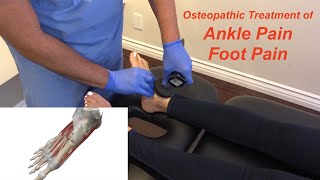
Today we're going to treat an ankle joint that has been painful for a while. It's the right ankle. It's important to evaluate and see how the ankles are rolling. And as I evaluate, I see that this ankle, it's tight and it's not moving in this part of the joint. These bones are not moving as well as these bones right here. And the patient is complaining of pain in this area. And you can see this whole thing moves as one piece, as opposed to having the flexibility that we see in this part of the foot. So I'm going to treat this ankle. Once I treat the ankle, usually I also treat the fascia that's in between and go all the way to the knee. Because the ankle joint and the knee joints are. Are connected with these two bones. The tibia, which is this big bone that goes all the way from the ankle to the knee, and the fibula, which is this smaller one that goes all the way up the knee. So usually when there is a foot or ankle abnormality, there's also a knee pain that is associated with it. So it's important to treat both, because if we don't treat both the knee and the ankle, the pain is going to come back. It's not going to go away completely. As I'm treating this, I see that this joint is really locked. So I'm just going to spend some time releasing this. The reason this happened was probably either an inversion or a twist of the ankle itself, or a trauma to the ankle and the foot, or it could be wearing high heels, because high heels basically put a lot of pressure in the arch of the foot. And that can create, after a while, it can start getting a little bit tighter again. We see this arch moving properly, and then this one moves as a piece. It doesn't move separately. So that's what we have to treat. After I treat the tibia and fibula and the fascia that's in between, I make sure there is no abnormalities of the knee. And here we see that the patella, the knee bone, has turned towards the right, so it's going medial. And so we know there's a force. We have to figure out how this patient walks. What's their gait like when they exercise? What do they do? There can be certain exercises that we do and we might do them wrong, and that can move certain joints in our body. It can loosen up or tighten up some of the tendons in our body based on how much force we're putting on those joints. So it's very important to be mindful of your body when you exercise. If you have someone who can observe you, that would be good. If you're doing it yourself, make sure you're exercising in front of the mirror most of the time just to make sure you're not doing a tilt that you're not aware of. Remember, even 2, 3 or 5 degrees of a tilt to one side, it's going to start creating an abnormality in the joints of the body. And that's where we hurt ourselves and pain starts. Usually it's a once or twice treatment unless this has been a chronic issue. That means if a patient had a they rolled their ankle two, three, five, ten years ago, and this pain has been there with them for a long time, it takes a little bit longer to fix it, but most of the time it's one treatment to two treatments. So we got the ankle and the knee loose and nice and ready. And now I have to put the ankle joint back because it's out of its joint. So I don't know if you heard that click or not. I did, but now you see that with minimal force, how not only the ankle is moving properly separate than these bones. You also see that these bones don't need any force and they're moving on their own. So this is the situation and you see how much looser this side is now and it resembles the other side. So. And after we do the treatment, there's one more treatment we need to do just to make sure that twist in the knee is also going to go away. You have to see both. A podiatrist will look at the bones and their alignment, and we'll do the imaging technique and figure out what's going on with the functionality of the bones. However, a podiatrist can give you braces as well as insoles to help out with this. If we don't treat the bone and we don't move the ankle and the bones, which you just saw, this pain is not going to go away. It's going to be there, but it's almost like putting a band aid on it, not feeling at certain times of the day, but then only to get the pain back when you get home and you take off your shoes. So in reality, you have to see both. We prefer that you start with an osteopath because a lot of the times we can just move the bone, we can just move the joint and your pain is going to go away. Because osteopaths look at the functionalities of all of these joints and as well as the treatment that goes with it and opens it. So sometimes it's as easy as one treatment to an osteopath that will completely release not only the ankle and the foot pain, but also the knee pain that was associated with it.