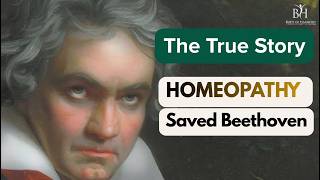
The video narrates the little‑known episode of Ludwig van Beethoven’s severe illness in the spring of 1825 and his subsequent recovery under the care of Dr. Anton Braunhofer, a Viennese professor who practiced homeopathic medicine. After a life‑threatening intestinal inflammation that left Beethoven unable to write music, Braunhofer prescribed a regimen that combined dietary restrictions, avoidance of stimulants, and a homeopathic dose of cinchona bark. Beethoven recovered, returned to composition, and expressed his gratitude through three works created in the summer of 1825: the third movement of String Quartet Op. 132 (the "Heiliger Dankesang" or Holy Song of Thanksgiving) and two short canons (WoO 189 and WoO 190) dedicated to his doctor. The video analyses the musical structure of the Heiliger Dankesang, highlighting its alternating sections of still, meditative Lydian mode and bright, triumphant passages that mirror the oscillation between illness and healing. It also situates Beethoven’s experience within a broader historical pattern of eminent artists (e.g., Wagner) turning to homeopathy, and argues that the efficacy of such treatment does not depend on the patient’s prior belief. The narrative concludes by linking this 19th‑century case to the modern integrative‑medicine philosophy of the Body of Harmony Institute, promoting homeopathy, functional medicine, and osteopathic care as complementary pathways to whole‑person healing.
Chapters
Il Ludwig van Beethoven (1770 to 1827) is widely regarded as the greatest composer in the history of Western music. His symphonies, sonatas, and string quartets have shaped the course of classical music for over two centuries. But behind the legend lies a story that few people know. In the final years of his life, Beethoven's health and his ability to compose was restored by a homeopathic physician. And in gratitude, Beethoven did something extraordinary. He immortalized his doctor in two musical canons and channeled the entire experience of illness and recovery into one of the most profound pieces of music ever written. This is that story. A genius brought to his knees. By the early 1820s, Beethoven was already profoundly deaf, a cruel irony for the world's foremost composer. But deafness was not his only battle. Increasingly isolated from friends and family, he complained bitterly about those closest to him. Servants recalled him wandering in fields, waving his arms, scribbling in notebooks, moving erratically between slow and fast paces. His shabby appearance and erratic behavior even led to his detention by police in 1825, who mistook him for a vagrant. He suffered from a range of serious illnesses throughout his life, and over the years, had sought the care of numerous conventional physicians, whom he famously referred to as "medical asses" (Hayden, 2003). He was not a man who gave his trust easily—to doctors, or to anyone. Between 1820 and 1826, Beethoven's physician was Dr. Anton Braunhofer, a professor of biology at the University of Vienna who practiced homeopathic medicine. The relationship between these two men would prove to be one of the most consequential doctor-patient relationships in the history of music. The spring of 1825: A near-death crisis. The spring of 1825 was not good to Beethoven. In late April, he developed a serious intestinal illness, an inflammation of the bowel. By May, he was spitting blood. His condition deteriorated so rapidly that he wrote to the writer and critic Ludwig Rellstab at the start of May: "Forgive me in consideration of my very delicate health. As perhaps I may not see you again, I wish you every possible prosperity." Think of me when writing your poems. Beethoven, early May 1825. He could no longer compose. He could no longer write a single musical note. The man who had given the world the Moonlight Sonata, the Fifth Symphony, and the Ode to Joy was, in his own words, dying. Dr. Braunhofer ordered him away from Vienna for rest at the nearby spa of Baden and prescribed a homeopathic regimen. That included dietary guidance, avoidance of wine, coffee, and spices, and a homeopathic dose of cinchona officinalis, Peruvian bark, the natural source of quinine. He counseled Beethoven against coffee specifically, explaining that while its stimulant effect might seem to offer temporary relief, it would ultimately damage his stomach and nerves over the long term, a perspective that aligns precisely with modern functional medicine. Beethoven's nephew Carl described Dr. Braunhofer's approach as homeopathic medicine, noting that he too follows fashions in medicine, a backhanded remark that nonetheless confirms the nature of the treatment. Under Dr. Braunhofer's care, something remarkable happened. Beethoven recovered. By summer, he was back at work and completed one of the greatest string quartets ever written, the String Quartet in a Minor. Opus 132, finished in July 1825. In August of that year, he wrote to his associate Anton Schindler, Mein Arzt half mir, denn ich konnte keine Noten schreiben. Nun aber schreibe ich Noten, welche mir aus den Nöten helfen. My doctor saved me, for I could no longer write a single note. But now I am writing notes that will help me out of my distress. Beethoven, August 1825. The German wordplay here is intentional and characteristic of Beethoven's wit. The word "note" in German means both a musical note and a state of distress or need— "not." Musical notes and rescue from distress, intertwined in a single sentence, just as they were in his life. The Heiliger Dankesang. A holy song of thanksgiving. Born from Healing. It was during this same period of illness and recovery in Baden that Beethoven composed what many consider one of the most profound pieces of music in all of Western history, the third movement of his String Quartet in a Minor, Op. 132, the Heiliger Dankesang, or The Holy Song of Thanksgiving. Beethoven's own inscription on the score reads, Holy Song of Thanksgiving of a Convalescent to the Deity in the Lydian Mode. It is a declaration of faith, of survival, and of gratitude, written at the very moment when Dr. Braunhofer's homeopathic care was restoring him to health. The Heiliger Dankesang, a holy song of thanksgiving born from healing. It was during this same period of illness and recovery in Baden that Beethoven composed what many consider one of the most profound pieces of music in all of Western history. The third movement of his String Quartet in a Minor, Op. 132, the Heiliger Dankesang, or the Holy Song of Thanksgiving. Beethoven's own inscription on the score reads, "Holy Song of Thanksgiving of a Convalescent to the Deity in the Lydian Mode." It is a declaration of faith, of survival, and of gratitude, written at the very moment when Dr. Braunhofer's homeopathic theopathic care was restoring him to health. The Architecture of Illness and Recovery. The movement is structured around two alternating musical worlds, and understanding them is essential to understanding what Beethoven was expressing. The convalescent music, written in the ancient F Lydian mode, a scale without sharps or flats. This section moves glacially, almost like a meditation. Musicologists describe it as sounding like being trapped in an infinite space, similar to the sensation of lying in a sickbed, day after day, with no sense of time passing. It is music of stillness, prayer, and waiting. Neue Kraft fühlen—feeling new strength. Then, without warning, the world shifts. The austere stillness suddenly breaks open into an entirely different musical universe. Warm harmonies, optimistic trills, the feeling of light returning. Musicologists describe this as one of the most shattering and unique contrasts in all of Beethoven's output. It is the sound of a body beginning to heal. But Beethoven does not simply move from sickness to health and stop there. The movement alternates between these two worlds: illness returning, then strength again, then stillness once more. As though he is truthfully depicting what recovery actually feels like. Not a straight line, but a back and forth between fragility and renewal. At the very end, the slow convalescent music returns one final time, but only briefly. The original 8-note chorale is slowly reduced to 5 notes, then 3, then 2, then 1. At the same time, the simple accompanying passages grow increasingly complex, until the entire soundscape dissolves into what Beethoven himself instructs musicians to play with the utmost, deepest, and sincerest feeling. Canon No. 2, WO 0190, June 1825. Written just weeks after the first canon in June 1825, this brief two-part piece is Beethoven's quieter, more tender acknowledgement of his doctor's presence during the crisis. The words are simple to the point of vulnerability: "I was here." Coming from a man who rarely showed vulnerability to anyone, this is a profound statement. It is Beethoven saying, "You were there for me when no one else was." The dedication to Dr. Anton Braunhofer is preserved in the official Beethoven-Haus archive in Bonn, Germany, the world's foremost center for Beethoven scholarship. A homeopathic principle immortalized in opera. The connection between music's greatest figures and homeopathy does not end with Beethoven. Richard Wagner, the towering German opera composer, credited a homeopathic physician with saving his life from typhoid fever in 1839, writing in his autobiography, "It was to a splendid homeopathic physician, Dr. Prützer, that I owed my recovery." and my life. And in what may be the most extraordinary artistic tribute to homeopathic philosophy ever created, Wagner wove the central principle of homeopathy directly into the plot of his final opera, Parsifal, 1882. In the story, the hero Amfortas is wounded by a sacred spear. He suffers for years until Parsifal retrieves the very same spear and uses it to heal the wound it originally caused. What this tells us about homeopathy and about medicine. Beethoven was not a true believer in any particular medical system. He was a pragmatist, a man who had dismissed and mocked many conventional physicians. What he cared about was results. And when Dr. Braunhofer's homeopathic treatment restored his ability to compose, Beethoven responded the only way he knew how. With music. The three works he created in the summer of 1825, the Heiliger Dankgesang, Canon WOO 189, and Canon WOO 190, form an extraordinary trilogy of gratitude. Together they tell us several important things. Belief is not required. Beethoven was deeply skeptical of medicine in general. His recovery demonstrates that homeopathic treatment can be effective regardless of the patient's prior belief, an important point when homeopathy is dismissed as merely placebo. The greatest minds embraced it. Beethoven joins a remarkable cohort of world leaders, literary giants, scientists like Charles Darwin, and cultural icons who sought and benefited from homeopathic care throughout history. The doctor-patient relationship matters profoundly. Dr. Braunhofer's care was holistic, combining homeopathic remedies with dietary guidance, attentive monitoring, and genuine concern for his patient's well-being. This integrative approach is precisely what we practice at Body of Harmony. Gratitude expressed in the highest form. That Beethoven, a man who called conventional physicians medical asses, composed 3 works of music for and about his homeopathic doctor, is perhaps the most eloquent and enduring testimonial in the history of medicine. Healing inspires creation. The Heiliger Dankesang has comforted composers, poets, and listeners across 2 centuries. It was born from illness and recovery, and the homeopathic care that made that recovery possible. At Body of Harmony Institute of Health and Healing, we carry forward this tradition every day. Homeopathy, functional medicine, hormone health, and osteopathic care are not separate systems. They are different expressions of the same truth: that healing requires seeing the whole person, not just the disease. Beethoven's story is not a historical curiosity. It is a reminder that the right physician, at the right moment, with the right tools, can change everything. And that sometimes, the The gratitude that follows takes the form of a symphony. A note for video viewers: if you would like to hear the music discussed in this article, we encourage you to listen to the Heiliger Dankesong (The Holy Song of Thanksgiving) from Beethoven's String Quartet in a Minor, Op. 132. Close your eyes, listen for the moment, the slow, ethereal, convalescent music. Suddenly gives way to the joyful section marked "Neue Kraft, Fühlend"—feeling new strength. That is the sound of homeopathic healing, expressed by the greatest composer who ever lived.