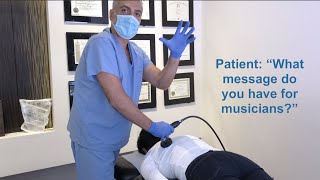
A practitioner (identified on-camera as Dr. Akimi/Payam Hakimi) demonstrates osteopathic evaluation and hands-on treatment for upper thoracic pain and thoracic outlet–type symptoms. He explains anatomy (vertebrae, ribs, shoulder girdle), common contributors (poor posture from phones/computers; playing string instruments), clinical signs (radiation to arm, neck, jaw; chest-like pain), and a staged manual approach starting from the sacrum, using a percussor, rib and vertebral releases, and shoulder-girdle muscle work. He also recommends adjunct measures (heat, topical magnesium/CBD, compounded topical meds) and practical aftercare (avoid strenuous exercise for 24–48 hours, short walks with good posture, drink water).
Questions this video answers
Avoid exercise for 24 hours; in certain cases (e.g., lower-back disc work) avoid for 48 hours.
Magnesium.
Chapters
Hello, I'm Dr. Akimi. Today we're going to treat an upper thoracic area pain which is basically from here down to here. This pain is usually caused by the vertebrae being out of alignment. And when the vertebraes are out of alignment in reality what happens is the clavicle, the shoulder joint and everything gets involved because they all connect in that area. The pain can go down the arm, even sometimes down this part, or even down to the thorax area. I've also had patients who complain that these pains of the ribcage area are causing pains that resemble chest pains with shortness of breath. It's a very anxiety forming feeling just because of the fact that there's a pain around the chest and the heart area and the lung area and it's hard to distinguish where it's coming from. So sometimes treating. And as you can see, as we treat the thoracic outlet area, the pain sort of radiates down the arm because these vertebrae have been out for a while, creating some problems. I'm going to treat it and then we're going to see afterwards what it's going to feel like. I use the percussor to release and relax the joints first and the ribs and the vertebrae. And obviously to treat the upper area, we have to always start from the sort of base of this whole area, which in reality is the sacrum. But when I examine this patient, I notice that she has some tightness in the sort of mid back area. So I'm going to release those ribs first and then go up higher and then treat the upper ribs as well as the vertebral column to treat these areas. We also need to make sure that the muscles that are around the shoulder girdle are also treated properly because they hold a lot of tension. When the neck goes out or the upper back goes out, these muscles get involved. So they make it a little bit harder to treat the upper back just because of the fact that it's this whole spasm of the muscle sort of holding the vertebrae and we have to fight through that to release the vertebrae. But it's a natural function that we're all doing. Right now we're on our cell phones and computers and everything else. So we have our neck down and the area in the upper back starts bending down a little bit and after a while those vertebrae start getting painful. And then the ribcage, the ribs try to support that and that's where the pressure goes on the ribs and then it becomes a little bit more. It's a little bit Harder to move, harder to breathe. Even this patient obviously plays music. And you can appreciate that if you're playing the guitar or any string instrument, you're going to put a little bit of a twist in the body and then the arms are going to be working differently. In essence, we're twisting the body and then loading it a little bit. And that creates these problems as well. The message is, so stretch as much as you can stretch every day. You need to make sure you have exercises for the upper back and the neck that is going to bring these ribs back and open them up. The other thing is to make sure when you're playing, you're sitting as straight as you can, especially people who play guitar. And the string instruments are going to get thoracic outlet syndrome because they load up the vertebrae and the muscles and the bones and the ribcage in that area. Sometimes this pain even goes up the neck and goes to the head, to the jaw. Some people get back pain, sort of either low back pain or neck pain when the mid back or the upper back is off. And obviously treating this takes a little bit of a finesse. We have to release the area, we have to move the muscles, relax the ligaments and tendons and the muscles. So she feels that her body is crooked and the upper part of the body is going in one direction and the lower part of the body is going in one direction. And that is normal to feel, it's not normal to have, but that's the feeling that comes with this. You have our ribs that go from the back, they attach to the sternal wall here and then from the back they're attached to the vertebral colon. So in essence, the rib cage is actually a cage. And if you move couple of the ribs this way, the ribs right across from it are going to move with the same direction as well. So you can appreciate if the ribs are off in any direction or angle, you're going to get the same thing on the other side that creates the twist. And that's why a lot of people who have upper back issues feel the twist. But again, if we're thinking of a musician, you can appreciate they're already sitting twisted. So that's the form that the body, the upper back is going to get. So the pains that have been in a specific area of the body for a while make that area obviously tighter. The muscles become tighter, the fascia becomes tighter around the muscles, and the joints in essence become tighter as well, and it becomes hard to move them. So treating them also becomes number One, it takes a little bit longer to treat them. Number two, it becomes a little bit more tender because we have to work through a lot of tissue to relax things. And if we don't relax the area, it's going to be really hard to put the bones back. One of the things you can do is to make sure that you're heating the area. You can use heating pads, hot showers, hot baths, Jacuzzis, anything that you have, saunas, anything that will help the muscle heat up a little bit, it's going to open it a little bit, relax it a little bit, and that makes it easier for us to treat it. When you're in the office, I ask some of my patients to take a supplement we have that's called muscle relaxer. And muscle relaxer has different ingredients in it, the main ingredient being magnesium. And magnesium has been used for a long period of time in medicine for muscle relaxation. Do any topicals help, like pain creams, CBD oils, some pain medications? Yes, definitely. Again, going back to magnesium, there are certain creams and gels that have magnesium in them and you can topically put them on the area. It seems that CBD oils and creams have been really good with changing the pain and the inflammation in the area as well. A lot of the times I have a compounding pharmacy compound a cream for my patients that has multiple different medications in it. There is an anti inflammatory nerve pain medication, muscle relaxer, but in very small doses. So instead of taking them by mouth, it's much easier to just put them on the area and get the medication directly on the area and have less side effects. What should I do after treatments? It's very important not to strain the area that was just treated because we're releasing, relaxing the area and then moving the joints. If you go and start exercising right after this because of the fact that the area is still not stable, you're going to move things back to where they were because that's what the body has become comfortable with. So if you start exercising right away after treatment, you're basically going to reverse the treatment a little bit. I ask my patients not to exercise for 24, and in certain cases, 48 hours, depending on what we're doing. If we're doing a disc in the lower back, it becomes 48 hours. So if you walk for 10, 15 minutes after your osteopathic treatments, with a good posture, breathe properly, and then take that day easy, drink lots of water, because we know sometimes osteopathic treatments have a detoxifying effect as well. Some people feel tired, some people feel energized. So it's important to take that day easy.