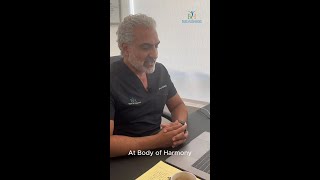
A YouTube interview ("What is Body of Harmony?") where Dr. Payam Hakimi explains his integrative practice that combines conventional medicine with selected evidence-backed alternative modalities (acupuncture, homeopathy, herbs like turmeric, chiropractic/osteopathy, dietary/detox plans). He emphasizes a whole-person approach—addressing physiology, structure/posture, and mind–body/emotions—long intake visits, sleep and lifestyle as foundations for healing, treating root causes to reduce long-term medication use, and patient education. He lists many conditions he treats (headaches/migraine, TMJ, anxiety/depression, vertigo/tinnitus, plantar fasciitis, joint/musculoskeletal pain, skin and hormonal issues, weight loss, detox, insomnia/fatigue, pregnancy and pediatric issues). The video ends with an invitation to follow Body of Harmony on YouTube and social media.
Chapters
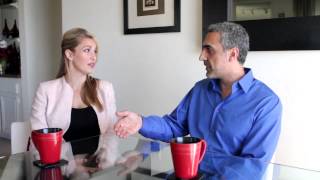
Hi, I'm Oriana Leo and today I'm interviewing my friend Dr. Payan Hakimi about his practice and philosophy called Body of Harmony. Hi, Dr. Hakimi. Hi, Ariana, how are you today?
Great, how are you?
Now I just want to understand and explain to the audience, you know, you're a medical doctor, but you've started this practice of Body of Harmony that really incorporates whole other perspective that seems to be more holistic. What motivated that for you?
I think it started from the beginning days in medical school. I figured out that there's a little bit more to the body than just, you know, what, what we study. So I started reading a little bit more on my own and trying to understand different types of medicine that is out there. And the more you add, the more you see that they all converge at a certain point together to create something that's a little bit bigger than, than just medicine.
Okay, so help me understand what that means. What are these other types of things that you were reading about that you wanted to incorporate into your practice?
So human body is more than what we think we know. And when you start with medicine, you read the physiology, anatomy, and then, you know, lab works and everything else that is sort of more physiologic with the body. Okay. Then we get introduced to psychology and then we see that there is, there's something else that actually takes our body and makes it function a little bit differently.
So emotions impacting your health, emotions impacting your health.
Right. Then you see that there is acupuncture, which actually tells us that our energy centers in the body or we can actually treat things with natural remedies. There is homeopathy that tells us you can actually stimulate the physiology of the body. You can make the body to work the way it's supposed to. Then there is chiropractic, there is osteopathy, and you know, there's all these other modalities that they're all a healing art. And once you add all of them together, you actually have a better picture of the body than just having one system intact.
So that's what makes Body of Harmony so special to me as a patient and friend of yours, is that you're really treating the entire patient top to bottom, inside and out.
Exactly. So it's about changing the physiology. And by changing physiology, we say the hormones and the chemistry of the body needs to change. It's about changing the energy of the body with emotions and mind, body connections. It's also about changing the structure of the body. We know that when you stand up straight, or when you sit up straight, you actually breathe better. Your heart works better, your lungs work better, you get more oxygen to the brain.
Well, I didn't know that, of course.
Right. So if you sit up straight and take a deep breath in, you see that you get more oxygen to your brain. Your brain functions better, the rest of your organs function better, and you don't have to work against things. So it's about putting all those together, the mind and body, physiology and structure all together to create a body of harmony.
So when a patient comes to you and they've already seen other doctors, maybe they've seen traditional doctors, and they feel like they're. Whatever they're dealing with hasn't been addressed, they're still suffering. How is your approach different?
That's a very good question. Because I get a lot of. A lot of patients like that. The approach is different in the way that I sit down with them, and I spend a good more than an hour just to understand them and understand certain things about their lives. That's very important to me. Sleep is very important.
Okay.
If we sleep good, our body during sleep, that's the time that we're actually healing our body. If we sleep good, our body can heal itself, as well as the fact that we're not anxious when we get up in the morning, we're not depressed as we go out throughout our day, and we have more energy. So by sleeping good, you can fix a lot of stuff in a patient by giving someone energy during the day. You can have them exercise, and as you exercise, you eat healthier. It's starting and working with certain parts of someone's body. And as you fix those, they start feeling better and getting better. And then eventually we get to the root of the problem that they have and then start fixing that. But the only way you can fix someone's problem is by encouraging health in their body. So first you have to make them comfortable, you have to give them energy, and then you can start treating the issues that haven't been addressed. Wow.
It's definitely a different approach than what I've experienced elsewhere. I know that a lot of patients have felt relief from this style of an approach to medicine. Can you give us some examples of treatments, I don't know, conditions that you've treated with success so that people can get an idea of what they could come to you for?
Of course, most of the issues that are treated medically can be treated also with the approach that we have. And the approach that I have is an integrative model and basically means I combine medicine and alternative medicine together. But we try to use more of the alternative medicine than medicine as we can.
What does alternative medicine really mean exactly? Kind of sounds hokey pokey. What does that really mean?
Alternative medicine are, and not necessarily any alternative medicine. What I use is medical aspects that have actually been tested. And there's science behind them. There's research behind them that shows that things work. Like turmeric, per se. Like an herb. Like an herb.
Okay, so why is it called alternative if we know it works?
Because it is not the mainstream medicine. It's not. The mainstream medicine is basically symptoms which gives us a diagnosis, and then after diagnosis we go to a treatment. Alternative medicine is looking at a person as a whole and figuring out what is causing all these symptoms and then sort of stepping back and treating the cause of all these issues, which ultimately.
Leads to true healing.
It leads to a deeper healing. It leads to actually getting something out of someone's body rather than continually treating it. And the whole goal is to, you know, if someone sees me, they don't need to see me for two years. They need to see me and get better and then move on.
Right.
So that is an alternative medicine is basically our herbs and let's see, acupuncture, homeopathy, things that are not necessarily mainstream medicine. But what I use in my practice is everything that has been studied. There's science behind it, there's research behind it, and we know that it actually works.
Okay, and what, what is your background and your history? Like, what made you even want to be a doctor in the first place?
I don't know. I always wanted to be a doctor since I was 11, 11 years old. I knew I wanted to be a doctor and I knew I wanted to help people. And the funny thing is I couldn't. I could not finish my schooling in Iran, so because of the sort of certain issues, religious issues, and so I left the country to come here so I can actually do a better job. And I'm very happy for the journey that I've been on. It's been amazing so far.
Well, we're happy too, because you're essentially liberating us so that we can be stewards of our own health. And I know personally I've benefited from that and taking charge and feeling so much better. And so many of your patients are just glowing with good health.
Yeah, you have felt much better.
Much better. So what are some of the common issues or health problems that you see and treat in your office?
So, yeah, that's a very good question. The list is actually very long, but I'll tell you some of the major ones we do. I deal with headaches and migraine, tmj, anxiety, depression. We deal with vertigo, tinnitus, plantar fasciitis, knee pains and joint pains and shoulder pains. I deal with skin problems, with hormonal issues, weight loss, detoxification, insomnia, fatigue, as well as pregnancy issues. You know, women who have the nausea and the congestion, back pain. And then also a lot with the pediatrics, with the sinus infections and ear infections and colic and everything else.
You essentially treat everything.
Most of what we can treat medically, we can also treat with alternative medicine. Okay.
So you're essentially open to see anyone with any condition? Essentially. Thank you so much for this wonderful interview and sharing your story with everyone. Is there, like a final thought or final word that you would want people to know about you and your practice?
Yes. The whole goal of the practice, Body of Harmony, is understanding the puzzle of what has happened to a patient and fixing that puzzle so that we can actually get them to feel better sooner. What I do is I spend a lot of time with my patients so that we can figure out what has happened to them, and then we work together so that we can get them to a point where they don't have to take any medications and we can get the issue out of their body.
So you collaborate with your patients for the ideal treatment plan that's ultimately going to leave them symptomless and without medications.
Exactly.
Okay.
And a lot of the what I do is education, because the more we know about things, the more we can either stay away from them or the more we can encourage our body to become better. And I'd like to invite everyone to follow me on Body of Harmony in YouTube as well as Twitter, Facebook, and my website, Body of Harmony. A lot of what we're going to do is education of the patient or education of the public because we want everyone to know that with everything that they have, it's very easy to treat it medically. It's also very easy to treat it with alternative medicine or with a diet or with a detox plan. And this information is going to be out there for everyone to view and share and enjoy.
Make sure that you subscribe to this channel and you follow Body of Harmony on Facebook, Twitter, and Instagram. And thank you so much, Dr. Akimi.