3 Best Ways To Use Claude 3.5 Sonnet For Businesses
Podcast episode discussing Anthropic’s Claude 3.5 (codename Sonnet) release of Dashboards: how users can upload data (reports, research papers, Excel sheets, pitch decks, customer reviews) and have Claude build interactive web-app style dashboards. Hosts highlight use cases (shareholder reports, research-paper learning dashboards, investor pitch decks, Excel→income-statement dashboards, Airbnb picker), implications for productization, personalization, and lowering barriers to building apps and analytics. They emphasize that the hard problems become data hygiene/ETL and idea/functional-spec design rather than front-end engineering.
Chapters
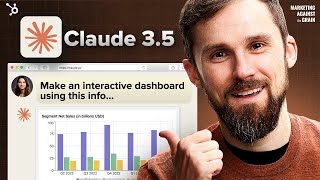
On today's show, we are breaking down the most powerful AI feature available today. And it's available to everyone. It's part of Claude. We're going to show you how to make live dashboards within CLAUDE and turn claude, which is Anthropic, into your data analyst. Let's get into today's show. Over the last couple of weeks, I think one of the most important AI features was released and I kind of flew under the radar and we wanted to do a dedicated show all about Anthropic's release of Dashboards as part of their CLAUDE AI. And part of what we're saying here, and part of the reason we're doing today's show is because as part of Claude 3.5, which is called Sonnet, they released a lot of features, but also the model just got way better. And Kieran. And that's when it started being really great for coding for you. And you're like, hey, I know the basics of coding and it is like making me like a decent developer now. And the next extension of that is what we're about to show with Dashboards, because what you're essentially doing is giving CLAUDE data and information and it's building you a little web app dashboard to display that information versus you needing to go and hire a data analyst or data engineer to go and do that same thing. Right, Right. And that is a massive transformation in how we work. And Kieran, I want to start by showing just one very straightforward example, and it's an example that I think like any of us would use. Shout out to Ali K. Miller on Twitter. She shared this. She took 100 pages of Amazon shareholder reports and turned them into dashboards. And she's like, I did it in 45 seconds. And what was, what's really interesting is she, basically, it shows what she did here. She. She took all the shareholder reports. She gave the Cloud 3.5. This prompt, it's literally a one sentence prompt. Make me an interactive dashboard using the following public shareholder reports. Kieran, you are a master prompt writer. We know that is not a great prompt. Right? Like it's. But it's. That is a prompt that literally anyone can do, literally anybody watching the show can do. And this is the output.
This is the other interesting thing about Claude. I don't think people realize this either. Where do my best prompts come from? Claude? I actually tell it roughly what I want and then I say, can you iterate on this and help me to create a better prompt? And so it actually starts to create the prompt for me. So I had a prompt that was good and I asked it, how can I make this better? So an AI assistant would do a better job of these three things, and it created a much better version of that prompt for me. And so that's the other thing that is really interesting to me is I still think the leverage is, the leverage you have is in prompting, but I don't know how long that is true for, and it's not true forever. And I don't even know if it's as true as I thought before I started to really dig into some of these advanced prompts for writing I don't like. Claude can write in a lot of cases, better prompts than me. Now there is another level above me which is like really advanced prompt engineering, right? And I think there's people who understand how to prompt the model. And I've Talked to like, CPOs who have prompt engineering doing things for their product like they're beyond another stage. Again, like they, they understand the actual model so well that they're able to prompt in a way that other average user, even like me, would not be able to do. But for the kind of, like people like me who are pretty knowledgeable, knowledgeable enough that they can do a lot of good things for prompting, the LLMs are starting to catch up in terms of just being able to take a rough command and be able to provide you the. A better version of your prompt.
Look, this very simple example, right? We know shareholder reports are public information, right? And so you can get these shareholder reports. And I think she uploaded shareholder reports from Q2 of 2022 to Q2, 2023. And it just, it knew to take all of those disparate reports, put them together and graph out the financial metrics and what those financial metrics were operating income, net income, free cash flow, and everything for Amazon. So you now have a pretty sick way to look at this company in a way that would have taken a lot of manual work beforehand and quite frankly, most people just wouldn't have done right.
Actually, let me just show you this because it's very similar. And then I want to make a point around how this actually is impactful for marketers. So, like, very similar, but a slightly different use case, which is there was a research paper basically released about how AI had reached its peak. Like, and it, it was making the case that there's just not enough data to keep training these models to get any kind of momentum. And they were making the point that if you look at the, the improvement between GPT4 and GPT4. Oh. Like they're not these huge leaps. We're not seeing the big leaps anymore. I would argue Claude Sonnet is a little bit of a leap, but totally is. I would have to like read this. I was, you know, going through like a research paper. Like this research paper. What, what's a better way to consume that? Well, again, if I could just give it to Claude and this way that you give it this research paper and then you prompt it to create a dashboard. Now they've actually created a good prompt, right? They've actually been very specific in what they want within this learning dashboard. So they've basically. What have they done here? Like they have written a functional spec to build an app. That is the way I would think about these. These interactive dashboards are just apps.
They are.
And so try to get that, like people should really get that into your brain here. The average user is building these interactive apps of this dashboard by just creating a prompt. So this one here is an example of someone creating a pretty good functional spec of what they want, given it the research paper and then having this interactive dashboard of how they can like consume the information, learn the information from that dashboard, right? So they have the tabs, they have the different charts, they have the different takeaways. Like just the kind of. They built an exact, an exact app that they want from that research paper based upon how they want to learn, learn about that stuff. And that to me, I don't think people realize how mind blown that is is. What's happening here is like the, the data, the data repository is just being turned into like an everyday app that you can use on a one to one basis and it's rendered in Claude. I can't fathom how crazy that is now. Like, what's one way, if I'm a buyer of software, I would like, why would I ever go to your website, just download all your stuff or get an agent to download all your stuff, put it into Claude and build me a demo, build me my own micro site of your product. Like why would I go to your website? Dude, this person's just built a mini.
Website around the data on an upcoming episode. What if we take all of the G2 data?
Why don't we build one for HubSpot.
For category and do a dashboard based off of customer reviews. Wouldn't that be sick? Let's do it for HubSpot.
Let's build a mini app, let's pick.
A couple other categories and break it down that way. But like I want to pause real quick here and do a quick check in because I do think something you just said there was very, very important that I want to underline for everybody. You said that that person who went through and wrote that spec for to break down that research paper, they essentially wrote a product spec like a product manager would do.
Exactly.
And I think in the early days of AI, we thought we were all going to be prompt engineers. And what it seems like, and I want to get your feedback on, it seems like the AI is going to be a very good engineer and very good at prompting. What it's going to need is the clarity and the functional spec. And it seems like we're more likely to all be product managers than prompt engineers because the AI is getting so good so quickly at the actual prompting and developing itself. Hey everyone. You know we're always getting requests on the show for more recommendations on how you grow with AI. Well, we're bringing you another one. We've got this free guide from HubSpot on how you can use AI to completely change the way you create content. This guide, it's got it all. Prompts to assist you writing and editing steps to incorporate AI into your marketing plan, and guidance on how to roll out AI across your team. It is the guidebook on how to integrate AI into your content creation. I've dropped the link in the description below. You're going to want to check it out. Now back to today's show.
I think that is true. I think the AI will be a better product manager at some point as well. If you tell it your outcomes, yes. It will be able to craft the functional spec to meet those outcomes. So what is left? The idea. Where do I think I would beat an engineer if I could code? I just think I have better ideas than a lot of people. Like I just do.
Correct.
And what holds me back for a long time. And I know I do because like there's several businesses that I had the idea for. Like, like typical person who says this, but like several businesses, I had the idea for years before they were created, but I just never did it because I didn't like my own. That that's just me. I'm not my failure as being an entrepreneur. I just didn't like persist to learn, teach myself to code and do anything.
Right.
But there is no. The barrier to entry is much lower. And so the idea and the ability to craft that idea in a way where users will find it valuable. Like, so I think you're, you're not, you're still somewhat of a product manager because I think there's still differentiation and how you bring that idea to life.
There's.
But like the way that you actually write the functional spec, the way that you bring that app to life in a way that makes it usable and useful for users. I can see the AI continuing to like, move up all the way back right towards the ideation. And it's the same thing that happened in Write. Like the Write in that. I was surprised. Like, I was like, oh, well, look, it's generic. No, no one is ever going to like, read this stuff. Right? It's. But it's good for the blank slate problem.
And.
But me as a writer, I've got my own personality.
I'm way better than this AI.
Yeah. And then you, like, then I, then I created a writing style for Gary Vee and like, it's not 100% there, but if you, if you actually look at it side by side, it can take a topic and replicate his style pretty well with some slight editing. And again, and when. So it moves back now that it can do pretty good writing styles. I think the trouble in part is if it moves back and has better ideas than me right, then I am totally fucked. But in this case, in this case, like I said this on a conference, I was speaking out. I don't know how you feel. I have never been so excited to have spare time. I actually worry that I should just not. I know this is terrible because I'm on the podcast and everything, but maybe I should just only do this stuff because I just feel like you can do stuff that you never were able to do before. You can take your ideas and bring them to life in ways that you were never able to do before. And I just feel it's so addictive. Like, it is so addictive.
There's a couple of things on this. This is. This is an important tangent. We have a friend.
I won't.
Won't name him, but we, we have a mutual friend and he was. He's kind of have a crisis of conscious and he's like, oh, I don't know. People want me to go start an AI startup and I don't know what to do. And my advice to him was like. Because he had that same reaction, Karen. He's like, oh, I just. I could spend all my time doing this. I've never been so excited about the world. And I was like, I think you're totally right. I think the world is not ready yet. I was like, I think you're a little early I think everything you feel is true. It's probably true in like 12 to 36 months, not today. And what our job is today is to spend enough time so that we know what's possible, we know what the opportunities are, so that as things get more mature, we can jump on them and invest all of our time and energy against those. And I think that's the advice I would give anybody out there is like, have dedicated time. Like, I've got some time tomorrow afternoon. I'm going to build a few dashboards. I'm going to DM them to Kieran. We're going to kind of go back and forth and for, for an upcoming show. But like, that's the time that I think is super valuable and where you really actually get leverage and get scale. The second part of this, Kieran, is I do think that we should take one small victory lap. And that victory lap is a long time ago, like over a year ago, we said that web apps would be ubiquitous and that web apps would essentially become free and you would have a web app for everything. Today's show is validation that we are on the steady march to that being true.
That is very true. Right. Look at this. So what we're showing is a chart that shows retention rates of the incumbents and the AI first companies. And what you still see is retention is the biggest problem. Like ChatGPT's retention rate is like 56%. Runways is 45%.
With that.
Yeah, you can't, you can't build a great business with these kind of retention rates. So I think you're right in that the overarching, kind of overarching thing that I'm seeing is that the stickiness of these apps are still much, much are pretty, pretty in question. The thing that we're showing is like how you build to your second point. And I want to show another quick example of a dashboard to kind of make this point is how you actually build personal personalized apps. These are apps for things that you use yourself, right? They' you're not trying to build a business around them, but you're able to do way more to be a way better version of yourself because you have these personal apps that can do things right. Like this is another example of one of a dashboard that I like, but again, it is a personalized app. It just happens to be the kind of dashboard. So this one is pitch deck into an interactive dashboard for investors. Right. One prompt and we'll show this. So if you basically, in a word gone past, I am an investor I have seen a lot of pitch decks. I have always thought the best tweet around investor decks was Packy McCormick when he had the, you know, you have the two by two where you have like, I don't know, like, you know, low cost, most efficient in the world and the, the startups that pitch in is the way up in the right hand quadrant and then it's like the most shit version of this and all the competitors are in like the bottom left corner.
Yeah, but all kind of the same.
Yes, they kind of look the same. Like there's something that really stand out but like. So you have a pitch deck, right? So it's, it's. But what could you, if you could build an interactive dashboard or interactive app for investors, that would be so much better. But why would you ever do that? Why would you ever say to a developer, you know what we'll do as a small scrappy startup, we'll actually build an app. We'll actually build an interactive dashboard for investors to be able to navigate all of the stuff that we want to tell them so we can make sure that they invest in us else. Well, like the human cost to do that is just too much for me. The scrappy startup, why would I ever spend money on that? Well, bingo. Human cost for this stuff is zero. So now you start to do things that make a ton of sense that you never would have done in the past. So here's the pitch deck. What we're showing again for our listeners is, is a cloud prompt. And what has he done? Right, he's, he's uploaded the pitch deck and then he's built a functional spec for the app that he wants investors to see as part of that pitch deck. And on the right hand side you'll see Claude is actually rendering that. And, and it's dope. Like, look at it shows all of the kind of. It has an ROI calculator to show their kind of usp. It has the problem stated, it has the solution, the plan, the market that they're going after. This is just such a better way to actually, this is a better way for any investor to get the information they need to decide whether they want to invest or not. So again, think about this. Why would I go to a conference in the future and have a born old, born a last deck, right? Like hold on, why would I have, why would have my decks an interactive dashboard or an app?
Well, so this is, this is, this was the point I was going to make. If you look at this and if you listen to the audio version. I do recommend you go over, hop over to YouTube and look at this on YouTube to see what we're talking about. Because what it, what this tells you, Kieran, is that all slide decks in the future are inputs to AI models, not outputs to humans. Like you still need the packaging of the data and the thoughts, but you're gonna do it to basically build a web app. Not to actually say like, oh, this set of 20 slides is my final product. No, no, no. That's the input to get a better final product. Right. Like I think that's mind blowing. People like that will take a decade or more for people to get their head around. Right?
Yeah, I think why again, apps become content, right? Like in a lot of cases an app, these kind of interactive apps are a better way to consum, but you just never would have done that before because the build an app takes a lot of work. Now you can create like remember the time the infographic was like the most the thing that really worked in content marketing. Like everyone loved the infographics. I think these interactive content pieces are going to be so easier to easy to do that they're going to become much more of a staple of how people do content. And you can do really creative things now with content because you can build these little micro apps to actually release to your consumers. And all you have to be able to do is have a good idea, have some really great data, have a good prompt and be able to just bring that to life in really creative ways.
This actually brings the whole contact record problem, it fixes it, right? Like so when you sell CRM, you have a contact record on everyone and you have that data. And the best way to sell a CRM is to show people that contact record in action, show them the information you have about them and then they can be like, oh, I could have all this information for my customers too. Like you could now on a contact per contact basis build a personalized web app dashboard that shows all of that and shows like, oh, if we had this other information, you could improve your conversion rates or emails or you could, you could increase your sales close rates and like that is bonkers.
There's some wild thing you can actually have. You're right. Actually that's the other thing I had.
To actually solve this problem.
Couldn't you just have a personal, like everyone should actually have a personalized analytical dashboard tool. Like why would I need to have a one to many kind of analytical dashboard tool when I can just, I, I only, all I need is like Upload the data into cloud and build my own dashboard, but my own personal. So like why would you need any of these analytical tools?
Well, what analytical analytics tools turn into Kieran is def. Like is the actual like data management, data hygiene side of it, like correct definitioning, etl. All the things you need to know that like I have the right data and I know what the data is. But once you have that AI is going to be a far better reporting tool. I can tell you.
And you can when you say then the analytics tool of the future future is just the LLM sitting on top of the good data hygiene database and then a fine tuned LLM on top of that to build you whatever dashboard and port you want.
There's also probably a middle layer which is the way to basically transform the data into the best format for the LLM depending on what you were wanting to do.
Yeah, so it's all the backend work, but the front end work should just be because how much time is lost from people trying to build different cuts of data.
Oh, passing around data report the average, at least the average technology company spends 5 to 10% of their revenue on this. What we're saying is it used to the. We used to think the hard problem was visualization of the data analogy of data. And that's actually not the case anymore. It's do you have the data? Is the data clean and accessible and are you smart enough to ask the smart questions of to the data to get the right insights? Right, right. Those are the things that are actually going to matter.
I have a lot of ideas and I, I have too many ideas.
This is the problem. My brain, like my brain hurts. The contact record thing is the contact record is wild.
We should probably talk about that offline.
Know what we're going to talk about tomorrow?
Yeah, yeah, all right, all right.
I do. I do have some more dashboard examples. You want me to show a few more dashboards?
Yeah, show a couple more people.
People kind of know what's up here. I found this to be a really good thread of some good dashboards. So shout out to. We're not going to say his name. Right. Cy Rahul for putting this thread together. So we talked about an earnings dashboard. That was his first example. Fine. You just shared the research paper example. This is probably one of the biggest examples that we've seen so far, which is Ethan Moloch who is a Wharton professor who basically had Claw take this Excel to reverse an income statement and make it a dashboard. So they took like basically an Excel of An income statement and made an interactive dashboard of that income statement. Like, I'm sorry, if you're like a CEO or you're running a small business, that's pretty freaking transformational.
No, yeah, it's huge. This would get, I. This would give me a great, like, maybe this is like related to the first dashboard you sent, but I definitely want to build versions of this for public companies and their earnings calls.
I think there's probably a way where you take the earnings calls of public companies plus customer reviews, plus employee sentiment on the CEO and bring that together to make a dashboard that would basically that I think would probably outperform most index funds.
Oh, that is a good one. Actually. I'm going to actually take my idea.
He's writing it down right now.
No, this is our idea idea. We can do this in the ship. But these are good. There's too many ideas, Kit. But I think I'm gonna have to just like, I don't know, like what am I gonna do here? We need more days in the week. I put a whole like this off.
Air comment about, about Nanny Kieran.
Yeah, okay.
If you fix that problem.
This is a good one actually. Earnings call G2 glass. Glassdoor.
Yeah, you take earnings call, earnings transcripts plus like Q. You know, the quarterly earning, actual statements in docs plus customer views plus Glass.
If someone wants to build this, want to come on the show? How about that?
Like, oh yeah, if somebody wants to.
Build this, if anyone wants to build us, come on the show. And actually there's, there's probably a startup here as well. So you make it some investment.
A few other examples is just general like Excel sheet to dashboard of any kind. You know, I think there are people out there who are really great in Excel but they're. They have a hard time of like, they don't have any actual web development skills like you were. We kind of started the show off and now it's like cool. If you're good in Excel, you can make a web app of basically an Excel sheet with cloud, which is pretty sweet. A lot of this is finance dashboard, use cases, shareholder use cases. This is actually pretty cool. It's basically helping you pick an Airbnb by taking all of the data about all these different Airbnbs and your criteria and creating a dashboard to help you decide. Decide. I saw what Airbnb you should pick, which I think is probably the most fun example of Claude dashboards. I think we are just in the early day days of Claude dashboards though. Like we're going to see these be made for so many different things. But we're seeing kind of the early adopter use cases now, which is basically, oh, we're going to build something lightweight off of publicly available data.
Yeah, that one is so wild because it's. They built like a mini aggregator on top of an aggregator, right? Like their dashboard was basically aggregation of Airbnb data. So you could actually figure out which one you want to choose. But again, it's a lightweight aggregation app. Like, it's, it's just wild.
It comes back to like one of the points that you've been making through the show is that like, we are moving to a highly, highly personalized Internet and that is both good for a lot of reasons and bad for a lot of reasons. But if you don't think that you can now have just personal web apps to everything you're trying to do and accomplish, you can. And like, that is a wild, mind blowing idea that like even a couple years ago, like, you and I would have laughed at. We would have been like, yeah, that's cool. Like, yeah, I'd love to have a web app for everything, but it's just I don't have $100 million to go have an army of developers build stuff at my whim. And now it's like, cool. I got some basic data trying to figure out which Airbnb I want to go to. I'm just going to upload stuff to this LLM and in like 10 minutes have like a web app to help me make it make a decision on where I'm going to spend my holiday.
Yeah, I do wonder if, like when you have cloud enterprise, how good it is at B2B use cases like uploading your contacts and being able to figure out which ones are a good fit, which ones are high intent based upon parameters you set it. I mean, I think we just cloud.
Enterprise, don't you think?
Yeah, I think that's one of the.
Action items from this show actually have.
I will take a note of that.
I'm ready to actually have it.
Yeah, we do actually. We're actually, we're on board in them at the moment, actually.
I mean, the writing use cases of Claude for marketing and sales are pretty obvious. Kieran has done some awesome, awesome stuff coming on a future show. I'm convincing him to release some of it to you all because it is a plus plus quality.
This is the first time the capitalist in me is like, I don't know, I'm going to give this away for free.
I was like, you Got to at least give the people something. Sum of this magic.
I'll update you because I'm a HubSpot through. Through. I actually been working. I think Dharmash is going to build it into a his. I've been talking to him about it. I think he's going to build it into his app. So I'm giving it. I'm giving it to Dharmesh because, oh, man, I want the people to have it. So maybe we'll be able to get it to the people live here.
The people. All right, that. That. That's coming up on. On a future show. Anything else on Claude Sonnets? Karen? I actually think this is one of the more important.
There's a ton of different. Yeah, there's a ton. I think we should do a series of these because there's writing styles, there's a. There's a bunch that I actually we. I have taken notes of. So I think this is a good first version.
But we're coming back and do some very marketing specific type of dashboard examples. But we. What we wanted to do today was take. Do a show of like, here's the technology, here's what's possible, here's what some early examples, what people are doing. And then we'll come back with other, like, very granular examples of like how we're using this in our marketing, how you could potentially use it in your marketing and share some examples. Like I said, I'm gonna play around with some tomorrow and get Kieran's feedback on some ideas that I got. Boom. All right, this is. This has been fun, man. It's been. It's been far too long. I'm glad that we. We were able to hop on and do the show today. Thanks everybody for listening and we'll see you real soon on marking institute.
This data is wrong every freaking time. Have you heard of HubSpot? HubSpot?
HubSpot is a CRM platform where everything is fully integrated.
Whoa. I can see the client's whole history. Calls, support tickets, emails. And here's a task from three days ago. I totally missed HubSpot Grow better.
More from Patrick



A NEW BREED OF PARTNER: The Partnership Ecosystem Model Journey of Patrick Biddiscombe, Part 1








Customer Success Workspace: Never Lose Sight Of What Matters Most | HubSpot Spotlight