Advancing Human Creativity With AI With Cameron Adams | INBOUND 2024
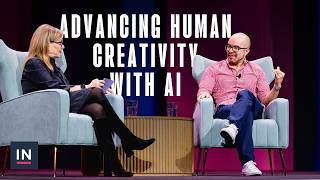
On-stage interview (INBOUND 2024) with Cameron Adams, co-founder and CPO of Canva, covering his career from early teen design projects through Google and startups to co-founding Canva (decided July 2012; launched 2013). The conversation traces Canva’s product evolution from social-media graphics to presentations, video, websites, and reports several platform metrics and business milestones, then focuses on Canva’s AI investments, ethical approaches (Creators Fund), and predictions about AI-native creatives and multimodal creative workflows.
Chapters
Morning. Welcome to day two of Inbound. My name is Debbie Millman and I am thrilled to be in conversation today with a person whose career has exemplified the integration of creativity and technology in order to revolutionize and democratize design. So please join me in welcoming the co founder and and chief product officer at canva, Cameron Adams.
Oh, which way do I go to the other front?
They were very, very specific about this meeting. Cam, before we start talking business, tell me about a Man in Blue.
Oh, I was worried about your icebreaker. This question's fine. The man in Blue was my very first attempt at brand design. So I was about 14, I think, and I was doing some work around my high school, so lots of kids needed graphics made and I needed a bit of an identity to represent my teenage design agency. And I came up with the man in Blue because I kind of wanted it to be me, but I didn't want to be center stage. So I just like made it quite vague and just had myself in blue.
So you had your own branding and design agency at 14 years old?
I wouldn't call it a branding and design agency. It was a bit of a side hustle, let's say. But yeah, there were lots of kids. Photoshop had just come out. I was like tinkering around with that. Lots of kids wanted stuff done, like posters and stuff like that. So I set up a bit of a side business doing that.
So this will help us get into this first question in a slightly different way then. How did you go from studying at the University of Melbourne in Australia working as I believe you studied law, Is that true?
Law and computer science.
So law, how did you go from studying law to working as a product manager at Google to becoming the co founder and chief product officer at Canva?
I think probably the key reason was that I was terrible at law, so I totally forgot to apply for any law jobs at the final year of university. And I had been working as a graphic designer through pretty much all my university career. So I'd worked on the university newspaper, kind of cut my teeth doing that. Ended up getting a job as a catalog designer for a mail order software company.
They had those back then.
They had those back then. It was the year 1999, just to date myself, and I learned my craft there. So took my design and branding agency into an actual workplace and learned about graphic design, about layout, typography, used a program called Quark, which I'm sure you're familiar with.
Ah, Quark.
Installing that on floppy disks.
Yeah. And I kind of miss Quark.
Actually it was a nice piece of software. It was, had its moment though. And out of that I kind of got into web design. So around the year 2000 the web was booming and back in Australia this company I was working for decided to go into making websites for people. And they said, you know a bit about design and you know a bit about programming, why don't you try and make a website? So that's when I really started developing digitally and again I had a bit of a side hustle making websites for people and that turned into my career. After university I've never actually I had one real job but since university I've mostly run my own businesses.
So you don't consider what you do now a real job?
It is a real job. I don't consider it being employed by anyone since I started the business. So the one real job I have had was at Google and that came around after six years of running my web agency, my real web agency. I did a lot of writing, got a bit of renown in the kind of website design space and got the attention of Google in Sydney through actually a recommendation from a person called Doug Bowman. I don't know whether you know him, but he was the very first UI designer at Google. He was also the very first designer at Twitter, so hugely influential in Silicon Valley and places like that. And he recommended me for a job at Google, which was surprising because I'd actually applied to Google three times before and got rejected.
Do you know why you got rejected? Did you get any of that feedback?
I had been applying for kind of programming jobs. So software engineering at Google is a high art and I wasn't a very good software engineer. So I was trying to do things in the space between design and technology, which I don't think Google really understood. They were like, you're either an engineer or you're someone who just pushes pixels around.
So if you applied there four times, you must have really wanted to work there.
I did really want to work. Everyone wants to work at Google or wanted to at least. And I also applied to Yahoo at the same time. Fortunately I didn't get a job there, but wound up at Google on this super secret project called Google Wave which was run by the co founders of Google Maps. So they had actually started the Google Sydney office before that. Google Sydney was just one salesperson and they brought the product team, they're actually an acquisition and brought the product team into Sydney and grew that out. And the Google office in Sydney is now quite, I think it's over a Thousand people or something, but back then it was about 100 people. And I walked in to my very first day on this mystery project that I didn't know anything about and went into this meeting room that had been blacked out like they papered over all the windows. And I met Lars Rasmussen and his brother Jens. So they're two of the co founders of Google Maps. And they said, this is the product we're trying to do. And it was like a next generation communications product called Google Wave. And I worked on that for four years. It was an amazing ride. Ultimately burned and crashed into the ground. But I learned a ton about creating digital products which I hadn't really thought about before. I'd been more in the website world and kind of online products weren't really a category that existed. So we were forging that path, figuring it out. I learned about product management as well as design. And when I decided to leave Google, I did another startup that I started called Fluent, which was the next generation email product. And we tried that for about a year. Went through trying to get funding, the whole startup journey didn't quite get across the line. And right towards the end of that, Lars recommended that I meet this couple who had just moved to Sydney and he said, go talk to them, give them some advice on tech and see how it goes. So I wasn't thinking of partnering with them at all. And I walked into their office and met Mel and Cliff, my co founders on Canva. And Mel described this amazing vision she had for democratizing design, as you mentioned, and it was the start of a long journey. Took us about a month of just doing Skype calls and various other things before we really decided to join forces. But in July 2012, we decided to start Canva together. And it's been an amazing journey ever since.
I was doing a little bit of research in trying to understand your path to Canva. And just from the other side of the sort of picture, I believe it took Mel about a year to find someone that their investors felt was worthy of the job. Is that correct?
Yeah, well, Lars, perhaps from Google Maps, was one of their advisors and he would put everyone through a rigorous interview, particularly when we're looking for a cto. But he obviously knew me from our four years together, so it was once I agreed to meet them. He was very excited. But yeah, it took Mel probably more than a year. So they'd been working in Perth, on the very far side of Australia, probably the farthest from Boston you can ever get, and they had built a school Yearbook business. So they'd created a design tool just for school yearbooks, and it'd been going pretty well in Australia, but they wanted to take it bigger. They wanted to take it to all sorts of design. Perth is probably not the best place you want to create a startup in, so they moved to Sydney to try and get it happening, and that's where we bumped into each other.
So a couple of questions around that particular moment. What gave you the sense that this could be what it's becoming? Canva as a tool to create any type of design. And second, talk a little bit more about this democratization of design and what that actually means.
I think there are two things that really caught me about Canva and Mellencliffe as well. The first was this exciting vision for what design could be. Throughout my career, I'd run a blog called the man in Blue, and I wrote a lot about experiments that I was doing in creativity and code and design.
And you still do write? Occasionally.
Very occasionally, when I get to.
He's actually quite good. Kem is quite a good writer.
Not quite as good as you, Debbie, but I try and make it happen in the little time I have. And through that process, I created a whole bunch of basically design tools. So I just quirky little experiments that let people create things that they hadn't really thought they could create before. So little 3D builders, little drawing tools that you move blobs around to create things with. And I'd been doing that for probably 15 years. And when Mel first pitched me the idea of democratizing design, he. It just instantly gelled with me because I'd seen what amazing stuff people could create with pretty simple tools. And being able to take the really complicated area of design software as it was back then and make it accessible to everyone in the world and give them the ability to express their ideas and bring things to life was really exciting to me. So that was the vision side. And then on the team side, I had worked in a failed startup, I had worked at Google. I'd worked with a whole bunch of people over the years, and I'd kind of got to know what I was good at and what I wasn't good at. And Mel and Cliff were great at the stuff I wasn't good at. So we fit together really neatly, just like a jigsaw. And I think we each recognized that the three of us together just created an entire picture of what the founding team of an organization could be.
Talk a little bit about the evolution of Canva, because I want to get to what you're currently doing right now in AI, but talk a little bit about how the tool has developed.
So we've always had a huge vision. The vision is to empower the world to design across every type of design and visual medium that you can think of. But if you're starting a startup, you can't start there. You can't. You have to start down here with your very first user. So we needed to scope the original version of Canva down to something that we could actually build with a small team and that would also be really attractive to a very core audience. What we ended up building was a design tool that had roughly everything. Well, most of the small things you needed to design. You could do text, you could do images, you could lay them out. And it was the perfect tool for social media, which was just emerging back in 2012. It picked up Steam, and you had people like social media managers who needed to create a lot of content for their clients. And they didn't have the tools they needed because they weren't professional designers. They didn't know how to use complicated software or even afford it. And a tool like Canva was perfect for them because it let them quickly get started. They could smash it out in a few minutes, uploaded to Twitter or Facebook, and it became an invaluable tool for them. So that was our initial audience, and we launched in 2013. And since then, Canva has grown in what you can do. So it can't just do social media graphics now. It evolved into presentations, into T shirts, into videos, into websites. And as we've kind of bitten off more parts of the design pie, it's resulted in some of the growth that you could see on screen. Now we've got 190 million people that use the product. We have over $2.3 billion in revenue. 95% of the Fortune 500 now use Canva, which is speaking to the evolution of it as a visual communications tool for everyone. It has just grown beyond our wildest dreams. But how.
How has that happened?
I think for us, it's about focusing on the product. So creating an amazing product that people truly value and that they want to talk about to other people. We didn't do any marketing for pretty much the first eight years of Canva. It was all word of mouth. It was creating really good funnels for people to find Canva on search engines, understand that it was good for the job that they wanted to do, and then have an amazing experience in their first time on Canva. And we actually spent, excuse me, A lot of time thinking about that first time experience of the product. So when someone lands in Canva, they need to be comfortable, they need to be inspired, they need to feel like they're a creative individual who can make things. And we set up the very first steps in the product to give you and build your confidence in being able to do that. Which I think has really been a philosophy that we've taken into heart over the last 10 years.
Canva is now investing heavily in AI. Why and where do you see it having the most impact in a series of design tools?
I think in the last five years, and particularly in the last two years, AI has rapidly changed as a technology and made things possible that just weren't possible today 10 years ago. So when we started Canva thinking about democratizing design and the technology that was available back then, it was all about mobile phones, it was about web browsers, JavaScript, a whole bunch of things. And we built the product using that technology and it did enable people to discover design and discover their own creativity. But ever since we've launched, we've continually made design easier, made expressing yourself easier and, and made it easier for you to communicate visually. We see AI as the next phase of that, and it's a really big next phase because what you now can do with AI unlocks even more stuff than what you could originally do with a mobile phone and a web browser. But we see it as a continuation of empowering the world to design, of enabling people to access design and visual communication that they couldn't do before. And really about shortening the time it takes to get an idea out there. I consider creativity not to be something that only artists or sculptors have. I think creativity is something that all of us can have and we express it in very different ways. And AI is now enabling us to express ourselves in ways that we didn't think we could do. Like we didn't think we were videographers, or we didn't think we'll fit photographers or copywriters. And now as business owners, as marketers, as salespeople, even as accountants, people who think they mightn't have a creative bone in their body, they can actually express themselves creatively using AI. And it is an amazing democratization tool that we have seen over the last two years. Now that we have deeply embedded AI into the product.
I don't know about how other communities and disciplines are reacting to AI quite in the same way. I understand how the design community is responding and there's this real palpable sense that somehow AI is going to destroy design and take the soul out of design and take all of the creativity, the sort of originality and innate creativity out of design. And in thinking about this, I'm old enough to have remembered what happened when the computer first came on the scene. Elder statesmen, very, very famous designers at the time, in the 80s, into the early 90s, were talking about how the computer was going to destroy the jobs, was going to take away all the soul out of creativity. It's sort of eerie in a lot of ways how the same conversations are being now had 40 years later about yet another disruptive, completely revolutionary, revolutionary technology. Now, back in the 80s, yes, there were some jobs that were lost. Typesetting as a solo entrepreneurial effort is now embedded in everything that we do in design. Some of the pre pro that went into the work that was done prior to design going to press. But I don't think anybody could deny that hundreds of thousands of jobs were created as well. So the net net is way positive. Talk about some of the fears that designers seem to have about AI and what your thoughts are on why.
Yeah, I think I can totally empathize with designers and a whole bunch of other people looking at the sphere of AI now and wondering what it's going to do for them and what their profession is going to look like. But I think as you said, you can look to history, you can look at every innovation that has happened over the last hundred years, even three hundred years, and the resulting increase in the ability to do work, to express yourself, to be creative through each stage, has always been net positive. As you said, in the AI age, we really see it as an unlocking force. It enables more people to come into the creative sphere. And it's a rising tide that I think lifts all boats as well. It's not just for non creatives who want to do creative things. It's also for creatives who want to do even more creative things. And we're seeing this with creative teams all around the world. It's decreasing the amount of time it takes to explore an idea. So that means that when you're thinking about a campaign or a billboard or a video that you want to shoot, you can actually storyboard the 20 ideas you had rather than the two that you normally would have been able to do with traditional tools. That means you can find exactly the right idea. You can start testing it earlier with audiences to make sure it lands. If it's not going where you want it to, you can try a totally different idea. And AI tools are allowing you to quickly explore that one of the best uses we see for AI tools is actually storyboarding. So we see lots of teams using this, including our own team at Canva. We ran a big event back in May in Los Angeles, and to come up with all the creative for that, our brand team used our magic media tool, our magic write tool, and of course Canva itself to create all the storyboards for it and quickly get a sense of the style of the narrative of the show. We could test that with audiences, we could rearrange it, and it was super seamless and fluid and rapid and enable us to land on the best idea. And we're seeing this replicated across teams all around the world. We have companies like Movement Climbing gyms here in the US who use Canva to write a lot of their copy to initially get that out, which then enables them to scale to all their stores around the country.
How do you feel about the copy? I'm finding that using AI for design and for ideation for me has been a lot more effective than what I'm seeing either from whatever I try to use with large language models. And my students try, for example, they all tried to write their resumes and cover letters using AI and they almost came back looking identical. And what I can say for anybody that's using large language models to help them write, very few people actually use the words moreover or hence in their writing.
I use that every day.
And that feels to me like a good giveaway that it's not really coming from a 22 year old.
I think we're all still learning about these tools, right? AI is not exactly how it's going to be in 10 years time. And for me, that's what's exciting about it. It is a new thing that you can innovate with that you need to learn skills for. And we're all learning this together. I think everyone in this room has probably touched AI in some way and you've probably figured out that you're also pretty crap at it. Like just typing a prompt into an AI tool and expecting it to give you the fully finished thing is a dream.
It's actually really interesting to see what AI comes up with when you do that. Let's talk about, I think what a lot of people are really, aside from the loss of jobs, what they're worried about in terms of some of the ethical considerations about how AI is scraping the work of so many artists, designers, writers. I want to talk about a little bit about data privacy as well. So talk about what you think about those concerns and then also what Canva's doing to sort of thwart some of those worries.
Yeah, I definitely think it's something that needs to be tackled. Bringing people's content into an AI model should be rewarding for those people whose content that you're bringing in. And that's a philosophy that we have taken at Canva. We actually have something called the Creators Fund, which is a $200 million fund that we've opened up to all the creators who we normally work with at Canva. So for the last 12 years at Canva, we've had a great relationship, not only with the end users of our product, but but also the people that supply our templates, our photos, our illustrations, the videos that you can use inside the Canva tool. And we've created a real community around that. And they get rewarded every time you use a piece of Canva elements. So if you drag an image into your design, they get a bit of royalty for that. And that is a vital part of creating design in Canva and. And expressing yourself. And we want that to continue to be the same in the AI age. So we created the Creators Fund, and any creator who opts in their content into any of our AI models gets rewarded for that. So that means that they can happily continue creating their photographs and their illustration, pass it into our library, and they get paid for any AI usage that occurs for that. And I think that's something that every other company like Canva or that uses an AI model to produce text or images or videos should also be paying their.
I mean, all of AI.
Any.
Any AI model. Any. Any. Anyone that's using AI as their business model should be rewarding the backup.
Exactly.
To make what they do.
And the only way the AI models are going to get better is if you continue to create content that you feed into the AI model. It's not like 2024 is the peak of human civilization and creativity. We're going to continue to create new things, to create amazing photographs, to draw amazing things, to come up with new ideas. And AI will be able to use those, but we should continue to reward the creators of those to feed them into the AI models and scale creativity for everyone else who can't take amazing photos or illustrations, but wants to use AI to help themselves.
What are some ways that artists can scale but also protect their work?
I think there's a bunch of interesting things happening. So, you know, companies like ours, paying creators to contribute to models is one way, but creators actually seizing control of AI Themselves to produce new ways of scaling their work is all also really exciting. So you're seeing a few things in this vein. One of those that came out recently was a thing called Google styledrop. They actually work with a bunch of artists to bring in that artist's portfolio of work, and they created specific AI models that then enabled those artists to produce more of their work. This is entirely consensual. They worked directly with the artists and kind of honed the AI model on that particular artist style. And I think this will be an increasing way that artists and creators can create new avenues for business and creativity in the AI age. If they create their own models and then offer those to people as their own app or their own paid service, that's one path that they can take. Another really interesting one that I saw was from a music artist, and he actually trained an AI model on hundreds, thousands of hours of music that he had created, and he's now using that as part of his performance. So he performs live with his AI partner who's been trained on his music, and they kind of riff off each other. So he's a dj, he produces a lot of dance music, and as he's doing a live performance, he can cue queue up the AI partner to produce something that complements what he's DJing. And it's a conversation that they have on stage using his own private data that he has trained a model on. So he has taken the reins of technology control and used it to his own benefit.
I think I only have time for one last question.
We'll make it a good kill my musical brain with the help of AI. Okay, computer drop now. Hard techno track with a very strong warehouse kick. Or not.
We have been talking about and reading about digital natives for quite some time, and it's only a matter of time now before we see the rise of AI native creatives.
I think we're already saying it.
Yeah. Do you have a sense of how an AI native creative will approach the creative process?
I think I don't have a full sense of what it's going to be like in 20 years, but we are seeing an inkling of it. That being able to think about the workflow of creativity, rather than just one part of what it is you want to create will become increasingly important. And being able to string together kind of multimodal creativity, I think will.
What does that mean? What is multimodal?
That means you're not just an illustrator, you're not just a writer, you're not just a videographer.
You're a polymath.
Polymath, that's the perfect word for it. And moreover, being able to touche, being able to bring all those things together into a cohesive narrative, a story to like, fully flesh out that idea that you have in your head and collaborate with AI, collaborate with other humans and just weave all these parts together like that will be an increasingly important skill in the AI age. And it's something that I think a few professions have mastered over the last century, like creative directors, music producers, book editors. Like, they work really well with other people who are producing creative things and they mold and shape them into something that is even better. And I think that will be an essential skill in the AI age because being able to take something that an AI spits out that maybe isn't quite appropriate for your audience and you need to massage it and change it and you need to know what good looks like. You know, just typing a prompt in and taking the first thing that comes out is not the key to great creative understanding. Of the five things that an AI spits out, which is best? How to merge them together, how to speak to your particular audience and tell the right story? That will be the key skill for creativity in the AI age. And I think it's something that all of us can master, which is pretty exciting.
Cameron Adams, thank you so much for making such an interesting platform for so many people to use. And thank you for joining me today on the inbound stage.
Thank you for a great show.
Thank you, everybody.
More from Patrick



A NEW BREED OF PARTNER: The Partnership Ecosystem Model Journey of Patrick Biddiscombe, Part 1








Customer Success Workspace: Never Lose Sight Of What Matters Most | HubSpot Spotlight