Barbara Bush & Jenna Bush Hager Discuss Their Childhood
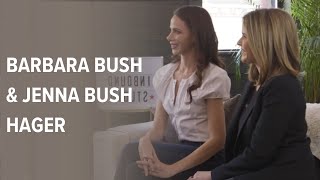
A filmed interview (June 5, 2018) with sisters and co-authors Jenna Bush Hager and Barbara Bush about their joint book Sisters First. The sisters reflect on the power of sisterhood—both as twins and as a model for women supporting women—describe influential women in their family (notably their grandmothers), and explain how they were encouraged to develop independent voices despite growing up in a prominent political family. Jenna discusses her work in journalism (Today show correspondent) and prior teaching; Barbara describes founding and leading Global Health Corps (work in East Africa, southern Africa, and the U.S.), leadership lessons (leading with love over fear), and mentorship. The interview also covers why they chose to write the book now, insights learned while writing, and brief personal rapid-fire questions.
Questions this video answers
June 5, 2018.
97 years old.
East Africa, southern Africa, and the United States.
About 50 team members.
About 1,000 young leaders from 40 countries.
Chapters
Hi, everyone. I'm Laura Moran. Welcome to the Inbound studio. We're here today with Jenna Bush Hager and Barbara Bush, former first daughters of the United States and authors of the book Sisters First. Thank you so much for being here today with us.
Thanks for having us.
For having us.
Oh, we talked to me and said.
I want to jump right in and start with just the book. And I read the book, and I was so inspired by it, but just it really came through the power of sisterhood and the bond that you have. And I just wanted you to talk a little bit about what that means to both of you, both literally, as sisters and also, like, the idea of, like, sisterhood as being women.
Well, I think we both realized that having a twin in our life has been this unbelievable gift in both private moments and then also and awkward public ones. To have each other was this unbelievable thing. And we have seen how it's made us both much braver in our careers and in our life past. Having somebody that wants to lift you up, that thinks you're good enough. And we see how that is exemplified throughout our whole culture. I work with mainly great women, and it's such a wonderful thing to have these good friends who can lift you up when you have those days that aren't great and who always think that you're pretty great yourself. So that's what Sisters first really meant to us.
It really was a love letter to each other and an example. In some ways, I think it's the luckiest thing in the world that's ever happened to me that I was born with a twin because I had someone to navigate life with that was my same age walking alongside me and everything. And that made me more brave than I thought I could be. And it certainly pushed me to do more with my life because I knew Jenna would have my back. And whether it's your blood sister or sisters that are best friends or colleagues or mom is an only child, but she has a lot of best friends that are like her sisters. It has been so helpful to be surrounded by really strong, creative women that I know have my back, whether it's professionally or in my family. And that's allowed me to feel comfortable going out of my comfort zone. And I think the same probably goes for other women as well.
I was really struck in the book. Obviously, it's about your relationship with each other, as you said, but just how much you talked about your mother and your grandmothers and the other women in your. In your life. And you come from a long line of you know, powerful men and very well known men in leadership positions. But you know what, what moments stand out to you? Learning from the powerful women directly in your family, even that you grew up with and sometimes behind the scenes were really making such a huge impact.
Yeah, well, both of us are named after our grandmothers. I was named after our grandma that nobody really knows about. Jenna Welch, she's still alive. She's 97 years old, lives in Midland, Texas where she's always lived. She didn't finish her college degree, but she was self taught and she continued to learn her whole life. I mean she took classes at the local community college until she was in her late 80s. She was a self taught naturalist. She taught Barbara and I, or she tried to teach us all the constellations and she showed us that the world is only as small as you let it be. So she, she got National Geographics every month. And even though she didn't travel to some of these places herself, she wanted to learn about different cultures and people and it was really important to her. And I think we look learned a lot from her. And to be able to write about her, a grandmother that doesn't have a school named after her was pretty cool. And then Barbara, of course, Barbara Bush was named after our other grandmother.
And it was wonderful to be able to write Sisters first while she was still alive. And she was one of our first readers when we had a draft that we'd already submitted, so we couldn't actually take any edits.
And we were a little scared by that because she always had opinions. Yeah.
So they would not be incorporated. But she was so loving and she read the book and loved it. And actually before she had gotten to a particularly hilarious embarrassing moment, had emailed us to let us know that she hoped that we included it because people like to laugh. And then 20 minutes later wrote, oh, I got to that part. You included it. But she has always never been afraid to be herself. I mean there was no being anybody else. And I think that that has been such an incredible example to us in that she had no fear of using her voice and she had no fear of loving people. And as cheesy as that is, I mean she lived very fearless even till the end. She wasn't afraid of dying. She chose how she was going to die. And so having her as an example, and even now that she's not alive, learning so many things about her that we never knew just because we were too young. I work in Global health and a number of AIDS activists that are gay men that Got involved in the 80s when no one knew what AIDS was at the time and how it was transmitted. Emailed me and said, you know, your grandmother taught us that we were fighting a disease, not people, because she was willing to touch people that were HIV positive when it was unknown how or why. And I never would have known that because we were too little. And it was so moving to me to hear that now.
And we wrote. I mean, to research her. I mean, we wrote. I wrote about that and to write about some of these other hilarious things that she said during. During her life, to do that research, to write about her in that way was really fun. I think made it even more special that we got to write about it before she passed away.
By the way, you know, just our apologies and. Or sympathies for that situation. But I thought, you know, everything was really beautiful.
Thank you.
So nice to sort of see your family come together and experience that.
So it was beautiful. Thanks.
Speaking of some of that, you know, you guys are in a super unique position that most people are not in. Growing up with, you know, a grandfather that's a president, a father that's a president, and under a limelight that very few people will ever have, understand, or have to be subject to. And I think because of the political nature of your family, there's a lot of probably assumptions made that your opinions are their opinions, and that one opinion stands for everybody. And so growing up in that, how did you sort of navigate and learn to have your own voice and sort of move out of that shadow whether or not it was your opinion?
Well, do you want to talk about this since you write about it in the book? Sure. I mean, I think I'll start, but I think one of the things I'm like, are you going to start? So you look at me and I'm.
Like, shall I go for it?
Okay, I will. I'm just gonna touch this so they can see your face.
Okay.
Does that help you? So the one thing that people assume is that, you know, when you come from a line of politicians, that you must believe what they believe and that our parents raised us in that way, that they wanted us to be little clones of them who believe the exact same thing. And that was not how our parents raised us. I mean, I think they very much wanted us to be curious, independent, and have our own thoughts. And now as a mom, I realized that that's the right way, in my opinion, to parent, to create humans that have their own minds and have their own voices and let them use it. Empower them to use them. But I also know that it's the braver way to be because it's so much easier for my 5 year old if I'm like, mommy's right. For her to be like, yes, ma', am, Mommy's right. It's harder to have disagreements, but it's also when you disagree and love, I think it's possible, I think it's possible to have him and still have this loving relationship for sure.
And our parents really raised us to have our own opinions and own voice. So I write about in the book, actually a number of times when I disagreed with my parents or my father's stance more typically. And I never did it actually in any sort of way to disagree with him. But what was interesting to me, for example, is I ended up, I think in 2011, making a video for marriage equality. And I remember going into it thinking that no one was gonna see it, actually. And Julianne Moore and Whoopi Goldberg had made videos before and they only had just a low number of YouTube views. So I thought, okay, I'm gonna make this. This is something I really believe in, and it probably won't end up anywhere. And instead it ended up on the COVID of the entire USA and in the back of every cab in New York. And so it was on Taxi tv. And what was really interesting to me, this was obviously before marriage equality was passed, but right before I would walk down the street in New York and people would come up to me, well meaning, and say, thanks for doing that. You know, it's so brave of you to betray your family or betray your father.
And.
And to me, it wasn't a betrayal at all. And it wasn't to him. I'd talked to him before doing the video in the first place about whether it was a good idea and would it be impactful and was that the right way to use my voice? And really I was talking to him because I'm shyer by nature and don't love a lot of tension, but it wasn't at all about, should I use my voice? And is it okay that I don't just, you know, that this might appear as if we disagree. And he coached me through the whole thing. And ultimately I did it because I knew we had walked through it together. And that is what surprises me more, is that there's this assumption that by not thinking exactly as our parents, which I don't think anyone in the world actually has the exact same thoughts as their parents, that that would be perceived as a betrayal.
Yeah, I Mean, Jenna, you both mentioned it, but just this idea of, like, disagreeing with love. I mean, the current climate lacks a lot of that. It's pretty polarized. No matter what side of things you fall on or your opinions, you know, living in the family that you lived in, the pressure for that is higher just by nature. So what does that look like for you guys? Like, how, like, what are the tactics to do this in a loving way and still be able to, you know, have a disagreement and then walk down the hallway together and, like, hug each other?
Well, I think it's. You don't ever let the dialogue become so vicious or hateful that you can't hug each other afterwards. And I think, unfortunately, what we're seeing sort of across our country is that the conversations aren't staying loving, and there's not very much listening going on. Our parents were both really good listeners, and even when we were, like, 13 and didn't even know exactly what we were talking about. But we're trying to fight some of our, like, political points. They. You could easily just say, you know, fight back caustically or just yell your opinions, but they would sit and listen. And I'm sure we weren't even that articulate.
No, I mean, I don't think we have any idea what we're talking about.
But they sat and listened to it patiently. And I think patience and kindness and empathy are things that we don't see so much. And I also think there's this casual cruelty where it's easy to just be like, okay, if you don't believe the way that I do from both sides, then we're not even gonna listen to it. I'm not even gonna listen. And I think that's probably where this kind of breakdown of compassion has started. But the other thing that I think is that if we expect. If we want to see X out of our leaders, if we want to see love or kindness or decency out of our leaders, then we have to act that way, too. So if we're in an argument with somebody that we disagree with, if we're asking for our leaders to act one way, we, too, have to show that respect. So that's harder said than done.
Yeah. I think another part of it is also just being open to change. Like, I hope that my opinions in 20 years are not the same opinions that I have right now. I hope that they're either more complex or more thought out, or I've allowed myself to be surprised by other things or ideas or other people's opinions or experiences. And that. That has led my life to a different place. And I think that that's missed right now, too, at least in the public dialogue of it's sort of fighting opinions. But, you know, maybe by learning from someone else, your opinion would be differently. And we were talking about this after our grandmother passed away. We read an article in the Atlantic about a letter that she had written. When was it?
She had met with a man for lunch with John Meacham and another man who is a writer for the Atlantic, and he is gay. And she was like, oh, I know you're gay. And they talked about transgender rights. And she was like, explain to me the situation. And he left the meeting thinking like, gosh, did I just. Was I too hard on a 90 plus year old woman? And she wrote him a letter a couple weeks later that said, you changed my mind. And I think to be 95 and be able to change, well, hopefully, you know, people that haven't even lived that long can also see different viewpoints.
Yeah.
Yeah. Okay. One last step sort of political question, and then we can move on.
Cool.
Generally speaking, people are like, you're not supposed to talk about religion and politics at, like, holidays. Right. Is that true in your family?
Well, I think yes.
I think, you know, we definitely have those kinds of conversations, for sure. But I do think, you know, the way that somebody might think about, like, lawyers or doctors, families, generations of lawyers and doctors, that all they talk about is medicine. You know, we don't only talk about politics. We're not like little UN meetings. And especially when we were younger, luckily, our parents. You don't bring flags to the table. Exactly. Like a model un luckily, our parents did not ever put the pressure on us to be anything but ourselves. So when we were teenagers, we were allowed to, you know, talk about Pulp Fiction, for example.
Yes.
Or music or our boyfriends or whatever it was. So it wasn't like we needed to be these perfect humans because that would have. That would have backfired.
Speaking of that, you've. Jenna, you're on the Today show. You're a correspondent, you're a journalist. Barbara, you have started your own organization, Global Health. You're both in the business of human connection. Why? Like, what has. In very different ways, but, like, what has drawn you to that? And what does that mean for both of you?
Well, I think both of us, that's what fuels us, I think. I mean, I won't speak for you, but I've watched. I mean, I can speak for you. I think both of us. I mean, I've seen you.
I want to speak for you, but.
I will just wait one minute while I speak for you. I've seen Barbara with the fellows that she works with, and, you know, people will say, like, oh, she's the shy one. And I'm like, she's done multiple TED talks. She's not that shy, you know, But I've also seen the way that she thinks and the way when she interacts with these people, when she's built a community, that that's part of what gives her energy. And for me, it's the same thing. I mean, when I travel around and get to interview people, you're doing a great job. I, you know, to get to tell people stories, I find it to be such an honor and a privilege, and I get energy from that.
I.
It fuels me to tell stories, and that's being with people, too. So I think it's just in us. I think it's in our DNA. But do you have a more complex thought about it?
Well, I think, not surprisingly, I get my greatest joy out of connecting with people, and it is the connection that matters to me. I'm not a huge fan of transactional conversations, and I think you have to love people in order to work in global health. There's no reason to work in global health if you don't love people and want to ensure that everyone, regardless of where they live, has the best that they can in terms of. Can live a full life, regardless. And so for me, I've had the luxury of working with a thousand young leaders, and they're from 40 countries and just such an unbelievably diverse group of young people that are 30 and under that are Global Health Corps fellows. And my life is so different. I never should have or would have met the people that I've gotten to work alongside. For now nine years, I wouldn't have sat on the subway next to any of our fellows from Rwanda. We just would not have crossed paths. And it is amazing to me and also extremely inspiring and fueling to know that they're my partners in the work that I do and that I know everything about them and they know everything about me because we can authentically show up as ourselves. And. And a bigger reason that that matters to me is that's why I think we can make progress on at least global health issues or the issues that I care about, because I never at all wake up and think, man, this is depressing. This is so hard. I wake up and think, okay, this was a rough. Yesterday was a Rough day. But at least I have 999 other people with me doing this work. And they don't look like what you'd expect because they're really just architects and doctors and engineers and from all around the world. And they are each other's partner. I mean, they believe each other are enough. I believe they're enough. And that's why we will make progress.
Founding the organization and being the leadership head of that. Is there any, I guess, eye opening moment or leadership lesson that you've encountered or learned that you didn't like see coming or expect to be true?
Yes. Well, I've talked a lot over the past two years. I mean, there's a million, by the way. I had major imposter syndrome when we were starting Global Health Corps because I had not started an organization nor opened offices in other countries and I was 26 at the time. So now we work in East Africa, southern Africa and the United States and we have a team of about 50 and we have a thousand young leaders that are in our program and we've made a lot of progress. But at the beginning I wasn't sure I would be able to navigate insurance in Burundi.
I still wouldn't be able to.
So I had major imposter syndrome. And I think that that was okay because none of us were scared or fearful of what we were doing. I just wasn't sure if I was doing anything right. And of course there's no right is what it turns out. And for me, I'd say the biggest leadership lesson has been a lot more about love than anything. I think right now the rhetoric broadly is very fear driven and that is so antithetical to at least progress in my mind. And as cliche as it is, I mean, I think you rarely, at least for me, I would not expect to see a leader stand up in front of people. And I do this all the time now and talk about leading with love over fear, but that is how I've chosen to lead and I think we've made a lot more progress had we not. And that's not. That doesn't necessarily sound like it makes business sense or I think it makes complete management sense.
Well, totally. Wouldn't you so much rather work for an organization or for a person that leads with love than the other way around?
Yes.
Well, now our whole. Now we all do. I mean, that's, you know, the culture, like attracts like in that way and that's the culture and, and I think there's strength and softness and that's a good thing. But I'd say when we started, I didn't know. I didn't realize that. And I think that that probably made me more critical of myself because I didn't look like what I thought. I didn't act like my. My values as a person and my strengths as a person were softer. And I didn't know that a leader could be like that.
Where do you think that, like, the confidence to accept that sort of came from?
I think it came through living and learning. I knew from the start that it just wasn't worth it to me to be fearful. If we could make an impact in global health issues, then we should, and it's our obligation. And if I was going to leave this idea on my to do list forever, then that would be mad, make me a crazy person. But I think just through experience and realizing that every time decisions were not made out of fear, but were made out of love, they were better. They felt more naturally to me. Instinctually, they felt better. And our team had better outcomes. We worked better together. And. And then I see, you know, I've learned from our fellows and from my team members who are doing incredible work in global health and really facing unbelievable hardships in doing so. And for them to wake up and act that way, every single lead that way every single day allows them to serve people better and treat them with dignity every single day.
For you, Jenna, are there any, you know, stories that have resonated in a certain way or like a special way that have changed your outlook on how you're approaching your career, how you're approaching the types of stories that you want to seek out and tell for people?
Well, I mean, I think all of it, you know, I mean, I think one of the things that I feel so passionate about is education. I was a teacher. I taught in D.C. and Baltimore. And so when I was hired, I was really hired as an education correspondent. And I was in school schools, which was such a good gift because I miss teaching. I think it's the hardest, but also the most important job in our culture. And it's not appreciated enough, it's not paid enough. And so to leave it felt hard. And so to be able to be in a school in New Orleans or interview Wendy Kopp or Michelle Rhee or any of these thought leaders in education, was this of kind good transition to now, you know, interviewing One direction, such good work. But I think that is important story.
To tell as well. We all need a little.
Yeah, I was like, no entertainment. And then all of a sudden I'm you know, with Celine Dion. Yes, I like Celine Dion. Who doesn't? I live for Celine Dion. So if you want to just. Okay, I'll put y'.
All.
She would love to be on this program. She'll sing anyway. I think my boss, who was a mentor, had this really good philosophy about doing a variety of stories, finding your voice in all these different ways. And obviously, I think the most impactful ones have been about incredible people, everyday people making a difference. That's what really fuels me. But then to throw in, you know, a little bit of the. Celine wasn't bad either. But I got to interview Maya Angelou. I think it was her last interview, major interview, when she wrote, I was hugely pregnant with my daughter, and she wrote a book about her mom, and I interviewed her for that memoir at her Harlem Brownstone. And so to be sitting at her kitchen table and hearing about how her mother mothered her was, of course, a highlight. And then, really, there's so many incredible people I've met who have started organizations or are teaching our principals. And those are the types of stories that I think really, where there's heart, where there's meaning, is what makes my job so fun.
You mentioned your boss as a mentor. Like, what role has mentorship played in both of your lives and careers?
Everything. Yeah. I mean, I think mentorship is one of the most important things that we have as a country. Like a value. And I meet for coffee. It just reminded me. I'm like, I need to eat somebody back. I mean, coffee with everybody that asked me, because I had these people that really taught me the ropes, Both education mentors, people that teachers, principals, but also somebody that started charter schools who took me under their wing, and I really appreciated that. And then also in the TV world, and in fact, I'm like, I still want more mentors. Like, I haven't. Have I aged out of mentors. I don't want to be done, but I don't. I need to find some more.
I don't think you're done. Okay.
Because I'd like some more mentors.
Okay, well, maybe. Maybe you'll get some from this.
Okay.
We'll send out.
Thank you.
CTA Mentors for Jenna.
Mentors for me, I have had incredible mentors, both in terms of growing organizations. I mean, what's amazing is most people that you reach out to are very willing to talk with you and give advice and want to coach you. So we, early on with Global Health Corps, met with, and they've become partners, like the guys that started Dropbox and we were talking about the founders of SoulCycle and so many people that have scaled businesses and organizations that were willing to sit with us and coach us and teach us. And then I have a lot of Global Health mentors, and I get asked a lot about female mentors. And the thing that's interesting is I work in a field that has predominantly been male. And so pretty much all my mentors are men. And they're incredible. And they both have coached me throughout my career, but also have typically made space for me or for our team. Is our entire senior leadership team at Global Health Chorus female, where they'll turn down speaking opportunities so one of us can speak or say that they'll attend as long as one of us can come? And that has been extremely powerful and. And allowed us to have space when we were too young of an organization to really garner that space.
I want to bring it back to the book, specifically, a little bit. Why now? Like, why was now the right time for you guys to want to share your story that way?
Well, we. There were multiple reasons, but one was that I had just had a baby girl or I was preparing to have my second daughter. And so we spent a lot of time telling Mila, my oldest, about the power of sisterhood. We talked about it. I mean, I think when you live this life, it's like, especially in New York, especially when you have multiple jobs, you don't really think, like, okay, what led us to this? And this gave us time to reflect on our history. But also, we tried to prepare Mila for the power of sisterhood. And we wanted her to love her baby sister and treat her well from the beginning, which she does.
She does.
Thank goodness. Luckily, it worked. We prepared her for that and talked about how powerful our sisterhood was, which made us kind of reflect in it.
We reflected it. I mean, Mila was three, so it wasn't as if we were, like, wildly pontificating to her, but just telling her she had a baby sissy coming. And so when we reflected on it, we have had a bizarre life in that our, you know, dad and grandfather have had jobs that are not necessarily traditional jobs. And so we've had each other through it all, and we actually ended up. We were playing with the idea of writing a children's book because we thought that that would be easier. Easier.
I've read into. They're fast, they're short, they take shorter amount of time.
And we actually had a meeting for it, and it was elect the night before the. No, the night of the election. And we live four blocks away from each other. So I went over to Jenna's to watch the election results come in. Her husband Henry was away on a work trip. And it got later and later, so I ended up spending the night. And Mila came and woke us up in the morning. And I think she was terrified. It was just a weird.
She was like, what is she doing here? She was like, where's dad?
And we had a meeting for the children's book that day. And just thinking about our life. I mean, we've woken up together on so many mornings after the election, whether they were related to our family or not, and have spent every kind of big moment of our life with each other, whether it was something that was a big deal to us that nobody else would know about, or these kind of big world moments. And so we ended up going in and having reflected on that with each other. Thought actually writing personal essays would be a better form of talking about our sisterhood and our peculiar life and also using it as an opportunity to talk about sisterhood that's not necessarily blood sisters, but women supporting each other.
And I think we realized there was a need for it. Most importantly, the day after the election. I think no matter what political party you're from, the way that women were talked about during the election cycle wasn't acceptable to us. And as a mom of two girls, there were things that we knew, like this power of sisterhood. And now, I mean, think about how.
Much has happened, how far we've come since then.
It felt like everybody needed that. We felt that. We felt like we should discuss women and we should discuss positive things about women lifting each other up. And since then, I mean, it feels like the world has changed for the better.
Are there things that you learned knew about each other in the book writing process?
Yes.
Yeah, definitely.
I'm better with deadlines.
No, a little better with deadline, last minute things.
You sure do. Thank you for admitting it. It's like the couch. No, we definitely learned things. I mean, it was very important to us to write authentically and to be very vulnerable and honest. And there were things that Barbara included that I never knew. Yeah. But I think if we were going to do it, we wanted to do it right, which to us meant be as honest as we possibly could.
I learned a lot more about not necessarily events, but ways that Jenna was feeling that she was very vulnerable in writing about, but wasn't necessarily, you know, sharing of the times. So that was interesting. And then there's a lot of really good diary entries of Jenna's that we went through for the book. A few are included. I was dramatic, so I learned more about her at different times in her life. She was dramatic.
I was very dramatic.
Has that changed?
No, no, but I've at least done some therapy around it. I have.
All right.
A couple, like, rapid fire kind of questions, but, like. Well, you'll see.
Okay.
What inspires you?
Other people?
I think travel and great conversation.
Are there any books that you've read that have particularly inspired you, personally or professionally?
A million.
A million.
Americana. We both just read Homegoing, which was really good. Mountains Beyond Mountains inspired me professionally.
House on Mango street was a book I taught to my 6th graders in West Baltimore, and I love teaching it. I want to read it again. A Tree Grows in Brooklyn was a book that I was reading while I was teaching, which I really loved. Why are you looking at me like that?
I never got that into A Tree Grows in Brooklyn.
You didn't like A Tree Grows in Brooklyn?
I thought it was fine.
Sad.
All right, well, you're allowed to have differences in opinion.
No, I don't think so. We're twins. I like to believe all the same things.
What's your superpower?
Loving people.
Humor. I'm funny.
What advice would you give to your 15 year old self?
Oh.
Oh, my gosh. That you're great. And it's. And it's great that you don't know what you want to do because that will leave you open for life and.
Not to pierce your belly button.
That's my belly button.
No, I pierced. I'm talking about myself. Like, don't.
You did, too.
But you probably shouldn't. You shouldn't highlight your.
That part.
Well, if it looks. If you have a sex part back, sure. If you don't, I wouldn't highlight it for me. I'm just speaking only for myself.
Not.
Not my best asset.
Yeah, you want to draw attention, so.
Don'T draw attention to that asset.
You know, would you let your daughter pierce your belly?
But listen, I think it depends if.
She has ass, maybe. But right now. I would say right now.
Never mind right now.
They're too little. I'm not going to say anything.
All right, final question. What does inbound mean to you?
I would say. I mean, I think the reason that we're here is something you said earlier about connecting and authenticity. And there's this quote that I love that says, engrave this upon your heart. There isn't anyone you couldn't love once you heard their story. And we talk about that a lot at or we tell stories for that reason at Global Health Corps. And I think that that is very meaningful.
And I would say perfectly piggybacking off that. That telling stories. It's about being with other people, listening, hearing their stories and connecting.
I think that's a perfect way to end things. Thank you guys so much for being here and doing this with us today. It was lovely to sit down.
Thank you. It was a blast.
Thank you.
More from Patrick



A NEW BREED OF PARTNER: The Partnership Ecosystem Model Journey of Patrick Biddiscombe, Part 1








Customer Success Workspace: Never Lose Sight Of What Matters Most | HubSpot Spotlight