Billie Jean King on Empowering Yourself
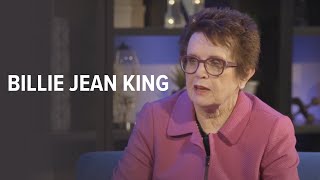
Billie Jean King discusses her biopic and decades of fighting for gender equality in sports. She contrasts her own prize money with today's earnings and shares how to empower girls: encourage their strengths, teach them to be assertive, and build teamwork skills.
Questions this video answers
October 17, 2017.
About four years (total from start to finish).
About eight weeks.
She said Sloane Stephens got $3.7 million at the Open and that King didn’t even make $2 million despite playing until age 40.
Chapters
Hi, everyone. Welcome to the Inbound Studio. Thank you for joining us. We're here with Billie Jean King, sports icon.
What's your name?
Laura Moran, host of Band Studio. Thank you. The host, My mom's here. She's going to be very happy you made me say my name. Thank you for being here. Fresh off the spotlight stage at Inbound 2017. But we're going to continue the conversation and have a little fun. So first I want to ask you because the movie came out on Saturday.
Yes. I didn't plan it either. You know, I said yes to HubSpot like over a year ago. I didn't know when they were going to promote the movie or anything.
Worked out.
It worked out great.
Did you ever think you'd have a movie made about yourself?
No. Somebody told me when I was a young girl, you know, like, you're going to have a movie made. Sure. It's going to be the number one actor, female actor, Emma Stone. And she won, you know, the bafta, the sag, the Golden Globe, the Academy Award. Sure. I don't think so. And then you got Steve Carell, who is all time great, been nominated for so many things and he's one of my favorites. And then the cast is. I've just gotten to know the cast because we've done so much promotion. We've been in Telluride, Toronto International Film Festival in Toronto, Louisiana, New York. We're going to go to London soon to promote it because it starts later there. And because I spent four weeks with the cast, I'm having separation anxiety. I just love them. Every single one of them almost. I think all of them, I think all of them are into social justice. So do you think I had fun? Whoa. It's like, like speaks to like. Yep. So it's totally having. And Austin Stowell, who plays my former husband Larry, he's such a feminist. You know, his mother had to raise three boys. And he talks about it with such heart and soul. So he gets it.
Did you. Were you involved in the production of the film and, you know, did you have influence over how they told your story?
Absolutely not.
Are you proud of.
I think they did great. I think they got the essence. When you do a biopic, you know, it's not, it's, it's, it's not a documentary. That's what. But they got the essence. And I first. It took about four years in the total from start to finish. Although they shot it in like eight weeks. I mean, they bombed through it, but all the preparation. But Simon Beaufoy who's the writer, he won Academy Award for Slumdog. I was approached at Wimbledon, actually, during Wimbledon. There was a documentary that we had done with some other company, New Black Films in England. James Erskine and Danny Boyle, who did Slumdog, who was the director and producer, all that, and Christian Colson, they all have this company with Simon. They work together. They love working together. They came to see the documentary and they said, can we talk? After I met them, and they said, can we come tomorrow to Wimbledon to talk to you about this idea we've had for a couple years. We've been doing research on you, we'd like to do it. Can we talk to you? And that's how the talks. But the directors are a female and a male, which I thought was really great idea. Daniel. It's Valerie Farris and Jonathan Dayton and they're very married. They're really adorable. Been married for a long time. They have great kids. But they did Little Miss Sunshine. Did any of you see that? Well, they've done a great job. Of course, they have to say okay to the cast, and they're the ones who really choose them in the end. But every single cast member. Sarah Silverman plays Gladys Hellman, who nine of us, the original nine, signed a $1 contract with. And that was the birth of women's professional tennis, the way you know it today. And you know, Sloane Stevens got her 3.7 millions at the Open this year. I didn't even make $2 million and I played till I was 40. So that gives you a little bit of sense, you know, one tournament she makes 3.7 million. That just shows you how far we've come since the old days.
Yeah, let's talk about that a little bit, because you've made a massive impact in sports, but beyond sports, with equality and, you know, just people considering women as capable of doing the same things as men, quite frankly. And so you were inspired, you know, at a very young age to be successful in what you were doing. And so can you tell us a little bit about that and sort of what drove that passion in you and how you. How that came to be?
Well, I think first of all, my younger brother who played 12 years of professional baseball, Randy Moffatt Moffitt is my birth name. King is my former husband's name that I kept. We both were really fortunate that we're well coordinated, thanks to mom and dad, Bill and Betty Moffat. Dad was a firefighter, but he was also a really good basketball player. In fact, he had been asked when the NBA was being formed in the late 40s. My dad was asked to join a team. So he was very talented. He was risk adverse, though. You have to understand, in those days there wasn't any money in it. But my dad's mom's generation lived through a depression, the second World War, and they were very risk adverse. Like, they always teach us, never go into debt. I mean, they're like pounding on us in different ways, but they only wanted us to be healthy and educated, didn't care for any good. But at 11, you were. At 11, I announced I wanted to be the best tennis player in the world. I played all team sports before that. And Randy when he was 10, I'm five years older. So fast forward five years, we're sitting at the dining room table again and my brother says, I want to play major league Baseball. And I go, oh, like, not another one. You too? And they're saying, you guys aren't playing for us, are you? We said, absolutely not. We pushed them. They didn't push us. And any parent out there, if you're a helicopter parent, you're going to make your kid feel so much pressure, he or she's going to choke so badly and they won't be any good. So just back off. My parents didn't even ask us if we won when we came home. In fact, my parents hardly ever saw us play.
Really?
No. My mother would go to a tournament, take us, take me to a tournament, and two other kids, usually from Long Beach. The parents would change. I mean, that's. It's really hard, as you all know, if you're a parent trying to get your children to different activities, how tough it is. So the parents help. But when my mother would take us to a tournament, she'd go and talk to the other parents. She wouldn't even talk. She didn't even watch me. She might watch their kids because they're watching their kids.
But I was thrilled you mentioned that conversation at the dining room table. Michelle Obama spoke this morning, gave a beautiful opening keynote, and mentioned the role that men play in women's lives. Totally in particular.
She's talking about her dad.
Well, she was talking about the subtle influences that, you know, were conditioned and taught to behave a certain way or think a certain thing because men talk more. You're told to be, you know, demure and ladylike. And so what role did your parents play and what role do you think men, fathers, brothers, in women becoming successful women.
Unbelievable. My dad believed in me as much as my brother, encouraged me as much Played catch with me. I drove him crazy when I was 3 and 4 years old, 5 years old. But it's interesting if you listen to Craig, her brother, Michelle's brother Craig, basketball coach. Okay. I heard them speak and I thought they were talking about Randy and my childhood. Okay. That's how much similar. Okay. They're in Chicago, we're in Long Beach. We had better weather. But they talk about playing catch and catch in this hallway, which is about this. And then they broke a lamp one time playing catch. And Randy and I always play catch. And my parents said, don't play catch in the house. I mean, it's the same story. Her father, I don't know if anybody knows, but he had ms, but he got up and worked every day. And he really was influential. But so was her. You know, I know her mother, Mrs. Robinson. She's fantastic, by the way. She is just. I love her. We sat and talked for four hours at the US Open one time. And you can see why Michelle's the way she is. Okay. And you can see why President Obama chose. They chose each other. It's just really so obvious if you know both of them at all. I don't know him that well, but President Obama was 12 years old when I played Bobby Riggs. And he watched it and he said it changed or at least made him think about now that he has two daughters and how to raise them. So all these, we influence each other. But my dad was so good about it, and she's right. And girls are taught not to ask for what we want in need be demure. Like. Like she said. And I don't know if any of you heard us speak out there, that when Selena, yeah, Tobacco Walla was a techie, that how she was talking about how women, how they don't interview well and how they don't get what they want. And you have to. And get in there and promote yourself. But make sure you have a plan to say, if I do this, this and this and be organized, don't just go in there and say, I want something. But men do. Men come in. I've owned businesses since 68 and been very tiny businesswoman since then. And the men are the ones that always come in and ask for a promotion. The girls never do. And the women think we're going to notice and we're just going to promote them. Everyone's so busy. Get in there, get in their face sweetly, but say what you want and need, but have a plan. You can do this. But girls have got to change another Thing is, girls always.
Do you think girls have to change or do you think boys and girls need to change?
I think both. But we have to help change them.
Sure.
You know, we have to say sweetly. I mean, there's a nice way to talk to somebody. Respect them, but bring it up. Say, I noticed this is bothering me. Don't talk about your own feelings. Don't tell them what they. Their truth. Tell your truth. When you're speaking to someone, it's their responsibility to speak their truth. So speak your truth. What you're feeling and what you're thinking and thinking, not just feeling. Because we're always accused of feeling, only not thinking. So say I think, not just I feel. Okay, when you're speaking, it's very important. So I think we need to say what we're thinking and feeling to somebody and to men and to women, too. And women are taught not to get along. Do you remember where you first heard that Women don't get along? They're catty or something. Because people perpetuate it all the time among ourselves. And men always say, well, you know how you girls are. You're all catty. And girls do the same thing. It's not just the men, by the way. Yeah, and where do you think. Where did you first hear that?
I think probably fourth or fifth grade is when I remember it. It probably happened.
No, that's right. But you remember it. But where were you? At school or. At school?
School.
And what happened? I think. Were they arguing or something?
Oh, yeah, yeah, yeah. It was like a massive fifth grade fight. I think Everybody was fighting. All the girls were fighting with each other. And the boys were like, I don't know what's happening. Our teacher had to get involved. It was intense, but it was, like, unnecessary. It was over like a hair, you know, it was like something stupid, right?
Yeah, but why do you think we socialize that way? Because where did that even start? Yeah, we're taught that's the way we are. We live down to other people's expectations. Do not live down to their expectations. Here's what. Okay, here's what I used to do in a small group and my younger brother. We're kind of the protectors of the block with the bullies. The kids never got hurt because we're there, like. And Randy was six, three eventually. Or brute. But when I would be in a group of young girls, all of us, maybe it could be even a team or whatever, and there's any that bickering or any of that started up, I go, stop Everybody stop. I say, do you hear us? I said, we cannot be like this. This is not going to help us. We're tearing each other down. Let's just start over, and let's be positive with each other. Let's just be good to each other, okay? And they go, okay, I broke it up immediately. I don't know why I did that. I think it's probably my parents or some. But it works, you guys. You have to step up and lead. If you're a boy or girl, I don't care. Step up and lead and do the right thing. Be strong. If. If one of those. Not one girl in that whole group said stop. Did they? No, they just kept going out. Right. But if one girl or two girls or somebody or if you got another, you know, if you don't want to do it by yourself, you go, do you want to be with me or not? Well, do this. You can do this. But we have to teach our girls that we can get along. It's how we're socialized. That's why I want girls in sports, because sports teach you how to have teamwork. Boys always have that. You know, they're taught that. But a lot of boys don't like sports either, by the way. I've met a lot of guys that go, I hate sports. My dad made me play sports. I hate it. I wanted to paint. I want to do something else. And so let's just let people be whoever they are. You know, just find out what their strengths are and try to help them with that. And just bring them along in their strength area. Yep. You know, if someone is good at painting, encourage their painting. See, one thing they found. If you will find a strength in a child, particularly girls, and they're good at something, make sure you tell them that, because that's what gives girls self confidence. Find something they're good at. I don't care if it's the littlest thing you think. It doesn't matter. It matters. And tell them, boy, are you good. Oh, my God. You're like I always tell little girls. Oh, you're so strong. You're so fast. Just like I tell a little boy, oh, you're so strong. You're so fast. Keep giving them positive messages. I'm telling you, it will change their life to much better life.
You're here with us. You were on the spotlight stage. You've now been around inbound. If you could sort of, you know, what do you think inbound's about? If you picked one word to sort of describe Your experience.
It's about the cloud and it's about improvement.
No, no, it is.
No, no, wait a minute. It's about improvement.
Yeah.
You have. What's the right word? You have things that will help you be able to self do it and learn. That's what technology is really when you think about it. It's just information and then it's algorithms. It's all the things that will help us with the data and the research and all that. It helps each person and you can also modify it to what you need. But inbound to me is being really what I think it's about today, at least to me, was inclusion and the things I believe in. Of course I'm being biased. Equality and inclusion. So I'm going to turn it that way. No, I think it's fantastic. Also relationships are everything. So just bringing the people together, getting to network and meet each other is going to help you in your life and in your future. And it's very connective. And I don't know about others, but when I feel disconnected to the universe and to people, that's when I'm really unhappy. You know, I've had a lot of psychotherapy too and I tell my therapist, you know, I don't feel great today, I feel disconnected. So it's really important. So this will. But technology keeps us all connected. I like that. I would love to be young today, but I think the I said it out there. I'm so impressed with the millennials and the Gen Z kids. These are the best kids ever, the best generations ever. For inclusion that is going to make such a big difference in this world. And they have to keep perpetuating, promoting it, being good to each other, showing respect to each other and just keep pounding on that area because that's what's going to change the world, to make it better. Because we have a lot of forces against us and that don't believe the way. They don't think that is the way, but that is the way. If we're going to have a decent world, it's not going to work the other way. War. And if you're self centered or a narcissist, that doesn't work.
No, I think it's a message we can all agree to. We're out of time. That was so quick and nice. But thank you so much for being here. Thank you for being on this studio with us. Had a fantastic time.
Good luck. You've been doing this how long? Six months you say?
Yeah, about that.
I know, but you got a degree in journalism. Journalism, right.
I did.
Where'd you go?
Northeastern in Boston.
That's great school.
It's fantastic.
So you just keep.
Shout out to the Huskies. Yeah.
Right. So you just keep going up, up, up. Is this what you want to do?
I love it. Yes. It's absolutely what I want to be doing. It's fantastic. I'm having a great time. How could I not like this?
Okay. I'm gonna see a lot more of you, though, I'm sure.
All right.
Anyway, good luck.
Okay.
Give me the pump.
Thank. Thank you, everyone.
Thanks, everyone.
More from Patrick



A NEW BREED OF PARTNER: The Partnership Ecosystem Model Journey of Patrick Biddiscombe, Part 1








Customer Success Workspace: Never Lose Sight Of What Matters Most | HubSpot Spotlight