Brit Marling on How Storytelling Changed Her Life
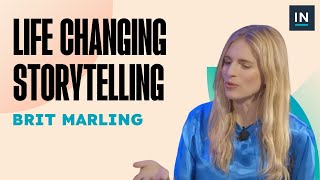
Brit Marling talks about how storytelling shaped her path from ghost stories at summer camp to writing her own roles. She calls acting "extreme emotional anthropology" and started writing because most scripts centered male characters. About 70 to 80 percent of audition scripts are written for men.
Chapters
Apparently at night, I started telling this series of ghost stories to the other girls in the bunks. I forgot about this until now.
I got called down to the office.
And they were like, your parents are here to pick you up and take you home.
Because so many kids have called their parents terrified of these stories. And they're like, kick that girl out of the cabin.
Is.
Television and movie creation. Is that something you always wanted to do?
I didn't think. I mean, this is gonna sound strange, but when I was a kid, I didn't know. I mean, I thought movies were made in, like, a cloud factory. I didn't think real people had jobs putting together films. It felt like when you watched a film, you were in the cathedral of the cinema. And it felt like they must have come from the sky, you know, these magical creations with these characters that were larger than life. And no one in my family was an artist or had anything to do with the entertainment industry. So when I moved out to la, I was very much on my own and, like, just trying to figure it out. So it wasn't something I had thought about really until college. And then I started making short films with a group of friends in college. And we all moved out to LA together and really kept making films there in the manner that we'd made them at Georgetown, which was just. Just run and gun it, beg, borrow, steal locations. And that was sort of our way in.
Have you always considered yourself a storyteller? Has that been a part of you?
You know, I wouldn't have thought so necessarily. And then recently my mom was reminding me of this story of how I went away to summer camp. And apparently at night I started telling this story, series of ghost stories to the other girls in the bunks. And I made up this very elaborate thing about how the knots in the wood above were actually the eyes of ghosts, apparently.
I mean, I forgot about this until now. I got called down to the office.
And they were like, your parents are here to pick you up and take you home.
Because so many kids have called their parents terrified of these stories. And they're like, kick that girl out of the cabin.
So I guess.
All right, so now we know where a little of the LA came from.
I guess in one way or another. I have been telling stories for a while. But you don't. You don't think of yourself as a storyteller. Then you think you're just trying to entertain your bunk mates, and then you get sent home, hopefully become a better storyteller in the interim.
What is it about Storytelling, about creating. What do you get out of that? What is that fulfilling for your person? Because you said you were thinking about going into banking. Economically, these are very difficult.
Different.
Completely different world. So what is it about what you're doing now that's ultimately fulfilling?
You know, I think about the job of being an actor as a kind of extreme emotional anthropology, which sounds sort of nuts, but it's basically like, how many strange situations can you put yourself in inside of one lifetime and really experience them deeply? And I have found that the more time I spend trying to become a better actor, the more open I am, the more I listen to people in real time instead of thinking, I know what they're gonna say. The more empathic I am, the more present. You know, they're all really good qualities. And I think I found that when I was in the world of banking, I didn't like the qualities I was taking on as much. And so for me, what I think storytelling does is it lets you. You live a great many lives in one, even as a writer. I was writing on the plane right over here. I sat on the plane. We're working on chapter seven right now. I literally maybe went to the bathroom twice, but otherwise was just there pounding on the chapter. And it's like being in a completely different world. I mean, you don't notice that the plane is touching down. You don't even notice the food as it's going by. You're just sucked into this other space. And I think storytelling, whether it's acting, writing, composing, any version of it, I think is about living inside many worlds, inside one.
I believe I've read this about you, and it may even have been a part of your conversation with Issa. But you got into writing to be able to act in the roles that you wanted to act in and that you didn't see out there. So talk a little bit about that and the lack thereof of roles and why you felt the need to create your own.
I think it's funny to me. I watched the original Alien with Sigourney Weaver recently, and it blew my mind, because I was like, wow, that is still a more provocative, balanced, complicated female role than most of what we see now. There's this new version of feminism that's like, well, let's just take every male script and change the gender and put a girl in it. And that's supposed to be balanced. Yeah. Now we've checked the box of, like, this is balanced, and we're showing women. And to me, it's more complicated than that it's about how are we gonna excavate what a female narrative actually looks like? I mean, we talk about this in the writer's room all the time. The hero's journey is a very classic thing. You know, the hero's there, there's a call to adventure. He ignores the call to adventure. Then he. He goes through a series of trials and tribulations, acquires something, and comes back to the real world with a new understanding. It's a very classic linear journey. Maybe the female journey doesn't look like that. Maybe it's not a straight line that ascends. Maybe it's more elliptical. Maybe it doesn't involve a rejection of the call to adventure. Who knows? But it feels like we're all trying to dig that out together in real time. And everyone's watching each other's work. I watch Issa Rae's work and I'm like, ah, that's a fresh take on what it means when your ex boyfriend comes to your apartment and you want him back and you don't know, you know, like, she's doing stuff inside those scenes that I've never seen before because I've never seen them written and performed from the perspective of a woman. So it's a really exciting time to be in because we're all digging it out together. Nobody really knows what it is, but I know that I used to think I just wanted to write as a means to an end, and the end was acting. And. And now I don't think that anymore. Now I think the writing is the most critical part because the writing is how the writing is how you're giving the audience a potential map for what it might look like. And that's exciting. Like, I don't want to be an actress as a, like, marionetted, puppeted doll baby in some other narrative, the same old narrative we've always been telling. I don't want Alien, Thelma and Louise to be the most provocative things when so much time has passed. You know, you want. You want something else to keep pushing it forward.
What, where do you hope to see? Like, what do you hope are the next steps in Hollywood? Or I mean, really any industry? But since Hollywood is the one that you're in and movie making and filmmaking is the one that you're in, what do you hope the future holds for the industry rather than just your. Your own personal career?
If I think about it, I think the thing that's really challenging inside the industry is that as some women manage to break through, how does it not become tokenism, because that's a really dangerous way for the status quo to maintain itself. It's like, well, we let this girl speak. So now we've done our job and all is fair and equal. And the truth is, I mean, I just know this from trying to create a writer's room for part two is very complicated to make it balanced in terms of gender, because for all the pool of scripts you're being given to audition candidates, 70, 80% of them are male. And the women don't have as much experience. They haven't been offered jobs as often, so they're sometimes not in the same skill set. Then it's your job as a female show creator to be like, okay, I'm going to take this younger woman who hasn't had as much experience. That's going to be my job, to catch her up on that, to help her inside the room, to show her the ropes in order to make the room balanced. And I think that that's the place that we're inside of in almost any industry, which is, how do we take it away from the token girl who makes us feel we've made progress and instead actually create a system situation and a system of balance? And I think that really relies on the women who have been given a foot in the door to turn around and help other women in, which isn't usually what happens, oddly.
Unfortunately, I am really disappointed right now because we're out of time.
Oh, that's lovely.
But this is so lovely. But I want to ask you one question before we leave. Now that you've been here and you've been on the main stage, you've been up here with us, you've seen a bit of the event. What does inbound mean to you?
It feels to me like a place of genuine, open discourse where there's an audience that's really excited and receptive and wants to hear new ideas and hopefully people come and bring some to the table. It feels like a really unusual tidal pool of energy, and I'm excited to have been a part of it this year. Every element has been wonderful, awesome.
We are so excited to have you and so thankful. Thank you for being here and thank you for doing this with us.
Thank you for having me. Thank you, guys.
More from Patrick



A NEW BREED OF PARTNER: The Partnership Ecosystem Model Journey of Patrick Biddiscombe, Part 1








Customer Success Workspace: Never Lose Sight Of What Matters Most | HubSpot Spotlight