Carmen Simon "The Neuroscience of Memorable Content"
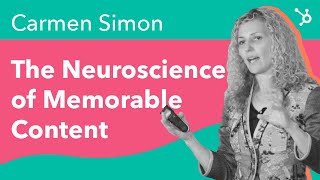
Carmen Simon’s recorded keynote examines why most business content is forgotten and how communicators can use evidence-based brain science to control what people remember. She frames the problem via the forgetting curve (people forget rapidly; a metaphorical 90% loss), argues attention is the gateway to memory and memory drives decision-making, and introduces the "Rexy method" (from Rexy Media) to guide attention, shape the memorable 10%, and influence decisions. The talk focuses on attention: habituation reduces attention, so vary internal stimulus (cuts/changes, recognition + surprise), leverage dopamine by creating anticipation and welcomed uncertainty, and use consistent repetition (hooked to reward) so place cells and long-term memory encode the core message. The speaker demonstrates these ideas with audience interaction (shoe-photo exercise), examples from Hollywood/news, and a short Q&A on capacity and reinforcement.
Questions this video answers
About 10% retained (about 90% forgotten — presented as a metaphorical statistic based on the forgetting curve).
The "Rexy method"; she co-founded Rexy Media (mentioned as founded eight years prior).
Attention → Memory → Decision (memory leads to decision-making in favor of the communicator).
Chapters
A few years ago, I started using a neuroscientific and business approach to a question I consider very sobering. As we blog and text and Twitter and create thousands of presentations and thousands of content bites, I've been wondering how much do people really remember from what we share with them? How much stays on top of their minds after we're no longer in the room or they no longer face a website that they're viewing that we have created? I've been using this scientific approach because I've been noticing two trends. One, content abundance. And as a result of that, I'm noticing that people forget a lot. And the other trend is this situation. I'm noticing that a lot of content is the same after a while. I'm curious if you experience the same thing and if you merge the two together, people are faced with this. So after all, who's to blame our audiences or our customers for forgetting so much? And while this may seem funny when printed on a T shirt, it's not so funny when it comes to business. Because if we are not on top of people's minds, if we don't earn a space there, we are no longer in business. It's as simple as sad as that. Research has confirmed that our audiences, our customers, forget most of the content that we share with them. It can be as much as 90. And that statistic comes as a difference compared to others that you may have heard, according to which people only remember 10% of what they see, 20% of what they hear, 30% of what they see and hear. Those are bogus. That's a myth. There is no statistical study out there that has proven such conveniently progressive numbers. This statistic here is based on a forgetting curve. This is a theory that has been evidenced for the past nine decades. And it reminds us that as the brain faces information, any kind of content you give forgets it very quickly at first. And that forgetting curve tapers off after a few days, and the little that stays there tends to stay there over time. This forgetting curve applies when people don't make a conscious effort to remember. And let's face it, in business content, how often do people come to your content and they face it, whatever that content is, small or large, formal or informal, with a conscious effort to I'm going to remember this. They have the wish to remember, but hardly ever do we make an effort to remember. So we realize that people forget a lot and they retain very little. We look at these numbers also as a bit metaphorical because it's impossible to place A strict statistic on how much people retain. It could be that they retain 11%. It could be that sometimes they could retain 18%. Maybe sometimes, if we're not lucky, they only take 1% away. But for the ease of the conversation, let's look at this 10% as metaphorical that people do tend to retain from our conversations. And the 90 they forget is significant. Imagine this for a moment. Let's just say that you live to be 100 years old and people you know only remember 10 years of your life. Some people you know may remember the years that you look like this. Some people you know may remember the years that you look like that. What you would like them to remember, however, are the years that you look like this or the years that you did something amazing. Even more the years that you made a difference to someone. It is important and satisfying to control what people remember. This is why this stat is fairly sobering. Because 90% of the metaphorical 10 they take away is significant. And I ask a scientific question. It's fine that people forget so much. We are all human. But is the 10% that they take away the right 10%? I remember attending a keynote presentation not too long ago, and the only thing I remember from that 45 speech is the fact that in Italy, 17% of people believe that it is okay to have sex and text at the same time. And I'm sure that was not that person's metaphorical 10%. He would have loved for me to remember something that was way more insightful. And I'm embarrassed to say that I didn't. It is important and satisfying to control what people remember. This is why I'm asking you to ask of yourself, are you controlling that metaphorical 10% that people take away? And we can do so if we apply brain science. I've been looking at this for the past decade, and I'm noticing the merger of two fields. When I say brain science, I mean two neuroscience and cognitive psychology. Neuroscience has to do with the function and structure of the brain. With improved technology these days, we no longer have to wait for people to die or have accidents in order to understand more about how the brain functions. Do we know everything? Definitely not. We are decades away from finding out more. But we have progressed from knowing 30 regions in the brain to knowing more than 300. That's neuroscience. Cognitive psychology studies mental functions such as attention, memory, decision making, creativity, problem solving. You merge the two, and now we know a lot more about how attention is taking place in the brain, how memories are formed. We have Advanced so much these days that we can actually see through an MRI machine the birth of a memory that is huge. We have insights and while we have not known everything about the brain, we can use that evidence based insights to apply to content and create something differently. It is a luxury for the modern communicator like you to be on someone's memory. We also realize that one of the reasons people forget so much is because they don't pay attention to begin with. Attention paves the way to memory. And why are we so intrigued, especially from a business angle, by how much stays in people's minds and how to even get there? Because memory leads to decision making. People make decisions in your favor based on what they remember, not based on what they forget. You combine these three elements together and I guarantee that for any of you, you will be able to impact some action, some behavioral change in any of your presentations or conferen content that you create. It is this combination that I call the Rexy method. Eight years ago I co founded a company called Rexy Media. We transform content by using brain science principles. Rexi comes from the Latin verb to direct or to guide. And my invitation to all of you is to use any evidence based principles that enable you to guide your own customers attention, control that metaphorical 10% they remember and make it easy for them to decide in your favor. So for the rest of the presentation, I'll be sharing with you a lot more about these principles, especially around attention, because it starts there. It's very difficult to get to be in people's minds unless we have their attention first. But we ask, okay, so we want to be in people's minds. What is it really that I want them to remember and act on later? It is a question that hardly ever do we ask when we create content, what is it really that I want to put on their minds? Often we create content from a place of abundance. We have so much excess and we find it very difficult to control the essence. Are you noticing the same thing? And when we don't have access to the essence, it's a lot harder to clarify what it is really that I want to put in my audience's minds. I'm always on the lookout for clear, crisp 10% messages. I've been impressed by this book. Has anyone seen it or read it? I see maybe 10, 20 of you. It's a trisp message. He says I'm defending food. And what I enjoy about this is that he has three sub points to his message. He says eat food, not too much. Mainly Plants. I enjoy people who are able to take such a complex content and distill it down to a few points that you can take to a place, in this case the grocery store, and do very well there as you investigate your own message. Do you have this kind of clarity? Because if it is clear for you what you want to place in your audience's brains, it will be more clear to them. If it's nebulous to you, it will be nebulous to them. What is it really that you want people to remember you for? And this is not so much in terms of a legacy, because sometimes you create messages that you want people to remember for a week, sometimes for a quarter, and sometimes for a lifetime. That length is up to you. But it still starts with a question. What is your 10% message? And are you in control of that? That's what we're here to answer. And because we have a limited time, I'm going to focus just on the attention piece because we want to earn a spot in our customer's mind, in their memory. And it starts with attention first. And what I'm noticing is this, quite often people move away from our content and they tend not to pay attention because of this trend. Habituation means that as we are experiencing exposed to a stimulus, we pay attention to it at first, but then gradually you're no longer focused on it. So let's just say that you're working and at your desk you have some music in the background. It definitely catches your attention at first, but after a while it's just that background noise. In fact, I'm curious, what are some things that you have habituated to in your workspace? Give me some answers. Your air conditioning, some noise, some music, some office mates, airplanes flying all around. Yeah. Which one? Co workers. Co workers. Yes. And imagine the evolutionary value of that. Because I can sense some annoyance when you're saying that habituation has an evolutionary value. Because if we did not habituate to all sorts of stimulating environments, we'd use stimulating coworkers, not annoying co workers. If we were not able to habituate to stimulating environments, we would just go absolutely nuts. Imagine if those AC fans that you're talking about or the buzzing lights that sometimes are above us, we would just go crazy. Imagine if you could not habituate to the sound of your own breathing. It would be very hard to create anything. Habituation has evolutionary value. Unfortunately, we habituate very, very fast. Take communication, for instance. In the beginning, we were communicating just very easily, face to face. Then we evolved that, and we evolved that communication means even more. And we kept on progressing and finding new means of communication. Those were rewarding for a while. Then we progressed and evolved a little bit more and even a little bit more. And these days, if you're flying and your Internet connection breaks at 33,000ft in the air, life is over as you know it. Here's how the brain deals with rewards. Because all of these were rewarding. At some point, it was rewarding to make the first phone call. But once you give the brain a reward, it is now habituated to it and it's now ready for the next reward. You double that reward, and at first it will seem accurate excellence, but then that becomes the new norm, and then you habituate to that, and then that doubling of the reward has to stay there in order for you to feel satisfied. Give me some of your own examples. What is something that you considered a treat a while back and now it's just that, a mundane norm. Massage. The newest app. The newest app. The newest app is always shiny and gets our attention. And after a while, eh, what else? I heard somebody said Facebook. Remember Facebook? It was just so nice and shiny at first. Remember, even Fitbit now is starting to fall in the background. We're starting to get used to that. The brain habituates very quickly, and we need to keep doubling these rewards in order to keep the brain satisfied. This is why, as we look at neuroscience and we ask how do we stay on people's minds, we first ask what attracts their attention, and we also have to ask what takes their attention away. In order to cure this, we have to know the symptoms. And there are two factors that impact habituation. One, you can see here. And you know how psychologists always have fancy names for everything stimulus? Internal variation simply means the degree to which you vary a stimulus you share with your audiences. So, for instance, if your audiences are watching tv, it is very difficult to habituate to a movie, for instance, because the sounds and images change so fast that it is very hard to get used to them. Whereas that fan that you're talking about, because there is no internal variation in there, it is very easy to get used to that. There is a second symptom here, and that's more subjective. As scientists, we can still measure it. I'm sure that, you know, people who get all excited at the smallest stimulus, and there are people who stay so calm in front of the same stimulus. We can measure this by measuring blood pressure or heart rate. And while you can't really have that much control over the subjective factors of Your customers, you do have control over how much internal stimulation you include in your content. That is your window. That is your window. We learn a lot from Hollywood, for instance, because if we talk about variation of the stimulus, they do very well. And Hollywood is still a business. They have to make money out of simulation that they offered to all of us. Notice how much internal variation has changed for movies. The average shot length for movies back then was that. Take a guess. What is the average shot length for movies these days? Two seconds. I hear that. Just like that. We didn't even have to wait for it. Not as drastic, but close. The average shot length for Born Supremacy, for instance, was 2.4 seconds. Obviously not the entire movie was shot like that or edited like that, but many portions were. And to add some misery to all of these stimulation injuries, it's not so much that we have shorter lengths, but we also have more motion in those short segments. You combine the two together, and now we're noticing that the brain is constantly seeking this type of combination. It is getting brutal. And if the brain is now crossing the threshold of stimulation, it's no wonder that at home, people are used to seeing that. But then they go to work or they read some business content, and when they have that kind of contrast, it is very difficult to keep people focused. The threshold for stimulation has changed. Even though the brain hasn't changed much in the past 40,000 years, what has changed is our threshold for stimulation. And the more we realize that, the more you also realize that we have to work harder at varying that stimulus. So I'm asking, are you making it possible for your audiences to look away? And to borrow a phrase from Hollywood, how often do you provide. Do you provide that cut? Because notice, when something changes, it instantly refreshes your attention. Often I get the question of, well, what can I vary? What stimulus can I vary so that I maintain people's attention and avoid habituation? This is not a complete list, but it gives you a start. And notice that anytime you ask the brain to move from one to another, you have refreshed attention. I'm intrigued by the last one because people say, well, let's just simplify our complexity. Simplify complexity. Things are just getting too complicated. But that's not simply true. You can't possibly give somebody something as just simple and get the brain to appreciate it. In order for the brain to appreciate any words on this list and any states on this list, it has to know the prior state. We wouldn't appreciate simplicity unless we knew the complexity that it has Come from. Anytime you change between any of these stimuli, you get the brain to refresh attention. So use change, very change. Vary the stimulus, but keep your metaphorical 10% constant. Your core must not change. And the more you activate it and the more you know what that is, and you have clarity behind it. And now you merge it with enough internal variation, you have the best of both worlds. You have a message that people are starting to trust because the brain equates consistency with credibility. But you also avoid habituation, and you're not allowing us to look away. So for the first principle around attention, vary that stimulus, and you are providing sufficient or frequent cuts so that people do not look away. And of course, as scientists, we have to ask, okay, so what is it really that happens in the brain when the brain habituates? And we know that the answer is relying on this neurotransmitter, which is a means of communicating from one neuron to the next. I'm sure that many of you have heard of this. It's one of the neurotransmitters that has been so frequently studied, almost overly studied, in fact. It has been so widely publicized that a lot of people call it the Kim Kardashian of neurotransmitters, which I don't think is fair to dopamine. What we have discovered lately is not so much that dopamine has to do with pleasure. Dopamine has to do with craving something enough to go and get it. Of course, we enjoy the reward. But you don't have to have dopamine to like chocolate. You have to have dopamine to want chocolate. So dopamine is associated more and more with behavior. And this is why, as scientists and as marketers, we are intrigued by this, because you get the brain to secrete this, then you can expect more effort from your audiences. And this is how we find this out. Let's just say that you take a rat, you put an electrode in the brain, in the rat's brain, in the area that secretes dopamine, and then you train the rat to press a lever so that each time it does, that neurotransmitter gets released. And because the process feels so good to the rat, it keeps doing it and doing it and doing it until it dies. Not a bad way to go. But we're noticing that as that neurotransmitter gets released, the effort is there. The effort is there. The effort is there. This is why we're so intrigued by having that chemical in your audience's brain. As they come and listen to you, or they come and read your content, they engage with you in some way. We replicate the same studies with monkeys. So let's just say that you take a monkey, obviously you're going to give it a reward, which it enjoys. And just simply knowing that it will have a reward, the dopamine level goes up. The brain is constantly seeking rewards. But what scientists are also noticing that before the experiment is about to start, so after a while, the monkey knows that, hey, I'm going to enter this room, I'm going to get some bananas. This is going to be rewarding. Dopamine level is up already. They notice that if they put a signal in that room, so now they're creating anticipation for what's to happen, the dopamine level goes up even more. So scientists are noticing that that chemical is not so much about the reward itself, but often it's about the anticipation of that reward. And here's another thing that they noticed. What happened? They said, if we only provide provided the reward half the time, now you're including a maybe in the equation. Now things are a little bit more uncertain. And guess what? Dopamine level does? It goes up even more. So as you're looking at this, we're also noticing that, by the way, if you kill the dopamine altogether, you have no efforts, you have no behavior. That's why as marketers, as communicators, we're constantly intrigued by how do we get the dopamine level to be up. And here's a combination of factors. How often do you include those three elements? And I'm intrigued by uncertainty in particular, because people sometimes believe that if we make it obvious for our audiences how something should be true or false, here it is. That will feel good in the moment because things are structured and organized and controlled. But that pleasure is not going to last too long. The longer lasting pleasure comes from that complexity that we're talking about earlier, comes from that uncertainty. And when we say uncertainty, even that's a strong word, especially for business, because we feel that we should make everything certain for everyone. Why would we want to give people the sense of uncertainty? There's a scientific formula for welcomed uncertainty. And I say welcomed because of course we have to realize that not all certainties is uncertainty is good. If you were to wait for a doctor's diagnosis, not too good of an uncertainty. If you had a picnic planned and you might rain, that uncertainty doesn't feel great. But there are situations where uncertainty gets that dopamine level up and here's the formula and the components for it. Anytime you have any number of alternative events that can happen, they can happen in any sequence and they have equal probability of happening. That's when the brain finds the situation very juicy. Picture this formula against our current political campaigns. Can you see if anything can happen in any sequence? I'm not sure about equal probability. That's debatable. But let's make a stretch. Or the U.S. open is going on right now. In the beginning, when there are more players and some of them are so equal in skills and anything can happen in any sequence, it keeps you glued to the screen. They make it harder for the brain to look away. So we come back to those three elements and we ask, how often do you create them for your audiences? Because when you do, you have the luxury of dopamine. And I'm going to demonstrate that right now because we're talking about habituation, talking about changing the stimulus. You've been watching some slides for a while and now it's your turn. Notice what happens in the room when we change things a bit. I'm going to ask you to grab your cell phones and capture a picture of your shoes. In addition, as you send it to me, and I'm going to display my email on the screen in just a minute. Tell me one or two sentences about the story that your shoes tell. Everyone's shoes tell a story. What is yours? I'm sure you may have been with those shoes in some amazing place. Maybe those shoes have seen something they shouldn't have. There was a person who sent this to me a while back, and he said these shoes witnessed Monica Lewinsky's TED Talk. Who knows where your shoes have been, and I would love to know. Here's my email address. You have exactly one minute. I have a prize. Talk about rewards. I have a prize for the most creative entry. One minute. Starting now, I'll be able to switch to my email and I'll share some of your entries. It will be interesting to see, especially in a room where marketing dominates, how your sentences go. The email address csimonximedia.com Reximedia and now let's see how you've done. Only 50 to go. We can come back to these as they are downloading in the background. And we'll also leave some room for your questions because I'm intrigued by your reactions and interactions. But the point that we're making with this exercise is this, as the brain habituates to a certain activity and seeing a specific type of stimulus, we can change things quickly and that refreshes attention. It's fairly taxing for the brain to stay engaged for so long, as you have done just demonstrated just now. But all it takes is the change of the stimulus and that internal variation and you can fix that. You can fix that and you can get that dopamine level up. And I'm summarizing there the skills that you can have to do it. Constantly wonder, how can I create anticipation, how can I give the reward and even how can I create some uncertainty? You know who does really well with anticipation is newscasters. They'll hop on about 5 o' clock and they will say what will happen to the stock market in the next few weeks and should you go away for the holidays, all of this and more at 11 and you stay glued. And sometimes they deliver if it's something that's important to you and you feel satisfied, sometimes they don't and then you feel annoyed. But they do really well with anticipation. You can send me an email, by the way, now that you have it. I can send you a visual handout for this. And if you're intrigued by this concept, by the way, every so often we have virtual workshops on this content. It's intriguing to find out more neuroscience based and brain science based principles as to how it can be on people's minds. And here's the final segment that I want to share with you in terms of capturing people's attention so then you can earn spots in their memory. We know from neuroscience that attention is a function of expectations. As you watch top athletes who are Talking about the U.S. open, we realize that a lot of people who are experts in the field, they are experts because they know where to look. There's an economy of attention already when you have mass something in a field. And it is for this reason that the tennis player, for instance, can return 137 mile an hour serve because they know what to expect. As you're watching your opponent, you're looking at the way that the body is turned, you're looking at the shoulders, you're looking at various positions. You know what to expect. And if you know what to expect, you literally see more. The brain sees better than which it expects. This is huge. But if it expects something for too long now, things are becoming predictable and we're running into the other problem of habituation. So we're asking in what ways do you think you have become predictable? This is a sobering question that hits right in the stomach because we want to be consistent and we want to be doing Things that have served us for long. But notice what happens when you give something to the brain that it expects, such as this, versus when you give it something that it doesn't expect, such as this. Notice when you're giving it something that is typical, fairly predictable. But notice when you change that stimulus a little bit, and now you merge something that's recognized with something that's a bit of a surprise, something that people expect and that looks like this versus something that they do not expect. I love how there's the blue doll right there in the corner. Give the brain something that it recognizes combined with something that is of an element of surprise. You have to have both, because we literally see better than what we expect. But if we can expect it and predict it, that means we can look away. How often do you combine elements of recognition plus surprise? Because when you hook into something that people already know, now you have a stronger base for memories to form. Sometimes we share with our audiences so much novelty that the brain doesn't find it easy to place it somewhere or to hook it into something. Memory works on the concept of association. Things are linked within a giant network. If we're giving them more links in which to hook the new information, we have more chances for retrieval. I've been very inspired by this author who takes fairly esoteric and complex and abstract concepts such as anxiety, compassion, courage, beauty, longing. Notice how these concepts are not easy to define at all. It takes a lot to say what all of these mean, and sometimes they can mean different things to different people. But notice how she beautifully defines them. This is what anxiety is to her. And I really love how she says, he kissed me once on the forehead and I had a headache for two years. You're expressing something that is fairly new to some people through something that is old and familiar. This is what compassion is to her. So you see how you take something that is fairly abstract, fairly complex, and you express it through the lens of something that is known to the brain, such as sweaters and volleyball. Now you're building a stronger hook into someone's memory. You're increasing the chances of retrieval. This is how the describes despair, and this is anger, and this is longing. Link into something that the brain already knows and you have more chances for attention and later on, memory. I've been very impressed by what this bookstore in Israel does. Just like any bookstore these days, of course, they're seeking more customers. They want to come to have people come in and read the books. And they could very easily create an ad that says, hey, come in buy a book. This is how they do it. They give the brain something that it recognizes and something that is of an element of surprise. It doesn't have to be huge because whenever you're giving the brain too much recognition in the sense of too much familiarity, things become boring after a while. If you're giving the brain something that's too much of a surprise, it is weird. After a while, you have to strike the right balance where surprise is being treated as caviar, not marmalade. Just a tiny touch of the surprise gets the brain to move away from habituation and into a more focused state. Give the brain something that it expects and something it does not hook into something that they already know and you'll have a much stronger chance for memory. I want to see if you have sent the the pictures because I am dying. Speaking about habituation, let's see, Joseph here got these shoes for Christmas. Oh, this is only his second time. Very nice. Beautiful composition as well. Great Christmas gift. And let's see, Blake, who says here he bought his shoes when he broke his hand. Oh, playing volleyball. So those are very handy as you're recovering. Good composition and very relaxed state. Here is Dolly walking in a convention, at a convention with these shoes. Very nice. And here's Jessica. Her love of mid century fashion design plus the need to move quickly after three children, boardrooms and soccer field. These shoes have covered them all. Great messages. Let me see. This will be a. Michael says, these shoe strikes to keep up with my little girl. Very nice. And notice we've been talking about storytelling and authenticity. Do you see how even the connection changes? And there are a lot of people in this room now when we have an insight into something that is fairly personal. So we're talking about varying the stimulus. One of the elements in there was moving from formal to informal. Do you sense how now you can connect more differently with these people even though you don't know who they are? I'll share just a few more. It's cool to see so many guys shoes. Charmaine says the shoes were an experiment in online targeting conversion. There you go. Merging the professional with the personal. Yeah, you see those ads where they say this is the last pair of shoes? And here's Andrea. My shoes have traveled the world with me. We would love to see them capturing pleasure, memories and lasting experiences. See, we can learn a lot from our shoes in terms of how memory works. Dylan says, I bought these shoes without informing my wife. Ooh, there is emotion behind these shoes. And wore them for the first time. After a soccer game, there are some things that have priorities. I love these stories so see you can easily vary the stimulus by empowering your audiences to contribute. They hide sand covered sun kissed toes. Ooh, alien and foreign. I love the mystery that's behind this picture. Thank you for sending this. And here's Matthew who says these shoes were bought for a wedding. Far less comfortable walking around the convention center. Authenticity at its best. And it's making it even hard for me to move away. Got them on my first day at a HubSpot. There we go. Good commercial. This should be posted outside on the wall. I love these and thank you so much for sending them. I promise that I will go through all of them and will determine the most creative entry and send you a reward. As you look through all of these aspects that we have shared with you, just know this. Anytime you have access to any evidence based principles as to how the brain pays attention, remembers and decides, you will be in a better position to control what it is that they take away. Do not leave that place, that spot to chance. Because when there is randomness, it is much harder for you to rely on people remembering. But more important important, much harder to rely on people making decisions in your favor. We have just a few minutes and I would love to hear some questions from you. Because all of these approaches take a little more time initially, a little more effort. Some of them may be new to you, some of, some of them may have some questions behind them. I know that at least a few of you have something in your mind right now as you're listening to this. Yes. So let me make sure that I heard the question correctly. Is there some capacity limit as to how much the brain can remember? Because we are exposed to so much information at some point are we going to reach the capacity beyond which we can't remember anymore? Is that what you're saying? Yes. What's going to happen when the information as of the year 2020, by the way, information is going to start doubling every do you know how often right now it's doubling every 18 months. As of the year 2020, information is going to start doubling every 17 to days. So it's very wise to ask about information capacity limitations. And what we know from neuroscience is this for memories that are starting to be enduring and they're indeed long lasting, our long term memory has the capacity to impact our DNA. So that means that those memories who have been in our brains for a long time are now part of our structure. So therefore they do not impact capacity any longer. So if you have the luxury to make it on somebody's long term memory for prolonged periods of time, it is very likely that you will stay there for that length of a time. And these days, since it sounds like we might live to be 200 years old, you have the luxury and the potential, using any of these guidelines to be there for that long. That's a great question. Yes.
You come back to this slide a number of times. How important is reinforcement? The formula.
Yes, the reinforcement. And I'm glad that you mentioned the repetition. The question is about how important is reinforcement. Repetition, as you know, is the mother of memory. The more we are exposed to the same stimulus, that does not change that much. Notice how I only accessorize a few things, but the platform and the foundation stays the same. The more the brain not only remembers it, but learns to trust it. That is huge. Because ultimately it's not so much about repeating the same stimulus over and over and over. It's repeating the stimulus in a way that is consistent and it's repeating it in a way that it is hooked to a reward. So those are two major conditions, and consistency is huge. What scientists have discovered lately is that in the hippocampus, which is one of the parts of our brain that is responsible, responsible for memories, we have this thing called place cells. Place cells, if we go back to the question on capacity, have no capacity limitations. Place cells are the kinds that enable us to remember things that do not move. From an evolutionary perspective, they made sense because we had to remember lakes, we had to remember trees, we had to remember those places that stayed the same in order to provide nourishment. In the modern day, we tend to remember more where our toothbrush is, but not where our glasses are, because one moves and one does not. You'll remember your car most of the time, but you may not remember your car keys. One moves, one does not move. So as it comes to your message, your 10%, metaphorical 10% message, the more it does not move, the more it stays the same, the more those place cells are going to take care of that and remember. Yep.
So short of high budget video production, content, and I guess transcending rank and file, blogging, what has been the most impressionable upon audiences in terms of content? So like infographics, ROI calculators, things of that nature.
Impression. Impression. Impressionable in the sense of leaving a lasting impression. Is that the definition?
Right.
It's intriguing to find a good definition for questions that we ask. So when we say we want to create impressions, do you want to create impressions that last for a few seconds, which is one technique. Do you want to create impressions that will last for five minutes? Do you attempt to create something that will last for a week or a last? Because if you're talking about infographics, sure, we'll get drawn to those. But those are bite sized pieces of information. They're very short lived. And if that's your 10% and it's very short lived, then go for those. If you're talking about something that's a week long related, now you have to tax the brain a little bit more. Now you have to bring in more storytelling elements. This is why for movies, for instance, one of the studies that has been done, people are able to remember movies and messages for three months, nine months even. Sometimes we remember some movie messages for a lifetime, but now they have more components around them. We have the cognitive, we have the perceptive, we have the affective. So not only are you appealing to our senses through the perceptive, you're appealing to our cognition through facts and abstracts and meaning. And you're appealing to our emotions. So to answer your question, anytime you have that combination of perceptive, cognitive and effective, you will earn your smart in longer time, in longer term memory, our time is out. So thank you, thank you so much for your question. Please use any of these and I guarantee you'll be able to control your 10%. Thank you so much everyone.
More from Patrick



A NEW BREED OF PARTNER: The Partnership Ecosystem Model Journey of Patrick Biddiscombe, Part 1








Customer Success Workspace: Never Lose Sight Of What Matters Most | HubSpot Spotlight