Deepak Chopra on How Businesses Can Incorporate Creativity
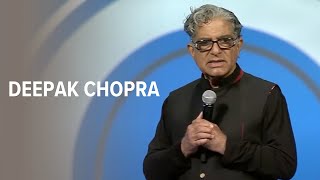
Deepak Chopra presents a talk linking cosmic/genetic origins and human development to workplace creativity and business success. He frames the body-mind as a dynamic process (genes, microbiome, epigenome) regulated by experience, and argues that holistic well-being—especially career engagement, social connection, sleep, and meditation—directly affects health and business outcomes. Chopra emphasizes storytelling as central to business and provides data-driven claims on engagement, costs of disengagement, and the physiological role of sleep in self-regulation.
Chapters
Please welcome Deepak Chopra. Thank you. Thank you. Great to be here. I suppose everyone knows how they got here. Let me show you how you really got here. Can we play the video, please? Ram. Ram. Ram. Ram. Sam. Congratulations. You've all made that journey and now you're here. So at the moment of conception, you acquired 25,000 genes from your parents, half from your father and half from your mother. And a gene is a stretch of DNA that codes for a unit of life, starting with the protein. The genes themselves are, as I said, composed of DNA, which stands for deoxyribonucleic acid. And scientists usually refer to this as the Alphabet of life. I'm speaking right now to you in the English language where we use 26 letters. But life, all of life, uses only four letters. A, T, C, G, which stands for four chemicals. And this includes all life, all of it from a microbe to a human being. About 65% of your genes are the same as a banana. About 70% of your genes are the same as a fruit fly. That's why we can do experiments on fruit flies and extrapolate to human beings. 80% of your genes are the same as a mouse, and almost 99% of your genes are the same as a chimpanzee. Very little difference between us. A little more than 1%. The chemicals themselves, of course, that make up the DNA are elements or atoms. And 96% of the atoms in your body are just four atoms. Carbon, hydrogen, oxygen and nitrogen. The remaining 4% are other elements from the periodic table. Where did the atoms come from? The atoms in your body, all the atoms in your body were forged in the crucible of burning stars, otherwise referred to as supernova. So right now, cosmologists believe that There are about 2 trillion galaxies in the universe. 2,700, sextillion stars. I don't even know how to write that. But it's 700 followed by lots of zeros and uncountable trillions of planets. Uncountable trillions of planets. So our planet, planet Earth, if you looked at all the beaches of the Earth, it would not be even one grain of sand in all the beaches of planet Earth. So why am I sharing this with you? The carbon right now in your fingernails, the oxygen that is helping sustain life in your body, the iron in your hemoglobin, all this stuff that makes up your body comes from different galaxies. It took the whole universe to conspire so that you could be here tonight. So once again, thank you for coming. There's mathematical precision to our life. Gravity, the strong and weak interactions, elements and forces of the universe, all have to be very mathematically precise for us to exist during the nine months that it takes for a human being to be literally created. Your biology goes through all of evolution. So you first look like a reptile. In fact, you have a reptilian brain, which is responsible for survival. And then you look like a mammal. Mammals are so called because of the word mama, which means breast mother. And mammals, unlike reptiles, don't lay eggs. They make babies. They create emotional bonds, and they nurture their families. They kiss, they nurse, they cuddle, they coo, they play, they sing. And this makes mammals very different from all other species. And then you have a third brain, which is called the cortical brain. So if you were looking at my hand like this from the side, this would be a profile of the brain, reptilian brain, emotional brain, and then the cortical brain, the intellectual brain, which has given rise to the human civilization and, as you'll see in a moment, to even what we call the universe, which is a human construct in human consciousness. The cortical brain is responsible for insight, for intuition, for creativity, for imagination, for inspiration, for storytelling, which is a major difference between the human species and other species, because we have language for stories. Why is this relevant to you as business people? The greatest businesses are also the greatest stories. When people go to buy a product or a service, they're actually buying a story. And this is what cultural anthropologists call ritual action. So if you have two products, two services which are equally good, the one with the better story, more emotional. A story that has intrigue, adventure, challenges, is the story that people will consume. They are consuming stories. Human beings consume stories. So I've been now sharing with you the story of human existence at the moment of birth, as the baby comes out from the birth canal, as you saw in this video, you acquire 2 million extra genes as the baby comes out of the birth canal. Then it swallows, it inhales, and it's covered by the vaginal secretions of its mother. And this creates a second inoculation of genes in the human body mind system. 25,000 human genes. But now 2 million extra bacterial genes. They're in your skin. They're all in the openings of your body, the mouth, the eyes, all the orifices, but mostly in the gut. And these genes are referred to as the microbiome, or microbiota. So now you have this interaction between bacterial genesis and human genes, which ultimately is what is happening in your body right this moment, technically speaking, you're a few human cells hanging on to a bacterial colony. Now, as the baby is out into this world, experience begins. So experience first begins in the form of perception. Sound, touch, sight, taste, smell. And then the interpretation of those perceptions, which we call thought, and then ultimately the experience that we call emotions. So we are a complex biology, which is the interaction of genes, the microbiome, and what is now referred to the to as the epigenome. So today's science is epigenetics, which means your genes are regulated by your life experiences. Everything that you experience, eating, breathing, digestion, metabolism, elimination, sensory experiences, thoughts, feelings, emotions, desires, insight, intuition, imagination, creativity, intention, are all regulating your body right this moment. So your body is in fact the metabolism of what we call experience, perceptual experience, which we call the world. And our body, because our body is also perceptual experience and then mental experience, how we interpret what's happening to us in our life, they're both equally important and they're regulating your body right now. This process is called self regulation or homeostasis. And it's our fundamental state of well being. So unless we have a genetic mutation, and I should share with you that only 5%, only 5% of disease related gene mutations are fully penetrant, which means they guarantee the disease. So if somebody has a BRCA gene, for example, for breast cancer, then that is guaranteed to predicts the disease. But what you need to know is that that's true of only 5%. Of all chronic illness related to mutations, only 5% are fully penetrant. And for these now new technologies are emerging, like gene editing. So very soon you'll be able to cut and paste a gene just like you cut and paste your email. But that'll only help a small amount of people. The vast majority of disease related gene mutations are linked to how we live our lives, how we think, how we feel, even how we speak, and of course how we behave. This is very important because the future of well being, which is what I'm talking to you about, is now predictable. It's precise, it's preventable in most cases, and it's measurable and it's participatory. It requires your participation. Before I go into the mechanics of what that entails, I think it's important to understand that your physical body is a process, it's not a thing. Another way to say this is that your body is a verb, it's not a noun. In fact, there are no nouns in the universe. Nouns are conventions of language. But they do not apply to existence. Everything is constantly moving, shifting, changing, and malleable. Your thoughts are your choices, so are your emotions. So is how you interpret your perceptions, and so is everything else that we call existence. It's a process. You don't have the same body you had as a baby. You don't have the same body you had as a teenager. You don't have the same body that you had even a year ago. 98% of all the atoms in your body are recycled once a year. So at the atomic level, molecular level, you're recycling your stomach lining every five days, your skin every month, your skeleton every three months, and even the DNA, which holds memories of both cosmic and biological evolution. The actual raw material that creates the DNA, the carbon, the hydrogen, the oxygen, the nitrogen, it comes and goes every few weeks like migratory birds. So right now, this body that I'm using to communicate with you is my year 2018 model. The last time I came to Boston, it was pretty recently. I brought the same suitcase, but not the same physical body. So if you think you are your body, you have a bit of a problem. Which one are you talking about? The body is a process. It's an experience in our awareness. And knowing that it's an experience in our awareness. And knowing that the mind is also an experience in our awareness, knowing that the physical world, which we access through our sensory perceptions is also an activity in our awareness gives us a clue on how we can reinvent, literally reinvent our physical body, our mind, and our experience of the world. So I'm not saying this to show off, but I'm going to be 72 years in a short few weeks. And I personally, I personally have practiced and enjoyed everything I'm sharing with you today. And I think as we move into the future, we're going to question regular ideas that we have imbibed through the hypnosis of social conditioning, including how we age and including the meaning of the process that all humans beings go through birth and finally death. So what I'd like to share with you in the next few slides is some of the insights that we have about how the process that we call the human body, mind, is regulated through some very simple activities that we engage in every day. Every day. So let's start with that. Although when I went to medical school, this is how I was taught to interpret the human body. A brain, all the organs, the endocrine system, the immune system. And this is very good if you want to specialize in what is called mechanistic medicine or Today's scientific medicine, which is very effective in acute illness, but not so effective in chronic illness. And the vast majority of disease in our world, at least in the Western world, is chronic illness like diabetes, heart disease, Alzheimer's disease, cancer, autoimmune illness, infection. You can look at the body as having these different parts, but you can also look at the body as a system. And when you look at the body as a system, you will realize that all these organs work together in harmony. Moreover, although we think of these organs as physical structures, as I mentioned, as nouns, they are in fact verbs. Every organ in your body is an activity, and every organ in your body is in total harmony with all the other organs in your body as a process. So even though we are looking at this diagram with all these different organs, you could look at the same diagram as one holistic system of self regulation. Self regulation, which is also called homeostasis, which is what healing is. Healing is the return of the memory of wholeness. Not looking at the body as isolated parts, but looking at the body as an activity of mind, physical processes, environment, personal relationships, social interactions, and everything that we call experience. Everything that we call experience. Today, as we look at well being, it is not enough to look at physical well being, although physical well being is a very important aspect of other aspects of well being. So today, when people actually look at well being in a holistic manner, they look at physical well being, they look at career well being, they look at social well being, they look at community well being, and they look at financial well being. So all these different buckets, and of course, spiritual well being, which we are now beginning to look at. You know, before this was not emphasized, but today people are beginning to understand that spiritual intelligence is as important as physical and emotional intelligence. So just a few words about the entanglement of physical well being, career well being, social well being, community well being, and what is called financial well being. Let's start with career wellbeing. Because you're all engaged in businesses. And today we know that successful businesses are those businesses where people are fully engaged and passionate about their business. Through many surveys, it is now known that only 20% of people in the American workplace are fully engaged in their work. 80% of people who go to work are either disengaged or, we may say, actively disengaged. Actively disengaged means they go to work not only unhappy, but with the purpose of making other people unhappy, okay? Because they want company. And this costs the American workforce about $300 billion a year in lost revenue $300 billion a year. More people die on Monday mornings at 9 o' clock than any other time of heart attacks because they hate their jobs. This is an extraordinary accomplishment for which only the human species can take credit. Presumably there's no other animal that knows the difference between Monday and Tuesday. So what makes for career well being? Career well being happens when people are expressing their unique talents, their unique purpose, their unique strengths, when they are part of a team where everyone is expressing their unique talents and purpose, where everyone complements their strengths, and where there is a shared vision and there's some emotional connection and bonding between those engaged in the workforce. If you look at these characteristics, shared vision complementing strengths and emotional connections, that's actually what a good sports team is. A good sports team has all those elements, and great teams in the workplace have the same elements. And so career well being is very important for your physical well being. If your boss or your supervisor criticizes you, you will get disengaged. If they ignore, you will get even further disengaged. When a manager or a boss ignores the people that work for him or her, disengagement goes up to 45%. If the boss doesn't criticize, doesn't ignore, but criticizes, actually engagement improves. So when you are ignored, then disengagement is up to about 40%. But when you're criticized, it falls to 20%, because human beings would rather be criticized than ignored. When you're criticized, at least you exist. You're acknowledged, your presence is acknowledged. If you're ignored, even your presence is not acknowledged. But when the supervisor or the manager notices a single strength, a single strength that you have, this engagement falls to less than 1% and health improves. So that's basically the key to job engagement. When you have happy people working for you and contented and healthy and engaged, then your customers are likely to be happy and contented and satisfied. And if your customers are happy, your investors will be happy. And if your investors are happy, then your business will be successful. So that's the first element. The second element is what we call social and emotional engagement. And this is very important. If you have a happy friend, even in the workplace, your happiness will go up by 15%. But if your happy friend has a happy friend whom you don't know, it'll go up another 10%. And if the happy friend's happy friend has a happy friend, it keeps going up. So it's kind of curious that how does the happiness of people that you don't know affect you and that is because we are all entangled with each other when I'm speaking to you. All the people in my life are influencing my happiness. That's true of you as well. And then of course, they have other people in their ecosystem. So ultimately, even the happiness of your perceived competitors and your enemies is important for your happiness. There is more and more data coming out of this. It's also known that when you are happy, you have better immune regulation and therefore homeostasis. Think of your biology as having two extremes. So one extreme is inflammation. And today we know that in almost every chronic illness, I shouldn't say almost in every chronic illness, hundred percent of chronic illness, there's low grade inflammation in the body. And when you do surveys, you'll see that it's all preceded by what is called existential anxiety, low grade anxiety, depression, low grade inflammation that puts you at risk for disease. So one end of the spectrum is inflammation. The other end of the spectrum is what we call lightness of being. A joyful, energetic body, a loving, compassionate heart, a reflective, alert mind and lightness of being. So that's the other extreme, which is total self regulation homeostasis. One extreme me. And the other extreme is inflammation. Most of all fall somewhere in between. So what are the most important things we can do to bring about self regulation? And here is a slide that shows you the six most important pillars of well being. They're not necessarily in order of importance, they're all equally important. So sleep is up there as the most efficient way to regulate your body. During an eight hour sleep, we have at least one and a half hours, which is deep sleep. Deep sleep is when your body renews itself and basically goes back into self regulation in deep sleep. Also amyloid is flushed out of your brain. So we know that deep sleep is actually the most important factor in the prevention of Alzheimer's disease. The Alzheimer's that is not related to the three fully penetrant genes. So you flush out toxins during deep sleep. And also during deep sleep, you fine tune your immune system and also fine tune the hormones that are responsible for for metabolism and also for weight regulation and what we call appetite regulation. So people don't realize. But lack of sleep today is known to be a risk factor for premature death from cardiovascular disease. But lack of sleep is also associated with obesity and type 2 diabetes. This is deep sleep. In REM sleep, which is the dream stage of sleep, you have renewal of your mind, you have renewal of your emotions, you have an access to your creativity, to biographical information, to insight and to intuition. So Both these components 1 1/2 hours approximately of deep sleep 1 1/2 hours of REM sleep the rest is light sleep which is also very important for you for self regulation. So everything that is important to us during our waking hours is actually programmed in our deep sleep and dream states. Now there's another spiritual aspect to deep sleep which is when you have the quietening of your mental activity when you have the quietening of the mental turbulence that occurs during the day you actually decrease first the excitations of consciousness that create perceptual experience then the excitations of consciousness that create mental experience and then finally just resting in awareness. So this is the closest you get to your spiritual self in deep sleep. And if you practice yoga if you practice breathing techniques if you practice witnessing awareness during the day then deep sleep becomes the window to your spiritual self as well. The second point there is meditation and stress management. So 40 years ago when I started speaking about meditation it was like.
More from Patrick



A NEW BREED OF PARTNER: The Partnership Ecosystem Model Journey of Patrick Biddiscombe, Part 1








Customer Success Workspace: Never Lose Sight Of What Matters Most | HubSpot Spotlight