Discovery To Sales: Full-Funnel Marketing On TikTok | INBOUND 2023
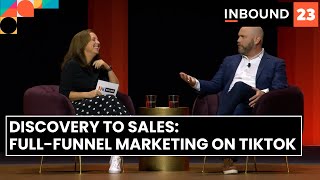
Panel discussion (INBOUND 2023) between Bryna Corcoran (HubSpot) and Garland Hill (TikTok) about full-funnel marketing on TikTok. They define a full-funnel approach as using TikTok's suite of ad products from mass reach to lower-funnel conversion, emphasize blending organic discovery with paid amplification, and highlight creators and UGC as high-performing. Case examples include Poppy soda and the Circle water bottle; tactical advice includes 'get on the platform', experiment organically, use creators or Spark Ads, avoid over-using fleeting trends, and measure results.
Chapters
Hi, everyone. Welcome to what's Next. My name is Bryna Corcoran. I am the global head of social here at HubSpot. I'm new to HubSpot, actually. I joined recently in July. Previously I was at Lyft where I launched the brand on TikTok. So I'm excited to talk to Garland Hill today. He's from TikTok. Garland, why don't you tell us a little bit about your role at TikTok and your team and then we can get into some full funnel strategies.
Yeah, for sure. Well, thanks for having me. First of all, I'm glad that we get to open up for John Mulaney. I think that he's got a hard act to follow here. So the way I start, I talk about my journey is I consider myself a reformed brand marketer, kind of post business school, I went to General Mills. I sold food in a can, Green Giant vegetables, Progresso soup for about three years of my life. Decided that's all I wanted to know about the food manufacturing production. But I learned a lot about marketing, media advertising, pulling all the, the media levers that you can in my time there. Left from there, ran global product marketing for a tech company in Austin, then joined Facebook kind of as it was taking off, working with a lot of large enterprise advertisers, helping them understand kind of back in like 2013 through 2019, how to advertise on mobile devices and the value that they could get from that. And then in 2019, I started our Austin office and I've started to build out what I call our growth business, which is working with advertisers between 10 million and a billion dollars in revenue. Very performance auction focused, but not consistently or solely performance auction focused. And so I've been doing that ever since through the pandemic and on until now.
So we have a lot of marketers in the audience today, some of whom are probably, you know, been on TikTok for a while, maybe have mostly an organic presence. Some of them are maybe new to TikTok in general. So I'm curious, how do you all at TikTok define, you know, full funnel strategy? Like, what are, what does that look like? What are some of the ingredients of what full funnel looks like?
Yeah, for sure. It's. It's been fun for me over the last three plus years to really work with the, the app and platform and dispel a lot of myths. Right. Like, some of the first conversations I had is that, well, I don't want to be on a platform that's only teenage girls dancing, right? And so I'm like, all right, well you can believe that all you want, but obviously there's, there's, you know, over 100 million. I forget what our latest numbers are that you can kind of talk about publicly, but well over 100 million monthly active users utilizing the platform. So a significant number of the gen pop and dispelling this, that it's. And I've heard it from either side, we're only a performance auction or performance advertising vehicle to you're only a mass reach vehicle. And both of those things can be true at the same time. So we have ad products that help with mass reach, video views, lead generation, lower funnel conversion, events, mobile app install. So the entire suite or complement of products within that kind of full funnel marketing solution.
I'm curious for, for those marketers who are a little more established on the platform today, what are some of the features that you think people are sleeping on or some of the ad products that you think people should be paying.
More attention to if you're more experienced on it? And one of the things, and maybe I'm jumping the gun here a little bit about some of the conversations and questions that you had, is that a lot of times my team or the clients within the client base that my team works with, they'll be very, very heavily performance auction focused, right? Like they're there for that click that mobile app install and that's the entire focus of their business. And they have a lot of success on a lot of our competitive platforms with that. And one of the things that we're really working on is expanding that. Right? If you think about doing some more mass reach, if you're a lower funnel conversion focused advertiser, is just bring more in through the top of the funnel, right? And you get better CPMs. And if you can optimize for that, then you're going to hammer more people down through that funnel and you'll therefore have more success at the lower funnel events. And so that's something my marketing team is going to kill me loosely we're calling it brand formats. But, but there's been a lot of success that we're seeing and advertising. As long as they're advertisers, as long as they're getting signal optimal, as long as they are, you know, piping into our events API, as long as they are implementing the pixel, optimizing for the right event for what they want from that campaign, they're lowering their CPAs, they're seeing a ton of improved ROAS and we just see more and more examples of this on a weekly basis.
Well, as someone who runs a social team and social brand presence for HubSpot currently it's, you know, as a, as the marketer, as a social marketer, it's hard to keep up with all the channels and all the content and you know, you're, you kind of feel like you have to be everywhere. Right. So I'm curious what you think makes TikTok unique and worth spending time and resources on as a social team.
Yeah, well, for sure. And you know, I mentioned that I consider myself a reformed brand marketer and when you're responsible for the P and L of a a brand within a large CPG company, as a marketer you're really responsible for allocating the paid media dollars and the consumer advertising spend that you have at your disposal across the consumer attention sphere. Right. Like that spectrum. And so what I can say with TikTok is that you've got a highly incremental audience. Right. So there's so many, so many users of TikTok that aren't necessarily using other platforms within the digital media space as well as like just traditional media. Right. We all know about the cord cutting and the attention shifting that's going on within the digital space. So TikTok offers a very highly engaged, I think, you know, what we say is that the average TikTok user spends the equivalent of a movie's worth of time per day on the platform. So highly, highly engaged. They're leaned in highly incremental. For many of my friends that are still marketers in the industry, I'm like, look, it's an arbitrage opportunity for you to be able to get to your next generation consumer and sell whatever widget or service you're trying to sell that's just going to have a higher hit rate and you're going to see a lot of benefit to being there. And so there's a first mover advantage that I encourage a lot of my friends to enter in onto the platform, start to experiment with it and get the begin, get the benefit of moving early. And I say that based on, you know, I've got a joke. I have like over a decade of experience selling ads on the thumb screen at this point. Right. Like not a lot of people can say that. I've seen this iteration across Facebook, Instagram, TikTok. The faster you move, the more you roll around in it, the more you get acquainted with the new platform, I think the better it is for whatever brand or business that you're trying to grow, develop and run.
I would love to give our audience maybe a couple real world examples of who you think as a brand maybe is doing it well, you know, maybe if you can throw out a couple profiles, people can pull them up on their phone and kind of do a little tick tock creeping and see.
Yeah.
But yeah, I'm curious to know who you think is just like crushing it on the platform. Full funnel, like organic paid, the whole creator ecosystem as well. Like who's doing a good job.
Yeah, for sure. Well, and I mentioned that the business that I established and the business that I run is generally more performance centric. So we have a lot of like the travel industry is very performance centric. So my team works with them and as well as businesses that are like $10 million in revenue and trying to grow. And so one of the things that we talk about internally is how do we take those $10 million businesses and build them into billion dollar brands. Right. And so one of the examples that I love and I've gotten to know the founder and CEO is poppy soda. So it's like a better for you soda. It's got a base of like apple cider vinegar. She's got this really powerful story about her own gut health and how what was out there in the market wasn't working. And so she would try apple cider vinegar because it's supposed to help her gut, doesn't taste good. So then started formulating the kitchen. You know, two years later, she's like the fastest growing or poppy soda, rather is one of the fastest growing independently owned, non carbonated soft drinks or carbonated soft drinks rather in the country. Right. And so she's successfully utilized the platform she attributes, I want to say like 25 now, 30 to 40% of her offline sales to TikTok, 15% of her online sales to TikTok. And she's charging up towards that billion dollar valuation just by capturing the organic. It started with her kind of telling the story. And she'll tell the story about how literally overnight she went from like, I don't know, tens of thousands of dollars of Amazon sales to this TikTok catching fire organically and her having like a quarter of a million dollar sales on Amazon overnight, then trying to have to like figure out how do you engage with your community. She becomes the voice of the brand. How do you do authentically and then how do you turn that into, you know, retail turns?
Yeah, well, I wanted to double down on the authenticity. I think that's what I personally love about TikTok is the fact that, you know, everybody here knows it's known for that sort of talk to kids, camera style, shot on iPhone, like not overthought type of approach. And this is where we usually see humans are doing the storytelling or the product selling instead of, you know, more polished content. I think we've all been victims of. TikTok made me buy it. Show of hands, if TikTok made you buy something.
Oh yeah, it's big on discovery. Yeah.
So I wonder if you can elaborate a little bit more about, you know, you were talking about how she as a founder was sort of doing the storytelling and kind of became the face. But I'm curious, the role you see creators playing, I know they've exploded on the platform. Everyone can be a creator nowadays, but where do you see creator landscape going and how does it play a role in that sort of like full funnel approach?
Yeah, well, I mean you just hit on it. We have some empirical data and third party data because we don't want to grade our own homework here, but it says that like 80, almost 80% of the users of TikTok indicate that they've discovered products that they've purchased on TikTok. Right. Just scrolling through their, their for you feed, things are introduced to them. And so we subsequently get the, the kind of, the nice marketing message of TikTok made me buy it. Right. And creators play a huge part in that. So it's not a lot of creators just are out there talking about the products that they like. So get ready with me is a big trend on TikTok. So there's, you know, dozens of beauty brands that have gotten the benefit of just having these creators with these massive followings. They're out there just pushing their brand. Right. And creators as a whole are huge, huge. You know, they're the lifeblood of what makes TikTok interesting and engaging. And the reason why, you know, I myself like spent two hours on the flight in yesterday instead of doing the work that I needed to do, I just scrolled through TikTok because it was a lot more fun. So we continue to support that creator community. We have avenues for advertisers to meet and connect with the creator community. So whether it's. We have a TikTok creator marketplace where brands and businesses can kind of put a, like an RFP out there, find creators that overlap well with their desired consumer base, reach out with them, provide them with a brief, and work through getting them to that creator to subsequently deliver your sponsored content. Your advertising, your paid media advertisement on the platform. And I think that we see 25% better performance on ads that are. That are developed by the creators. And that way, what else do we have? We have a branded mission ad unit that think of it as like, same sort of concept, but crowdsourced through the creator community. So you pick like five or ten and they kind of have a Pepsi Bake. Is it Pepsi Bake Off? No. Pepsi Challenge?
Yeah, something like that.
Betty Crocker Bake off, whatever. I'm mixing the analogies, but they'll put together their attempt at your ad and then you get to select that and you get to put paid media behind it. We have Spark ads where if it's just normal UGC that's created on the platform and you like it. We were talking about this backstage.
Yeah.
I'm from Austin. I love YETI as a brand. If there's something that's put out there by anybody on the platform where they're hitting on everything that YETI thinks is core to their value prop and speaks to what they want to develop their brand equity, they can reach out to that, that user and put paid media behind that and push that out to the community. Have it, have it come off as very authentic and not super high production. And a lot of times that sort of authenticity, I think, goes a long way within the community. And not just TikTok, like just in general. When you're having a conversation with your consumers in a very authentic way and your core brand championship, that goes a long way to driving the brand equity and ultimately to driving the sales of your product.
That was something, you know, that I've seen work at HubSpot, but also when I was at Lyft, was letting the creator sort of do the creating, having it live on their channel, and then literally like sparking it as a brand. So it sounds like that, you know, if no one here has yet explored that, it's definitely worth checking out. How's our time? Okay, so I wanted to double down a little bit on like. So I am an organic girl. I have a lot of heart for social. You know, if something pops off organically, you know, like, hey, if we put some paid against that, it's really going to crush. So one of the things that I love about TikTok is the fact that you could start really organically on the platform. It's hard to build a social team. It's hard to make content. It's hard to make content at speed. So starting organically is usually the way most of us start on these social networks. But what I love about TikTok is you can, you can find success there, you know, starting organically. Sometimes things hit the for you page and you get, you know, a little traction. You're like, where did all that, all those views come from? It's because of the algorithm, how awesome it is for organic. So I'm curious what you know as kind of like the growth paid side of TikTok. What do you see as like the right blend? What are sort of like the growth initiatives? Because I think what's great about organic is it's more of like the authentic side, right? Of like it's the personality of the brand coming through. And then on the growth side that's more of like the selling and the pitching of why someone should buy your product or why someone should care, care about you as a company. So how do you strike the right balance? Like if you're starting out on TikTok and just kind of, you know, taking organic to the next level.
I'm with you. Like you're, you're organic, girly, I'm a paid boy. You know, two peas in the pod. This question always. Like 15 years ago I went to Cannes and Keith Weed was the CMO of Unilever at the time. And like just an amazing speaker, amazing, amazing marketing mind. And, and if you guys will forgive me, he had this fantastic quote that I think that this, this kind of matches to and it was something to the effect of like, you know, finding the right balance of organic and paid. It's like high school sex, right? Like everyone's talking about it. Very few people are doing it and even fewer are doing it well, you know what I mean? And it's just such a hard, such a hard balance to strike and there is no silver bullet, right? Like I can't give you the Oreo after dark super bowl moment. I've been like, I said 10 years of this. I can't. What I tell people is like, I can't tell you what's going to go viral, right? If we, if I could, we'd be having this conversation on my yacht, like all of us, right? But there is definitely a blend of that organic component, especially with TikTok, where you can capture a little lightning in a bottle. And what I tell my friends that have know small businesses and or large marketers with a number of brands underneath them is you want to dip your toe in the water and just kind of try it out because it is free, right? And it is one of the last Platforms where it is free, where you can get some organic traction. See what's working, see what's resonating, you know, see how many, like, likes it gets. It might not take off, but you might see like, of the 10 things that you're trying to these two, I got a few hundred more. Read the comments, try to understand and interpret what resonates, and then based on those learnings, try to incorporate that more into, you know, the creative work that you're pushing paid media behind. And that's as near as I can get to how you can get that paid and paid, owned, earned, social, you know, like all of it organic to come together. Yeah, but there's just no, there's nothing formulaic that I, trust me, if I figure out the formula, like, we're taking it on the road together, you know.
You know, it's funny you mentioned, like, how everyone talks about high school sex. I always say organic is always the bridesmaid, but never the bride. You know, it's like we're always invited to the party, but we're not. It's harder to get the resources. It's hard to get, you know, creative support. So I love that, like, there's a marriage there for both of us.
Yeah, there really is. It's hard.
Yeah. One of the other things that, you know, I know you can't talk too much about algorithm and all of that, but, you know, can't talk.
I don't. I can't even spell it.
The secret sauce of the for you page. You know, I love that, that, you know, you can put something out there and it just sort of pops. Pops off. I'm curious, you know, what are some of maybe the growth strategies that can marry up against the for you page? What I mean by that is like, when you. I don't know how many people here have seen like a good ad or a bad ad on TikTok. But, you know, one of the disappointing things is when you kind of click over to the profile and you can see they haven't really figured out the organic strategy. So I'm sure, I'm wondering for our audience, you know, how. How can. How can organic sort of fuel the for you page? But how, how can we apply some growth strategies to that as well?
That's a tough one. You know, I think if I was running a business, right, and I'm trying to grow it, I would experiment with things. Well, I'll use another example of like, one of the businesses that's done really well over the last year and a Half utilizing the platform and that circle circle water bottle, right? And so I don't know if many of you are familiar with it, but it's kind of a reusable water bottle and they have these like flavor cartridges and you can snap them in and you can dial in how do you want it to be, like stronger or lesser or whatever. And so it's got like this reusable, sustainable, reusable arc to it. And they started pretty heavily on the organic side. I think that they were drop shifting shipping to a lot of influencers. And so again, there's no formula for how to be successful with organic. But I think as near as they could, they kind of found something that worked for them and worked for their brand and business because they drop ship product to influencers that they could find or contact and they might reach out using the direct messaging applications within the platform and explain what they were trying to do. And then these influencers would use it and they, I like it. And it became kind of organically this, the water bottle of TikTok. Right. And you've seen the leggings of TikTok, all these things and again, you can't catch lightning in a bottle with any of these. But it worked for them. And then after that then they really started leaning in, putting creative work together, putting paid media behind it and caught the momentum that they had started on the organic side and then extended that to their paid side and then really started getting traction as a business. Demand started increasing. They leveraged that demand to go to Walmart. They started getting, you know, ACV and distribution at Walmart. And like this all happened in a short order of like 12 to 18 months, right?
Yeah.
So that's more of an anecdote because I can't tell you like what the rubric is for it, but I think that that's as close as you can get to thinking about what for your product or service or business or brand, what is it that makes it special, what's unique and different about it, what's your value prop and then rolling around in the platform as the marketer, as the business leader, understanding what the means are, understanding what works and might not work on the platform. And you get like this, this feel after a while. It doesn't take much, spending a few, few minutes a day, 5 to 10. Try to spend 5 or 10 because it'll suck you in. You'll lose like an hour and a half of your life and you'll be up at 3am Like I do. But that's that's the. That's the advice I give family and friends in the industry that are trying to capitalize on this and see what works and really find the sweet spot for them, because it's going to be unique for them and their brand and the personality of that brand and business, because it's not a one size fits all solution at all.
I'm curious for the audience, maybe a show of hands, are you guys familiar with this water bottle? Because I feel like everybody circle water bottle. The TikTok water bottle.
So 20, 21. All right.
Okay. We only have a few minutes left, but I want to leave our audience with some, you know, tactical things that they can start to apply. So I like to play this game called Stop Start. Continue. So what should marketers in the room today start doing effective immediately, if they want to light TikTok on?
Yeah, if you haven't. I mean, if you haven't heard this, like, get on it, right? Like, I had a little makeup applied backstage. I feel pretty Hollywood right now. And as I was doing, the makeup artist was telling me, she was like, well, I'm so embarrassed to say I'm not even on TikTok. And I hear this all the time, right. As I kind of. I talk to peers or friends in the neighborhood or whatever, it's almost like they're bragging to me about it. But if you're a business owner or marketer or at any point in the ecosystem of marketing, advertising, and media and you're not all on TikTok, you need to start doing that, right? Like, you gotta get a feel for. This isn't. We've reached a tipping point. Hundreds of millions of users. This isn't going away, right. So it's the next application out there. It really has the strongest opportunity to compete with the duopoly of Facebook and Google. And I can say that as a Facebook alumni. So you want to be in and involved and understand where your consumers are spending their time and attention. And then once you do that, you understand what. What the. The power of the platform, how people use it, how you use it, how it would fit your brand. So that's the biggest takeaway for anybody that's not involved with the platform is get on it, understand it, and. And then you can start to get, like, more strategic and thoughtful about how you want to use it for your business. But, like, dip a toe in the. You know, the water's fine, and I guarantee your competitors are.
It's funny you're trying to pitch the makeup artists backstage because I was Doing the same thing. I was like, have you all seen that snail mucin on Tick Tock? They're like, yeah, we're on it. I was like, you guys?
Yeah. She was like, I'm on reels. And I'm like, well, you found out about it four weeks later than everybody else.
Yeah. And as like a skincare sort of like, beauty, like, rabbit hole, Tick Tock person, I was like, ladies, you guys would do so well on Tick Tock if you just got on there. Start sharing your expertise and see where it goes.
Right.
Okay, so that's the start. What should people stop doing and stop wasting energy on what was like, so 2020. Don't even think about it anymore. Like, just stop doing it. What would that be?
I mean, participate in the community. Try to find the communities that. That gravitate towards your brand on the platform. I should also said start being. No, well, I'll use that on. Continue. What's it. What's a good stop?
I have one.
You tell me yours.
Okay. Stop jumping on trends too much.
Exactly. Yes. That's where I was.
It's like trend overload. It's like. And you know, it's hard, it's easy to jump on trends, but, you know, how do you. How do you, like, blend it?
You know, use the trends, know the trends, but the trends can be so fleeting and ephemeral that by the time, like a. Especially the bigger brands, by the time they, like, get all the traps cleared and clear all the. Get all the signatures and run it by their agency of record or the social media agency or execute it, it just looks. It looks inauthentic. It looks like a big brand trying to be cool. Yeah, it'd be like me trying to do the Tick Tock dances, you know, like, it's not gonna work. I'm not gonna look cool.
I feel like trends was how we all started in the. The platform in 2020 and 2021, because it was early and, like, no one was really on there. But now I feel like more and more brands are on there and it's easy to just get lost in a trend very quickly because, like, some of us are late or whatever. So, you know, I'm really pushing for, like, trends as the cherry on top. And I think people are moving more and more towards, like, wanting to spend time a little bit with, like, expertise and valuable content. So, yeah, stop being so thirsty for trends.
Yeah.
Okay. And then what should people continue doing? I think you mentioned, you know, roll around on the platform a little bit. Experiment.
But yeah, for sure. Continuing to. To get more comfortable with the platform, with the users. You know, you do want to be on there so you understand the trends and what's working and kind of the tone of voice that would work best for your brand. Continue to experiment with your own organic content, to continue to experiment with the paid ad units that are out there that might work for your brand. We're rolling out a ton of measurement. As a former marketer, as a former P and L owner, I think it's incredibly important to understand what did you execute and how did it perform? So you can kind of rinse and repeat. What else? Yeah, but. But don't walk away from it because it's not going anywhere.
Yeah, you and I, just briefly, because we have a couple more minutes. You know, you mentioned, I think, like, people who run social teams or started in social. One of the, like, tropes we all hate is, oh, the intern. The interns behind the social account.
Yeah.
But I will say I. At HubSpot, we have a really young team and they are kind of, you know, early 20s and, like, this is kind of like their first big job. You were mentioning backstage that sometimes the easiest way to get started is to give the phone to your intern. Yeah, yeah. Share some thoughts on that.
Well, it's. We were talking backstage, and I get asked a lot. It's funny, over the evolution of the last few years, at first it was like, why, right? Why TikTok? And I feel like for the most part, the conversations that I have now in marketplace, people are like, okay, we get it. We get the why. Right? Like, you get a lot of time and attention. A lot of our consumers, we, yes, bought into that. Now we're moving to the how stage. And a lot of the how stage comes down to, well, what does that creative execution look like? Do I use my high production agency of record created creative that I, you know, my TV ad, and I just reskin it for a phone? Or do I use a. A creator? Right, the Use the Creator Marketplace. Go lock in with some of the influencers on the platform, give them a brief, let them execute for me. Or do I just hand that phone to an intern and have them come up with the voice of my brand? And what I tell them is the same thing that I started out with, that as a marketer, you're responsible for placing your paid media where the consumer eyeballs are. Right. Like, the best you can do is distribute it almost mathematically across where the time and attention of your consumers is going to be and then hit them with the same message over and over again. Right. It's kind of Marketing Advertising 101 with this. I almost see that the same way for the creative experiment with that. If you have the benefit of an agency of record and and bigger brand budgets then try something high production. See how that works for you. Measure, test and learn. If you have a creator try that out and if you want to hand it to the intern and have them produce your organic content and see if it takes off like the Poppy founder. Right? Yeah. Then do that and just experiment with what works for you and start to dial that in for what's more the most authentic for your brand what drives the most brand equity which ultimately leads to the most base sales.
Awesome. Well thank you Garland on behalf of the inbound community and all the social marketers here in the room thanks for today's discussion.
It's my pleasure.
Thank you everyone.
Thanks all.
More from Patrick



A NEW BREED OF PARTNER: The Partnership Ecosystem Model Journey of Patrick Biddiscombe, Part 1








Customer Success Workspace: Never Lose Sight Of What Matters Most | HubSpot Spotlight