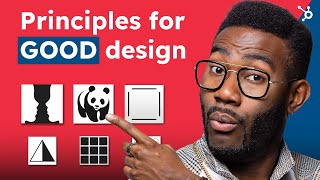
Patrick Biddiscombe explains how Gestalt psychology shapes perception. The theory, developed by Wertheimer, Koffka, and Köhler, shows we see wholes not parts. Six principles—Figure-Ground, Similarity, Proximity, Closure, Continuity, and Order—help designers create cohesive visuals that feel complete.
Chapters
When looking at this, what's the first thing you see? Do you see a bicycle? Or do you see handlebars, pedals, spokes, tires, brakes, a seat and a frame? If you're human, I'm guessing you saw a bike. This idea that we make sense of things by seeing a whole rather than the individual parts is called Gestalt psychology, and its principles are especially important for designers in creating complete and compelling visuals. Because of psychology, Max Wertheimer, Kurt Kafka, and Wolfgang Kohler, Gestalt theory can be broken down into six design principles. Figure Ground. The thought that when we look at a scene, we separate objects so that some of the focus or figure and others are the background. Similarity. The notion that we place objects with similar characteristics in a group. These characteristics could include color, size, font, shape, texture and more. Proximity. The belief that we group together objects that are close to each other. Closure. The idea that our minds close objects that are not necessarily together or complete in order to create a whole. Continuity. The theory that we continue to follow objects that are visually aligned until they are interrupted. Order. The belief that alignment and symmetry are attractive and essential elements of design. When gestalt principles are ignored, designs tend to look out of place or incomplete, forcing our eyes to focus on little inconsistencies rather than the greater whole. You may not know exactly what seems off, but you will feel something is out of place. The best designs unintentionally make the world feel a little less chaotic.