Google’s Gemini 2.0 Launch is INSANE! Everything You Need To Know
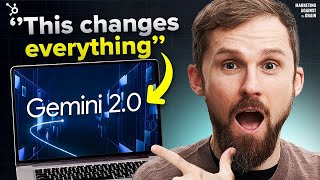
Patrick Biddiscombe breaks down Google's Gemini 2.0 launch. Deep Research drafts long-form answers and exports to Docs. Project Marina agents can read sheets, browse sites, and complete multi-step tasks. Flash model streams your screen live to tutor and correct you in real time.
Chapters
Okay, Google just did the biggest AI launch of the year. They give you Jarvis in your pocket. They continue to disrupt their own search engine and they are going to automate all of your work. This is an emergency. Podcast marketing against the grain. Bringing you the latest in Google's Gemini 2.0 launch. Let's get into today's news. All right, so Google had a huge launch called Gemini 2.0. And I want to talk to you about a couple of the features in here because they're impressive, pretty important for all of us marketers, knowledge workers and just people, people who are trying to grow a business. So I'm going to talk about Gemini 2.0. I'm going to talk about the deep research part of that. I'm going to talk about Project Marina and I'm going to talk about Gemini Flash. I think all of these are pretty important updates. Let's start with. Where we should always start with is what is happening to our search traffic. And so we know that Google is continuing to disrupt search traffic or AI is continuing to disrupt search traffic. When I think about search, I think about it broken into three core categories and this is how we've been thinking about. Number one is comp. Non complex queries. So they are just. There is an answer to the question non complex query. And AI is incredible at giving you that information today. And I believe all of that traffic disappears. It's just a matter matter of when, not if or how. Which means if you have a general question, you will go to AI to get the answer to that question. Then there are complex queries, right? There are these complex queries and these complex queries are basically. These complex queries are basically you have to do a bunch of research to put together a well thought out, clear and concise answer to a very complex question. You have to do a ton of research, a ton of thoughtful analysis and to me that is much more defensible traffic and where you should spend a lot more of your time. We thought that was pretty ring fenced. Then there are transactional queries where someone is searching for a product or searching how to take an action and they are at the moment not being touched by by AI. I do wonder if that changes as AI becomes much more integrated into the apps and things like that. But that's a whole other episode and so, so non complex gone. Poof. It's a matter of when, not if or how. But what do we think about complex. Well, here come Google who are really being forced to innovate on their own search experience. Because of the likes of ChatGPT Search, because of the light of perplexity. And they come out with something called Deep Research. Now, Deep Research is available in Gemini Advanced, of course, I have a Gemini Advanced subscription. I'm subscribed to every single AI pro tool you can get. And what Deep Research is, is I do wonder if it's. There was a product called Google Learn. We talked about it on the podcast. It was this really cool way that you could learn about complex topics. It was in Pilot and I wonder if it's a spin off of that. And, and really what it allows you to do is when you go into your Gemini Advanced you see it's a separate model. It's not integrated into the new Flash model that I'm going to talk about and I'm going to talk about what I think will happen. And basically what you can do here is you can ask it complex queries. Now, I'm a B2B marketer, so I asked it not that much of a complex query. I want to use AI across B2B market and paid advertising. Now you can think of much more in depth prompts here around science subjects, math subjects, whatever they may be. This is not a very hard prompt for it to figure out or to be able to research and provide me something back for. But you can see what it does here is it basically provides a little guide. I'm going to do all of this research. So it does all of the research across all of these different sources and starts cleaning all the information together. Now remember the golden olden days, back in the blue links days, who was doing this work? You were doing this work. I was doing this work. And what was happening, all of these publishers were getting rewarded because you were on their website doing a bunch of this research. They now Google is doing all of this for us. And it then takes a few minutes, analyze the results, creates reports and it, it says ready in a few minutes. Now this took like 10 minutes. So again, if the more complex you information you ask for, I suspect the more time it will take. But that's a good sign because it's researching thoroughly all of these different resources. So the first thing it pulls me back is it gives me this kind of comprehensive guide to the question that I'd asked and allows me just to open it into Google Docs. And the thing I hadn't really even considered is how valuable Gemin is when you integrate it into Google Drive. It's actually amazing. I use it in work, I use it for personal and now I can just go from Gemini, open up the doc, and I can start to actually refine the doc in here if I want to. But I can also do it in the conversational UI panel because now Google has done the deep resource research for me. It's figured out all of the things I had asked it for and now I can just ask it follow up questions on that topic. So I never again have to leave this UI panel, the conversational panel. I never have to go back into the Google search results. And so deep research I think is a really interesting feature as part of the Gemini 2.0 launch as a separate model in pilot at the moment. Because I do think it's going to start to cannibalize that more complex bucket of search traffic, being able to provide users with better answers in a short amount of time. It's so quick. This took 10 minutes and I think if you ask someone to go do this, it would take them the entire day. That's what we're talking about, AI, 10 minutes, singular person, entire day to put this together. And that means that again there's like less reason to go into the Google search engine. And that brings me on to what I think is happening here. So Gemini Flash Flash is their latest model. If you use Gemini, you should have access to it. You can go try it out. It's faster, has better multimodal capabilities in terms of video analysis. Like one of the things you should go try out is. I think I might have an example here. Yeah, the integration with YouTube is just dope, right? Like I, I basically said, what are, what's the latest podcast for marketing against the grain. And then I asked it, what are some of the key points here? But the integration is really cool. You can just go pull information from video, analyze video, go pull information from audio, analyze the audio. But the interesting thing with Google Gemini is it can also call the Google Search Engine. So what is it doing? The advantage Google has in this game is they do have that search engine that does sort through and prioritize the global information, all of the information across the globe. Because they had the big innovation of PageRank, so they're able to like prioritize the sources of content. When I search on ChatGPT search or when I search on Perplexity, I'm always wondering how are they determining what websites to go and research and give me to give me the best answer. Whereas Google had that built in because they have the Google search engine now. What's interesting is I keep saying time and time again that what this is doing is pushing everything into the background. Because there is an agent layer, an AI layer sitting on what we call the Internet today and that moves everything into the background. And this is a good example. Google Search is being moved into the background as a data resource, as a way to validate information, as a way to prioritize information that the Gemini model can use. And to me this is what's going to happen with search. These are going to be the front door experiences for us to acquire information. And Google search is like in the background, maybe used for location based search, maybe used for some review stuff, maps, things like that. Although I expect that all gets integrated into here. Like I wonder if what is the best. I get lost all the time. Route from London to Paris. Does it pull? I haven't. Yeah. Okay, so it's always. I haven't been using Gemini much. I've been using all the others. Darn, why do I ever go to Google Search? It's so interesting, right? They are having to like disrupt their own search engine in real time. And it's just so much better than the blue links. And so that is a search, right. I believe that Google Flash eventually includes deep research, is integrated into all of these different properties, is integrated in Google Drive. I just, it's a much better experience than the blue links. The blue. We are, we, we are in trouble on the informational content where it's educational traffic. I just don't see how that just does not continue to be cannibalized. Now at the moment it is not being cannibalized like rapidly, rapidly. But if you've ever watched the movie Everywhere, what is it? Everywhere all at once. I don't know what it is, but the basically, you know, it, it kind of doesn't happen and then it happens all at once. I feel like that George Bush, when he makes that completely terrible gets all of those sayings wrong. All right, so what else do we have? Okay, this is the other cool one. So Project Marina is the ability to like automate tasks in your browser. Let's just watch a little bit of this video because it will kind of blow mind a little bit today.
I want to tell you about Project Mariner. It's a research prototype exploring the future of human agent interaction. And it's built on Gemini 2.0. Like with all new technology, it's important for us to build this responsibly, which is why we're starting small.
Blah, blah, blah, responsibility. Come on Google, who cares? Okay, so you start with a Google sheet again integrated in Google Drive pretty routine workflow here. I want, I have a list of companies, I want to find their email address.
I'm going to start by entering a prompt here. I have a list of out.
What I love about Gemini is how deeply it's interwoven into G Drive. It's just available in the right hand panel as an assistant.
Then find their websites and look up a contact email I can use to reach them. This is a simplified example of a tedious multi step task that you could encounter at work. Now the agent has read the Google sheet and knows the company names. It then starts by searching Google for benchmark click climbing and now it's going to click into the website. You can see how this research.
Okay by the way, this is Google doing this right? All the clicks and everything you see is Google. It's not a person.
Once it finds the email address it remembers it and moves on to the next company at any point.
So what's really cool here is, is basically what I love about this is the autonomous agents is like really interesting because I think people are going to be freaked out by them and they're just not want to want these agents to go do things for them and come back with the result. And the UI pattern for agents has just been an unknown thing. I think Google have a good pattern here because you can actually see what the agent is doing on the right hand side and the person is still in the loop. So you can stop it, you can ask it to change things so the human still feels very in control and can see exactly what the agent is actually doing smoother.
And it's so important to keep a human in the loop. After the fourth website, the agent has completed its there you go addresses for me to use. And there you have it. We're really just scratching the surface of what's possible.
When you bring Flash model has much better reason. When you go into look at its performance against historical models, much better reasoning.
There's so much hype around AI right now. We talk about it on the show all the time and so many people are going to use AI in the wrong ways. The smart people and the smart marketers are going to use it in the best ways. At HubSpot, AI is transforming so much of our marketing. It's helping us clean up our data, transcribe our videos and content from one language to multilingual, boosting our conversion rates with personalized emails and landing page. And that is just the tip of what we are doing. And if you're a smart marketer and you want to transform your work with AI. We have just published an amazing 12 page AI prompt guide that goes through some of the best AI prompts for marketers right now. So if you're maybe uncertain of use cases or how to get started with a prompt, this is the perfect guide for you. We have linked it in the description below. So go and click that link.
Check that guide out.
Now back to today's show.
Okay, blah, blah, blah, blah, blah, blah, blah, blah, blah. Okay, that's one, one of many examples. So what's going to happen here? You work predominantly in your browser and what Google is going to do or any of these. It's not just Google. Like most of these large providers want to do the same thing, which is like get all your data and then basically just automate all of the work that you want it to automate because it's like screen captured all of the things you're doing. That is how we get to like 50%, which was the Sam Altman quote, 50% of knowledge work being able to be done by AI pretty rapidly because it can just screen record all the things you're doing. And we saw this, Claude had a launch recently where AI could control the computer. We've seen, I think it was maybe OpenAI had the similar launch Claude definitely did. I don't know if Open OpenAI did as well. And they can control your computers. Basically everyone is going down the automation path. All of these kind of tools that allow you to automate things, they are in deep, deep trouble because these large providers are going to do a really great job of this and they and Google for Google owns a browser, one of the most popular browsers on the planet. So they're going to have unique advantages here. So Project Marina, super cool as well. Let me show you the last thing that I want to bring up here. Okay, so that's Project Marina. The last one I want to show you is this. This is the jaw drop moment. This is basically Jarvis in your pocket. So let's play a little bit of this.
Just testing a bunch of the new Gemini 2.0 stuff and I'm trying to figure out what's going on here. So if you look over here on the left, I found the stream real time area and I gotta show you guys.
So what he's doing is basically he's in a Google AI studio, he's on stream real time and he's basically just allowed Google to see everything he's doing on his screen.
Share that.
Okay.
Hey Google, can you see my screen?
Yes, I can see your screen. It looks like you're on the Google AI studio page.
Okay, so one of the more interesting things that I found by the way, Google, just ignore me. I'm talking to the audience here right now. So what I'm going to do here is I'm actually going to have it walk me through as like is.
So he basically sets up a code tutor. That's kind of fast forward here he goes into his python and he starts asking the questions about how to code.
How about a simple command line number guessing game or a script that converts units of measurement?
Yeah, let's do the, let's do the guessing game.
Great. Next you can create a main function and inside use the random dot randint method to generate a random integer. This method takes a minimum and maximum value as its arguments.
Okay, little pause here before let's go on. So basically it's teaching them how to code. I can see everything on the screen and answer questions in real time.
Okay, I got that.
It's also very good at basically having conversational like it can, you can talk over it, you can ask it to correct itself, you can like in real time course correct the conversation.
Wait, so how do I. Okay, in, in Python if I do this random number like this, is that the right way to do a variable?
Yes, that is the right way.
Okay, and then I'm assuming that if I just do this, this is the correct way to print it.
Yes, you're right. Using print random underscore number.
Okay, cool, I got that. Let's move on.
Okay, great. Now you have the basics down, let's move on to the next step.
Wait, actually really quick, I would love to just like run the program. Can you show me how I should do that?
Okay, see what you did? If I did this, didn't say what he did because it can see your screen and correct you or teach you in real time. This is unbelievable. The use cases for this are pretty incredible. It means that like everyone can have an incredible world class tutor at their fingertips. You're not kind of. It doesn't matter what school you have available to you, whatever it may be, you don't really the quality of the teacher because you can as long as you can share your screen and most people are working on devices you can actually have AI guide you around the place. Now what I love, what's actually interesting here is Google have for Once front run OpenAI. OpenAI had a 60 minutes where they showed their kind of their functionality to do video and stream to AI and AI to be able to like help you do things when it can see your screen. They have not launched that yet. So Google have managed to like jump, jump ahead and all these kind of companies are battling to be the first to get all of this functionality out. But that is is like the Google Gemini 2.0 launch. We went through the deep research, we went through the Gemini Flash, we went through the Project Marina and then the last one is the I think coolest one, the real time screen share where you can actually have an AI watch what you do and again think about Project Marina. It can basically watch what you do and start to say hey, should I automate that? Should I not automate that? Do you want me to do this? Do you not want me to do that? This is the personal assistant you are all going to get. It is 100% going to happen. You will have a knowledge worker with or a personal assistant for your personal life. Knowledge worker for your B2B life. Join you in day to day. Be able to look at what you're doing on your computer, be able to look at what you're doing on your screen, be able to provide help whenever you need it. Be able to automate stuff whenever you need it. And get ready. It's happening. The AI updates are wild. I hope this was useful. And until next time, keep on AI in.
This data is wrong every freaking time.
Have you heard of HubSpot? HubSpot is a CRM platform where every everything is fully integrated.
Whoa.
I can see the client's whole history. Calls, support tickets, emails. And here's a task from 3 days ago I totally missed HubSpot.
Grow better.
More from Patrick



A NEW BREED OF PARTNER: The Partnership Ecosystem Model Journey of Patrick Biddiscombe, Part 1








Customer Success Workspace: Never Lose Sight Of What Matters Most | HubSpot Spotlight