How Humor Gave Me Purpose
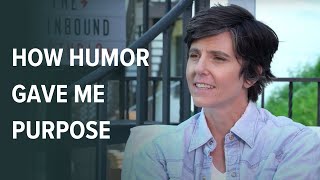
Tig Notaro talks about finding comedy through family, surviving pneumonia, C. diff, and cancer, then turning those experiences into stand-up. A set she did right after her cancer diagnosis became a hugely successful album.
Chapters
You know, when I look at my babies, I'm like, I told jokes and bought you that outfit.
Tig Notaro is a comedian, actor and writer, originally from Mississippi, now based in la, where we join her today to talk about the power of humor. Tig, thank you so much for joining us today.
Of course. Let's start at the beginning.
When did you discover comedy in your life?
I discovered. I mean, it wasn't hard to discover because my mother was very funny. I mean, my father was my stepfather. I feel like I was surrounded by humor everywhere, every direction.
And how did you find that it was something you wanted to do as a career?
Well, I always thought that people that did comedy were just special, chosen ones floating around the universe. I had no idea how people got to do that. And I was always kind of the class clown, I guess. And I remember a friend of mine, her mother told her, tig should be a comedian. And I remember thinking, that would be so cool, but I had no idea how to do that. And then I tried an open mic, finally, and then I have not stopped since.
So there's obviously been. You've experienced quite a few, what many would consider hardships in your life, probably most notably surviving cancer. And you're well known for talking about that very openly on stage, in particular, your show just a few days after you found out that you were diagnosed with cancer. So how. What was the thought process in getting up on stage and talking about that as openly as you did?
Well, I had had several things before I was diagnosed with cancer. In four months, I had had pneumonia, and I had contracted this potentially deadly illness, C diff, where your insides are essentially eaten. My mother had an accident and died and then went through a breakup. And then I was diagnosed with cancer. And so when I went on stage, I kind of felt like I had nothing left to lose. And I also didn't know if it was going to be the last time I would perform. So I just felt really in that place of. There's kind of a weird line of nothing matters in kind of a depressing way, but also in a freeing way of, you know, nothing matters. So I'm gonna go on stage and I'm just going to see if I can make light of all of this, because I felt it would be so dishonest to go on stage and tell jokes that I had done before or tried to act like I wasn't in physical pain or emotional pain. So I just. I just thought I'd share that. And I. I didn't think it was going to be a highlight of my career. I thought it was going to be one of the most uncomfortable bombings of my stand up career.
Were you surprised by the reaction of the audience and how helpful it was to audiences both in that moment and beyond?
Yeah, I was stunned by the audience's reaction the night of my performance as well as when my album came out. I really felt like I was taking this risk doing this performance live and I, I kind of expected more and it was an awkward evening, but I expected more silence and more of a bomb feeling. And I was not expecting the laughter, the nervous laughter and then also the audience members that were even crying and stunned. And I, I just, I hadn't really thought too much. And then. Except I bet this isn't going to be my best performance. And then when the album was coming out, it took me a long time to agree to release it because I felt like it was something you needed to see in the moment. So when I thought of it coming out for everyone to hear, I pictured. I just, I kept telling people I want to go to some deserted island for two weeks and just let it come out, have everyone say this is terrible, and then go about my life. And then it went to number one around the world for months on end. And I was just like, it is not my best performance. Because as a comedian you work so hard at refining the material and editing and working it out and adding and taking away and ditching things for good. And then this was essentially like an open mic in that I hadn't said that material and. And then it became a record. And it took me a long time to accept that that performance was so popular because as a perfectionist in what I do, it was hard for me to own, like, yeah, that is great. That was a great performance. Because to me I'm. It's more like, I mean, if you like that or it helps you, then great. But I feel like I have better material than that.
Generally speaking, not specific to that performance. What is your goal with your audience? Like, what are you, what are you trying to achieve in what you're sharing with them?
I love feeling like I am hosting a party and. But I'm the only person that really gets to talk at the party. So it's kind of an odd gathering. I just really want to have a good time and I did get a lot of attention for that set about everything I'd gone through. And then I was kind of pigeonholed as that that's my thing. And I started to think at times like, yeah, I Guess that's my thing now. But I also really love silliness, and I'm getting in touch with that more so in my new material that I've been working on. But it was hard to go through that traumatic time and not have those issues weighing on my mind and want to talk about them. And I've had every, you know, an album, a book, movie, TV show. I. I think I've covered it. I've really gotten it out there. So I'm thankful for all of the avenues.
But the phrase laughter is the best medicine is kind of a popular one that gets thrown around. I think it can be applied to your situation, quite aptly. How do you feel about that phrase?
I mean, I think it's true, but I also think it can be a little psychotic if people are just like, no, everything's fine. You know, I think if you have a real connection to something that you're going through that you can make light of. I don't think people need to feel like they have to force. Force themselves into hysterical laughter or making light of their situation. But I think if, you know, if it feels right, I think it definitely can lighten the load. And you might not get there immediately. You know, it's like when my mother died, I was so paralyzed with devastation. And when I got this, you know, thing in the mail asking how. And it was for her, she's dead. And it's saying, how was your stay at the hospital? I was so full of rage in that moment. I didn't get it, and go, my mother's dead. She can't answer this. That's where you're a crazy person. You know, it took a few beats, and it took a couple months where it crossed my mind again. And I thought, that is insane. You know, and so I don't carry it as a heavy load anymore, that anger that I had towards the hospital. I do think they need to stop and, you know, pay more attention to who they're asking to fill out surveys. But, yeah, so whether it's something that.
Serious or even something, you know, smaller, just on your average day, do you think you're able to find a bit of humor in everything? Or there are there things where humor is just not appropriate?
I mean, I would never say that there are things where humor is not appropriate, because I think people feel that way because they're picturing some obvious angle that somebody might go at, a topic that would be stupid or offensive. But I think that's what's amazing about great comedy is it hits you from behind. And you're like, I never would have thought about that angle on that topic. So I don't ever feel like things are off limits. Off limits. I think there's so many bad attempts at it where it should be off limits because it's so, so dumb. And a million other people have said it that way or offended people that way.
What do you think humor allows you to do or has allowed you to do in your life that you wouldn't be able to do otherwise?
Make a good living. I really. I failed three grades and dropped out of high school, and I got into stand up with no real ambition because I never really had ambition. And it was something I felt like I was finally good at. And I can't believe I pay a mortgage and support a family. And I don't know if that's really the best answer, but I.
An honest one.
Yeah. I cannot believe, you know, when I look at my babies, I'm like, I told jokes and bought you that outfit, you know, that amuses me. Or when I order their organic baby food that comes to the door, I'm like, huh? Yeah, I told some jokes and now you get to eat. There's something that feels really good about that.
What makes you just laugh out loud? What gets you every time?
What do I think is funny? I don't even know. I love looking foolish to people. I. I love looking like I don't have information or the correct information. I love playing the fool. That gets me every time. When people don't know that I'm in on a joke and I absolutely look foolish. That amuses me. I also enjoy going to parties where I don't know people. And, I mean, I hope this doesn't sound like I get myself every time, but I like to, you know, tell people at a party that I'm going to bed in 10 minutes, and I never know if it's the owner of the house or, you know, just to see their reaction. Yeah. Just to make people wonder why the party's ending so soon. And then I went to the joint birthday party of Ellen and Portia, and Ellen was talking to all of the most famous people in the world, and I interrupted her conversation and told her I was bored at her party. Just. I don't know. That kind of stuff amuses me.
Putting people in an awkward situation.
Yeah, I guess awkwardness I enjoy.
What do you think's next for you and your comedy journey?
I hope I can continue to write material that people care about and that I care about. I'd like to write another book. I think I just want to maintain what I have right now. That's what I always go back to, is I don't want to run Hollywood. I don't want to be the most famous, the. The richest. I think I have a really great thing going, and I just. I'd like to maintain that. I'd like to put out another special, another book, that kind of thing. Awesome.
Well, thank you so much for joining us today and sitting here and talking about the power of humor. It's been fantastic.
Thanks for having me at my house.
More from Patrick



A NEW BREED OF PARTNER: The Partnership Ecosystem Model Journey of Patrick Biddiscombe, Part 1








Customer Success Workspace: Never Lose Sight Of What Matters Most | HubSpot Spotlight