How I Scaled My Ai SaaS Business To $500 Million
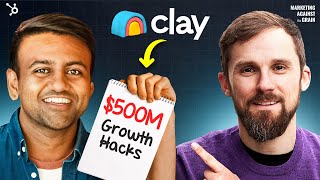
Varun Anand, co-founder of Clay, shares how he scaled the AI SaaS company from community-driven growth to Series B. He reduced onboarding demos from eight to nearly zero through reverse demos, turned Intercom support into a 15,000-member public Slack, and built a creator program that amplified product-led content across LinkedIn.
Questions this video answers
Series B company valued at $500 million.
OpenAI, Anthropic, Ramp (among thousands of customers).
More than 15, maybe 20,000 people.
There wasn't a way to pay in-product until past $1 million ARR.
Over about eight to twelve months (roughly 7–12 months mentioned).
Chapters
I just got done talking to the co founder of Klei, Varun Anand. Now Klei are on Fire. In B2B, everyone is either using Klay, talking about Klei or showcasing Klei's use cases on LinkedIn. They've probably seen them yourself. So I had to talk about his approach to go to market. Now, there are some incredible lessons in this episode. He talks a lot about how Clay's early days, they grew from communities. That's pretty counterintuitive to advice you would normally get, but there's a real unique method to have Varun did this that you really want to tune in for. He talks a lot about why they have an engineering mindset to marketing and growth. And in particular, it's really interesting how Varun applies engineering principles to marketing things I think all of you can learn from. I love the way that they have rethought the demo. He went from eight demo calls down to a single demo call that converts at a higher rate and he gives you the exact playbook of how to do it. And then, of course, you had to talk to Varun about how you do the unmeasurable parts of marketing, the things that you can't quite quantify. How do you invest? What do you do? And more importantly, if you're a marketing leader, how do you impress your founder and show him or her that you are doing incredible work, even if you can't measure? All of that and more on this episode of Marketing Against Grain. Hey, Varun, welcome to the show. We're really excited to have you on the podcast to talk about Clay and all of the interesting things you've learned about go to Market.
Thanks, Kieran. I'm excited to be here, I guess.
Just for the audience, because we're going to get into go to market tactics and some of the things that Clay have done that are really smart to grow the business. What kind of stage are you at? So our audience has a little bit of an idea of where you are in the journey.
Yeah, for sure. I mean, we are a series B company valued at 500 million and we have thousands of customers ranging from OpenAI, Anthropic Ramp and many more.
Very cool. You know, you're a company fresh at the gate. You're in this space. It is a wildly competitive space. It is harder, I think, to grow a business through digital channels over the past kind of three to five years than it was before that because there's just so much more competition.
Yeah.
Where did you start? Like, let's just take us all the way Back to you have to grow this business. What are, where did you decide to kind of start to build up demand to start to acquire some customers for your product?
I would say it was a bunch of hacky things. Like so some of the very first things I did. One is Slack groups and WhatsApp groups. And so what you can actually do is you can like set up like some basic social listening. And what you can do is on Slack, you can join a bunch of these sales groups and you can in Slack itself set preferences where you can add in some keywords and it'll just ping you every time someone says anything about this topic. So I would just like do that and they would. And it would automatically do that for me. And then what you can also use is you can use a tool called Siftin to track it on other webpages like Reddit and stuff like that. And then finally a lot of these agency owner people lived in these dark social WhatsApp groups. And so I would just join them and then I would wait for people to talk about their problems and then just privately DM them when they did. And so that was where we found a lot of early people.
I think that's really cool because it does give the first example of applying engineer, an engineering mindset to how you grow a company. Right? Like there's a lot of engineering thought process there and how you use tooling and automation immediately out of the gate. Just really quickly, if you, if you tell that story to most, you know, quote, unquote marketers, they will say, yeah, you have to like add. There's this actually quote around how marketers were told to use social back in the day, which is like provide nine things of value and then ask for one thing for your business. Like provide. You can have one sales conversation or you can post something around sales for your business in there. How did you think about that? Right? You're joining communities, you're trying to help them solve problems. But how did you think about promoting your product in those communities in a way where you were not chased back out of the communities?
To be totally honest, I didn't care. I mean, I'm trying to survive over here, you know, I'm trying to build a business. You know, do I care if I get kicked out of a community? Not really. I mean, I'm a nice guy, let's be honest. But like, I mean, look, I think when I look back on it, I did get maybe one or two messages where a moderator messaged me about maybe this not being appropriate. But let's be honest, I'm trying to help these people, you know, I'm trying to solve their problem. And actually. And we can talk more about this, but like when I would get them on the phone, my objective in the 30 minute call would be to completely solve their problem in 30 minutes and blow their minds in the process. Who does that on a sales demo? You know? And so, like, really, I'm doing them a favor. And so I guess, yeah, I didn't think about it that way.
No, I think this is a good point. Right? You can say you were promoting your product, but actually you were promoting a solution to their problem. Right. I think where a lot of people go wrong is when you're just out and out in a community. Here's my product, like, buy something. But it's not actually contextual to the conversation. It's not contextual to the problem that community is discussing. And what you're saying is, no, I went in with a real solution. I could get you on the phone and I can actually tell you that solution in 30 minutes. So I've actually delivered the solution.
30 minutes or show you the solution. Not even show you the solution.
Give you the solution.
No, no. Yeah, no. Solve their problem.
Solve your problem.
Like you would. I would ask these people to come to the call beforehand with their problem and we would solve the full problem in 30 minutes. That would be pretty cool.
That's pretty cool. It's like one of those DIY heist programs. You know, when they have to like refix the house up in a certain amount of time. You can like get in there, commit to doing the 30 minutes first. I'm really interested in this, right? Like early stage founders, I do a ton of angel investing around pre seed C stage deals. Talk to a lot of companies in those stages in series A. And most of those companies veer towards like core digital channels. Like, how do I build robust scalable channels out of the gate? How did you decide? Why did you decide on the community aspect to begin with? Was there something in your prior experience that said, hey, this is a good space to play? Or like, what was your thought process? And that was a good place to.
Start, I think, Karen, this is one of those situations where I'm benefited by my ignorance. Like, I am not a marketer by trade. I guarantee you that every listener in your audience is probably a better marketer than me. And it's more, I think, like, I'm not trying to build a scalable channel that gets us to the end of the road. At that time.
Right.
I'm just trying to get to the next stepping stone, you know?
Exactly.
And just get to the next point. Just get us to the next point. That earns us the right to get to the point after that. And, you know, we're not even like, like, so you asked about the community, for example, and so that just honestly felt kind of obvious to me. And so I'll give you an example of this. We were getting a bunch of questions on our Intercom. We had the Intercom widget in the app, Right. And I was just noticing that we weren't always responsive. We weren't helping them. Other people can help each other. And. And I was obviously in these other Slack communities where people were kind of talking about thought leadership and stuff like that. And we were just like, what if we just had our customers ask their questions in Slack, you know, so we shut down Intercom and we basically said, if you want to get help from us, you have to join our Slack and that's how you will get help from us. And we forced everyone to join our Slack community. And it wasn't a community, it was just a support channel in Slack, basically. But it's. Everyone is there in a public place. And that was one of the things that really helped us. And ultimately we kind of just focused in those early days on three things we were. And it all comes kind of comes down to this feedback loop, right? But it's just like this feedback loop of building content that drives top of Funnel, supporting the people who come through in this community and then taking all this feedback and building a great product with it and just focusing on that feedback loop over and over again.
That's really interesting. So you took your customer support widget, like the Intercom widget, and turned it into a Slack community of your customers.
Yeah, yeah, we just said no more Intercom. If you want support, come to Slack.
And you're. You're at a different scale today than you were when you started that. Has, that, has that, has that scaled with you? Have you actually started to see that break or you believe that that's a pretty good way to do customer support and grow your company?
Well, thankfully in the last three years, technology has caught up with us and so we still have the Slack community. We have more than 15, maybe 20,000 people in it now, and people are still asking thousands of questions there a month. But we have now also expanded our customer support offerings to Intercom and email and stuff like that, but they all go to the same place now. So now our Support reps don't have to worry about being in Slack or Intercom, whatever. They're just looking at one unified view and are just answering questions wherever they come from.
Okay, very cool. And so you're, you know, you're creating a bunch of demand through providing people with solutions within 30 minutes in the community. I think that's a really good takeaway for our audience and how you actually get into these communities. Deliver outsized return One of the things Kip and I say a lot on this is marketing is really just how do you provide 10x the value for free versus what's available in the market? Like how do you just continually over deliver in value? And I think that's a great example. But you know, unscalable things at some point have to become more scalable. You know, you have to do forecasting, you have to do drag the spreadsheet models to see how you're going to grow over the next six months. How did you start to, what were the things you started to do to transition into kind of the more scalable programs? Maybe you could give us an idea of where were your next couple of investments to do that.
Yeah, I mean just really quickly just to circle back on one earlier point you were making just as like a tactical point of advice and for some context, we were again trying to create a self serve product. Like that was our goal, that's what we wanted to do. And we actually at the time, you know, no one would just log into Clay and pay us money. In fact, there wasn't even a way to pay us money in the product until past a million dollars in ARR actually. And so like I would have to send you a manual stripe link to get you to until a million in ARR. And so actually at the time what we were focused on was like, you know, we called this like reverse demo. And actually in retrospect I realized what we were doing is kind of what people call product growth or optimizing an activation funnel or something like that, which I didn't think of it at the time but we were basically trying to take a sales led motion where people were charging, where we were charging like 300 bucks a month for a product into a self serve motion. And we kind of methodically over seven or eight months were kind of able to do that and so, or even a year so able to do that. And we went to the beginning where it was like seven or eight demos to get someone to pay you a few hundred bucks and within eight to 12 months brought that down to one or zero demos. So almost a complete self serve motion. And this like kind of reverse demo concept helped a lot with that because and I would recommend this frankly to all self serve demos where if you are trying to build a self serve product, I would not recommend you demo the product to them. Like they should sign up for your demo and they should sign up to the product and they should share their screen and do the things and you can Zoom annotate your way through it. And the reason you do that is because they learn how to use your product and more importantly you get learnings, you get to see all the buttons they click and more importantly the buttons they don't click. And you can ask them about it. And so it's also a user interview at the same time and then right after that call you can go give those learnings to your engineering team.
I think it's pretty amazing that you got it done from like 8 demos to this. The ability to have someone kind of do their own trial. Can you maybe talk about that experience? What is the experience for the consumer in terms of doing their own trial? Like do they log into a portal and then just click around with these kind of tool tabs to walk through? Like if I'm a user going into your sales demo, what actually do I do?
Yeah. So tactically, here's what would happen. Let's pretend you were one of these users, right? So I would find you in a WhatsApp group or a Slack group. Maybe I would post on LinkedIn all the time. So maybe you responded to one of my LinkedIn posts. That's how we'd find you basically. So I'll just take you through a sample funnel. That's how we find you. And then you would basically go to a calendly link and. And you'd book a time. Once you book the time, you'd get an email. That email would say, hey Kieran, you should come up with a data set that you want enriched because data enrichment was our first use case and you should come with like what you want to happen. Right? Tell me your problem beforehand. And then I have a little bit of context. And you would have your data set already and we would join the call and you would basically explain, hey, here's what I have and here's what I want to get to. And I would make you share your screen, I would make you create an account in clay, I would make you upload your CSV usually into clay and then I would, you know, Zoom has this feature where you can Click annotate and you can draw arrows and tell them what to do basically. And I would basically click arrows for every single button I would want you to click. And. And I would watch basically how that happened. And usually not every time, but more often than not we would completely succeed in what they were trying to do within the 30 minutes. And I would also be. I'm sure there's AI note takers now that could help with this. But like I was furiously also taking notes of all the little problems and stuff that I was noticing. And then after that, you know, one of our engineers, Eric, we would work super closely together and I would basically tell him all this, you know, and he would make a lot of these changes, you know, and we would do. And I would have like eight of these calls a day. And so it was just like a master class in UX learning. And then also we were getting customers at the same time.
Okay, so it's still a human assisted trial, as in like there is a, it's not a self serve trial, as in the user is off navigating it themselves. Like you actually do join the call.
After that it is a self serve trial. After that first experience with me, it's become a self serve trial.
You onboard them to the trial?
Yeah, I basically onboard them to the trial, but my goal is to solve their whole problem, not just like show them feature.
Very cool. Okay, so you kind of, it's kind of like Superhuman did a really good job of this in the early days where they had an initial 30 minute consultation, got you on onboard to the product and then allow you to the rest of the trial yourself. And I always thought that was a pretty good experience.
But I'm the other human, even like I'm a Superhuman user and I love the product but I've done that 30 minute demo and now what it is is they tell you the features that are in the product. Right. And you get used to it.
Right.
But. And you know, like I'm a user of Vimcat, love the product. I did that. They did the same thing, but I would take that three steps further. You're. I would say you're not supposed to just show them like the features because then you'll kind of forget or whatever. You should try to take them through your daily workflows or the core workflow in that call so that they've actually done what they need to do on a recurring basis so that muscle memory is bought in.
Very cool. Yeah, you want them to actually take the actions themselves so they've internalized it. There's another thing I think you're doing that I want to ask because if you are, it's a really important lesson on how to use human assisted to engineer away friction which is, it sounds like what you do on those calls is also capture a lot of the friction points that people have when they are using the tools and then you can actually give that to the engineering team and they can engineer away some of those friction points.
And we, that scales by the way. And that scales. And so we, you know, have more than 70 employees now and that scales. And that goes back to one of your comments earlier around. You know, we, we our product is about bringing like an engineering discipline to, to go to market. But our business, our company is also about that as well. And so almost every single person on the business org across go to market support, everything has a very technical background. Even our support people. We don't outsource that to India or the Philippines or whatever. Our support people are paid New York salaries and a lot of them have technical computer science backgrounds are salespeople. And we can talk about this too now that we have a sales motion multiple of them. Even the sales leader has never done sales before and is a marketer by trade and an engineer by trade.
Nice.
And so there are multiple engineers just doing the functions themselves. And the whole reason behind this is the tight feedback loop, right? Because if you have these technical people in these roles, they can do way more. And that way you don't need multiple people specializing in different things. So the communication becomes much, much, much more efficient. It's all within one person. And then most importantly, it's about product feedback because all of these people are technical, they have product sense and so they can understand the product feed much more deeply and translate that to engineers. And everyone in the company is trained to do that. Which is also kind of one of the reasons we don't really have yet. Because everyone's kind of acting in that function.
Yeah, I love that. I think that is going to be truer as AI technology becomes more prevalent across the market than ever. In that it becomes much more, everything becomes much more of a technical discipline. I love that approach in that you are a very engineer mindset across all of the functions. Not least because I'm an engineer who went into marketing and growth. But the other thing that is interesting about that is you have this firm, the thing that you really commit to is solving that problem within 30 minutes and trying to make that self serve experience really great. And we can get into A couple of the other tactics and the fact that you're maybe going off market a little more because you have a sales team or just how you think about that, do you ever worry that that breaks as your tools and platform become more complex? Especially if you start to maneuver up to larger companies? Or how do you think about that? Because a lot of the PLG companies that I've spent a bunch of time with and are really great companies, that is always the gotcha is they kind of become more sophisticated as a, as a tool or as a platform. They move up market and it actually is counter to what they want to do at the lower end because the platform of the product becomes much more complex and so those self serve things become harder for the user because the product becomes more robust.
So I guess what I would say is a few things. First of all, the whole like 30 minute thing was when we were a very early stage company, we had dozens of customers, not tens of thousands or thousands. And we had one core use case, right, which was data enrichment. And I could do that in 30 minutes or less.
There's a lot of marketers out there using AI. Most of them are just kind of copy and pasting ideas around. That's not the right way to do it. The smartest marketers are going to use AI to transform their marketing. At HubSpot, we've used AI to turn videos from one language to multilingual in minutes, not days. AI has completely changed the game for us and it can change the game for you. In fact, we just dropped a 12 page guide of AI prompts that are going to turbocharge your marketing. And if you're somebody who's trying to get started with AI, wants the right prompts to kind of push you in the right direction and outline the best use cases.
This is the guide for you.
So click that link in the description and go check out our free prompt guide.
The products in some self serve products, when they go enterprise, sure it could be more complexity, but also the way the product is used itself changes. So if you look at a notion or a Figma maybe, obviously each designer is still using it in the same way, but the enterprise element of that is sure some security features, but namely the fact that Figma or notion are going to be used by a lot of other people at the company because it's going to spread across lots of teams, which creates more complexity, which changes the way a lot of this collaboration happens, right? And that's where maybe a lot of the complexity is, because a lot of the product complexity like notion just released Notion AI can cascade down to self serve users like yourself or myself or Kip or whomever. Right. But I think with Clay it's a little different because we are a usage based business. We are explicitly not a seat based business unlike most other go to market products because we are a product of efficiency and because this even at greater scale like the OpenAI's and the Anthropics and the, and the Verkatas or ramps of the world, like they are using the product in still a very similar way because it's a more concentrated team of growth or ops people as opposed to hundreds of people in the company like other products. And as we launch more and more features, those features can cascade down because everyone has the same common denominator interest, which is how can I grow my business faster? And all these features help all those people in different ways.
Yeah, okay, that makes a ton of sense. Okay, so we had a pretty great introduction for people who want to build that 0 to 10 distribution engine that you had a clear strategy that worked really well. I kind of just.
Sorry to just interrupt there. I definitely did not have a strategy. Okay. Just to be really clear. And I would actually, I'm making more of a point about this somewhat intentionally because I think too many people in tech are like, hey, here's what I'm gonna do and then I'm gonna do it and I'm gonna show you that this worked. Right. And that's not really my experience and maybe it's other people's experience, but really it's us just like doing something, seeing if it works, listening to the market and then just doubling down very quickly and iteratively on the things that worked. And then looking back, it all kind of makes sense. But like I think there's like a famous Steve Jobs quote about that in the Stanford speech. But, but in the moment it's not like, hey, here's this grand strategy. It's just like, let's just do these things and see what happens. Yeah, yeah, go from there.
Yeah, yeah. It's a ton of like, as you coming back to the engineering mindset, it's a ton of trial and iteration and then you kind of write the conference deck after it actually worked out. But when you're in it, it just feels like a bunch of experimentation and doing more of what works.
Right.
But, but you, but you figured out something that worked really well. And I think there's some great points for anyone who's trying to at least think about how to, you Know, get that initial distribution engine going. The other place I wanted then to come into is like some of you are more scalable motions, right? Like content is a motion that Clay is doing I think incredibly well. I think you have a creator program as well. We have one in HubSpot. Maybe we'll just talk a little bit about your, your approach to content. Right. Because I think you, you with an engineering mindset. I'm actually really curious to think about how you think about content because I would say that typically an engineer mindset, content may go towards, well, you know, search, because search is a. How do I. I can look at the exact reverse engineer of how I get from customer to content. And search is the most predictable kind of content engine you can build. But I don't think that's where actually Clay started. Right, but. Or not started, but where Clay have done a lot of work is on places like LinkedIn, your creator program. You actually have more thought leadership content or you know, content that not necessarily search driven content. So what was your initial approach to content?
This is a motion we learned through our iteration. We didn't expect this at the very beginning, but basically in the process of doing all those reverse demos that I was telling you about, what we noticed is that a lot of our users would actually start posting about these use cases on LinkedIn. And we thought that was pretty interesting and curious and again, makes sense in retrospect because a lot of these people were these Legion agency owners. They were already posting on LinkedIn because that's how they got their customers and they were starved of good content. And here comes a product that's like almost great for content, it's almost made for content. And they had like a built in incentive to post about this content. And there's two things, right? There's first the social capital. Because they get social capital by telling people about a tool that no one's ever heard of before and educating their audience. And then there's a financial incentive, right? And it's not like an affiliate fee yet. We don't introduce that for another like well past 5 million ARR actually. But the other incentive there is the financial one, which is they position themselves as an expert on how to solve these problems and position themselves to their future customers. So they get Legion for themselves and we benefit, right? Because then they talk about our product. And so that's kind of how it started. And then we obviously professionalized this program with people like Bruno, who leads our growth marketing, and Scott, of course, who've helped scale this and we can go into more of the tactics there. To answer your question on kind of the engineering mindset and how we bring that to content. You know, I'll give you a great example of someone from our team that did something that blew my mind at least, and this is Tommy. And what he did was he figured out a way to basically enable our creators at scale to create, to create content programmatically, which seems insane. So he used this product and he was yarn and basically what it said. So again, we'll role play. But Karen, let's pretend you are a creator, a Clay creator of ours. And this is like a position that we've invented and you would basically we have a feature release or a product launch or something. We will send you a link and in this link you can click the link and we can programmatically create them. And you would basically be able to send in a voice note and then the end product will be a video of Clay of our feature announcement or whatever with your voiceover on it. And so we've just like programmatically created ways for dozens or hundreds of people to amplify whatever we want to talk about in that moment in a way that feels authentic to who they are.
Brian Balfour used to teach it at Reforge around high growth companies that there is just natural product channel fit. So when you're, you know, same thing as product chat, product market fit, you have product channel fit. And it sounds like Klay just has really great product channel fit with content because you can actually show the tool within the content. And it's super interesting, right? It's not like some of the BD companies are trying to shovel the content or shovel the product and content and it makes no sense. It's like the interesting part of the content is actually the tool. And I've seen this first half firsthand. I've seen a bunch of content and workflows built with clay and like they're super interesting workflows and like it's Clay is the. As the product. The other interesting thing there is again, you're applying an engineering mindset to a problem, right? You're actually figuring out how to automate and programmatically do these things for creators. And I'm just curious because I know our listeners are, you know, we started up a creator program when we acquired the Hustle. So we were pretty into creators quite early. And I'm curious, like, what, what, who are your creators? Are they like people who are just like power users of Klay itself or like what is the creator Program in Clay.
Yeah. So we basically have different tiers of ways you can get involved with us. Right. So there's the creator program, there is the Clay expert program, and there's kind of tiers within those. And basically these people, they could be power users, they could be agencies that are largely building off clay. And there's different incentives why they would want to be part of these programs. And maybe those incentives are financial. And now as we've scaled, we have added an affiliate program. Other incentives could be support from our side, more deeper involvement, co marketing opportunities. So there's a lot of different incentives and then there's programs and, and I have to, you know, really shout out like Bruno and our team who's kind of really operationalized this and scaled it from, from the more hacky kind of one off ways we were doing this in the past.
So. Link. LinkedIn is definitely one of the channels that I see. I wouldn't say I see Clay a lot. Like not the company posting. Yeah, it's like all of these people posted by Clay, which I expect is the thing you actually want to happen. Because the thing Kip and I have talked a lot about on this podcast is when you look at digital today, actually most of the channels that are still growing are actually better suited to an individual than a brand. And most of the channels that, that are saturated and are declining or at least not growing as fast are like branded channels. And LinkedIn is a good example of a place where it just doesn't suit brands, it suits individuals. And you have a ton of individuals posting about Clay. I would love to ask like, why LinkedIn as a channel and what's worked on LinkedIn? Because it's become more competitive over time. So what have you done to stand out there?
Yeah. So why LinkedIn? Again, it wasn't some fancy choice. It was just the fact that our users were there and that's what they were posting. And we noticed that in the early days and so that's why we gravitated towards it. And to be honest, I like was always kind of like envious of the brands that were on like popular on Twitter or whatever. But this is what works for us and this is what's authentic to us and our customers. And so that's why we've like tripled down on it in terms of what works. I really wouldn't overthink it. In the early days when I would post content on LinkedIn, I would just try to come up with content that I thought would blow people's minds. That's really it, you know. And so, you know, an example of a post I would do in the earlier days is I would just take examples of my life and come up with ways to connect clay to it. And so, for example, I was in at a dinner with a few of my friends and a couple of women at this dinner were pregnant. And in New York City, if you'll believe it, there are, there's only one hospital in the city where you will be guaranteed a private delivery room. It's called Weill Cornell. And, and all the women wanted to like get that hospital, right? And they wanted to find an ob GYN where, where that ob GYN would have admitting privileges at Weill Cornell. And then they also wanted to make sure that person was a woman because they prefer a female doctor and who has good reviews. And so like a clay table, though not its core purpose, can do this, you know, and so you can like scrape Google Maps to like get all the obs in New York City. You could scrape their websites to figure out which have admitting privileges of Weill Cornell. You can use the Genderize API, this is before ChatGPT, to figure out if they're a man or a woman. You could scrape their Yelp reviews or their Google reviews to figure out if they're highly rated. And you know, that content's pretty cool because it's kind of interesting. And so it doesn't have to be too complex. It's just like what's interesting to people.
Yeah.
And post that.
Yeah, yeah. And again, you have the advantage that you can, you have a product that's again, you can actually create interesting content using the product. It is such a, such an advantage.
Yeah. And I guess the point on that is like you can't, you can't force the marketing.
You know, you have to have.
And you have to listen to that and realize that and then shape it, mold it around what you have. Because this is what worked for us under these specific circumstances and good execution. But with very different circumstances and with poor execution, it could look very different.
Right. And 100% agree. Like, you cannot dictate the product channel fit. You can only execute within those guardrails. So there's like a product channel fit which is like you have a product channel fit with content. You can only once you have that, then it's up to you to execute to like incredible world class level. But you can't change the dynamics. You can't make an accountant software product fit with content in the same way. It just doesn't work. You're you're from an engineering background, you think a lot in terms of like engineer mindset to all these problems. How do you think about measurement for something for like LinkedIn? Do you look at like direct return on whatever or like how do you think about these channels that are harder, more indirect to measure?
I know, I know this, this really has bothered me for quite a while.
That's why I ask is like every founder who has your kind of, you know, kind of comes at problems from your perspective, I always find they struggle with indirect channels like brand product marketing, like all these kind of channels.
Yeah, I've really struggled with this. I think what I've learned is here's what I was anxious about. I was anxious about our over reliance on word of mouth and content as the main reason we were growing. You know, because it feels fluffy. It feels like you can't rely on it. And I was always very fixated on what is the ratio of our, of our, you know, customers that are coming from branded traffic versus non branded track of traffic and how can we improve those ratios. Right. And I was always looking at benchmarks for other companies and this and that and what I've learned. And again, I only have, you know, 30, 36 months of data. I'm sure Zapier and HubSpot also, which have grown through these motions, would have way more data on this. But what I've learned is it's actually very reliable and predictable and it doesn't feel that way and there's no reason why it should be given the inputs. But somehow it has been very predictable and consistent month over month. And so I've learned to kind of just live within that and control the inputs that I have. And so this has also been a struggle when we're setting goals and we're planning the company, which is how do you think about goal setting? Right. Is it inputs oriented or is it outputs oriented? And I think lots of great articles will tell you that, like the goals need to be associated to numbers and metrics driven and this and that and that again, may work for most companies, but given the style of emotion, there's a lot of qualitative nature to it. And so it's just kind of like controlling the inputs and doing a really good job of them and then knowing that we have a predictable kind of consistent thing, even though it doesn't feel that way, where the outputs will come out on the other side.
Yeah, I definitely have to dig here a little bit. I'll tell you why, because I think there's a lot of founders who actually do struggle with this. And also there's actually a lot of marketing leaders who struggle to work with founders who are really, you know, engineer mindset, really think about core outputs. Right. And how I actually track those outputs. And when they go to the indirect channels, they just really struggle to articulate the value of that work they're doing. And so in that way, like the inputs, if we just take LinkedIn, but we can, you know, you know, brand content or whatever we want to call that, but we take LinkedIn, you know, one of the inputs were, would be things like number of posts per month and the number of total impressions and the number of engagement or whatever. You know, those kind of metrics. The part that is like harder is like then you, it's just correlation to demos, correlation to more signups. So what part, what part did you have to get comfortable with? What was the part that made you, you know, least comfortable to begin with, that you actually got comfortable with? Is it like that as long as you can see good work going into LinkedIn and some sort of input target that and you see the overall numbers getting better, that you're happy or like, take us through the part that you managed to get comfortable with as a, as a founder.
Yeah, I would say this is not a solved problem for us. You know, this is something that we continue to wrestle with. And you know, we're going through Q4 planning right now and we were reviewing some of the marketing goals and we've kind of move them away because we were just realizing the incentives that would happen in Q3 when we set certain output driven goals and even when we set certain input driven goals, right. Even when we were like, let's have this number of creator posts or this number of LinkedIn posts, we noticed it would dilute the quality. Right. And you know, where does this come from? Right. I'm sure there's some emotion here where it's like, you want to build a generational company, you want to make sure you're all performing at the highest level. I think it also probably, if we're being honest with ourselves, comes from fear, right? It comes from a lack of trust, of can your team, is your team working all the time? Are they performing? And at some point you have to fall back on the fact that you have a great hiring process, or at least a hiring process you believe in and you have great people and if you don't, you should performance manage them out and you have to trust them and you have a culture that sets the work ethic and mindset that you want in your company. And I think you have to believe in those foundational things and then let your great people do the work. And that's not to say you shouldn't micromanage them or whatever, but it's just not perfect. We just put up billboards all around San Francisco for Dreamforce and Saster and things like that. And billboards are famously hard to do attribution for, but it feels like they've made an impact, you know, and that's worth a lot too, because to be honest, it's all about like, at some point it's. There's a huge part of this that's perception too, and perception where we are in the market. And that's why a lot of these decisions are more art than science. And that is okay. And that's necessary in order to build.
Yeah, I totally agree. And I do, I do think that's the thing you have to get a little comfortable with. It's like there is just some. It feels like this thing is working, but it's hard to see in like a single graph just to end here. I think this is a good topic to end in because this is such a. This really is a thing that a lot of marketing teams and marketeers obsess about right now is because marketing is moving more towards indirect return on investment because of things like privacy laws and all these different things are happening that make it just harder and harder to measure the output of market. And honestly, it's. It's also that B2B buying journeys have become more considered and there's just way more channels and it's harder to track that.
We.
There was a really good post on LinkedIn where someone talked about buying HubSpot and they talked about like when we acquired the Hustle, they started listening to the podcast network we set up. Then they started consuming our YouTube videos and three years later they purchased. Right. How were you. How would you ever track that? Right. It's so indirect. And so as you said, like as a founder, you have a good hiring process. You put faith in that hiring process. And so your marketing leader comes in and you have confidence that they'll be able to do their job in that kind of indirect portion, that thing that's more art than science. What are some things they. And I hope I'm not putting you on the spot, but what are some things they could do that would make you lose confidence in them? So we can make sure our listeners who are market leaders or aspiring market leaders do not do those things.
What are things that marketing leaders that you hire could do that could.
In the part that's unmeasurable? Because I think the measurable part is kind of binary, right? Like it's like it's above the line, it's below the line, but in the stuff that you're like, it just feels like it's working because they could say, well, it's not my stuff, it's this, you know, the conversion rates on the self serve. It's the sales team are not closing the deals. Like what do you think are things that would make you lose confidence in that portion of the, of the marketing?
I guess I would think back to what is within people's control. Right. And so, and it actually, I think in many ways comes back to the theme I've, I've, I guess I've been saying for this, this episode, which is feedback loops. And so you can control your speed. You can control the speed at which you take feedback and apply it to what you've just done. And, and you can control the quality of your output. Right. And those are things within your control. And all you can hope for really is people who are smart, have good ideas, implement those ideas, take the feedback from those ideas and learn from them and continue to complete that loop. And I'm trying to think of real life scenarios, but I worked at a business called Candid, which was a direct to consumer business, really struggled with cac, right. And marketing leaders were out of that company every six months and they probably weren't like improving the cac, but were they doing all these things within their control? Because if they were, I'm not really sure what the alternative is. And really the problem was probably the product and that business actually pivoted to more of a B2B business. Right. And so similarly here at Clay, it's like that's all we can control. And if that isn't working, you have to think about is the problem them or is the problem something else? Whether it's you, other people, the product or something more. I agree.
Yeah, I think it's for a lot of marketing leaders, it's to make sure that you align with the founders on how they think about marketing, how they actually think about the things you can do to, you know, what are the things I truly want to see from your team and the parts that are harder to measure from you, your team? What are the things I deeply care about? What are the things I'm going to be fine with if you just kind of do the job like For a lot of founders. You know, some, you know, some founders, they just obsess over the positioning of that product and they struggle to get aligned with the market leader. Some just struggle with all of this brand work. Okay, all this brand work is happening, but I don't see my, you know, searches for my brand go up. I don't see all these good things happening. So it must be, you know, the brand team.
Yeah, but, but you will see.
Exactly. Deliverables.
And I would encourage people to, like, yeah, I would encourage people to listen to their feelings too, about this. Right. Which is like how to like, just listen to your emotions on how, like, even if you don't have the vocabulary for why you're not thrilled with this person's performance, you do know how you feel. And you do know that, like, you do know the feeling you get when that marketing leader calls you, you know, or when they come to your desk. And is it a feeling of like, this is going to be good news and I'm excited to have this conversation, I'm leaning in, or is it something else? Right? And you do know that, like, yeah, it's hard to quantify the brand things, but you do remember when your customers make a comment about it, right? Like, we have these like, delightful customer unboxing moments for our creator program where Puneet on our brand team kind of built these. We even have a brand team at 60, 70 employees. And we made that investment and he builds these great boxes and they get hand shipped and hand delivered. We don't use any like, technology or something to automate it. And people love it so much that they record unboxing videos like it's like it's an Apple box, you know, or like it's something else. And, and that is intangible. But you feel something with that.
Yeah, yeah. I think brand is about creating magical moments. And, you know, I think that magical moments should be something anyone can kind of visualize and see and talk, are talked about. And I think again, I think too many marketing leaders are like, well, my problem with the founder is that I can't measure this stuff. And so I just cannot figure out how to get on the same page as them. And it's like, well, literally more than half of your job is to do that part of marketing and to try to figure out how to get on the same page with the founder. And I think part of it is learning how again, what does that find or deeply care about? What are they going to get excited about? What can you do to make sure that they feel like you're doing a great job. This was a great conversation. I know that our listeners are going to get a ton from this. There's a ton of tactical takeaways. So super appreciate you doing this. Really appreciate you building clay. You guys are on fire. Literally every company I talk to is using clay in some way. And so you've done a pretty incredible job. And, you know, again, appreciate you coming on the podcast.
Of course. This is a blast. Thank you so much for having me.
Cool.
This data is wrong every freaking time. Have you heard of HubSpot? HubSpot is a CRM platform where everything is fully integrated.
Whoa.
I can see the client's whole history. Calls, support tickets, emails.
And here's a test from three days ago. Totally missed.
HubSpot grow better.
More from Patrick



A NEW BREED OF PARTNER: The Partnership Ecosystem Model Journey of Patrick Biddiscombe, Part 1








Customer Success Workspace: Never Lose Sight Of What Matters Most | HubSpot Spotlight