How I Use ChatGPT To Grow My 54,000+ Subscriber Newsletter
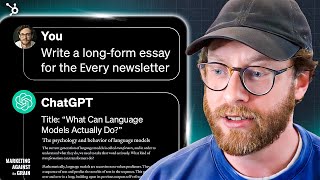
Dan Shipper, founder of the Every newsletter with 54,000 subscribers, walks through how he uses ChatGPT, Claude, and other AI tools to write, edit, and repurpose content at scale. He transcribes voice with Whisper, outlines and edits with ChatGPT, and built an internal tool called Spiral that converts articles into headlines and tweets automatically.
Chapters
On today's show, we're diving deep into the everyday practical use case of AI. I have an amazing AI expert, Dan Shipper. Dan hosts a podcast where he talks to everyone from all walks of business on how they use ChatGPT. So you know, we're going to break down some of the best ChatGPT use cases. We're going to talk to Dan about how he uses AI in his business and we're going to break down what the different large language models are best at and how you should think about using an action packed show. Let's get into today's episode. Welcome to Marketing into the Grain. I'm your co host Kip Bodnar, CMO at HubSpot. I'm flying solo with my guest Dan Schipper. Today, Kieran Flanagan could not join us. He is on new dad duty and we'll be back on an upcoming episode. I'm so excited to welcome Dan to the pod. Dan, thanks so much for joining us on Marketing against the Grain today. I'd love to kick off if you could explain to everybody what you're working on right now. It's called Every, but what the heck is it? Give everybody the background.
Well, thanks so much for having me. Is a daily newsletter. We publish long form essays about business, technology and the examined life. So every day you get a really great high quality essay that's sort of like the stuff that you get on Substack or Medium. But we have an editor, it's highly curated. We care a lot about the craft of writing and we care a lot about writing things that are really useful for people who are building in technology. I specifically write a column for every called chain of thought where I cover AI stuff. I sort of drill into ChatGPT and specifically thinking about ChatGPT and other sort of chat models for creativity, for thinking, for personal productivity, for personal development, for understanding yourself, all that kind of stuff. So that's the like core of every. We have a bunch of writers who work for us or work with us and then we have a podcast. I have a podcast, it's called how do you use ChatGPT? Where I talk to really smart people about how they use ChatGPT and we even go like over the shoulder where you can watch someone use it or see their historical chats. And we've done that with everyone from the economist Tyler Cowan to Reid Hoffman, the co founder of LinkedIn, to film directors to writers. And so it's a really, really fun way for people to get ideas about how to use AI in their work and in their life. We also run courses. So I run a course called Maximize youe mind with ChatGPT that I run with a clinical psychologist, Dr. Gina Gorland. So that's another part of the every business. And then we have a consultancy where we work with companies to help them implement AI, and we also incubate software products. So there's a lot of. There's a lot of stuff going on and happy to dive. Any part of the business you want to talk about.
You've got a modern media empire going on, which is a topic I love. We've got something similar going at HubSpot with the Hustle and all of our properties. One of the reasons I was really excited to talk with you today is I was at south by Southwest a couple months ago, and it was a very interesting climate where, like, there was a real tension between the creatives and the kind of what I'd call AI optimists. People who are really interested in AI, positive about AI versus the music, the film, the graphic design. Those folks like Peter Deng, who runs ChatGPT at OpenAI, got massively booed because there was just this very anti AI sentiment at this event. But what's interesting to me is you are living at the intersection of those two worlds. You care very much about the craft of writing and creativity and all the things that those folks care about, but you also are a huge AI optimist and proponent. Can you just explain for us why and, like, help decode this, like, confusing thing for me and maybe everybody listening today?
It's a. It's a great question. I mean, I think that it's totally legit for people to be worried about it and to be afraid and to ask tough questions about how it will affect their jobs or. Or how it will affect art or creativity going forward. I think for me, fundamentally, I just, like. I'm just curious about this stuff. It's like, it just lights me up. I'm just like, holy shit, this is amazing. Like, I have magic powers, right? Like, now I. I can build an app. I can, like, I can make a film. I can, like, draw something. Like, all this stuff that, like, I might have had ambitions to do before, but maybe not all of the skills or maybe not all of the resources to do. And so I am like. I feel like a kid in a candy store, and I just, like, can't help myself. But I think also, when I think about how to deal with, like, new technologies, what's the most interesting question for me is not, like, what does this destroy. But like what opportunities does it create for us to make things that we couldn't make before? And I think there's tons and tons of opportunities. The fact that people are afraid of it and that there's a little bit of like a stigma to using it actually increases my belief that there are opportunities because it means that fewer people are going to be like going there and like finding the low hanging fruit. And I think anytime there are new technology revolutions, there is the ability to like create foundational works of art and create creativity with those tools that sort of define that genre and that era of creativity. You know, there's a reason we still watch like Hitchcock films. Like he's the first, he's like defining that era of filmmaking which hadn't really been done before. So that makes me, that makes me kind of, kind of excited to, to, to be playing in this arena.
Before we get back to today's show, here's a quick word from HubSpot. If you're a marketer, one thing I know for sure is you love data and boy do we have data for you. The 2024 State of Marketing port is chock full of data and insights around the current trends that are shaping the marketing industry today. Things like artificial intelligence, you know, I love AI tools, personalization, influencer marketing, all of the topics that are key to getting a competitive advantage this year. It's going to make sure you're not stuck in old strategies and old tactics. So click that link in the description and get. Go get your free copy of the 2024 State of Marketing report today. Now let's get back to today's show. Yeah, so it almost strikes me that the exclusivity of making things is going way down, right? Because you get access. Like you just said, it's like, oh wow, I have magical powers. I can do things that I couldn't before. So if you were this highly specialized person who could do those things, I can totally understand why you might be scared, concerned, frustrated, different things. Cause you're like wait a second, what makes me special in the world is changing in some way. And like I think you and I are here as optimists basically being like, oh, we think that change is really positive because it opens up the world to make and create way more things, way better things and do more first time things, blaze new trails. Which I think is really valuable in all this, which is, which is great. My follow up question to you is like, what is the thing that happened to you that gave you conviction? Because there's a lot of people listening out there that are like, still kind of skeptical, still kind of worried, like, what, what was the moment where you're like, oh, okay, I got it, I got to go and I have to really do this.
That's a great question. I think it was really at the, at the very beginning of like sort of GPT3 era AI. I just started seeing people tweeting about it. And at the time, me and, me and my co founder, we've always like, thought about like incubating software apps. We've been a lot of things like that in the past. And at the time he was interested in incubating a, like a Google Docs replacement. And so he was sort of building that on nights and weekends. You know, it'd be really interesting if you just like put this GPT3 thing in there. And when we did that, you know, pressing a button and having. Having it write something for you was like, holy shit, I cannot believe that it's doing that right. And AI, like, you're like, it is.
A literal magic trick. It's crazy.
It's totally crazy. And we eventually launched that. It's now spun out. It's its own company. Nathan is, Nathan is running that as the founder, which is, which is really great. And. But I think that that moment was like a big light bulb of like, wow, this could be like, really, really cool for creative work. And it also is really interesting to like be on this, on this ride from, from that point, because I've had so many of these like up and down moments of like when you first see it writing, you're like, oh my God, it's going to totally replace me. And then you like really look at its writing and you're like, no, this isn't, this is not good. And then you're like, no, actually. But there's all these like little micro skills or micro tasks that I can have now. I'm like, way more efficient than I would be before. Or it can like help me do things that I might not have been able to do at all, but it's not going to totally replace me. And so I've been through all the like, emotional ups and downs and I kind of like feel like I know the ride that other people are on. I'm just like a little bit further ahead and probably I'm like, just maybe a little bit more like techno optimist or, or whatever where I feel like I can take advantage of this and, and do fun things with it. And that makes me like more excited Than. Than afraid.
Same here on the techno optimist side. So if, if you guys are looking for, for two people who are not that this is the not sure for you. It's cool to play with something and learn something, be optimistic about it. But like you're running a business and that business is about writing and content. And I want to know. We're going to get into the Chat GPT stuff and how to use chatgpt soon. But I want to know like, how has it changed how you make what you make? You're making a daily newsletter with a team of writers. How does AI made that better?
Tons, tons of ways. So I can, I can take you through every part of my process and also the process of other people at every.
Yes.
And it has like really changed every part of that process process. So if you want to start with like the beginning of the writing process, which is just ideating, it's like finding interesting ideas, right. I think AI is like incredibly good for I go take a walk and I just like blab about whatever's on my mind. And it. I have Whisper, which is from OpenAI and it will transcribe everything that I'm saying. And then I go take that out.
And that's transcribing it into the Chat GPT app.
You can do that. You can do it into chat into ChatGPT. I also, what I will often do is just take it, use it, do it a voice memo. Um, because sometimes the ChatGPT app crashes and if you have a particularly long ramble, you don't want to like lose your. Lose your work. Um, yeah, but, but yeah, then I transcribe it and then I, then I throw it into Chat GPT. And when I throw it into Chat gbt, like it's incredibly good at just like doing a bullet point summary of like, here are the things that you talked about or here are the interesting things, like that kind of stuff, which is really helpful for me to like find stuff that I want to write about.
So step one is it like, it takes the nuggets out of like the kind of stream of consciousness you're giving it, right? Like, hey, I'm just clear my mind dumping all this stuff and it's giving me kind of my own insights back to.
Yes. And then another part of that process which is more on the ideation process is like, I think it's an incredible like reading companion, right? Like if you want to write good stuff, you have to be reading good stuff. You have to be running into ideas all the Time and, and there's so many books and things like I love Wittgenstein, like this, you know, 1950s era philosopher and. Or maybe he's a little earlier than that, but. But his writing is incredibly dense and hard to read. And I've always kind of felt like, okay, maybe I need to go back to a. Maybe I need to go back to like a graduate level philosophy course and like take it in school. But I don't really want to do that. I can now just like go read Wittgenstein's Tractatus and take a picture of a passage that I'm unfamiliar with and then have it explain it to me like a college level or a PhD level professor would. And that's really amazing, right? Like one, just because, like, I'm a curious.
It's just incredible, actually.
It's crazy.
Such a simple use case. You don't think about it, right?
Yeah, it's unbelievable. And I think one, just as a curious person, that's like so fun. But two, I can write things that I wouldn't be able to write before because I can have ideas explained to me that I wouldn't have access to. And that's like so important without having to go take a class or whatever. And you know, a really simple example is when I interviewed Reid hoffman. He's a PhD, he was, he almost was a philosophy professor and he loves Wittgenstein. So like, in order to prepare for that interview, I was just like pouring over Wittgenstein with chatbots and like, I did a much better job than I would have ordinarily. Yeah, so. So that's sort of like the ideation phase. And then the next phase for me is like, often when I'm writing something, I will have like a running document of notes where I'm just like throwing stuff in there. I don't know exactly what it's going to be about, but it's all in this, like this mishmash of, of things, of ideas, quotes, like sources, like whatever little sentences that I like. And what I'll often do is I'll just like take that and throw it into ChatGPT and be like, can you find a structure here? Can you like find an outline? And it's like really good at doing that, which is great because I think that's one of the hardest things is like, especially for pieces that are really important, they've been working on for a while, figuring out what the structure is is like really hard. And you have to start. You have to. Often you have to start there. And ChatGPT is really good at finding the, like, really simple structure that's been, like, that's hidden in there that you just couldn't see because you're, like, too stuck in the weeds. And it has, like, taken things that, you know, it would have taken me such a long time to, like, find the right way to write this piece. And it's just like, here it is. That's the. That's the structure. And then I can just start writing, which is amazing.
The. The. The kind of almost inverse use case that I. That I do. It's like, you know how you're writing something sometimes and you're just like, you get in love with a line or an idea that's in there, and you're like, oh, this is so good. But then you're like, I don't know if this actually goes here in this thing. I'll often ask and be like, does this actually go with the rest of this, or should I parking lot this and keep it, but use it for something else? And I have found that that just makes whatever I'm working on so much better, because either helps me reframe it, or it's like, no, get that. One of the things Kir and I talk a lot about on the show is that AI is a very good editor, especially because it doesn't have the emotional connection to what you've been writing. And the way you do that can, like, help give you that clarity.
100%. Yeah. And I think, like, we'll get to editing in a second. But. But I think it's. I think it's really great for that. I think, like, when I'm in the writing process. So for you, maybe it's like, it's helping you figure out. Yeah, is this. Is this sentence right? Another thing that's really helpful for in the writing process is helping you figure out what you're trying to say or what you actually think. So an example is sometimes I'll be like, I was writing a piece maybe five months ago, and I needed the right simile. And so I just asked ChatGPT like, okay, here's what I'm trying to express. Here's my idea for a simile. And then I was like, come up with more options. And it came up with options. But I realized that the simile that I was making was the wrong kind of simile. It didn't fully express the idea I was trying to express. And I was like, actually, that's not the right thing. And I was like, can you do A simile in this new way. And so like just being able to chat with can come up with ideas and sometimes the ideas are gold and that's like really awesome. But also being able to talk to it, you sometimes realize what it is you're actually trying to say, or sometimes it'll point it out to you. And I think that's really, really helpful because, like, it's really helpful to also talk to writers or editors. Like, we have a lot of those people at every. And I love that. But they're not always available at like 2am When I'm like trying to figure out a piece on a deadline. And that is like super awesome too is just having that always available partner that can help you figure out what you're trying to say.
And it's a partner that's like, it's not distracted working on its own thing that's on a deadline for. It's like it's kind of there at the expressed purpose of like helping you 100%. So you kind of went through ideation, thought organization, kind of the editing and crafting of an article. Anything else that you all are doing in terms of like creating a daily, basically a daily newsletter, daily long form.
With AI, a ton of things. So what. What I find is that as an editorial organization, I think probably HubSpot is similar. And there's just every company has these kinds of tasks is there's some core amount of creative work that we're doing and then we are translating that work from the formats in the original formats in into lots of other forms. So an example might be we have to take an article and turn it into a headline for that article. Or another example might be we need to take an article and turn it into a summary for we send out a digest email every day. We need to send it, turn it into a summary for that. Another one is take an article and turn it into a. A tweet. Another one is take a podcast and turn it into an article or turn it into show notes. And all of these are like fundamentally summarization tasks, but they're hard to do well. Like, they require taste and expertise and experience. And you have to have the tone and personality of the publication of the writer to do it. And we use, we use ghostwriters for that. Those ghostwriters are amazing. They're hard to find, they're hard to train, and it's hard to get it right all the time. And for them it's a little bit of like a drudgery task. A lot like it's sort of rote.
It's not exciting.
No one really wants to do that that much, at least not over and over again. And what I found recently is Claude is actually a good enough writer to basically get like 70% of the way there for any kind of task like that. And so I built us this internal tool called spiral. How the tool works is if there's any kind of, like, task like that where you're taking an input and turning it into an output reliably, it helps you build a prompt that just works for that kind of conversion task. So if I want to convert an article into a headline, for example, I can create a spiral and I give it a bunch of articles with their headlines and say, this is an article and this is the headline. And that was good. These are, these are good examples. It will pull out the patterns in those examples and then it will create a spiral that anyone can use and I can share with the team and they can just paste an article on there and it'll come up with a bunch of headline ideas. Um, same thing for like podcast transcripts to tweets or, you know, so we have this like, library of spirals now. And the, the kind of amazing thing is for the. For those writers, it sort of starts them at like 70%. So they can, instead of doing the, like, facing the blank page and like, you know, figuring out, okay, like, what's the main idea of this podcast and how do I turn it into an article? They are starting with like an article that's like, pretty good, and they can spend their time, like, really polishing it and really taking it to the next level or doing like, net new creative tasks. And I think organizationally, the like, really incredible thing about it is it helps us like, imbue our taste and voice into every part of the organization without necessarily having to retrain people. Because it's all legible inside of the spiral, right? Like, the spiral pulls out patterns and the examples we give it, we can always change those patterns or change those examples. And everybody has access to that whenever they need to make something. And I think that's really, really cool. And it's. It's definitely changed how we make things.
And so for anybody watching, it's really like, if you have a repetitive task that you know you're always going to do, if you can find a way for AI to do any part of it, even if it makes, even does 30% of it versus 70%, like spiral, like, that's hugely valuable because it's saving you a Bunch of time, especially time from folks who really don't want to do it. And the work can be kind of inconsistent or you might be in between people or those types of challenges. Right. And that's pretty remarkable. I was just thinking, I was like, oh, you know, what I want to do is I want to get a group of my team together and just take a day or a week and be like, let's go through all the work we do and then why can't we do that with AI? Is there a reason we can't do this thing with AI? Okay, but if not, how do we build some lightweight prompts or workflows to basically at least do part of it with AI? That's one of the big inspirations to me and in this conversation with you is like, AI is going to get 10, 100x better over the next few years, but it's still good enough today to do a lot.
And I, and I think also if you're using it today, you will be much in much better position to use it well tomorrow. And that's, I think that's really important. And I think people, there's this weird trade off, right? Like if you are doing your job and you have a limited amount of time in the day and you have a choice between like doing the job in the way that you know how, where you know it will go well and you know you won't waste time versus like using an AI tool, you're probably going to just like pick just doing your job so that you can like actually get the work done. And I think it's really important for people, maybe people individually or maybe companies to like give themselves permission and space to just like mess around with this stuff.
Yes.
Because if you, like you said, like, if you just take a day and you're like, we're off the daily publishing grind, like, it doesn't matter if this doesn't work. Like, all I want you to do is like play around with this. I think it's very likely for people to get to those like, wow moments where they're like, oh my God, I didn't even realize I could do it with this. And then there's like all these possibilities going off in their head that, that they wouldn't have run into otherwise, but they just need some space to get curious and creative that is like sort of risk free.
You got to get out of the grind. And they got us. They got to get out of doing like, hey, I'm doing this high stakes thing and I can't Afford AI to mess it up for me. So I'm just going to. To, like, keep doing it the way I've always done it.
Right.
Which is the. The mindset. Then you wake up three years from now, and you've never really adopted AI and the whole world is going to start moving you by, because AI is going to be the thing that facilitates how we all work and get more productive.
Totally. And I think a way to think about this, I think the good. The best sort of mental model for it is in a lot of ways, the way that creative work is changing is we're going from sort of sculpting to gardening. So if you're a sculptor.
Oh, I like this.
Yeah. If you're a sculptor, every single thing that happens in the. In the transforming a block of marble to, you know, the David or whatever, you're doing that with your chisel. If you don't have a team assistance, but you're doing that with your chisel. Right. It's like you have control over every little thing. And that's how creative work has been for a long time. But now that we're sort of becoming model managers, we are moving to a world where a lot of what we're doing, especially at the start, is gardening, where a gardener isn't like, creating every. Every petal on it, on the flowers or every part of the tree or every part of. Of the shrub. Right. What the gardener does is the gardener sets up the conditions for a seed to grow into a plant. So you're paying attention to, like, what's the soil like? Does it have enough light? What's. How much water is there? All that kind of stuff. And so model managers are like, what. What you have to become good at is creating the right conditions for the AI to. To do the work. Get that first draft, and then what you can do is you can go back into sculptor mode and be like, okay, now, I want to get all the fine details right, but I think that's a bit of a different mindset for people that they have to get used to. And it's actually a lot more like managing a person. So the more you can think of yourself as having hired an intern that's sometimes brilliant and sometimes not, and you have to get used to what the intern is good at, and they get upgrades every six months, the more successful I think you'll be.
Okay. I love the sculptor versus gardener metaphor, but I have to ask, have you seen the AI sculptor thing going around?
I haven't now.
All right, hold on. I Got to show you this. This is a total detour. But so Stripe had their big event this week and they unveiled this big marble statue.
I did see that. I did see that. Yeah, yeah, yeah.
And well, so Shield, who's a VC on Twitter here, I'm going to, I'm going to butcher his last name. Mohanat basically said that that statue is carved by Monumental Labs, which is an AI robotic sculpture. And here's the video of it. You can get a marble life size bust for $6,000, a life size figure for $32,000, or a monumental figure for $95,000. And I proceeded to slack here and I was like, kieran, once we get to 100,000 YouTube subscribers, we are going to get a marble bust of the show made. And in the background of one or both of us. But I thought this, like you just brought that metaphor up and I was like, he has to see this. If he hasn't, it's pretty.
I love that. You know, it's, it's marble busts for everyone. Democratizing marble busts, you know, and I think that it's the same trend we're seeing with writing, with, with films, with all that kind of stuff. And I think there's a, there's a world where you're like, oh, that's bad. Like, we want, you know, handmade sculptures to exist or hand, you know, handmade carved objects to exist. And I think that that's totally true. I just think in a world where this robot exists, you can buy one robot made when Your show hits 100,000 subscribers, which you wouldn't have been able to do.
And honestly, human have been able to do otherwise.
Exactly. Like. And human made sculptures are still going to be more valuable. Like, people care about things that humans make. So I think there's, I think, I think it probably expands the market for sculptures rather than, rather than contracts.
It also. I could not have told you how much a sculpture actually costs. But if so, if $6,000 is 85% cheaper than handmade, like bus sculpture of a human, like, that's sculptures turns out really expensive. Who knew?
Who knew?
I didn't. I should have, but no, no idea.
But it's, it's fun to live in a world where I could afford a marble bust of my own head. I just like that.
I think that, yeah, like, if people were to ask us why we're optimists on this stuff, like, this is a great example where it's like, I don't know that I need this, but it's fun that that's a possibility now in a way that just wasn't possible before.
Totally. And I think that that is also this. The fact that that creative work is less expensive to produce. There's an underappreciated aspect of that, which I. Which I've found in a lot of people I've interviewed. So, for example, I interviewed a filmmaker. His name is Dave Clark. He's amazing. And he's like a traditional Hollywood guy who has. He hasn't made any like, huge blockbusters or anything, but he's been working in Hollywood making commercials and short films and all this kind of stuff for a long time. And he started making AI movies. And I was asking him, like, what the benefit of making AI movie is, and he was like, well, if I have an idea for a movie, I can just make it. I don't have to get it funded. I don't have to convince anyone. And he's done that where he's made movies that no one would have wanted to fund. They've gone viral on the Internet. And then, then he gets meetings with the Hollywood producers to be like, okay, maybe we could fund this thing. And so it creates this world where anyone can like make. Make something to prove that the idea is good without having to like, ask for money or without. Without having to have years and years of experience. And I think that is like, super cool and a super underappreciated benefit of lowering the cost of producing this type of work.
Yeah, your whole point here is like, the cost to prototype or test is approaching zero. Right. And if that's the case, you get more ideas out there, which is awesome. And then we basically, of those ideas that go out there, we can actually fund and pick the best ones. And we're likely going to end up with a better overall quality of ideas because we just have a bigger pool to choose from, which is pretty awesome.
100%.
Okay. You host a podcast all about how to use ChatGPT. If we didn't do a real segment of this show to get like the best 5 to 10 chat GPT tips, people would be really angry with me. So I'm. I gotta go there.
You.
You've had a whole host of guests on. You've done the over the shoulder thing. Like, what is the master class of Chat GPT?
Wow. It's. It's gonna be a little hard to. Just to do all of, all of what you need to learn in, in 10 minutes, but I think we can do a lot.
So we can do a handful that I think will Help illustrate what's actually possible for.
Cool. Yeah, I think, I mean, honestly, like I would start with the basics, right? So one basic thing that people tend to not do is, is they don't press redo. So you should be pressing redo whenever you do a prompt and like just go through the space of possibilities because like the first response that you get from it, it's only like one, one response. And it's going to be like, statistically it's going to produce new things and so sort of traveling the space of possibilities. I think it's like really important and people feel like bad about doing that or they don't even realize it's a thing. But I think it's, I think it's a really, really important part of prompting. I would say, like prompting ChatGPT, you want to start really simple. You want to add complexity over time. So you don't want to go and be like, okay, like I want to turn my, my tweet into a novel and I'm just gonna be, I'm gonna put the tweet in there and then I'm gonna like, I'm gonna like write a whole long prompt about exactly how to do that and then I'm gonna press enter. Because you're just gonna get a bad result, right? You want to like start with a very, very simple, quick and dirty thing as quickly as you can to see the result that you're gonna get from ChatGPT. You wanna, you wanna press redo a couple times to like sort of travel at space of possibilities. And then what you can do is you can refine so you can go back and press edit, which people very rarely do, and try again with a slightly updated version of your prompt, giving it some more details.
So instead of a follow up prompt, you're saying like, go back and make that original prompt.
Exactly. You can add.
Nobody I know does. Literally no one I know.
Like, you can add more details. You can be like, if you notice it, making a particular kind of mistake, you can start to add something, add a rule into the prompting. Like, I don't want you to do it this way, I want you to do it this way. Right. Another thing to do is, aside from adding rules, is giving it examples of what good looks like. And those are specifically input output examples. So if I want it to take a podcast and turn it into a tweet, or take an article and turn it into a headline, what I'm going to do is I'm going to find a bunch of examples of that, that look like the thing I want it to do. So I'll get articles and, and those headlines and I'll put those into the prompt and do it like one at a time. Like don't put 50, because doing it one at a time, you can see what changes and you can start to learn like what's working, what's useful, what's not. So giving it examples, giving it rules for what to do and not to doing it incrementally, hitting redo, pressing, edit, all those things are like, I think the like, sort of like the first step to like really good chatgpt usage.
All right. Once you've figured out the basics, like what should people actually be using ChatGPT for? The majority of people that I talk to, they're like, oh cool, yeah, yeah, I've used ChatGPT, but I don't really use it on an ongoing basis. I've tried it. Like it's fine, it's pretty good. And I think you obviously, and a lot of people you interview on your show have had a different experience than that. So like, what are the, what are the other things that people should like maybe try to do every day for a week to like really understand the value there?
That's a good question. I think that's a very, that's very contextual. So I can, I can give some like high level things that I think are really cool that a lot of people get value out of and I'll do that. But I also think it's like, it's a super contextual thing where I would notice times in your day where you're doing something repeatedly that's like sort of rotating. ChatGPT can often do that. So all the summarization thing we've been talking about, I would also notice times in your day where you're like kind of confused. You're like, I don't know how to do this thing. That's a really good thing to ask ChatGPT about. Even sometimes I think a lot of people get stuck because they're like, well, I don't even know how to ask ChatGPT for this thing. Like I'm confused about what to say or what to ask. Asking that is enough to get started. And I think that's really, really important. And for me, like one of the things that I think ChatGPT is most underrated for is understanding human behavior and human psychology. And that can be other humans and it can also be yourself. So on the other humans front, ChatGPT has like incredible theory of mind. It's very good at understanding and simulating how other people think and feel. And so if you're like in interpersonal situations where you're making like high stakes decisions, feeding in the information about the different players in the situation or the emails or the text messages or whatever, it's like actually really useful for like unpacking those situations and helping you make decisions. It's very underrated. I think it's also quite good for helping you understand yourself so, and therefore like make better decisions and achieve your goals and all that kind of stuff. So when, when I, you know, I teach this course. Maximize your mind, which actually be t. We think of ChatGPT as being two things. One is a really good mirror and two is a really good mentor. So on the mirror front it can really help teach you like, what are your strengths, what are your weaknesses, what are your psychological patterns, what are your values? All that kind of stuff, which I think is really important because, you know, I think in a lot of, in a lot of ways you are not what you build, you build what you are. And so knowing who you are is like a really, really important like step to making anything in the world. And then on the like mentor front, it's just really good at, if you're in a particular situation, like helping you understand, okay, like what are, what are my psychological blockers? How do I normally make mistakes in these situations and how can I, like how can I move through it or how can I stay focused on my goal? And one of the big things for me in that, in, in that is ChatGPT's custom instructions feature which basically like gives ChatGPT context on who you are. So what, what. One of the things I use it for a lot is there are certain kinds of situations that I struggle with. So I'm a, I have like people pleaser, personal personality type and, and it's hard for me to say no. And I, I've noticed in, in therapy that a really good question for me to ask in a situation to like, am I doing this because of like people pleasing or not, is to ask myself what would I say if I was not afraid of feeling guilty? And so like removing the fear of guilt from a situation with people makes it easier for me to say no. But sometimes that's like just like, it's a realization that you have and then you just like lose it. It's like hard to remember, but I just throw it in my CHAT GBT custom instructions and I'm like, anytime I'm in an interpersonal situation, I'm making decisions, please ask me this question. And I use ChatGPT all the time for that kind of thing. And it's really good at just the right moment. It's like, by the way, what do you think you would do if you weren't feeling guilty? And I can't tell you, just that simple little nudge is so helpful. So stuff like that is great.
Well, what's interesting about that, that's fascinating to me is there's a lot of talk when it comes to AI about how we as users can prompt the AI. And what you're basically saying is like, hey, use special instructions to have the AI prompt you. And that can be just as if not more powerful.
Yeah, 100%. And I think that that's coming, coming more like I imagine that it will be more deeply integrated into our browsers and into our operating systems and all that kind of stuff. And the opportunities for it prompting you are going to be much, much more frequent.
Okay, before, before we, we close out today's show, we've talked a lot about AI, we've talked a lot about workflow. ChatGPT, I heard you talk about Claude earlier and how you use Claude to write summaries. Could you give the people, give the marketing. It's the grain listeners, your summary of kind of where the LLMs out there sit for you that you use. Because it's more than just chat GPT and kind of what you use different ones for and what you think, think different models are better at so that like, if folks are like looking where to, where to maybe go for a specific task, they can get some clarity there.
That's a great question. It's really important to know your models. It's changing all the time. So this is like a point in time.
Yes, this is a today we're recording in April of 2024.
Yes, I think for me like ChatGPT is like my sort of go to. It has a really, really good mobile app. It has custom instructions, it has some of these like UI features like the redo button and, and stop generation button and the edit button that like Claude for example doesn't have. Um, So I use ChatGPT like probably most often because I think it's just good enough for almost every like day to day task. Um, I also use it for coding specifically. Um, I really like ChatGPT for coding. I have a custom GPT that a friend of mine made that I think is, is, has a lot of good defaults for using it to build simple little apps. So I think it's the best coder right now. Claude is really fantastic for writing and it also has the longest context window, or not the longest, but it has a long context window. So it's quite smart. It's really good at writing. And you can put a lot of text in it. I think you put like 300 pages of text or something in it. So I was on the phone with my lawyers before this and we had a question about a contract and the contract is like, like, I don't know, a hundred pages. And they were like, we're going to go check. And I was like, no, I will just ask Claude. And I just put it in there and Claude answered the question, you know, and that saves a lot of time. Everyone's happy. I mean, maybe the lawyers, maybe the.
Lawyers aren't as happy, but lawyers definitely wanted a billion. They don't get to now.
So Cloud is quite good for that. Although obviously you always have to be careful. Like it can, it can still hallucinate, it gets things wrong, all that kind of stuff. This is not legal advice, but. And then Google Gemini, Gemini is really cool because it has like a million million and a half tokens in its context window. So it's by far the longest context window. And that's sometimes useful for, I don't know, really crazy stuff. Like if you want to take all the journal entries you've ever written and throw them in there and ask it questions, you can do that. So I use it.
Let's break that down just a little bit because I think not everybody's going to understand that when we talk about context window and what we can do can put into prompt an AI or large language model. In this case, it's kind of like the short term memory for that model. Right? It's what that model can know about you and the situation kind of in that moment. And if you have a complex task or question, you need it to know a lot. And if you don't have a very big context window, it's kind of like hard to get the depth of response that you're looking for. Is that like, is that the right way to think about it or do you think about it?
That's sort of, that's, yeah, that's, that's basically right. Um, so the context window is, it's what you put into the chat box plus the length of the response. And, and the, what you put into the chat box is usually like the, the, the vast majority of the context window. Usually the responses are capped at like, I don't know a couple, a couple hundred to a couple thousand words. Um, so, so the vast majority is, is, is the, the, is the prompt length. And yeah, I think it's, it is sort of like the, sort of like the, the, the short term memory for, for the model. It's like it, that's the hard information it has about what you want it to do or, or what you want it to summarize or, or whatever. It has a bunch of like latent information which is like sort of stored up from its, its training, which is sometimes a little bit less reliable. So if you want to ask about, if you want to ask it a question about something, you want to put, put as much information about that thing into the context as you can to like make sure that it does a good job. But if you have limited context, you have to decide, okay, like what's going to go in there? How do I pick which sources of information, all that kind of stuff. And that lowers the response quality basically.
And so you're saying you use back to, back to Gemini. You're saying like Gemini has an extra long context window. So if you're doing things where you need that, that's really the use case in which.
Yeah. And like, I don't know, one of the, the cool tricks of Gemini is it's multimodal, which means it can convert text to image, image to text, video, video to text, that kind of stuff. So you can throw in a YouTube video and be like, can you annotate this? And it will annotate the video in whatever way you want it to, or output a transcription or tell you for each scene in the video what was on the wall behind the person who is in the scene. It will do stuff like that, which is kind of crazy. I have not found very many day to day uses for it, but I think they're out there.
We covered all types of ground. Dan, I really appreciate you joining us today on Marketing against the Grain. Before we go, is there anything else that you feel like we didn't cover that we need to hit or do you feel like we hit it all today?
I think we hit most of it, but I really do want to sort of like underscore the thing that we started with at the beginning is like how important a spirit of like exploration and curiosity is to these things. Yeah. And how kind of how just like cool it is that I can go and like make an app in like an hour that would have taken me days. And like people who couldn't make apps at all are Making them like, I have someone on my team. He's not technical at all. And he built an app for us that we use internally in like two days. He has no idea how it works, but he just built it with ChatGPT because he knew what he wanted and he had enough kind of like, stick to itiveness to do it. And I think we're just on this, like, we're just in this incredible time where if you have enough curiosity, you have an exploratory spirit, you can make any kind of creative work that you want to make. And I think that that is so awesome. So I hope that the people who are listening to this just, you know, take some time to try it out, because it's really worth it.
Set some goals for yourself of things you want to learn or like, hey, I want to do, you know, one thing with Chat GPT every day, what have you. And then kind of your other point is, like, if you have a clear goal, kind of grind it out, work with it, iterate on it till you actually get what you're looking for. Because that is like the aha moment of like, oh, this is actually possible. And if you expect, like to just put in a few sentences and get the perfect thing, like, that's not what's going to happen a hundred percent.
Um, I think, I think it's really important to remember that what you put in is what you get out. And so if you're, if you're putting good stuff in, you're going to get good results. Um, and also these things are changing very fast. Like, what was possible, what's possible now was not possible a couple months ago. And so I think that there's this tendency to, to have a little bit of capability blindness where you're like, I tried that but before, and it didn't work. And so as new models come out, like, keep trying things, because in a year or two, some of the things that were totally impossible are going to be possible. And I think that's really, really important to, like, to know and stay on top of.
I love that. And it's like, you can even just set a reminder like, hey, once a month, I want to try this and it's eventually going to be possible.
Right?
And even if it's years before it's possible, gets you out of the mind mindset that like, oh, this technology can't do what I want or I don't need to pay attention to it yet it gets you in that exploratory mindset, which I think has been one of the core themes of the show today, and I deeply appreciate that from you, Dan. And thanks so much for joining us on Marketing against the Grid today. It's been a blast.
Thank you so much for having me. This is awesome. I really appreciate it. This data is wrong every freaking time.
Have you heard of HubSpot? HubSpot is a CRM platform where everything is fully integrated. Whoa.
I can see the client's whole history. Calls, support tickets, emails. And here's a task from three days ago I totally missed HubSpot Grow better.
More from Patrick



A NEW BREED OF PARTNER: The Partnership Ecosystem Model Journey of Patrick Biddiscombe, Part 1








Customer Success Workspace: Never Lose Sight Of What Matters Most | HubSpot Spotlight