How Stories Can Break Down Boundaries | Chimamanda Ngozi Adichie
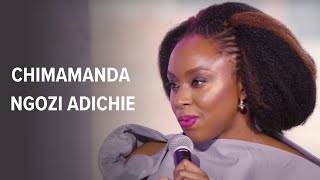
Chimamanda Ngozi Adichie talks with Laura Moran about storytelling and how stories break down boundaries. They discuss her writing process, her views on diversity in media and literature, and why the stories we tell matter.
Chapters
Thank you all for being here. Thank you for being here.
Thank you.
Hi, everyone. Welcome to the Inbound Studio. I'm Laura Moran, your host, joined by Chimamanda Adichie. Thank you so much for joining us at Inbound 2018.
I'm happy to be here. Thanks.
Chimamanda, you're an author, and you've written some really prolific stories to two that stand out for me are Americana, and we should all be feminists, which I know started as a TED Talk. Can you just talk a little bit about the role of storytelling for you and have you always been a storyteller and how does that all come about?
I have always been a storyteller. I don't remember a time when I wasn't interested in stories, when I didn't want to write and read stories. And so I kind of think of it as, at the risk of sounding precious, what I'm supposed to be doing, what I'm here for, to tell stories. And I just find that when I write and read, because reading is as important to me as writing, that there's a kind of joy it gives me, and it's a way of kind of trying to make sense of the world, you know? And also, I just believe in stories. I believe that stories are powerful. I believe that much more than theory. Right. So we can talk about sort of things about the world when we turn them into stories. I think that's when people actually start to connect and understand, and that's how we can start to break down boundaries that get in the way of people connecting with one another.
You have a popular TED Talk that's called the Danger of a Single Story, which I think is incredibly profound, and it's true across all facets. Can you explain that idea just a little bit for the audience and talk about how you, in your work, really aim to bring in different viewpoints that allow for diverse stories to be told?
I think the first thing to say is that I'm an unrepentant eavesdropper and that I really recommend this for everyone, especially if you're interested in writing. And so I'll sit in a cafe and people are doing their thing, and I'm pretending that I'm having a cup of tea, but I'm actually just listening and making notes. And I think that's one way to kind of get a sense of. And I've just heard the most interesting things you don't want to know. But it's also really that I'm a watcher, that I watch the world. I listen and I think of myself as a lifelong student. I'm always sort of wanting to know and learn. And I think as a storyteller, that's helpful. But also fundamentally, it's just knowing that, you know, in the end we're human. Right. The ways in which we go about trying to fulfill our desires are different. But those desires, I think, are fundamentally the same for everybody. And keeping that in mind as I write, having that as sort of my central guiding light, I think is what I like to think it's helpful.
What are your goals for your audience? Like when you're sitting down and writing a new book or writing a short story, whatever it might be, how are you thinking about the audience that's going to read that as you're working on it?
I don't actually think about audience.
Who do you think about or what do you think about?
I'm thinking about, is this page bullshit or is it okay? I'm thinking about the sentence isn't very good. I'm thinking about this character isn't doing what I want this character to do. And I say that because when I write fiction, it really isn't entirely. It's not entirely conscious. And I think that's the thing, the wonderful thing about creating that there's something about it that's transformative, that I sit at my desk and when my writing is going well, I really lose a sense of time. But when I'm writing nonfiction, which is entirely different. So when I write essays and when I write sort of memoir pieces, I'm very much aware of audience. But that's when I self censor. So if I'm writing about people I love, I'm not entirely truthful because I want to protect them. Which is why I think that fiction is much more truthful than nonfiction. But in general, I hope that if people read my writing that they. Yeah, I don't know. I just hope that they get something from it. I mean, I've been surprised by the people who have connected to my writing. People I didn't necessarily expect to connect to my writing. And so it's hard for me to talk. I don't have. I don't have an idea of a perfect audience. If anything, I write for people who like the kind of writing that I like. Yeah. Whoever they are.
Do you have a, you know, between nonfiction and fiction, do you have a preference and do you. Or do you use one to communicate something and the other to communicate something? If that makes sense.
Yeah, I think. I think that's actually. I Think the latter. I think that they're really different. When I'm writing fiction, it's a different person who's doing the fiction writing. And nonfiction is more about trying to convince or to persuade or, oh, I have a point. Hopefully, this is the hope. Right. But with fiction, I don't have a point. I'm just sort of like, ah, let's see. So I think that's different. But I don't want to sort of pretend that I think that fiction doesn't mean anything, because I think. I think fiction is actually much more powerful than. And all of the stories. I mean, just looking at history, you think about how it is stories of human beings that made people start to rethink terrible, unjust systems like slavery. Right. That when we humanize stories as fiction does, it has a certain kind of power. And that power comes, I think, from just seeing the messiness of what it means to be human. Right. And so, yes, I certainly think that I'm two different people. I'm slightly crazier when I'm writing fiction.
I like that. How much of your work, like, how much of the stuff that you write down makes it to print and how much ends up in a garbage can?
Oh, you don't want to know.
No, I do.
This is the kind of thing that makes a writer just fall into deep depression. Because then you start to realize, my God, it's like 95% of it. No, there's a lot. And lately, what I've started to do is I go back to the old things I discuss. I don't actually put them in the trash. The wonderful thing about technology now is that it's in a folder that is labeled rubbish. I go to the rubbish folder and I look at things I've done in the past, because I'm thinking maybe I'll get inspiration. But I think the thing about writing, and I think this is true really, for any kind of creating, is that you have to make room for just the bits that are not very good, you know? And I often say to my students when I teach writing, write away the crap first. So sometimes when you start a story, that's not really where the story starts. Sometimes you need to discard the first page or the. You know. And I do that quite a bit. But it's not an easy thing. It's. It's a difficult thing because I guess we're human and we kind of want everything we do to be perfect. Yes.
How have you learned, like, that meter of, like, what's good, where to stop, how to know that the first few pages go in the rubbish bin and then the real work begins.
I don't know. I think you keep trying, you keep doing. I don't think there's a formula. And I do think as well, that you have to be open to yourself, by which I mean you have to be willing to listen to that voice. Because I think most of us know when something isn't good, but sometimes we choose not to know. So I try to be open to my voice. And I think it was Faulkner who said that you have to kill your darling sometimes. And so there are darlings that. I just think. I think this is so such a good sentence. But I realized it doesn't belong in the story. Right. You need to kill it. And so there's a kind of being. Yeah. Kind of being like a firm parent to yourself.
Oh, I like that. Do any of those things in the rubbish bin ever, like, get resurrected and turned into something that you.
Yes. Happened one time. Yes. So there's hope. So I would just. I would recommend. I would recommend. Don't throw them away entirely. They're terrible. Okay. But just put them somewhere. You never know.
You mentioned that you teach.
Yes.
If you had to choose, like, a handful of key takeaways that you would give to your students or anybody here about writing or the creative process, what are the pillars of that, those lessons for you?
I would say read a lot, read very widely to know what you like and what you don't like. And I would say be kind to yourself because I think it can be quite brutal to be. There's the kind of. The pressure that's self imposed most of the time that you have to create and it has to be perfect. And even that is something I'm learning to be kind to myself and also to revise, revise, revise. It's never done the first time. I just don't. I just believe in revision. I think writing can be easy. Rewriting is quite difficult. And it has to matter to you. I think that to get into any creative endeavor, you have to deeply care because that's the only way that you'll keep going. That's the way that you'll spend days without taking a shower. Because you're not that. I'm talking about myself, of course. I just mean one.
The royal.
You. Yes.
What do you read?
Oh, I read everything. I read. Well, I read most things. I have discovered what I don't like, so I now don't read them. And that would be science fiction and fantasy. Sorry. I realize but the thing is, science fiction doesn't need me because tons of people read science fiction. So science fiction is like, I don't care. I don't read science fiction. I don't read fantasy. It just doesn't work for me. But I read everything else. I read a lot of poetry, especially when I'm writing fiction, because I just find that it feeds my. My work. I'm reading a really wonderful memoir right now by a woman from her name is. I probably am going to ruin it. Sereng Wampong. Anyway, she writes about. Wait, someone knows her? Oh, okay. Sorry. I thought I knew anyway. But I read a number of books at the same time, so I'm also reading. I'm also reading a memoir, which hasn't come out because, you know, I get lucky and I get sent books in advance. Yeah. But it's by a brilliant, brilliant African American man. And then I'm reading lots of poetry. I'm reading poems by Mary Oliver. I'm rereading a book by Elizabeth Bishop, and I'm also reading a history of Cameroon in West Africa.
Are there other mediums beyond written word that you find particularly inspirational or turn to for different moments?
I'm not a very keen fan of music, sadly. And I'm very limited in my. In my ability to appreciate music. One must be honest about one's shortcomings. And so I guess I listen to like five things. High Life from the 1960s, Nigeria, Nina Simone and Joan. I'm a trading. And that's it. I don't know anybody else, but film I find increasingly interesting. I think film has a certain potential, especially in our age where, sadly, I think people don't read as much as they used to. So I think film has potential. And I'm drawn to film as a storytelling medium, not as a person who wants to create, but as just a person who wants to consume. So, you know, I do Netflix, but I don't know if anybody from Netflix is here. Can they just change the ridiculous, juvenile way that you can do thumbs up and thumbs down? I mean, there has to be some nuance, right? Because they changed it before you could do three stars or four stars. Now it's thumbs up. I'm like, are we 12 years old? Well, not all of us are.
Probably a lot of people on there are.
Yeah. I was going to give another rant about just how ridiculous it is that the whole society is youth obsessed. All right, I'll stop.
I don't know. Keep going. What drives all this work that you do? Where does it Come from?
I don't know, my great grandmother's spirit that speaks to me and guides me. I like to think she was known as a troublemaker, my great grandmother, because she pushed back against a lot of societal ideas that held women back. And I like to think that, yeah, I like to think that she. That she's present in my life.
Are there personal goals of yours or I guess broader reaching goals for storytelling or, you know, books in that way that you would like to see in the future, that you would like to see the industry or whatever you might call it, have more of or turn to?
Oh, yeah, I'd love to see more women in. In films in which women are not the sidekicks. I'd like to see different kinds of women. I'd like to see women of different races. I'd like to see more black women with natural hair. I'd like to see more women who are not skinny. I'd like to see more women who actually have breasts that look like normal breasts, not balloons. I'd like to see. See more women who. I'd like to see older women. You know, I'm very interested in learning, as I said earlier, and I think that one of the perils of a youth obsessed culture is that we don't have the opportunity to learn because you learn from people who've experienced things. And so I'd love to see more of that, sort of older women in roles in which they are, you know, resilient, beautiful, able. I'd love that. And just more diversity. I'm very excited, for example, about the film Crazy Rich Asians that apparently did quite well.
Did you read those books?
No, I didn't.
They're great.
Really? Maybe I should. Maybe I should. Actually, I was thinking I probably will now, but for me it's just proof of what I've kind of always known that people will watch a good film. People are people, people who watch a good film. And I hope that executives are listening and that they start to realize that it's wonderful if we can watch entertainment that mirrors the societies we live in.
Not to be youth obsessed, but knowing all these things that you do know now. If you could look back and give your teenage self advice for the future, what would it be?
I would tell her to stop worrying so much about what other people think. I think I spent a lot of time. I would tell her, yeah, I would tell her to stop worrying so much. I would tell her that she's not the only one who feels uncertain, that actually almost everybody else in the world feels uncertain. I think the thing about being a teenager, and I was a very moody and difficult teenager, an annoying teenager, I think. But I think it's that you think you're alone in feeling uncertain and not knowing. And I've come to realize as an adult that you're not alone, that many other people feel that way, and that's comforting. And I would also tell her to stop wearing bronze lipstick. There was that phase when I was growing up.
It had its moment.
Yes.
You're here with us in the studio. You're about to give the final keynote here at Inbound 2018. If you could pick one thing that you want to leave this audience with, what is that?
Should I go for the hopeful or the not hopeful? All right. I would say America is screwed. No, the message I would leave is that we can do better and that we should do better and that as a person, I want to do better and that I think it should sort of be the guiding light for us. We can do better.
I think that's beautiful.
I love that.
I can't wait to hear the keynote. Thank you so much for stopping by here before you make your way down there.
Thanks.
And thank you for being here.
Thank you.
Thank you, everyone.
Thanks. Thanks for being here.
More from Patrick



A NEW BREED OF PARTNER: The Partnership Ecosystem Model Journey of Patrick Biddiscombe, Part 1








Customer Success Workspace: Never Lose Sight Of What Matters Most | HubSpot Spotlight