How This GPT-4 Prompt Is Breaking a $257 Billion Industry
Kieran Flanagan and a co-host show how GPT-4 prompts can replicate brand-tracking surveys at a fraction of the cost. They test multiple models, demo aided awareness and NPS outputs, and argue marketers should build flexible infrastructure now for better models arriving in 12 to 24 months.
Questions this video answers
May 2, 2024.
"I do have a soft spot for GPT2."
Aided awareness: estimated ~65–75%; Net Promoter Score: estimated ~30–40 (ranges given by the hosts).
Chapters
Welcome to another episode of Marketing against the Grain. In this episode, we're breaking down. Is there a secret version of GPT5 out? We're going to show you some of the tips and tricks of how to use AI in your marketing. That and so much more. Let's get into today's show. Kieran, how we doing, my friend? How you living? It's been a while since we've had a. Just, just the two of us, no guests. We've had some great guests recently, so go back and check some of the recent shows. But like how you living?
I am busily, even as we speak, busily, trying to play around with the secret release that we has come from OpenAI. We think it's kind of like GPT 4.5 is a rumor on Twitter. I can, why don't we just like, get straight into it?
Yeah, get straight into it. Tell people what happened. Sam Altman had a cryptic tweet. I could pull, I could pull that tweet up while you're explaining.
Oh, let me tell you the full story because you and I talked off air about. I think one of the things is interesting for our listeners because it tells our listeners a little bit about us is because it really resonated with me, which is like AI is bringing out the best and worst of us. What do we mean by that?
We had, we had like a five minute therapy session on this.
I talked about this a little bit. You won't get this because you don't watch Three Body Problem. But like in Three Body Problem, there's this kind of civilization and they have like the stable time, the chaotic time. Right. And the stable time is actually a time where you, you can be happy and should be happy. It's a good time in your life. Like stability. Enjoy it.
Never happy there.
Yeah. Have some balance. I, I, unfortunately, I'm not happy there either. And I like chaos. Right. I've, I've said that. I don't know if I've said this on the show before or I said it to someone I was speaking to last week. I forgot who I said this to. But if I'm in a period of stability, I create chaos, like all around me, in my life, all around me. And so I need to be in a chaotic time because it brings out the best of me, but it also brings out the worst. Cause I get obsessed and I'm going somewhere where this story, I get singular focused. I know you do this as well. You're incredibly singular focused and can learn things very quickly because of that. So I'm in bed. Kip Hope gets up at half five in the morning. I play with her a little bit, and I look at my phone, which is something you should never do.
You should really terribly not do that, especially when you're with a cute little baby, Right?
It's an awful habit. So I'm like, oh, you know, and then I look, I'm like, what? New secret GPT model, half five this morning? And so I go hunting. I go hunting it down, right? And so Sam Altman had a cryptic tweet. He talked about the fact here, I got the.
I have the tweet up right here, right?
He loves GPT2.
It says, I do have a soft spot for GPT2.
Sam Altman has really figured out the social game, hasn't he?
He's slowly leaving it to X. He's killing it.
He's killing it on X. So if you want to. If you want to let me share my screen, I can show you what's going on here. So there's a place you can go. It's pretty cool, actually, where you can play around with all of the models. So Llama, you know, Facebook's big release came out. I think it was last week or the week before. You can go here and play with that if you want to. Wanted to. I think it's up here. The other thing, what, you know, people noticed, I think, yesterday or today, this morning, was that there was this secret model added GPT2 chatbot, and people started playing around with it. So you can go here, you can. I am prompted. And so you play with all of the different LLMs for people who are our listeners. I'm showing a screen. The screen has a dropdown. The dropdown allows me to pick any LLM model I want and then directly chat with that model. So you can like, be very first person to try any new model comes out. Very, very cool. Now I will put in a prompt. And so what I actually did when you were teeing up the intro is you and I talked about an app that I was thinking would be a really cool app for marketers. And I want to use this because it shows you how quickly things can move. So I asked Claude while you were doing the intro to build me a prompt for AI to build a project brief for that app. And I'm going to try to put the prompt into the GPT 4.5, which is rumored to be GPT 4.5 on this. Yeah.
So this is rumored to be a new model, but not GPT5. Like GPT 4.5 a big improvement on GPT4 but not a full turn to GPT5. Is that right what I think?
Yeah, GPT. Well I think people are just speculating because so you know people did Matt's quiz, there were some maths questions, people trialed with it, there were some coding questions and they saw that the performance was better than GPT4. So they the you know the kind of rumor online is that this is somewhere in between. Like they are started to put this out here to train it. So it's a step towards GPT5 but it's like somewhere in between. Now what I think will happen here for people following along on YouTube who are looking at my screen is I will get rate limited because I was trying it earlier on. Everyone is trying this and there's just not enough bandwidth.
Of course there's a lot of bug was because you know Sam's good at Twitter.
So here we go. It won't let me do it. It's pretty anti climactic but if for people who are following along on YouTube or your or listeners this would probably be a couple of days later you can go to the URL we put it in the show notes. It's chat.lms y-s.org probably we'll link it.
Up down in the description here. Before we get back to today's show, here's a quick word from HubSpot. If you're a marketer, one thing I know for sure is you love data and boy do we have data for you. The 2024 State of Market is chock full of data and insights around the current trends that are shaping the marketing industry today. Things like artificial intelligence, you know, I love AI tools, personalization, influencer marketing, all of the topics that are key to getting a competitive advantage this year. It's going to make sure you're not stuck in old strategies and old tactics. So click that link in the description and go get your free copy of the 2024 State of Marketing report today. Now let's get back to today's show.
That is what I spent my morning doing is we've seen this huge progression in models, right? We've seen Claude come out with some really great models. That's what I kind of use day in, day out. I have started to use Gemini Advanced. Someone put me onto that model. It's pretty, pretty great. And actually GPT4 has been relegated to like third place for me. So I used Claude. Then we'll use Gemini Advanced and then use ChatGPT Pro. ChatGPT Pro appears to have gotten worse over time and there's a reason for that. We can maybe do a whole episode, it's called Habsburg AI that I need to look into. Basically why Data, why LLM models get worse over time and chat. So chatgpt I think is behind. OpenAI is a little bit behind the curve right now. And so this would be, this would be exactly what we expect them to do, which is like come out with a model that blows every other model away. And maybe we can talk a little bit about the fact that, you know, the, we've talked about it before. The economic upside for companies and models is going to come way down over time because Facebook really changed the entire game by releasing Llama, which was just as good a model as any of the paid and they open source that, which is pretty huge deal.
The way I think about this. Kieran is one. It's interesting, right? The AI models are kind of penalized for being popular, right? Because they're trained on all the human interactions that like the more popular potentially the more volatile your model could be and in some ways could get worse. Which is what you're saying is happening with GPT4 and which is why you're using it less and using things like Claude a lot more. Right. But we know the pace of innovation is going to be super high and that whether this is GPT 4.5 or GPT 5 that they're testing through this kind of like very small scale audience, we know that we're going to be doing a show at some point about the release of four, five or five and walking through you all the things it's better at, especially for kind of marketing and business use cases. And that's just an inevitability because we are on this steady march of progress. The thing to remember is that AI is going to get exponentially better and the cost of compute to give everybody cheap access to the AI is going to get exponentially cheaper. So it's going to get better and it's going to get more cost effective to access like that is just a fact and we are just marching down that progress and we're seeing that now with the release of this secret release of a new model from OpenAI and we're going to see that just kind of happen from all the big LLM players.
The thing you and I have talked about is if you were pretty wise in this time, you would build for the model as it is in 18 months and 24 months time and use a Current.
Explain what you mean by that. You and I had a off air WhatsApp about that. I thought this was brilliant. Break people, break it down for people. What you really mean, like what should they actually be doing?
So I think what most people do is they take the model and then they look to see what use cases I can build around this model. And so for the most part these models are not great at customer facing use cases because they're too unreliable. The actual output is pretty inconsistent. And so you're not going to put it in your front and center, go to market or places like that because you're worried about the actual results. I think that's the wrong way to build for AI. Like for sure you should have some use cases that you can build with the current model in mind and you can put out live and use them. The other thing I would do is I would build use cases for where the models are going to be in 12, 18, 24 months time because I would want to be the first person to actually turn on those use cases when the models catch up to what I want to do. So the bet I would make is AI is going to be exponentially better than it is today, exponentially better today. And I will bet my entire career on that, right? That it's just a given, you don't need to question that. It's just a given. And I would build a certain percentage of the use cases with that in mind. And so I would say, okay, look across the entire go to market, across my business, where do I think AI is going to be most helpful in 12, 18, 24 months time. And I would build out all of the infrastructure to bring that use case to life and plug in the current model as a minimal viable version. And so I would look at the current model and I would put that into the use case and I would say cool, it's like good. It's not anywhere near customer facing or that I can use, but it's pretty good. And as soon as that new model comes online or a new model comes online, I could just plug it in and see the results get much, much better. This is why the startup ecosystem for AI sector is so much is so interesting, right? Because never before that I can think of a whole bunch of startups get increment exponentially better overnight. Overnight, right? When these models come out, they get exponentially better. Now there's a whole other downside to that, that if you are building some sort of wrapper around OpenAI or you're building something that OpenAI itself will do. With these models, you're just going to get smoked. Right. But the way to keep ahead of that is like, to build again for the future, not build for today. Sam Altman himself has said, these models are not very good. Right. If these are the not very good models, you should be prepared for the very good models. And that's the way I think about AI. So when I'm practicing and learning and doing things, I'm like, I don't look at it. That a lot of people go and say, that sucked. I looked at it and go, that's pretty interesting. I'll keep that one in the back pocket. And as soon as the model catches up to what I want to do, I'll just plug that back in again.
You know what, Kieran? I will. I want to share with everybody that you've really come a long way. When I met young Kieran Flanagan, he was one hell of a pessimist.
Oh, yes.
And one hell of a skeptic. And look at you now. You were like, Captain Optimism over here. You were basically like, look, this is going to get better. Like, 10 years ago, Kieran would have been like, oh, AI can't do what I needed to do. It sucks. I'm just going to ignore it. And now you're like, hey, first of all, I think it's pretty awesome. Everybody's kind of, you know, shitting on it, but I think it's. I think it's pretty great. And second of all, I think it's going to get way better. So I'm going to build the infrastructure now to take advantage of it. Because my point is here, people who are optimists and embracing this technology are going to end up way ahead of everybody else for the point I just made. They're going to have a lot of the infrastructure done that as the models get better and better, that they're just going to go live immediately while everybody else is playing catch up. And it's going to create this really large divide between kind of the AI optimists and the AI skeptics. And the AI optimists are going to get a really huge return on their optimism.
There's two. Two things that I have learned over the past number of years. And so one, the thing that really helped me actually was in 221, I really wanted to get into Angel Invest, and I. It was a thing I wanted to get better at, if you remember that time. And I. And since then, I've kind of done what I usually do, which is like, talk to people who are much better than me. Do trial and error, like figure out what my frameworks are, do a bunch of like get into, get into the arena, as Shamath famously said, and actually do a ton of deals. And you know what it's really taught me is you really like when you meet all these incredible founders, you really want to stand behind your conviction and you want to be an optimist about the future. Right? Like you cannot actually be a very good investor if you're a pessimist because you are back in companies who have these large visions. And I'm mostly investing in precedency stage. So you have to believe in their optimism that the future that they are trying to shape will come true. I think that's really helped me to say, well, if I have deep conviction about something, you want to stand behind that and go all in. And actually you want to be optimistic about the outcome. Right. And, and also there was a really great tweet. I don't know who it was from, but it was from an incredible founder I remember putting into my swipe file, which is like optimist gets paid. Optimists have much better outcomes financially than pessimists and I am a coin operated person.
So do you know what the quote is? A lot of people have said it. I forget who attributed to, but pessimists get to be right. Optimists get to be rich.
There you go. That is actually the quote.
That is the quote. That is the quote.
There you go.
Kieran, I want to stoke your optimism a little bit because everybody's out here kind of talking about AI being ads. Fine. Right now it can do some things. I want to show you a marketing use case that I was playing with last night that I think is actually pretty good and pretty close today. About a week or so ago, I was talking to an awesome founder raising around. If you're, if you, if you want me to connect you. Her name's Chelsea. She runs brand AI and she was talking to me about how some, she's been working with some academics and some professors and they've been doing a lot of research around kind of brand tracking. And brand tracking is traditionally done through these very expensive and slow surveying processes. Right. Where you go pay for a panel of respondents, you field a survey, you get all the data back and you kind of analyze that data and from there the output is normally aided awareness, unaided awareness. Maybe you might do a net promoter score. It might be kind of the key reasons people pick your products, things like that.
Right.
But it's, it's pretty expensive. Like you have to be kind of a capital B brand, pretty big business to afford to do that. And it takes a long time and most, most companies do it, do it quarterly. The really big ones can like pull it off like monthly. Right. But it's, it's slow and arduous. But I was talking to her and she was like, well, you know what we found? Like some of the folks I've talked to have found that like LLMs are with like within a couple percentage points of that survey method for those, for those, for that data. And I was like, wow, that's, that's kind of interesting. Like that would save companies a whole lot of money, make marketers way more agile if you could get real brand and product marketing insights for essentially free or close to free and basically in real time or you know, you could do it every week versus every month or whatever. Right. So she was working with a professor from UC Berkeley who did a big academic study comparing traditional brand tracking survey methods to LLM brand tracking reputation and found that they were like much closer than you would expect.
And so just query in the LLM.
Yeah. So I want to show you I'm about to blow your mind. I'm so excited about this. It's rare that I get to do something AI related that Kieran hasn't done yet. So like I'm very excited. So I was in, I started in chat GPT because as we said, I was like, oh this, this would probably be the worst result, right. Like because of how the current models are performing. But I find I like to iterate on prompts and chat GPT, that's just.
Me a hundred percent.
So I, so you'll see here I've iterated on this prompt five different times to get it to a place where I like. And by the way, if you're watching the show, we're creating a prompt library of a lot of the prompts we've talked on the show and we're going to be releasing those soon. So this, this will be in there. I did this for HubSpot because it's obviously the company I know the most information about and come. And Kieran, you having worked at HubSpot will kind of understand a lot of the nuance here. And you can tell me if I got the prompt right. Right. Which is, I was like, hey, I would like help your help in determining my brand awareness position. You have access to a large amount of consumer sentiment and intelligence in your training data. I would like you to help me determine some information for my company, HubSpot. And I go on to describe what HubSpot is, who we sell to. Cause I wanted to try to define the target market. And then I tell it who the decision makers for that product are.
Okay.
Then I say, I would like you to estimate what is our aided awareness, But I want you to do it specifically for companies between 200 and 2,000 employees. And I say, please, I give it more context. Please consider we're currently the number two player in the CRM market and have less aided awareness than the market leader. Please provide an estimated percentage of 0 to 100% and give me an estimate no wider than 10 points. Because my first prompt, it was giving me like 30, 40 point ranges. So I had to kind of cull it down to like give me a kind of a 10 point range. Then I asked it, what are the key reasons businesses select HubSpot over competitors? And then I was like, well, brand awareness, that might be interesting, but what about net promoter score? Could it give me a proxy for net promoter score? And I said, what would you estimate our net promoter score? And I have a typo in here, sorry guys. Of our customer base to be based on public sentiment. Please provide estimated numerical score for this request. Please make sure the range is no wider than 10 percentage points. All right, you following me? Is there anything you would have done different in that prompt?
First of all, I think this is a great example and the reason I'm looking across here is so I can see it on this screen. But this is a great example of, I think we put this in an episode. I put it on LinkedIn, which is people say ChatGPT Pro is not useful to me especially for strategy. And I said it's because you're not very good at strategy. So this is a good example of a prompt where you deeply understand the. The request like you deeply understand what you're trying to ask it to do. And that's the reason your results are going to be much better than most. The other part of it is, the only thing I would probably add is for it to summarize how it came to its conclusion. Right? Like tell me your sources.
Should I add? You want me to add that in there?
I think that's the thing I would add in, is like, please summarize, please give me your summarize a summary of how you came to the. To the conclusions you did. Because I want to see if it references any particular sources.
Please give me a summary of how you came to the conclusion for these questions.
Yeah, exactly.
Okay.
I do love this because LLM is just trained on the Internet and if you actually ask it for Aided Oriented Awareness, it's probably going to look at like how many times your brand appears in certain ways.
So obviously I know what these numbers are. I'm not going to disclose these numbers.
Right.
But I'm going to give us some directionality. But because of that I could craft the prompt a lot better. Right. And so I don't know, I think it would be harder if you're like, hey, I just don't know what my awareness, aided awareness or Net promoter score is. But I think if you went and fielded that once or twice, you could probably continue monitoring it with LLMs much cheaper. Because let me show you what it gives me, Karen. It's. It's saying right here that among business buyers company, it's estimated at 65 to 75%. That is not correct. But it's, it's in the ballpark of correct. Right. Like it's, it is not accurate, but it's not wildly inaccurate. And it gave me a nice rationale saying, you know, guesses who the number one player in the market is and it tells us what we've. That we've made significant improvements. Right. Why do people pick HubSpot? User friendliness, integrated suites, scalability, strong customer support and cost effectiveness. Does that sound right to you?
Yeah, I actually think it's. I've done some testing on it, picking why people pick certain products and I.
It acts pretty good.
Pretty good.
It's pretty good. And then estimated Net Promoter score based on public sentiment and typical feedback loops over observed online. HubSpot's MPS is estimated between 30 and 40. It is not that far off from that range.
It's not calculates that, is it just like looking at the average SaaS company as in within certain ranges and puts you in the average order.
But you have some historical data here. This is pretty good.
Yeah. But I wonder, is it just a coincidence that it's good? You know what I mean? Does it look good? Well, you know what NPS score is for SAS brands?
You know what, Kieran? I had the same thing. So you know what I thought would be a good, good idea to do? I was like, why don't I just do this at a different LLM, right? And you just told me Claude is the, is the one you're using the most. Right. So it's like, cool, well why don't I. And this is the prompt before we just edited a second ago. Why Don't I just take the same prompt, put it into Claude and see what I got Here comes back with a dated awareness number that's much closer to the current aided awareness. This is within a few percentage points this range. It is not like it's close ish, like it's a decent enough approximation and it rationalizes kind of why we got there. It picks the same, it picks the right criteria. Very similar to GPT4, easy to use integrated scalable solutions, good customer support, almost the same set of attributes. So one takeaway here is that like your product marketing attributes and the reasons customers choose your product or your competitor's product are pretty apparent in the market and an LLM's pretty good at identifying that. And it came back with the same Net promoter score range, which again is not that far off the current Net promoter score range. What I would say here is like this.
Do it for a brand. You could do one. One interesting exercise is to do it for another brand where you think the NPS score would be significantly worse. I don't know the way we're allowed to say this. You can edit this out Darren just be bit out. But obviously would have a far worse NPS score because their product isn't very good. But we can do another example like who would be another. It would be interesting to do it as an another SaaS brand and see if it regurgitate like see if it actually has the same sort of scores.
Well, you could do the opposite. You could do a company like Apple which I think historically has been reported to be in that kind of 75 to 90% range. Right, right. And so like let's just, you know, we can just go to a new chat here.
I do love this like what we're basically saying and I guess the bet that brand AI is making and I have to give some credit here to Wade because Wade, when I was a zapier really question these kind of glossy brand. We do the same, same thing, right? Like brand studies that showed aided and unaided awareness and they were super helpful in some of the context. But he's like why, why do you need to. To do these surveys? Why can't we just use a AI version to query the, you know, allow them to query the Internet. And I think he's right. Like I think what you're saying is that entire industry is going to come under pressure because why do you survey a thousand people when you can just ask the Internet that.
That is my, my point is I think if you and I sat down for Another hour together, and we just crafted, really refined the prompt. I've done six revs now, right. Like, let's say we did another six to 10 revs. I think we could probably get within five points, like a 5% margin of error on what the real data is versus what the LLM is telling us. And if you can get that close, because what you actually care about in brand tracking is less about what the absolute number is and more the trend line of is it getting better or is it getting worse?
Right, right.
So if you can get a really good prompt where you have really clear, like, consistent ways to retrieve the data, then you just track it every week, every month, whatever frequency is. Right. And understand how it's going.
I really want to show you this because it ties perfectly into the conversation we're having. And it's pretty interesting because it's another example where Claude got this right, because Claude agrees with us. So one of the things.
Hi, Claude. Thanks for your help, man.
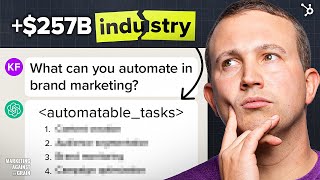
One of the things I've got obsessed with because we have Ran coming on the show and we put out this quote that Sam Altman, it was attributed to him, whether he said it or not. It was a really great quote. Got a ton of, like, got a ton of people talking, which is potentially AI will automate 95% of a marketer's work. And Ran believes that it's actually the opposite. Like, it will struggle to automate more than 5% of a marketer's work. And I think that's going to be a great debate. Make sure you subscribe. Ran's coming on the show, so I want to be prepped. But I also got obsessed by that, which is, boy, like all of these marketing roles are a series of tasks. And if you break down the tasks, what task will be automatable versus not automatable in the future? And it's really interesting. We can stick with brand because it's really interesting what we're talking about. Right? So I build a prompting Claude. I asked it to break down individual marketing roles, and here's how it breaks down brand marketing, like the role of brand marketing. And it breaks it into. Now, this isn't as detailed as what I will eventually get into, but this is a good overview, right? It breaks into what is the subtasks, right? So it says, hey, brand marketing is. Involves defining guidelines, creating branded content, monitoring brand sentiment, and online discussions, which is kind of what we're talking about. Personalizing brand experiences across channels, identifying influencers and partners to amplify the brand, analyze and performance data to optimize and brand and efforts. Now the cool thing is and for people following the rss, I'll continue to call it out, but if you're on the YouTube you can follow along and see the actual prompt that's in our. On our screen that we're looking at in Claude now. It breaks it into automatable tasks and manual tasks. Right?
Yeah. This is really smart, by the way. I like this a lot, right.
I want to actually I did the kind of free AI course. I want to do something more intensive next. And so I really want to figure out if I can automate marketing roles, right. If I can create AI agents that will automate a large part of individual marketing roles. So the thing that thinks it I want to go through really quickly, but I want to touch on the brand monitor one. So it says what you can automate in the future is a bunch of the content creat. Right. We kind of agree with this like that you've just shown me a company that are doing some of this, which is the visuals, the video, the written content, but the brand guidelines. And it will be able to have a system where you create those things and it will adjust them to make sure that they adhere to your brand guidelines that we can, you know, talk about how useful or useful, how useful brand guidelines actually are. But I think it believes you could do that. It believes you could do audience segmentation. But here's the one. It gets this right, right. It says in automata will, in the task that AI can do, it puts brand monitoring right. Employee, employee to scan social media reviews, brand mention, sentiment analysis. It basically didn't put the fact that it could then translate them and give you, you know, articulate them really well. Because basically what I can do is aggregate all the data but then provide you an executive report of that data. Yeah. Which is the thing prompt is doing.
Is there Kieran is there. We are not very far, I would say months from the point where we could have a really sick prompt for brand monitoring for us for a company and a set of competitors that an agent runs daily and gives.
Put a GUI on top of it, put a simplistic GUI on top of it and then have it like look really nice and have any brand.
The agent could even just send you an executive briefing every morning in your email. It doesn't matter. There's a bunch of different ways to bring it.
This is not that hard to build.
No. Like we could literally like you and I sadly could probably do this in like a couple of weeks and that displaces like billions of dollars of companies, right?
Just give a free tool away. Have AI build you a brand aided and unaided awareness report. Now I know we're going to get the people who use those reports. Abby. You talk to individuals, you get the context, you get all of that stuff. Sure, but that's a thousand people versus everyone who's created something wrong.
But no, I think what you would do here and again I think where anyone, you, me or anyone is going to run into trouble is if you are too binary in your thinking. Right. Like I think one of the ways you would in this brand monitoring space, for example, I think one of the things you would do is have the agent spot outlier data and have the agent prompt you when it might make sense to go run a survey.
And you should be able to upload your customer. You should be upload your data like your sales calls, your social media tracker. You should be able to upload that data.
Kieran's about to build AI SaaS company right now actually.
So I had thought about because this is a version of what I put, I put out there that wouldn't you like, like I actually want to build this as one of my first. So I people know I'm coming back to HubSpot. One of the things that I really am interested in doing is some sort of like Grammarly type tools for customer language. It is pretty easy to build. Like all you actually need to do is have your customer language sources and upload them. You can have ChatGPT Pro basically aggregate that data, create PDFs based upon themes within that file and language and tone and voice guidelines based upon that data and then upload it to GPT and create a custom GPT. So when you upload a blog post or whatever else, it can check it against a language file which is based upon all of your gong calls, based upon all of your website data, based upon whatever social media mentions and instead of like correcting your grammar and spelling, it corrects your language to match how your customers actually speak. There's just so many things you can build.
There's. There's so many things you build and, and by the way everybody, in case you just missed Kieran's really quick announcement, you are coming back to HubSpot. You and I are going to work together again. We're going to AI ify the world of marketing and kick some serious ass. And so leave Kieran a little congratulations comment. I'm super psyched you didn't want to spend much time on it. But I think it's important for our regular listeners, regular viewers to understand what was going on. Right.
As someone said in my comment on the comment of the LinkedIn post where I mentioned it, I'm not surprised. All you guys do is obsess about AI.
You know what? I like being on the right side of history and I'm very much looking forward to being on the right side of history with you because we are going to do this and we're going to do it much better and much faster than anybody else. And I feel pretty optimistic about the results that are going to come from that. So it's pretty exciting. I love this. I'm really pumped for this episode coming up with Rand Kieran. But like I like the automatable and non automatable. I think you should edit this prompt though for AI to give you a confidence score of the stuff you can automate. How well is it going to automate and what's the time frame that it thinks to automate it really, really well? Like, oh, there's going to be gaps in X, Y and Z today, but once models get better, it will work and be better in scope.
The other thing I'm going to do is focus on one role. I might take Brand because we talked about it so much, I can come back to the listeners and show it. But basically under each automat automatable task, have it create a project brief of how it would automate that and then plug that into Gemini Advanced because Gemini Advanced is actually really good for kind of coding projects. Just plug the brief into Advanced and look to see how far it gets on like code in a singular workflow. And I might, I'll start with the brand monitoring because I think that is like a, an easy place to start.
It's close, right? Like that is a task that like you saw what I did. It's not that far off. Like if we kept iterating on it, we could get something that would be provide you very helpful data anytime you ran it. Right.
The thing it would need to do is you would need to add a confidence score for the AI to say there's a certain amount of data that has to exist online for me to be able to do this. So you can imagine we created this and released it to everyone, which we should do. But you can come and just add your email address and brand and it would send you your sentiment score, your idated unaided awareness through the LLM. But it would need to say, hey, like you, your, your brand just doesn't have enough data online for me to be able to.
You. Yeah. You would have to have a version of the prompt that's like, I want you to have a greater than x percent confidence that, that this result is accurate based on this brand being big enough. Right. If you are, if you are not.
Big enough for this tool, you shouldn't be working on brand anyway. Like you're probably.
Exactly. It would literally be like cool if you don't return in this. Don't worry about brand. Go out and build a bigger business.
Exactly. Demand gen the hell out of things.
Yeah. 100%. All right. Anything else, my friend?
No. We went AI. This was fun. AI AI AI, AI, AI. Aio.
It's like you're gonna start singing your daughter like little AI theme.
It's gonna be like a working session so people got to see us actually just like, actually just do a real being you catching up session.
Which I think, yeah, this is, this is like literally how our lives work. So it's, it's pretty awesome. But we were going to have a new OpenAI model soon and even with all the sometimes I think criticism of AI, it's really good, it's still really good and it's going to get way better. The brand tracking use case, that is months off, that's not years off. Right. And so I think the most important thing for everybody to take away today is, was Kieran's point of like, if you're building for AI now, you're kind of future proofing because you can take the infrastructure you built, swap out a new model in the future and the results are going to be instantly better. Right. That is, which is a pretty amazing outcome of your, of your investment and your optimism. And so this is a little pro AI optimism show today. I hope you learned a few things. I hope you give that brand tracking prompt a try. Leave us a comment. If you do and you see if it's really good or really bad for data about your company, we'll see you real soon. Another episode of Marketing Gets the Grain. This data is wrong every freaking time. Have you heard of HubSpot? HubSpot is a CRM platform where everything is fully integrated.
Whoa.
I can see the client's whole history. Calls, support tickets, emails. And here's a task from three days ago.
I totally missed HubSpot Grow better.
More from Patrick



A NEW BREED OF PARTNER: The Partnership Ecosystem Model Journey of Patrick Biddiscombe, Part 1








Customer Success Workspace: Never Lose Sight Of What Matters Most | HubSpot Spotlight