How To Become The #1 Influencer In Your Industry (Lenny Rachitsky Case Study)
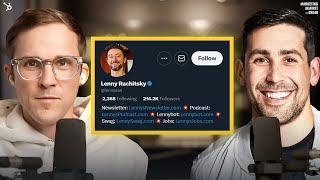
Lenny Rachitsky built his way to the top of product management by spending 5-6 years writing essays that synthesized what practitioners actually thought. The formula: talk to people in your field, find the patterns, write clearly enough that anyone gets it, and commit to the work full-time.
Chapters
My goal over the next year is to become the Lenny Rajitzki in marketing.
It's our dream. It's everybody's, Everybody's dream. We're changing.
Hard.
Well, marketers are different. They are like I think the Lenny thing like when he, when he applied it to PM it was like interestingly underserved for that kind of content. Whereas the difference I think in marketing a little bit is it's overserved. And I think that's, you know the more it's not that it can't be done but that's the complexity of it.
Well but the, the thing is like you're like oh, I think I could be lenient like over the next year. It's like it took Lenny six years.
Totally.
If you look at all the data it was five to six years before it hits an inflection point. It was a real five year grind.
Totally.
Which is the hard, hard thing.
I'm actually curious about this. When you say that it's overserved, I'm curious what, what tells you that it's overserved? Because I see a lot of marketing content but I also think a lot of it is by non practitioners or experts which unfortunately is where most people playing building personal brand on the Internet. That. That's most people.
Yeah, I think so. Like what is. Because I've thought about this a lot. Why, why, why is Lenny so you're.
Trying to be LinkedIn famous right now.
Too.
By the way. I think, I think you're one of, I think you're one of the few. I'll say. I would say like I follow a shit ton of people who talk about marketing on LinkedIn. To me there are like three people who actually provide anything valuable. I think you are one of those three people. I also think it has to be a person's full time job if they want to be the Lenny for marketing.
That's the hard thing.
Yeah. So my plan is it will be my full time job.
Yeah. Yeah. And again I think you there's more likelihood that you will do it than anyone else because you actually have the skillset to do it. So like if you actually extract extrapolate what Lenny does, it's not like he just does the eight the bolts and nuts of you know that that the topic and has an incredible and laddered up to incredible guest. But I think about what. So why, why did he win? The reason he won in that first year is because he did something I thought was pretty smart. He basically just had a network and then he would ping the Network and say, hey, I'm writing a topic. Give me some snime bites. And everyone was like, oh, shit. And it's not that you.
It's.
It's. You weren't educated on that topic. You were actually having, like, real people and brands as part of the, you know, material. That's how he won in the first year. And then he rode that rave. And then he got. Then he. Then he cornered the market and guests, like, every single. And so he has, like, I actually mapped it out. I actually told Lenny what he did when he came on the podcast, because I thought. I thought about it so much, but it's a simplistic formula. Like, it's pretty simple. But he. But he did it to the nth degree, like you would expect a growth PM to do.
I think what matters to do what Lenny did is longevity. You have to take quality at bats for a long time.
Yeah.
Quality of network and access.
Exactly.
And then. And then ability to synthesize.
Exactly.
If you read every essay he's written, and I think he would admit this, there's nothing truly novel in most cases. He's doing an amazing job of basically focusing on a thematic, like creating a thematic in a given essay, finding anywhere, depending on the essay, from one to 50 people to get their perspective. He's taking their perspective, and he's synthesizing it into, like, the four or five things you should know with specifics from these people.
Right. And he starts with the thing that everyone actually wants to know. So he gets the thing. Right. Because he's worked the job, he's a practitioner. So like, when he's like, what is a freemium apps churn rate? And then he gets 30 people he knows with known brands, and everyone is, like, eating that shit up. Like me. I'm eating it up because I don't, like. You don't usually get that. You usually just get, like, best practice churn rate. Right?
Yep.
And so. And again, like, because he's a growth practitioner, I really think he, like, tweaked the knobs really well.
Well, what's interesting here is why Alex probably has the best shot of anybody to be the linear for marketing is that when we had Limpkin on the pod, Alex, he was like, YouTube people are too smart, too deep in this shit to ever make it simple enough for everybody to understand. This is our biggest problem. And he goes, the magic of Lenny is that he wasn't like the VP of product. He was just like a frontline PM at Airbnb. Like, he had enough of the craft to know what's going on. But he wasn't so deep in the craft that he could get lost in the craft. And when Kieran says that the marketing world is overserved with content, it's actually overserved by people being either very esoteric or very overly complicated talking about marketing things. It's very hard for folks to just like do what her Moses done in sales and just be like, I'm just gonna say the most basic stuff a hundred different ways again, again, again and again until it like drills into humans heads.
Right?
Totally.
You know, one of my funniest Halligan stories actually is literally about this. I remember when we were trying to grow the product LED business and it was going okay, not great. And Halligan was doing like the G decided to do the GM role because he really wanted to that to work. So I was kind of dotted line into for a little bit. And I remember going over and I did a presentation. And I think actually a week after I told you about this, Kevin, you corrected, you corrected it for the next one. And I and I went in, I did this big presentation of like how here's how we're growing the business, blah blah blah, blah. And I remember howling. He went out and sat out in his laptop and I went, hey, Brian, how'd you think that went? He goes, look, here's the thing. I know you're smart. It's pretty evident that you're smart. And that whole presentation was about smart stuff. I didn't understand anything you said. And that's how I think it went.
I was like, oh fuck, that is incredible.
I get it, I get it.
But, but I think to that point, like the needle like that you have to thread is like how do you make it simple enough for a lot of people to understand, but it's still valuable.
Yeah, it's still differentiated.
Like basically look at something on like the way I think about business creators, by the way, in general is like kind of like college education. 101-501-501 is like PhD Level 101 is your intro to Econ class. I think if you're playing in the 101, first of all, there's endless competition there. You dilute your audience. Driving meaningful engagement is hard. Like I would say that's like kind of the Hermosi or maybe her Moses 201. Like I would say Gary Vee is 101. I would say 301 is kind of like my first million or like marketing brew, retail brew, like the highest level of a given industry or function. 501 is like the SEO expert I follow on LinkedIn who like 95% of what they're saying literally could be written in a different language and I'd understand as much. I think an intentional choice is like where do you live and how is it still valuable enough for people to action off of it? My view is you kind of have to live in like the 301 hey.
YouTubers, thanks for watching today's show. Quick stat for you. AI usage has increased by 53% since last year. How do I know that? Because I just read HubSpot's brand new AI Trends in Marketing report. This report is packed full of amazing data that not only highlights the the latest in AI trends, but also shows how businesses are using AI to grow. In this report, you'll learn the top five AI tools across marketing. You'll learn exactly how teams are investing in AI and where they're getting the return on that investment. And maybe most importantly, you're going to get a data backed answer to the big question Is AI helping or hurting your marketing career? I invite you to get all of this amazing data and research all for free. We spent hours on it. Grab your copy today by using the link in the description below. Now back to today's show.
More from Patrick



A NEW BREED OF PARTNER: The Partnership Ecosystem Model Journey of Patrick Biddiscombe, Part 1








Customer Success Workspace: Never Lose Sight Of What Matters Most | HubSpot Spotlight