How to do 10 hours of research in 20 minutes with Ai (Gemini + NotebookLM)
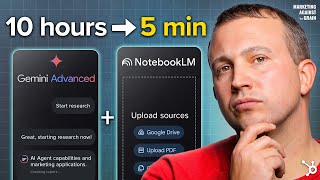
Dharmesh Shah shows how to research a topic in 20 minutes using Google Gemini's Deep Research to pull 32 sources, then import everything into NotebookLM to generate a written summary and 23-minute audio overview. He walks through five uses for AI agents and five marketing tasks they can automate, from social scheduling to A/B testing.
Chapters
Hey, everyone. On today's show, I'm going to blow your mind because I'm going to help you become one of the top 5% of AI learners and practitioners in the world. And I'm going to do that through showing you how to stack AI tools together to create super productive workflows. Today we're going to break down how you can use Gemini Deep Research with Notebook lm. And it's sick new interactive voice feature. In using this workflow, I truly believe anybody can be an expert on a topic in minutes instead of days. It could be world class in probably weeks. Instead of this is the opportunity to accelerate your life, accelerate your career, your business. Let's get into the show. Okay, so this is what I was doing a lot over the holiday break was thinking about, how do you put multiple AI tools together to do really interesting work? And I wanted to share today how I've been using a couple of Google's AI tools. And so one of the tools that I really love is Google Gemini and its new Deep Research feature. I'm a very curious person. I want to get into the details of a topic and deep research has been an amazing way to do that. And so if you go to Google Gemini, what I'm trying to do is I wanted, I had Google Gemini do a research project on AI agents, the use of AI agents, the marketing application of AI agents. You can kind of see my prompt there, which is I want you to do a deep research project for me on artificial intelligence agents. I, I want to know what they're capable of automating well today, what they're not capable of automating well today, when should I use an agent versus a traditional web application? And how should I think about how AI agents should be used in marketing? So if you're watching this podcast, which is all about marketing and artificial intelligence, then obviously, like, these are the kind of questions you're going to have. And these are the kind of questions I have. And so what I would have done before this is I would have gone and done a bunch of manual research and kind of called it and copied it together. And Gemini is doing that for me. So what you'll see right now is that Gemini is working and it has researched over 32 websites on this topic. You can see all of them there, has everything attributed. And now it's in the, in the midst of creating my report. And so it's going to take what I want to know. It went out and did all of the work. This is like a great example of AI like, I probably, first of all only would have gone to like 10 or 15 of those 32 websites. I wouldn't have found all 32. We're also going to assume that Google's artificial intelligence is as good or better at actually, like doing the search queries and finding the most relevant links and articles as I am. And here it goes. It generates a report for me, and that took about five minutes before. That would have taken me five hours probably. I mean, at least a couple hours for me to go through and do everything. And so what you'll see here is that it has put together a very detailed and very robust report with all these source topics. And what I love about it is that I can just go and open it in Google Doc and I can create a shareable document to kind of share with anybody, which is very cool. So now I have this. I have this document here and I could go read through this. I could do everything I wanted with this and that would be cool, but I don't think it's actually as helpful as we'd want. So I want to do something different. I want to go to a different one of Google's tools, which is Google's NotebookLM tool. Hey, everyone. I'm so excited to share something with you that's an absolute game changer for marketers like us. We've put together the real playbook top marketers are using to turn AI into their secret weapon. And this guide skips all the fluff. It's packed with strategies that are actually making an impact. Right now we're talking proven tactics straight from the pros at HubSpot, A16Z and Asana. Whether you're looking to scale your marketing operations or future proof your career, these strategies are exactly what you need need. Grab your copy at the link in the description. Now let's get back to the show. So I go over to notebooklm google.com and this is what it looks like when you just come in. It's blank, it's empty. And what you're. The goal of this tool is to let you to create a notebook of lots of materials that you're trying to learn about or work with. And so what's cool is let's say I want to go and upload or add sources to my notebook. The first thing I can do is do a Google Doc. So I want to do these AI agent capabilities, which is the research that Google Gemini just did for me. So all that deep research that we were just talking about, that's now, now in Notebook LM like, all right, that's, that's pretty cool. I like that. But I've got some other sources that I want to add. I'm a big fan of what our friend of the pod, Dharmesh Shah and HubSpot co founder Dharmesh Shah is doing over Agents AI. And so he also has a, a newsletter called simple AI. And let's say I want to add some articles from simple AI. So he's got this great email newsletter that gets sent out. Go check it out at Simple AI to subscribe. And he posts all of his newsletters online. So I can just take the links to these newsletters and I can go and just add them in to my Notebook LLM. So I'm just going in and adding and doing that. That's pretty cool. So I got a few relevant email newsletter articles that I have then posted there. If you didn't have the links, you could just post the raw text in to NotebookLM. Like that's, we were like, okay, that seems pretty interesting. What I also want to do is again, I said I'm a big fan of what he's doing on Agent AI. So Dharmesh was on my first million and he talked a lot about AI on this show. So what I'm going to take is I'm also going to take Dharmesh's episode that he did on My First Million and I'm going to add that as a source over here so that my, I have that my notebook because it allows you to easily add YouTube videos as a source. And what's really cool about NotebookLM is like I can have all these sources or I can interact with just one of these sources. Okay. So the other thing that is new is NotebookLM has come up with a brand new feature where you can interact with the podcast so you can take all of this, the sources, and it can generate an audio overview. And so I am going to generate an audio overview. And while that's generating, I'm going to do a little bit of a prompt to get a summary. I would like a detailed summary from all sources that outlines the five best uses of AI agents today. Five examples of how to use in your marketing and an executive summary. Okay, that's my prompt. I'm going to hit that prompt up. It's looking at the deep research I did. It's looking at Dharmesh's YouTube video, it's looking at those, those newsletter examples that I add. And here goes the five best uses of AI agents today. Automating complex Workflows. And what's really cool is it it gives you sources and citations. One of the things I think Google has done a really good job of is connecting AI recommendation result back with the source material. It's really good at data collection analysis. Unsurprising. It's what we're using AI for right now. Personalizing your marketing, customer engagement. Totally agree. That's the number one use case we have seen in doing our work at HubSpot with AI. Great at content creation. Agents are great at content creation and great at acting as digital proxies. Agents can understand user preferences and handle basic tasks such as planning travel, evaluating software, managing schedules. Worst, you don't want agents to need common sense, real world knowledge. They don't have extensive memory. A lot of them don't have up to fully up to date information. They don't have the creativity and emotional nuance and emotional intelligence of humans. So it's pretty, pretty clear what's good and what's bad and what's awesome is that from a massive amount of deep research that Jim and I did and saved me a bunch of time, and then from additional resources that I had found that I thought were really good, I got what was a very manageable readout on what to do. Okay, so now what we have is after a couple minutes of work, it has generated a 23 minute AI over overview where I can listen to a 23 minute kind of conversation. Let me give you a read of what it looks like.
Welcome to this deep dive all about AI agents.
Oh, cool.
We're going to be looking at a bunch of articles today. Yeah, and even a YouTube interview we.
Found with Dharma calling out the sources.
CTO of HubSpot.
Oh yeah, for sure.
It has the context to know who Dharmesh is.
Agent AI.
Oh, wow. Okay.
He's calling AI agents the next big thing.
And so like this is like having a personal podcast. And when Notebook LM first launched, this was the feature where we're just like, wow, this is incredible. Like, I can get this amazing summary in a podcast and audio form so that I can consume on go, which is really, really cool. And then it was made cooler because deep, you could go to Deep Research in Gemini and get real rich insights and then get that into NotebookLM and get that in audio form. Now what I want to show you today is their brand new interactive mode which is still in beta, but it allows you to interact with the show and I can join the conversation with the two hosts. Let's see how this goes.
Hey, There. Want to share your thoughts on this?
Yeah. I was hoping that you could explain to me how I should be using AI agents in my marketing strategy based on what you two know.
Oh, that's a great question and something we can definitely dive into for you.
Yeah, we were just about to get into the nitty gritty of what AI agents are.
Right. And how they're totally different from things like chatbot.
And then we can definitely talk about how you might be able to actually use them in your marketing.
Yeah, it seems like Dharmesh, the guy we're talking about, is really excited about AI agents.
Yeah, he's the founder of Agent AI.
Oh, wow. Okay.
He's calling AI agents the next big thing in tech, big statement. And even compared his new company to, like, the LinkedIn for AI agents.
Well, that's a bold statement for sure. It definitely piques my interest.
Yeah, me too. So before we get too far, let's just break down exactly what an AI agent is.
Okay.
Because I think when a lot of people hear the words AI agent, they just think like chatbots.
Yeah, right.
But this seems like it's something totally different, right?
Yeah, you're right. It's way more than just a chat bot. Okay, so think of it more like a digital teammate that can handle complex tasks. You know, things that require multiple steps.
Gotcha. Oh, yeah, let's hear it.
So when you're all talking about AI agents handling complex tasks, can you tell me more? Like, what are some examples of complex tasks AI agents could handle?
That's a great question, and it's helpful to get into some specifics.
Yeah. Okay, so let's unpack this a bit.
So it's not just about simple one off tasks, like what a chatbot can do.
Right.
Instead, think about things that require a sequence of steps, like planning a whole business trip. So an AI agent could handle booking flights, finding hotels, and making restaurant reservations.
Wow.
Or in marketing, they could manage an entire social media campaign.
Hmm. Like, what would that look like?
It could start with generating content, then scheduling posts, and even analyzing engagement. Oh, yeah.
So I really am interested in that use case around an agent planning a trip that you just talked about. What specific tools or tool could I use to actually go and do that now?
Okay, that's a super practical question and it's great. You want to try this out yourself?
Yeah, let's get into that.
So while there isn't one single perfect tool that does everything end to end yet, there are some platforms that you could start experimenting with today for booking flights. And hotels. Some people are using tools that have integrated AI like Kayak or Expedia.
Okay.
These tools can help you find the best deals and some even offer personalized suggestions based on your past trips.
That makes sense.
Then for things like restaurant reservations, you could try using something like OpenTable or RACI, which also sometimes have AI features.
Okay, so no, like single AI agent to handle the entire process Quite yet.
Not quite yet. But the idea is that these tools are already starting to become more interconnected.
So it's like we're seeing the building blocks right now.
Exactly. It's like we're seeing the early versions of those multi agent networks that Dharmesh was talking about.
Okay, that's a helpful analogy.
And while those specific trip planning tools are not fully AI agent based yet, they give you a good idea of how an AI agent could work.
Yeah, it's cool to think that these types of tools are just going to keep evolving.
Yeah. And it is also important to note that these agents will improve as they work with you and learn your particulars.
Oh, yeah. Like learning your preferences over time to get better at their tasks.
And that's where this idea of hybrid teams that Dharmesh talks about comes in. He thinks that we're going to soon be working in these teams where you have humans and AI agents working together.
Wow.
And each is going to play to their strengths.
Yeah.
Yeah. So I really like the conversation you're having about these hybrid teams, and I'd love to understand what hybrid teams could look more like.
Okay, that's great feedback and we're glad you're finding this so interesting.
Yeah. So let's dive deeper into this idea of hybrid teams.
Right. So you know how we were talking about AI agents taking over those repetitive tasks?
Yeah. Like scheduling social media posts.
Exactly. Well, that frees up human employees. Yep.
Go on. Can you give me like the five most repetitive tasks that AI agents could handle today?
Absolutely. That's a great question. And it's helpful to think about some of the specific tasks.
Yeah, let's get into that.
So first up would be scheduling social media posts.
Yeah, that definitely sounds repetitive.
AI agents can handle posting across different platforms.
That's a great use case.
Second would be data entry and report generation.
Yeah, that's super time consuming.
Agents can pull data and create basic reports automatically.
Okay, that's another good one.
And third is sending out personalized email sequences.
So they can nurture leads automatically.
Exactly. They can tailor the messages to different users.
Okay.
Fourth, AI agents can also handle basic customer service inquiries.
Yeah.
Like answering FAQs.
Right. This frees up human support staff for more complex issues.
That makes sense.
And lastly, they could do AB testing of ad copy and images.
Oh, yeah, that's super repetitive for a human.
Exactly. They can try different variations and analyze the results.
Oh, back to our listener.
Yeah. Could you tell me what tools I could go and use for those five examples that you just gave?
Okay, that's a very practical question, and it's great you want to get your hands on some tools.
Yeah. So let's dive into what you could use today.
So, for scheduling social media posts, a lot of people are using tools like hootsuite or Buffer.
Yeah, those are popular choices and pretty easy to use.
And then for data entry and reporting, you could check out tools like Tableau or Google Data Studio.
Okay, so those are good for the analytics side of things.
Right. And when it comes to sending out personalized email sequences, Mailchimp and ActiveCampaign are great options.
Yeah, those are some of the big players for email marketing.
Oh, yeah.
Well, what about HubSpot for email marketing? I've heard they do a good job.
That's a great point. And it's worth exploring that option too.
Yeah. We've talked about Dharmesh being the CTO.
Of HubSpot, and HubSpot does have its own market of automation tools.
Yeah. It's a pretty popular platform.
So you could definitely use HubSpot for personalized email sequences, just like you could with Mailchimp or ActiveCampaign.
And it can handle a lot of other marketing tasks too.
So I think what's interesting here is that how they've built this feature is that you are a listener and you're asking contextual questions in the moment. Like, you are jumping in. If you'll notice. Like, the very first thing I tried to do was to use it as basically like a voice chat bot and just ask the question I wanted to know right off the top before it got into anything. And it was basically like, nope, nope, nope. We're gonna go ahead and play our script that we have. And when it comes to the point we're talking about that, we can address your question where it really shines. And if you're like, me, it's like, I'm often watching a show on YouTube or I'm watching a podcast, and I'm like, I just have a bunch of questions. I'm like, all right, that's cool. But, like, I need to let next level of detail, or what about this? And this experience is basically letting us do that. And I suspect at some point not too far away, you'll be able to watch like your favorite podcast. And through AI and AI avatars, the hosts are going to be able to basically have an avatar and interact with you and go deeper on those individual questions, which would be pretty amazing. But right now I think Google has built the best stack of products for research on the planet. Like, if you are trying to do great research, I think the combination of Google Gemini 1.5 with deep research and NotebookLM is unmatched for the ability to get a lot of information in one place. So deep Research and then put that into NotebookLM and take any other sources and put that in NotebookLM, query that information, but also learn in the way that works best for you in this. With this new voice beta feature where you can actually interact with the generated audio overview. And what's really cool is you can still go take and listen to the podcast, but just while you're working, if you're just listening in, you can just chime in with questions. And I think to me, where this shines is you can go from novice to, to a high level of expertise on a subject exceptionally fast. That's what we're talking about today. We're talking about how you go from knowing very, very little about something to being a top 20% expert in knowledge in a topic in days or weeks, not months or years. And that is transformational in terms of your ability to find, access and process information. And these two tools have been awesome at it. I highly encourage you to go play with the new Notebook LM interactive audio feature. I find it to be one of the better voice AI features I've used so far. So I would go check that out. I think it's. I think they've done a really good job. I would go and use Gemini Deep Research and a book alone together if you were tackling any of your kind of getting the year kicked off projects where you're like, I'm just trying to learn to get up to speed. This is going to help you get started so much faster. Thanks everybody, for tuning in today's episode. See you next time on Marketing against the Grain.
This data is wrong every freaking time.
Have you heard of HubSpot?
HubSpot is a CRM platform where everything is fully integrated. Whoa.
I can see the client's whole history. Calls, support tickets, emails. And here's a task from three days ago. I totally missed HubSpot grow better.
More from Patrick



A NEW BREED OF PARTNER: The Partnership Ecosystem Model Journey of Patrick Biddiscombe, Part 1








Customer Success Workspace: Never Lose Sight Of What Matters Most | HubSpot Spotlight