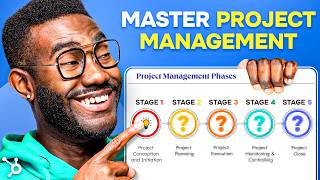
A short tutorial by Patrick Biddiscombe explaining how to manage a project using the five-stage project management life cycle: Initiation, Planning, Execution, Monitoring & Control, and Closing. The video walks through creating a project plan for a new online storefront (scope, objectives, roles, deliverables, budget), shows using a status tracker during execution, and highlights common project-management approaches, mistakes to avoid, and essential PM skills. The speaker also points viewers to free HubSpot project-management templates linked in the description.
Questions this video answers
20% increase in sales (objective).
25% increase in sales (observed during test site deployment).
Two weeks (missed deadline).
Increase their failure rate by about two-thirds.
February 9, 2024.
Chapters
My business's sales are down and I'm in desperate need of a new online storefront that can help give them a boost. So in this video, I'm going to put on my project manager hat and build a thorough plan to make that happen. Let's go. There are five stages to the project management life cycle. Stage number one is initiation, or as we called it during my Greek life days. The good part, this is where we kick things off and where we're looking at the project through a realistic lens. Ask yourself questions like what's the purpose of this project? How long will it take? What's the budget going to be? Once I've thought through all of that, I'll start filling out our plan. So in the overview, I'm describing the problem I'm trying to solve and who the stakeholders will be. With our new online store, we want to be able to increase sales and doing so is going to involve the product design and sales teams. Project management is going to help me meet key deadlines, increase buy in from stakeholders and customers, and keep us on budget. And another added bonus is that it can even help improve the culture of our organization. All that sounds, sounds fantastic, but how exactly do you build out a comprehensive plan? Let's get into the nitty gritty. The nanular granular. Stage number two is planning where I'll take the broad strokes of the project and get more specific. So let's move down to the scope section. The scope is essentially the foundation of the project. What it will and critically, what it won't include, which will make it clear to all stakeholders what the expectations should be throughout the project. For example, we're completely redesigning the online storefront from scratch. However, we're not redesigning the product pages, but maybe we'll do that at a later date. So our objectives section explains the results we expect by enacting our plan. And we're going to be super specific here. So for building a new storefront, we believe the measurable impact will be an increase in sales of 20%. It's important to make sure every member of the team knows what their roles and responsibilities will be before the project gets going. So outlining that in the appropriate section will be helpful here. If you're digging the look of this template that that I'm using, you can get it for free by checking out the link in the description below. HubSpot has created a ton of awesome project management templates, generally some of the most helpful templates in the entire game. For this, I don't know how we always give away so much awesome stuff for free, so definitely check it out in the description below. The next step of planning is to list out the specific deliverables and their deadlines, along with who's responsible for the task. Finally, the last portion of the planning stage is budgeting, where I'll list out the cost of each deliverable I just specified above to determine the project's overall budget. Once all the planning is squared away, it's time for stage number three, execution. This is where the team as a whole gets to work. I'll assign tasks, track updates, and keep stakeholders in the loop. All of that runs concurrently with stage number four, monitoring and control, or as we called it during my Greek life days, a night at the library. This stage is crucial in making sure we're meeting deadlines, staying on budget, flagging any potential blockers, and adjusting as necessary to make sure everything stays on track. I'll move down to the project status portion of the template where we can put in an overview of the project as it stands when we check in. Then I'll use the status tracker to keep the team up to date on where the deliverables stand. We've got the wireframe delivered early, so I'll reflect that here and provide a link to it. The feedback from the sales team was also on time, but unfortunately the beta build hit a roadblock because we lost a member of the team and it slowed us down, so I'm going to reflect that here as well. I miss that guy. As a result, this could have an effect on the budget status. The block increased our budget on the beta site, but since the wireframe actually took less time than expected, we're thankfully still right on budget. Once all deliverables are in, it's time for stage number five, clear closing. Or as my fraternity would call it, freshmen, get out of here. It's time to go home. This is where we have the final product ready for delivery and determine if it delivers the intended results. In the summary, I'll put a brief overview of the project's wins and losses and anything we learned that could be applied to future projects. Project successes should include things like the 25% increase in sales we saw during the deployment of the test site, signaling that our investment was worth it. A failure would be missing the deadline by two weeks due to the staffing change, which means we potentially missed out on two weeks of boosted sales during Q4. Some good with the bad in project learnings. I'll mention that planning for more resources towards building the product will be beneficial for future initiatives, which will come in handy when we decide to do those product pages that I mentioned. Those are the basics of project management, but I'm sure you're wondering, are there other ways to do it? Yes, there are four popular approaches to project management, including the one I just used, product based planning. This means it was focused on launching a new product or service from conception to completion, resulting in sales or growth. Another approach is process based planning where the project manager focuses on making sure all the tasks in the project roll up into achieving organizational objectives. Objectives will totally vary based on the company, but would include things like brand awareness, innovation, sustainability or culture. Then there's the phased approach to project management which is ideal for small, well defined projects where the project is broken down into smaller phases. Great for smaller teams. In the project we just finished, for example, one phase would have been just the website wireframe and that entire project would be broken down into the five steps of the project management lifecycle. Finally, there's Project Production management, which uses operational principles to optimize the delivery of the project, using data to accurately predict and determine achievement. So you've got the method you want to use, but what are the most common stakes to avoid when managing a project? Mistake number one not investing in project management software. In addition to the HubSpot template I use, there are great organizational software options like Asana, Airtable or Jira that can help you track specific tasks and assets as well as enhance cross team communication. Mistake number two not being flexible. The reality is that most projects are going to have hiccups, but if you build your schedule with some flexibility, a minor delay won't snowball into a major problem. Sometimes deadlines can't be changed, and that's totally okay. Just be sure to flex the schedule elsewhere to accommodate. Mistake number three not communicating. Clearly get together with the stakeholders of a project at the beginning and see how they want to communicate. Do they want to have a weekly call for updates or just a monthly email collecting the headline items like Sigma Chi kicked off campus. Knowing this kind of stuff ahead of time will save lots of headaches later. Mistake number four and this one will get your fraternity kicked off a campus. Not knowing your metrics. You're working on this project to achieve a particular goal, so know exactly what that is and how to measure it. And just as important, know what constitutes success so you can determine if you're delivering or not. You might be thinking that being a project manager is a lot of work, and it totally is. So what does it take to be an athletic Effective Project Management I genuinely can't overstate how crucial it is to have solid project management for a successful business. In fact, companies who don't use project management increase their failure rate by about 2/3. But being a project manager is a tough job that requires a lot of different skill sets. It requires interpersonal skills for managing relationships between team members and different personality types. You've got to have strong decision making skills to prioritize resources and assess risks to keep things on time and in budget. You've got to have A plus communication skills to facilitate meetings and provide feedback to all different kinds of teams who communicate very differently with different priorities. A legal team, for instance, might want updates as they pertain to risk management, while a marketing team is going to want updates as it pertains to being able to advertise a particular feature to a certain demographic. Last but not least, you've got to have management skills to lead a team, hold one on one meetings and address performance challenges as they arise, in addition to potentially recruiting team members specifically for the project. It's a challenging job, but thankfully HubSpot's got all the tools you need to help your project get to the finish line with minimal updates. Check out the project management templates that I use in this video at the link below. Again, some of the best templates in the game genuinely can't be more excited to share them with you. If you've got any advice or tools you'd like to share from your own experience in project management, let us know in the comments below and be sure to subscribe to the channel so you can always be up to date with the latest and greatest marketing tips and insights. Now, if you'll excuse me, it's time to petition my alma mater to bring Sigma Chi back and I'm going to start by using one of these project management templates to get the team together. Until then, I'll see you next time. I can't find this client info have.
You heard of HubSpot? HubSpot is a CRM platform so it shares its data across every application. Every team can can stay aligned. No out of sync spreadsheets or dueling databases.