How To Transform Storied Organizations With David A. Thomas | INBOUND 2024
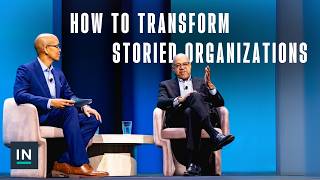
David A. Thomas, president of Morehouse College, on transforming long-standing institutions by starting with mission and values. He raised $300 million, pushed online programs and Metaverse expansion despite resistance, and targeted a 70% graduation rate to replace the current 60% six-year rate. He steps down after seven years.
Questions this video answers
1867.
3.5 million.
About 22,000 stakeholders (including ~18,000 alumni).
$300 million (described as most in the college's history).
Approximately 60% (six-year graduation rate).
Chapters
Good afternoon, everybody. I'm Jeff Bennett, co anchor of the PBS NewsHour. And it is my pleasure and honor to be in conversation with Dr. David Thomas, President of Morehouse College. You see that QR code on your screen, or you will see it momentarily. Whether you're here in the room with us or watching the live stream. We invite you to submit a question over the course of our conversation. And by way of introduction, Dr. Thomas, before becoming president of Morehouse, professor at Harvard Business School for more than 20 years. After that, Dean of Georgetown's McDonough School of Business, and then before that, assistant professor at the Wharton School of Business at the University of Pennsylvania. So a real expert on organizational behavior. And for the unfamiliar, we should let folks know that Morehouse was established in 1867, two years after the end of the Civil War. It's the nation's only historically black private liberal arts college for men, and it has a proud legacy of producing leaders who shape the world, chief among them, Martin Luther King, Jr. So with that as background, let's just jump straight into our conversation. The topic of our conversation is building transformational change. So help us understand, Dr. Thomas, the approach you take to develop a. A vision for meaningful change or transformation. What steps do you take to ensure that your vision is appropriately ambitious, while also strategic and achievable?
So I try to start by understanding what I call the soul of the place. Because if you want to transform an institution, you have to really understand what are the things that you don't want to break in the process of the transformation. And so, you know, you get that by talking to people, by studying the institution's history, by really understanding what's motivated it throughout its history. So at Morehouse, it's very clear. You know, most institutions have a written mission, and it often actually doesn't resonate. But at Morehouse, the mission resonates, which is to develop men with disciplined minds who will live lives of leadership and service. That's part of the soul of the place, animated by a set of values. Equity, social justice, and a belief in a higher power. God, whatever we want to call it. But there's this sense of, you know, we're about something bigger than ourselves. And so I start there. I did the same thing at Georgetown. And one of the things I realized when I was at Georgetown was that the business school didn't really embrace the soul of the place because they were ambivalent about being anchored in Jesuit tradition and being a business school. And what I did there was I actually put that forward. Around which we built the transformation. Similarly, at Morehouse, people understood the mission but had no vision for how do we elevate the mission in the 21st century? So we were still talking about Martin Luther King in the middle of the 20th century and not talking about the 21st century, which, you know, led me to initiate an effort to create the first globally accessible online program for men by a historically black college or university. And the focus was on men with some college, no degree. Turns out there are 3.5 million black men just in the US with some college, but never finished their degree. And the demand for the program has been exceeding. And that's about saying, okay, in the 21st century, how do we keep the soul of the place intact but expand our reach? And part of that expansion has been technology. We're the leading university in the country, not Stanford, not Harvard, not mit using the Metaverse to actually teach. And all of that is about expanding our reach in the 21st century but being true to the soul of the place. And, you know, that's how I think about creating a vision. And I don't consider myself to be a visionary leader. You know, I consider myself to have the ability to ask questions about how do we expand our reach and create an agenda around it.
Well, it takes vision to have that sort of practical approach. How would you scale that or apply it to the business world for folks who work in marketing or sales or service?
Similar. Similar concept. Right. So probably as I've walked around, you know, this is a pretty young audience of some of my examples may not resonate as a baby boomer, but you just take, for example, a couple of decades ago, Coca Cola decided that they were going to create a new Coke, and it failed because they didn't understand the soul of Coke. Right. It went against the soul of Coke. And I think, you know, in the business world, if you're running or if you're involved with a company that's actually producing value for people and not just profit for shareholders, there is a soul of the place, and you have to understand what that is and articulate it and motivate people to engage in the transformation, because it's going to have us be better at what we deliver. That actually adds value to people's lives. And, you know, I taught at the Harvard business school for 22 years, so I'm a business school professor. I've consulted to companies on exactly these issues. How do you create transformation that actually enhances the soul of the place? And as leaders, we have to be able to articulate what that soul is, especially if you're a new leader who's coming in from the outside. People have to have a sense that you understand them well.
How do you do that? How do you immerse yourself in the culture, Culture of a place, and how important is it to understand the existing culture before you try to implement change, whether small or transformational?
Yeah. One, you talk to people. So at Morehouse, I would ask people, alumni, what was the most important, you know, aspect of your experience at Morehouse and common theme, the brotherhood, the community. So I've gone about really, you know, now I've been there seven years, but I spent a lot of time early on just observing the community come alive and what changes drove it and to make sure that I didn't make changes that undermine that community and put that in my language that I use. So, as you know, he's an alum of the school, there's a phrase that lots of people use called iron sharpens iron, which is not about sitting in a classroom with a professor. It's about the young men being able to bump up against each other in debate, in discussion, as well as in rituals. And another aspect of the way I lead is when I see things that don't make sense to me, I try to understand why they make sense to us, other people. So you, you know, we have lots of traditions at Morehouse that, that I had never seen in that quantity at any of the other places I've been. My first impulse was to say, we don't need to do that. But then I came to realize that many of those things were actually about expressing the soul of the place. Yeah, right.
Yeah. And, you know, there's so many stakeholders at Morehouse. Some 22,000 stakeholders to include students and parents, obviously the board of trustees, some 18,000 alumni. You've got state and local officials. How do you engage those 22,000 plus perspectives? Disparate groups, Disparate perspectives, disparate goals, different goals. How do you engage all of those folks in the process?
It's. I sort of level it, Right. Starts with, what are the things that I want to say to everybody? Right. What are the things I want to say to everybody? So if you watch me give a talk, I will say that we are the only institution in the world singularly devoted to developing black male excellence at scale. Then I think about what's the interest of that constituency and what do I want them to do for Morehouse? And from there, you know, it's kind of like a funnel, right? It starts with here's here's the business we're in. And then I move it down to now I want to sit down with you and ask you to write me a check. Right.
Which you've done a lot. There's a $500 million, which I've done a lot. Yeah.
Now in that conversation, I've got to shape it around you, Right. What your interests are, your investment is, and I've got to understand you as an individual. Because the same conversation I have when I ask a foundation for money is a different conversation than the one I have to have with you. Right. So that's kind of the way I think about it.
And there has to be connective tissue among all of those different messages and all of those different narratives.
Right. And that connective tissue has to be a belief in the value of that first statement, are we doing something that is worthy in the world? And even when I'm trying to recruit students to the college, hey, this is what we're doing. Does that resonate with you? And then I work it down to what do you want to major in? What do you want to. And you know, part of that, the skill that's required there is empathy to get it down to the level where an individual feels motivated by that conversation.
What are some of the specific or unique challenges you face in leading an institution that is 157 years old, that has such a rich legacy and such deep roots.
Institutions with deep legacies and a legitimate claim to having been successful are often underestimate the need for them to change. So, you know, a lot of the changes that I tried to implement initially, people were like, why do we need to do that?
They say, this is the way it's done because we've always done it this way.
This is the way it's done because we've always. But actually, you know, what they say is this is the way we've always done it, so it must be the best way because we've been successful. So when I initially tried to implement online education, I got a lot of resistance from the faculty and from alumni who said, you know, this is not us, this is not what we do.
And I imagine there was a fear that it would water down the brand of Morehouse. When you open up the gates and allow people to access something online that you could only previously have accessed by enrolling and getting the in person education.
Right. You're exactly right. And also what you have to do is take advantage of a good crisis when you're trying to create transformational change. And the Good crisis for us was actually the pandemic. So all of a sudden we had to take everything online. So the idea that you couldn't create a Morehouse experience online kind of went out the window. And we rushed through that window anticipating that, you know, the pandemic wouldn't last forever, but Morehouse would. And Morehouse Online could extend and expand our ability to impact the 21st century. And it's proven to be true.
I'm going to invite folks to use that QR code to submit a question, whether you're in the room or watching the live stream. Dr. Thomas, applying business sense. Your background is in academia, obviously, but as we mentioned, you're a business professor for a long time applying that business acumen in the academic realm. How did that go for you?
Well, if you paint by the numbers, it's gone pretty well.
Yeah, right.
We've raised $300 million, most in the history of the college. I think that we have improved operationally, which has created a better experience for our students and importantly for our families that are sending their students to Morehouse. And, you know, when I'm talking at the college, I very seldom use the word business, in part because faculty don't think we're a business. But I use the same perspectives and acumen, strategic planning, having strategic themes, which if you walk around the campus today, you'll actually hear people talking about those strategic themes. Morehouse beyond borders rising Men in Morehouse. Right. All that came out of my business, you know, acumen developed by studying and teaching business. But I translated into the language of the realm, which is academic, you know, academic ease. For my faculty and for my staff, it's about serving our constituents, our main constituents, our students. So I developed a term called putting our students at the center of every decision, because we weren't doing that right. Well, you know, that's my version of saying, you know, we're going to be a low cost airline. Right. You know, and, you know, or, you know, we're, we're, we're going to be the best, you know, name the company in the world or X.
How do you strike that right? Balance between preserving tradition and fostering innovation.
First of all, I don't talk about them as if they are a trade off. I talk about innovation as a necessity for us to actually deliver on our mission. And I respect our traditions. You know, even when I alter some aspect of how we do it, Right. I try to let people understand that, you know, what I'm trying to do is enhance the tradition through innovation. And when People resist. I don't, you know, I don't treat all resistors as if they're the same because there are different reasons why people resist change. Right. For some people it's politics and power. I can play that. But for lots of people it's often, you know, my self esteem is tied up in the way we do things today and you're asking me to do them differently and that's a threat to my self esteem. I try to differentiate, you know, the resistors so that I don't treat them all as if they're resisting me or the idea for the same reason. And that's proven to be, I think, highly effective because I have lots of people who didn't want to go with me in the direction I was identifying. Who today are some of my biggest supporters. Same thing happened at Georgetown.
That's interesting. And we actually have a question that was submitted that's along these lines. The question is, how do you get an organization on board and rowing in the same direction when a third of the company was around prior to an IPO and two thirds came after and are used to shareholder first thinking.
One, the leader cannot be afraid to articulate their view and values. And a good one here is, you know, people are used to shareholder first thinking. Well, the leader can't be afraid to talk about who should be first if it's going to be the customers or if it's going to be the people in the organization because they'll serve the customers. And that's how we create shareholder value, not short term thinking. And finally, you know, and I think I've been working this my entire seven years at Morehouse is you have to get the senior team aligned and break down silos in the organization.
Here's another question. When do you know it's time to realign your mission and vision and how do you go about doing that?
Ah, great question. You have to pay attention to the external environment. And the question about mission is, is our mission still relevant? And if the answer is yes, then you have to create a vision that enhances the relevance of that mission to the demands of the outside world. Again, that's why we went to online and we've created something at Morehouse in conjunction with our sister institution Spelman, called the center for Black Entrepreneurship, because we know that the racial wealth gap is something that's out in the external environment that Morehouse has to be relevant to and that's expanded our vision, but in line with our mission, because we think our mission is still relevant, but our Vision had to expand.
You know, higher education is facing so many different external pressures from financial constraints, the, the lingering effects of the pandemic, changes in societal expectations. And then if you think about the business world, there's so much change and turn in the political environment in our economy. I mean, the Fed is expected to cut rates today, and they might have already done it while we've been sitting here. How do you navigate those pressures while keeping the mission and the legacy at the forefront of your work?
That's a great question. And to your point, the role of university and college presidents has changed tremendously in the almost 40 years that I've been in higher education as a professor. I think one, it takes courage. You've got to be able to confront those realities and you've got to be able to match them to the values of the institution. You have to be able to match those realities to the value of the institute, to the values of the institution. Sometimes that means that there are donations that we will not take. Sometimes that means that we have to speak out about things that are going to be controversial. And you just take, for example, we're the only college or university other than the West Point that was willing to invite Joe Biden to come speak at commencement this year because most people were scared of the politics of it. We had protests that we allowed, but we were also clear that we would stop our commencement if it meant that the protests would be disruptive and not allow people to celebrate the young men who were graduating, but that we would not have the police come and take anybody out. Right. You know, that's about values and a willingness. The courage is to take the heat. Right. And one of the values of Morehouse is that we're a place that should be able to allow discourse that other institutions in this country can't tolerate. Can't tolerate the tension.
And one final question here that was submitted online. Were there any initiatives that you tried to implement that failed? Failed, and how did you respond?
Initiatives that failed? Well, I don't know about total failure, but there are initiatives that have not met my intended outcome. So, for example, we launched our online program, yet we have not been able to advance beyond one degree. And I thought by now we would have at least three and hopefully five. And you know, we've been slower than I would have liked at increasing our graduation rates. So I promised that in four years we'd be at 70%. Today we're at about our six year graduation rate is somewhere around 60%. So to me, that's a fail. Right. I thought that would be a layup. And it turns out that it was harder, you know, that it's a harder needle to move than I, than I anticipated. And most of my other failings have related to people decisions. Either I moved too slowly when a change needed to be made, or I didn't bring in the right person to do the job because I saw some aspect of them that I thought also translated into them being the right person. And the other failure. A dimension of failure for me has been that I have been impatient and underestimated how much time certain things take. And you know, great example is it's taken us basically five years to really get anchored in this notion of operational excellence and breaking down the silos. And I thought that after my first year of me telling people that's what we needed to do and it didn't happen. Right. It's now taken off. But underneath it all is a lack of patience.
In my view, cultural change is hard. I've described it as trying to push an iceberg with a spatula. At times it can be that difficult. My final question to you. You announced earlier this year that you were stepping down at the end of the academic year. So two questions at once. How do you as a leader know it's time to move on? And as you reflect back on these last seven years, what are you proudest of?
You know, it's time to move on. At least for me. I realized that new perspective and energy will accelerate the pace of change and steepen the trajectory of change. And you have to ask yourself, do I have the energy to do that? And I'll be 68 at the end of next week.
Happy birthday, Early.
Thank you. And you know, part of what went into my thinking was, it's time for a new.
More from Patrick



A NEW BREED OF PARTNER: The Partnership Ecosystem Model Journey of Patrick Biddiscombe, Part 1








Customer Success Workspace: Never Lose Sight Of What Matters Most | HubSpot Spotlight