I Created An Ai Email Course Using ChatGPT
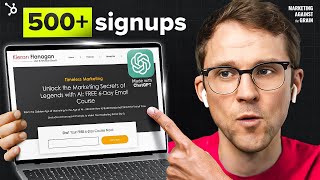
Kieran Flanagan built a six-lesson email course for marketers using ChatGPT, combining copywriting lessons with AI-generated scripts and avatar videos. He got 450-500 signups from a LinkedIn post and found AI speeds up iteration but struggles with video emotion and output consistency.
Chapters
I'm going to show you how I created an AI course for marketers, all of it done using AI. I'm going to go behind the scenes. I'm going to show you each and every lesson. I'm going to give you some advanced prompts, I'm going to give you some really cool AI tips, and I'm going to give you the summary of how I felt AI performed in creating this course for me so you can use AI to create things like this for you. All of this and much more on this episode of Marketing against the Grain. I'm Kieran Flanagan, co host of Marketing against the Green. Let's get into today's episode. Hey, all on this episode of Marketing the Green, it's a little bit of a special episode. It is a Kieran solo episode and what I'm going to do is cover a short email course I put out recently. Doesn't sound that interesting. Stay with me. I know it's just a short email course. Everyone who listens to this has probably released some form of an email course over the past decade. The reason we're going to cover this in a short solo episode is because it was, for the most part created by me and AI and it was all about how to bring timeless the craft of marketing, the timeless craft of marketing, together with AI and have AI instrument that timeless craft for your brand. Now let me give you a bit of the backstory. Why did I decide to create this course? First of all, you should always have little side things that you do. It is the best way to learn. I don't care where you are in your career, if you don't really like doing this stuff. Doing the work, doing the craft. Like, I shipped this little course Yesterday, put a LinkedIn post up. I've only done one little bit of promote promo. I've got some more to go this week and there's about 450, 500 people already signed up. That's cool. I love it. Like one LinkedIn post, people seem to enjoy the course and you just watch the little, you know, conversions come in on the HubSpot platform and you can see people actually signing up for your course. You know, you create something that is the craft and then people actually find it valuable. That's why I love doing what I love. And I think at times you get really removed from that. Right. You actually end up becoming a people manager and that's all you really do is move boxes around and move budget up and down in different places. I actually enjoy doing the work. I want to do the craft. And so this was really cool for me. I was up at 12 o' clock last night to put the LinkedIn post up at midnight, like refreshing the form. How many people have signed up? And I've got a bunch of promo going live. So my goal was to get 2,000 people signed up for that. So a little bit about why I think these kind of little side things are really important. It's really how I learn I have to actually do the thing. Aside from that, there was a couple of reasons I decided to do this. And so recently I put out a post on LinkedIn that blew up. I I've seen it covered lots of times since then, which is a quote attributed to Sam Altman said that he thinks that AI in the future will be able to automate 95% of a marketer's role. Fun episode coming up. Rand Fishkin thinks the opposite is true. AI will only be able to automate maybe 5% of a marketer's role. And we're going to debate that because I think it can be much closer to maybe 95%, not 95%, but closer than Randa's. And so we're going to debate that. But this quote was attributed to Sam Altman and it blew up on my LinkedIn feed. Got tons and tons of engagement. Like, I think it was about 700 different comments. And what I noticed in the comments was, well, marketers really fell into three categories. They fell into AI is only hype. I'm not even touching it. AI is like really good for being an assistant to do some blog posts. And then there was a small number who really got it, like, oh yeah, this is really going to change the way I do work. And I the marketing against the grain. The reason we created that podcast is because really, that 95 to 5% quote, whether you agree with it or not, it really speaks to why we want to do this podcast. And why we enjoy doing this podcast is because we want the people who listen to this podcast to be in the 5%, right? We want those marketers to be the risk takers, the opportunistics, the people who do things first, the present and future leaders. And that's really the only reason I wanted to do this podcast. When we originally agreed to start recording this podcast, one thing Kip and I were really clear on is if we just regurgitate best practice for marketing, we're out. We don't want to do it right. We actually would prefer to do something where we can help people be in that 5%. And I think AI is one of the things that you can adopt much faster than anyone else and be in that 5%. And then there was the other category of marketers who think, hey, AI is really cool for blog posts. Like, that's all I really use it for. Sure, it's fine. It's a good assistant for blog posts. And it's not that they are not working hard or want to do new things. It's just that they don't really have the inspiration to figure out how to use AI for more things. So I was like, oh, cool. Well, you know, what I'll do is I will create a short course and I will use AI to create the course. But I. And the course is about how to use AI to implement the craft of marketing into your business. And so what I'm going to do here is go through a little bit of the course because there's some prompts and things like that and some learnings that I've had that I can pass on to you all here. And maybe that will be helpful for you to figure out how you want to use AI in your marketing going forward. So this is the killer page that I put together in a very short amount of time. You probably have heard me talk about my design skills. I am very fortunate that I get to use HubSpot. I have a HubSpot account. I think it's like a pro or an enterprise account. And so the, you know the first thing to say, and this will give you a little description of the course. And. And then I'm going to get into like how I used AI and get into a lot of the prompts that you can kind of steal or go sign up to to get the exact text. This is, for the most part, much better. If you look at YouTube, not mean I'm not going to make it really good for all of you RSS subscribers. We love you all, but I just. In terms of the visuals, when you look at the prompts, although the prompts are just big blocks of text, so I'm not going to be able to read them out, but I'll give you a synopsis of them. So if you can go use it, go subscribe to the YouTube and check out our YouTube channel. It's doing really well. You'll get all of the visuals. If you're an rss, I'm going to give you the Bitly link where you can sign up for the course. You can just get a dump of all of the prompts if that's Helpful. Before we get back to today's show.
Here'S a quick word from HubSpot. If you're a marketer, one thing I know for sure is you love data. And boy do we have data for you. The 2024 State of Marketing port is chock full of data and insights around the current trends that are shaping the marketing industry today. Things like artificial intelligence, you know, I love AI tools, personalization, influencer marketing, all of the topics that are key to getting a competitive advantage this year. It's going to make sure you're not stuck in old strategies and old tactics. So click that link in the description and go get your free copy of the 20 state of marketing report today.
Now let's get back to today's show. All right, so the reason I'm kind of starting with this is the land page. So I have about 400 again I did a LinkedIn post, I think I did a tweet, but the tweet I really have not dived back in to figure out how to get my audience back up on Twitter ever since a lot of the algorithm changes. That is on my list of things to do this year I've really just kind of focused on LinkedIn because of time constraints and so I think it has like 450 to 500 signups, which is kind of cool. I have to email my newsletter, I have to do a bunch more LinkedIn promo. I've got some other fun things I think I'll do to to promote it just for fun. But the reason I'm saying that is because the land page was created using AI, right? So I give AI an outline doc that I'll quickly show you that we did together to create an initial outline for the course. And then within the prompts that I show people how to do there's like this prompt from John Caples and I'll get into some of the lessons and the marketers behind those lessons. And it basically takes this incredible copywriters core tactics to create incredible ad campaigns and then you can create a land page in their style. And it worked, I thought, pretty well. Now I would love for you all to comment back in the YouTube to tell me whether this is a good conversion rate or not. So maybe it hasn't because the conversion rate to date on about 500 signups is about 43%. Right? And again one of the things I did in this course is I really stayed true to the purpose of this course which was to allow AI to be to ship the things and me to really only do light edits. But for the most part, I just directed AI how to do the edits because I really wanted to open people's minds into the quality of the work that AI can do. So for the, for, for the most part, everything you see here is created and shipped via AI and I am in the background, like the editor in chief, like kind of directing it where to provide some edits and things like that. So this entire landing page was created by AI. We went through a bunch of different variations. One of the things that people really undervalue in AI is it doesn't get bored, it doesn't mind the grind. And the grind that Kip and I talk about all the time is just like those incremental ways to improve the work that you do. So for example, this kind of headline here on this landing page which says again, the core, you know, value that I thought about this course was, you know, the timeless marketing. Decades old lessons implemented through AI. So bringing the old and the new together. The headline here is Unlock the marketing secrets of legends with AI free 60 day email course. And they're like subscribers. This sub description was pretty cool. From the golden age of marketing to the age of AI. Discover how to build brands stand the test of time. And then I put in the include advanced AI prompts to make your marketing stand out. Now the copy again, pretty good. So you can see what's in the course. We have the likes of David Ogilvy, John Caples, Gary Halbert and many more kind of incredible legendary marketers and ad copywriters and ad campaign people. And so what's in the course? And this is what we thought about in terms of the outline. So maybe I will first, first of all dive back into the outline. So where did I start? And I'm going to show you all of the docs I used here. So I'm going to just give you all of the docs again for the RSS listeners. Thank you for tuning in. I will call things out for the YouTube people. You can see it. So this is the first thing we kind of worked on, which is like the outline, right. So I came up with the initial idea of blending together the craft. This is the two things I'm really passionate about. A craft of marketing, not the science, the craft and then instrument in that through the science, which is AI. So we came up with, with, you know, marketing through time. Seven lessons from the legends. And then I, I decided to do six because one of them wasn't very good. And the thing I really worked with AI on was a format for each lesson, right. And I didn't want that just to be a, you know, tips and tricks, best practice. I wanted to do something much more creative. And so if I showed you my prompt for creating this course with AI, and it was created for the most part through ChatGPT Pro, and I'll come on to a little bit about the challenges I had recently with ChatGPT Pro, but also Claude, over time, I was using Claude much more. But like my ChatGPT Pro prompt, creating this course is probably like 20 pages long, right? It took a couple of weeks to build, but way easier to build than using humans. I will be really honest because again, AI does not mind the grind. It doesn't mind me asking it to create many edits, many variations, and that's what I loved about it. And really quickly iterates through things. And so we landed on this structure. Again, everything that I selected to do was suggested by AI for me prompting it, right? So I didn't say, okay, well, like, that idea is good from AI and I will decide, oh, I'll use some of that, but I'm going to change it because I believe the structure is better. I really wanted to stray true to the reason I did this course, which is, hey, like, AI can do much more than you think, right? It's not all hype. It's not just good for blog posts. And so this is a structure we landed on after much kind of iteration and variation, which is each lesson. So we, we crafted like each day would have a singular lesson, right? And that lesson was a foundational part of marketing. So we have, you know, day one is introduction to conversational Copywriting. Then we pick a legend, which was Claude C. Hopkins, because that was a big part of how he created the book of Scientific Advertising. And he has that famous quote that you should write in the same language that your customers use. Then each video, I want each lesson, I wanted to have a video summary for me, again created by AI. And I'll get into that. Then I wanted to have real actionable stacks and the actionable steps are actually an advanced prompt to actually instrument that lesson. And then I wanted to have a homework. And so I really thought about this, like, what would make the course different and the ability to have like a homework assignment and actually instrument this for your brand. So that's the way I learned is by doing something. It's the reason I did this course. And so I was like, how can I use custom, a custom GPT to be able to do that? And I'll come on to that a little bit later because it worked a little differently than I. Than I thought. So each day has this kind of core. So I was pretty happy with that. Right. So I was pretty happy with the way that I structured each lesson. I think people really want to know the prompts. So I'm going to actually go through maybe three lessons here. If you want the entirety of the course, you can go to the following link. Bit ly and then just dash, timeless dash marketing AI. So it's just like bit ly, timeless marketing AI. And I'm sure the team will put it in the show notes. And so let's get into some cool lessons. And I will open up the actual emails and show you some of the videos I think we're going to do, I think some of the cool ones in terms of the prompts you'll be interested in. We're going to do conversational copywriting because there's some cool things in there. I think we'll do the Gary Halbert one because it's really, how do you create a short sales spiel for your product? And then the one I really want to get into is the Psychology of persuasion by Dr. Robert Cialdini, because I try to create an entire marketing campaign using his principles and something else, like a neat little trick that I'll show you as well. All right, so let me share my screen and show you the actual emails. All right. All right. We are in HubSpot. The very first email that I think some people are starting to get today. After the introduction, I did so again, all of this created by AI all of the copy done by AI Me as the editor, not creating any copy. Tiny little words here and there maybe, but again, staying through to the purpose. So each. Each email has this quick introduction which I think is done really well. And then the video. So let me show you. I'm gonna do like an minute of video 1. I'm gonna do a minute of the first video, which was, for Claud C. Hopkins, a quick summary of that lesson. And the thing to know here is that AI AI actually created the script. And then I instrumented this, the video through hey, Jen. So I did not. I did nothing, right? So, like, basically, I did really nothing other than, like, again, continue to prompt AI where I thought it could do better, where I thought it actually was not that good, and say, hey, like, you should make these edits for this video script. Do a little more of this, do a little more of that. And that did take a bunch of Work. The editing really did take a bunch of work. But again, I did not change really any words or anything like that for the, for the video script. So here's what it sounds like and I'll give you my thoughts on video in general for as part of a course like this after about a minute of this video. Hey there. Today we're going to cover a lesson. Claude Hopkins. He is considered one of the pioneers of modern advertising. Quick pause for the people on YouTube. You see this like cool little image of Claudi Hopkins come up in the top right hand panel. All of my own QuickTime editing skills. I have real skills, right? Pretty awesome. And strategies that are still used in advertising today, such as the use of scientific approach. Other thing for people on YouTube and even you on the RSS. What do you notice about the video? I think why it's better quality and ones that I've done previously on hn because I'm a hands wavy person. I kept my hand very, very still. And so this way, this is why this video looks much more realistic than other ones that I've done previously. So that's. That's the video. So every single, every single lessons comes with a cool video overview with me with a very Americanized accent. Now I will say all of my friends think I sound American anyway because I've worked with American companies so long. But hey, Jin really like gives me the real American accent. Now what do I think about these videos? They're good, you know, they're fine. I actually would use them as part of a course because they're so easy to do, right. I'm sitting downstairs at 10pm and I'm doing the video script via AI and then I don't have to go upstairs and record it myself because I've already trained hey Jen. To have an avatar for me. So then I can just put in the script and actually have a. The AI generated video without me having to go back and forth and actually record. Now if you really want the video to be something that sells people on something or converts them or makes them feel a certain way, then yeah, these videos are not great, right? Because they don't have much emotion, they don't have much randomness of tone, all of these things. They don't have any of that, right? It's very like formulaic. I think it's good for like an educational video. I also think really like they can be a little boring, right? So this was. The first one was two minute long. And then I watched it. I was like, oh, like people are probably going to think this is a little bit boring. And so then I made the other ones a little bit shorter. But I wanted to include a video for every single email. Again, to stay true to the purpose of this, to say, hey, what would it look like if AI created this email or this course with someone directing it? So I think again, good for educational things, not great if you really want to use video to sell someone, make someone click on something, make someone feel a certain way. Now I want to get into the. I think the thing people really will want to know is like, okay, well tell me about the action plan. Like how do we create the this. How do we have AI create the craft for us for each of these lessons? So the lesson here was really to talk to them in the language they use every day, the language in which they think marketing this stuff still is the key, right? Like we've, you know, maybe forgotten that like in some ways marketing is a simplistic thing like sell customer, like create value for customers. Selling customers on the benefits of your product and the language that they understand. I don't know how brands, and particularly B2B just don't get this, right? You go to their website and it's so jargony. It's such bullshit. It's such like bleh words, vomit of words, right? Like do you talk to customers? Do you actually listen to the way they talk about your product? Do you actually hear how they describe the benefits of your product? Why not just put that on your website? It's much, much cleaner, right? So how does AI help you to do this in a much more scalable way, right? So today you have to be some sort of, you have to be like pretty good at copy. You have to be a good copywriter, understand content, understand your customers. Here's what I think you can do in the future. And there's a detailed step by step way to do this in this very first email, which is really build a Grammarly of customer language, right? I use Grammarly all the time, got an email notification from them, whereas one of the only ones I find valuable. All brands do this now. They think it's like really cool. Became a real kind of way to get people to reconvert, which is, hey, here's all of your data, how you're using the product, like in really interesting ways. Grammarly is pretty interesting that I'm a power user and it showed me how I do better than all of the other Grammarly users on like vocabulary and all these different things, right? But what about A Grammarly for your customer language that actually when you put in content and you create that content, whether it's a webpage or a landing page or an email, it starts to correct it to be much more like how your customers speak. And AI will be able to do this, right? So you'll be able to take your sales calls and transcribe all those sales calls using something like Otter AI, you'll be able to compile those transcriptions and then you'll be able to create a ChatGPT prompt to theme that, to create categories of themes, right? And summarize those things. And I, and I put in a detailed prompt where you've, when you've got the transcriptions, all you need to do is transcribe through any one of these AI tools. I kind of said what one did I say? Otter AI. But there's a bunch of them and I think even GONG might have its own features that you can just export the transcriptions and then I provide this kind of advanced prompt that when you just have it dumped into a doc, will actually be able to convert those things into themes, right? Convert all of those things into themes. And that is the beauty of AI, that it's able to distill so much data into like core themes and categories. And I think that's one of the main advantages of it. And then I go through this where you can basically, you know, get all the way to the end and then create a custom GPT. So think about the custom GPT, right? I will pre program it to basically look for errors in the content that I upload that don't fit the themes and categories in the way my customers speak, right? So example simplistic prompt here is highlight how this copy aligns with our customer language themes and provide suggestions for making it resonate more effectively with our targeted audience. So I'd actually have a custom GPT pre programmed to look for these errors where my copy deviates from what the, the way the customers actually speak about it. And I would have already had an AI go through these transcriptions and create summaries and themes and things that are really important to make sure that they're incorporated into our copy. I would have uploaded that for the custom GPT and the custom GPT will then actually kind of act like a Grammarly in a way. Whenever I have uploaded a document, it will check against the pre programmed doc that I've uploaded to see if that language resonates with our customers. The cool thing here is you can actually have a custom GBT for sales, one close one deals and close lost deals. Right. What are the commonalities in language for when people close versus when they don't? And can I check my copy against either of those things? Because I want to be much more like the. The language used when people actually close and buy my product. And then you can actually continue to expand this. You can export customer support tickets, you can export website copy, you can export social media mentions and have a real. Actually a customer comms library pre programmed into a chatgpt to act like a Grammarly for your content. Then I get into a legendary example again all done by. I really enjoyed this part. So mean AI kind of cycled through different examples from these marketers. There was a really famous one from Claud C. Hopkins for Schultz Brewery. There was this amazing piece of copy that he wrote to really change the fortunes of that brand. I'm showing it on the YouTube. I'm not going to read it out for the RSS feed, but it was like you can, you can get this from the course if you sign up and then it kind of goes through again. AI did all this why that campaign was so successful and I think it was pretty good. Right? And then, and then the thing that I did was create this mass market and masters GBT that I'll get into in a, in a second because we need to wrap up here. Cause this is going pretty long but I want to get into a couple more lessons and then I'll get into my thoughts in the custom GPT because there's some things there that happened that are pretty interesting. Okay, let's quickly show this, let's quickly show this. And then I'll get into actually what I thought it was good and bad for the AI. A little bit about the custom GPT and what is cool about that. I'm going to get into that now as part of this and then we can wrap up. Right? So. All right, so this is a, this is, this is a lesson from Dr. Robert Cialdini, who's an American psychologist and wrote this book about the art of persuasion. And the lesson basically shows you the different persuasion techniques that he feels you can incorporate into your marketing to get people to buy your product. And then I give this advanced AI prompt to actually create a entire marketing campaign campaign that incorporates those techniques into the campaign itself. Now what I'm going to jump across to is the ChatGPT. I think this is a good time to show the custom. Or the. Yeah, the custom GPT. So let me bring that up. Right. This was A big part of what I wanted to do, which is to make courses different. If you provide a custom GPT, would that, you know, change the experience of the course, make it a little bit more interactive? And so each lesson and, and we'll go through this one has this ability to go to this homework bot, right? And so if I do about this bot and you'll see on the screen for the people listening, it basically gives you guidance on how to use the bot. And so it will say, hey, like I hope you're enjoying the six day email course. This is really for people who subscribe to the course. And then it says, hey, choose the homework assignment that you want to do. Right? And this is, I've been trying to figure out like courses, a lot of them aren't that interactive unless you have a community. And this is a way to make it a little more interactive without having to set up a community. So we're going to do day six. We're going to do the psychology of persuasion and Copywriting. So we're going to choose day six. And this is not going to work really well and there's an interesting reason why. And I want to tell you about that. And I'm going to jump between this and the prompt to show you what is happening to, to ChatGPT right now because it's pretty interesting. Okay. This is actually ex. I'm so glad it's doing this because it's actually wild that it's doing this. So here is the incredible thing that is happening to ChatGPT Pro. I'm on Pro and I noticed this because I have some people going through the course prior to me actually promoting it. I had some people go through the course and they started to tell me that the prompts that I was providing were not working in the same way. And, and why are they not working in the same way? Because ChatGPT is getting really lazy and is getting answers are getting much worse than when they were like two to three weeks ago. This prompt worked perfectly. Now that I've noticed. Now I've noticed it's the exact same prompt and it works very differently. So what. This is a great example of what it started to do. So this is the prompt, this is the result from ChatGPT, right? This is pre programmed with a prompt. So the way you should do this is the custom GPT has an 8,000 character limit, so you can only actually incorporate 8,000 words of instructions. And so what I do is I put the instructions in PDFs if you want it to be a complex custom GPT. And then really the what I put into the custom GPT itself in terms of the instructions is just a big if, then else loop, right? So if the user selects this, execute this PDF that I've uploaded, which has all the instructions for that option. If the user selects this, execute all these instructions that I've just uploaded. And so what I'm going to show you is the prompt to get the marketing campaign created by Dr. Robert Cialdini. So you can see here what it's done is I've said day six and it said, cool, here's basically what you should do. And it's told me to do all the work, right? It's told me to provide a product name. It's told me to provide a campaign strategy. It's just give me like what I should do. Incorporate psychological principles. So then it says I should do what Dr. Robert Cini does. Then it says campaign strategy refinement. So basically it is basically telling me to execute the prompt. It is treating me like I am the AI. Because I'm going to show you the prompt that I've been refining and work really well. This was my, actually my favorite prompt. So let me just show you something about this prompt, right? So basically you give it a task, right? So the task is to create a compelling marketing campaign for the product's target audience. And then I say, you know, the campaign should offer something of incredible value. I provide some suggestions. The marketing campaign should include the key principles. And I give the principles that I want it to include from things taught by Dr. Robert Cialdini. Then I the only input the user should have is product name. So the user should input the product name because that, I think that, you know, they have to input the product name to get a campaign for that product. Then it says, do each of the steps below for that product name. And you can see it says, hey, create a campaign strategy. The thing that was working really well is this part. I really want to show you this part. So most people, they just take the first output from AI and it's really generic and it's not that useful. And this here is a loop. And that loop should be done five times. And at the end the each time it goes around it should get edits to make the campaign better on the next iteration. And I tell it the loop is considered over when you've delivered the fifth campaign. I tell it here at the start, you must do this five times or else we have not served the user. I've tried multiple ways to get it to do this five times. And this was working. It was working really well. I did one for Airbnb. It would create a campaign, then it would say, cool, here are the edits to make this even better and more compelling. And it would do a second version, and then it would say, these are the edits we can use to make this better, more compelling, more interesting. And we create a third version. Now, what it's doing. And you can see then down here after the loop, I give it all of the kind of techniques and persuasion techniques that it should lean into from Dr. Robert Cialdini. Now what it's doing. And you can see it in the homework bot. And I'm going to copy and paste this because I will see if this will work if I just copy and paste in the chat GPT. But, yeah, so we go back to the homework bot. You'll basically see that it's telling me to do all the work. It's like, no, screw you, you do all the work. Right. So we can see how this works here, because I think if you copy and paste it in, sometimes you get different results. So let's just see. We can copy and paste this exact prompt. It's going to ask me to. So we will do this Airbnb, and then I will also do one in Claude and show you the results for that, because I think Claude is starting to become much more of my favorite bot to use. And whilst these are. Let's see if Claude will ask you not. I'm not showing cloud on screen yet, but let me just. I'm gonna do Airbnb for both now, while this is happening and we're way over time here, I'm gonna just.
More from Patrick



A NEW BREED OF PARTNER: The Partnership Ecosystem Model Journey of Patrick Biddiscombe, Part 1








Customer Success Workspace: Never Lose Sight Of What Matters Most | HubSpot Spotlight