I lost 30% search traffic to AI… What do I do?
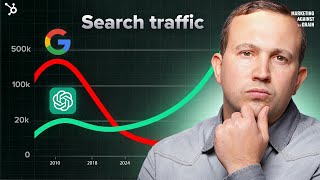
Transcript of a Marketing Against the Grain episode (host Kieran and guests) discussing recent search disruption caused by AI-driven search assistants (ChatGPT, Perplexity, Gemini). They report businesses losing roughly 10–30% organic search traffic—mostly informational content—because AI overviews synthesize multiple web pages into one answer, reducing click-throughs. The hosts debate implications for SEO, paid advertising (expected rising costs), and recommend diversifying demand channels (video, social, influencer marketing), continuing to publish authoritative content to remain included in LLMs, and experimenting with AI search to understand impact.
Chapters
Hey everyone, we are breaking down the future of search engines. Today I got an email from a founder that really kicked off and inspired this show. What the heck is happening with search disruption? Why are you losing traffic from search engines? How do these new AI driven search engines work? And how can you be successful as a business and as a marketer in the next era of search? Those are the topics we're going to cover today. Let's get into today's episode. So Kieran, I think some of our.
Best shows come from conversations that we're.
Having with each other or things we're.
Hearing from other leaders in the market. And I think this show is going to be that show today because it all started with an email. And I got an email from a very successful CEO founder, like top tier VC backed company doing 100 plus million dollars in revenue, doing great. And she was basically like, look, we're looking through all of our data and the amount of like demos and interest we are getting from search is really taking a big hit. What's going on? And she, she reached out and she was like, ah, we think it might be like the Gemini snippets, what I would call AI overviews in search. But we not, we're not sure. How could we or should we think about that? And that email was the start of, of a show we need to do to tell everybody where we're at in the world of search today, what we think is going to happen. Explain a little, a little bit about how we think the next era of search is going to work and what, what it's going to look like.
Yeah, let's do it. Let's try to give people the complete search breakdown.
Okay, so the whole search breakdown and where we're seeing it so far, Karen, and correct me if I'm wrong on any of this, is if you are a very aggressive SEO focused organization, whether you're a media, website, software business, just a really good marketer overall you have seen a lot of decline in the past 12 months to search traffic to informational content. Most people I talk to have seen somewhere between a 10% to 30% decline in their search traffic. And when we say informational content, we mean to articles like blog posts or resources or things like that. Less so transactional content like product detail, pages, solutions pages, things like that.
And is that kind of in line.
With what you've seen, what you've heard from everybody?
Yeah, I think that's right. I think for the most part it's informational queries, things where you can Just get a Q and A answer. I think anywhere between 0 to 30% traffic people are seeing decreases by like we saw this with Q and A side stack overflow first kind of we're just seeing the natural evolution of this which is all of these informational blog posts and informational content are starting to be cannibalized by the AI assistance.
Yeah.
And so what's happening are less people.
Are going to Google and people are using other forms of search engines. That's what we talked about. The other thing that's happening is that Google is returning more just AI generated answers.
So people don't need to go and.
Click through to the link. Right.
Like they can get the gist of.
What they were looking for in that article without having to go and visit.
The actual website page.
And that's like the core thing that's happening in search right now is that Google's market share is slowly declining. And the click through rate from Google search results as they have AI overviews are going down and AI overviews have just been an English language. They're moving to multi many other languages at the end, through the end of this year and next year. Which means that if you're a global business or you sell multiple languages, you're going to start seeing an even bigger impact.
Yeah.
And I guess my question to you before we get into AI search is like what the heck should people do about this change and what do you think like is just going to happen.
In the market for the most part in that informational space like AI? If you use ChatGPT search it's just like a much better experience. If you use perplexity for the most it can give you like a lot of the answers without you ever having to go to the website.
So.
So I don't know if there's much you can do other than assess what risk you have over the next couple of years if this stuff gets really good, if you start to see a lot of that traffic disappear and then start to figure out what the plan B is. Right. Like figure out what am I going to do? If we start to see a little bit of diminishing returns from search, I.
Think we can tell people to try to do one thing right.
I think one of the things you.
And I have talked about is that the most obvious thing that seems like it's going to occur is that as the search disruption happens, the first thing people are going to do is move over to Google Ads and Facebook ads and kind of the tried and true, what we would call programmatic advertising platforms and try to spend more money there. Right? And what's going to happen is that those costs are going to go up. And I think most people you and I talk to think those costs are going to go up to the order of somewhere between another 5 to 20% depending on the amount of search disruption and the amount of companies impacted.
Right.
And so I think the number one.
Thing that you could try to do is to try to have some type of channel for generating demand that is not paid ads or search, even if it's early, even if it's new, whether that be video, whether it be trying to really up your game on social media and go for more of an incrementality based approach to generate awareness that that's going to convert to demand later down the road. You got to do something. If you don't do anything, I think you're going to be sitting in a spot where you're like, your ad costs are going up and your search traffic is going down. Do you agree with that?
Yeah. Yeah. Okay.
So I think one of the interesting things about the future of search is.
What'S different about AI search versus traditional Google search.
Right. And so I've got a ChatGPT window here and Kieran, I was basically like, I would like you to search and do a real time comparison and evaluation of my marketing. I'm the CMO at HubSpot. Will you please do the following? Identify my competitors, rank HubSpot versus those competitors on SEO, social media, marketing, advertising, brand awareness. I would like detailed explanations and metrics for each of these above. Following the comparison, give me specific tactics I should consider to improve my marketing. You would have never typed this into Google search first and foremost, right? Like you would have, you might have had a sentence, would be a complex query in Google search for most people. This is a very complicated query that you can do in search GPT. So I just entered this in and I and I put search on when I entered it in just like this. And then it basically identified competitors. It did a good job of identifying a pretty close list of competitors. So that was interesting to see. It determined what the key metrics for.
Each of these things were, which I.
Thought was pretty good. And it had a really good summary where it's like, hey, we have a high domain authority and ranks prominently for numerous marketing and CRM related keywords reflecting a robust SEO strategy. Like if you're doing a basic overview, competitive overview, like this is all like pretty good. Did the same thing for social. Did the same thing for advertising. I thought this was pretty good. Like, HubSpot invests a lot in digital advertising, achieving high reach and competitive CTRs through targeted campaigns. Salesforce allocates substantial budgets, aka they spend more focused on enterprise clients with moderate CTRs. Like, it's actually pretty nuanced and pretty good. But this show is not about, like, how good this result is. This show is really about. This is a very complex query with a very detailed and complex result. And so, like, how do you get that information? Well, you get that information by taking content from a lot of websites, right? And I think this is the biggest change that's happening. It used to be I entered a very simple search query, I got a list of links and I go look at one website to get information. And now if you look, 1, 2, 3, 4, 5, 6, 7, 8, 9, 10, 11, 12, 13, 14, 15, 16, it's like basically 20 different web pages were used to give you this one search response. That to me is like a massive shift that I don't think most people understand.
Right.
This is kind of what we said from the head start. Why is AI a better experience than Google? Because in times gone past, you would have had to do all of the, going through these different links in the right hand panel and then trying to pull all that into a doc and then trying to format it and clearly concisely put it into the, you know, into the answer that you were actually looking for. And the AI assistant is really just a layer on top of Google that has been able to do all of that for you and do it in a much better way. So I just don't think there's any way that you ever go back to a worst experience. Like, I think if you continue to use these tools and they are getting much, much better, especially for search. And one of the things I can kind of show you is like, the interesting thing is ChatGPT search is also now guessing your search, very much like Google started to guess the answers. Like you, you start typing in the search query and it will start to say, hey, are these the kind of queries you want to do? Like, basically in the same way that Google work? So yeah, this is the Beauty of using ChatGPT search is it moves the blue links into a data repository and that data repository is really something you never have to look at. Like, even if I was trying to validate something that the ChatGPT search had given me back, and I could theoretically click into one of these links and say, well, I'll validate it myself. And so Then you will get traffic from someone validating that answer. But I don't think I would do that. I think I would just ask a follow up question and say actually this here one I'm not sure about. Can you actually give me three sources of validation that this is the right thing? Right. So again I would, my, my entire interaction would just be in here because I would just, I, I feel like from something I'm someone who has used really AI search exclusively for nearly a year and the only time I would use Google would be for local search queries. I actually feel going back and doing the research myself is just such a weird, antiquated way to do things.
I think this is really important and this is a really important point. If you had an intern or an entry level analyst put this together, it would have taken them hours.
Right?
Because they had again, you said had to go all these websites, do this all manually and figure out the insights. All manually. Right. And what's interesting, Kieran, is that what's kind of crazy to me is sometimes we don't believe what people tell us enough. And right here you have the sources links which opens up all the source material that generated it. But what do they call these source links? Search results. So it's doing exactly what you said, right? Where it's doing a bunch of search queries to find the right articles and the combining the data that you need from those articles in a way that's helpful. And the point you're kind of making is if you're out there, you're watching today's show and you're like, oh, am I going to get the traffic back I'm losing from this cycle of search disruption? The point you're making is like, no, you're not going to get it back, you're going to get a little of it back. The data that I'm seeing, Kieran, I think that you're seeing too is, you know, Companies are losing 10 to 30% of traffic with this disruption and traffic from ChatGPT and perplexity is like half a percent to a percent.
Right? Right. Yeah.
So it's exactly, it's not, it's, you know, it's not making up the delta and it makes sense intuitively, right, where you're like, I don't need to go and click every link, but there are going to be times where I'm like, oh, I'm actually very interested in this detailed comparison.
Right.
Making that up and I'm going to go look at that specific thing. So, you know, this this query. Cause I did a follow up query that has some additional sources. I probably have like 35 links in this one ChatGPT window. And what, I might click on one of them.
Exactly. I even think one of them is a stretch.
Like yeah, I would say I might click on one of them every few searches. Not every search, right?
Yeah. I don't even know if you would click on the sources that much. Like I think you click on them now because it's a novelty and you're like oh that's cool. But because even if you wanted to look at the sources, I would just ask it to within the answer, cite each of the source sources within the answer. I know it kind of does that. Anyway, I think the sources are there to make you feel confident in the answer. So you can click on them and say, oh, it's done the work of going through all of these links. I do wonder, you could basically say, hey, recraft that answer and remove this, this, this source if you saw sources in there that you did not like or trust. But, but I don't think you, I again, I just think if we think that there's going to be real opportunity to get that traffic back via AI assistant, I just don't think that that is true.
Hey guys, real quick. You know we love building custom GPTs on the show and we love sharing it with all of you. Well, we wanted to kick that up a notch. We just developed this free guide that teaches you how to build your own custom GPT on chatgpt. We've taken the guesswork out of it. We've got templates, we've got a step by step guide to design and implement custom models so you can focus on the part that's actually fun, the part we love actually building it. And if you want it, you can grab a link in the description below and go check it out now. Now back to today's show.
The other thing is I thought like this was kind of interesting when I was playing around with it yesterday is like it's starting to really look like a search engine. Right? Like it has the, you know, the queries when I type in what is the best and then it will say, well this is what we might, we think you want travel destinations, ways to learn new languages, X routine exercise routine for beginners, travel destination for 2024. So you can actually start to look at keywords in this way. Because you can. This is probably the most popular questions that people are asking ChatGPT for this phrase. So if I type in what is the best CRM for it only triggers for certain things.
It's really more common consumer use cases.
It's common consumer. Yeah, top 10. There we go. Top 10. Yeah. It's really consumer, very broad based consumer searches. But they are going to look more and more like a search engine over time. I think the first question would be how long before they look very similar to Perplexity and because of OpenAI's financial model can give a lot more away than Perplexity can. And then the next question would be how long before they look very similar to Google in the way that they integrate video, audio and other kind of media into the, into the answers. And then the last thing I'll say is what you're getting at is like one, one of the other reasons this is a better experience is because you can take a bunch of like you could take 50 different links and craft a single page made up of those 50 links. Perplexity had a pretty cool strategy to acquire traffic from Google. Like the classic kind of disruptive play where they did just that, right? They created these things called Perplexity pages. And so if you wanted to know all about a single person, a celebrity, they had A.I. i would say what they had done is like go look at, pull a bunch of keyword research from Google and then go build the best long form piece of content for that keyword. And they had AI do that for them. And so AI basically created on Perplexity it's this thing called Perplexity pages like these knowledge articles kind of like Wikipedia esque look. And again that's an example where I could go create that myself now like I could create the most informative page for any topic that I want. It could be made up of like hundreds of different pages and results for that keyword. But I never have to know about that. I just get the actual ideal page for my topic crafted for me. So again I just think, I just think that there is no, no going back actually. Have you seen this little sidebar here? What is, what is the thing I was showing you. I actually just noticed in that crete. Okay. So it's just. Oh, it's put a little. That's pretty cool.
So what happens if you click one of those things?
Surprise me.
So that is then.
So it's just surprised me with a.
I don't know the story about you.
It surprised me to start by yourself. Time I learned much, I can't lie. Okay, this is about ChatGPT.
It's about ChatGPT. It's kind of Lame.
Yeah. What are other options there? Okay, that's weird. The options also kind of appear and disappear.
Yeah. It feels like they're just running a bunch of tests, right?
Yeah, yeah. They're back again here. Analyze data. So they're just like hot buttons. It's pretty cool actually. And that gives you the. It gives you actually some pre prep prompts. This is the other thing that's like really interesting for me long term is these are going to be prompts and so it'll be able to just craft a prompt for you. That's always what I thought would happen is like it will figure out how, it will figure out how to ask itself the question better than you can ask it. I think that's kind of what it's.
Going to do here.
Understanding those pre populated prompts and whether you're included in them or not is going to be kind of one of the future points of SEO. Right. Where it used to be like, oh, do I rank for this keyword? It's now like I know that users of Search GPT are going to get recommended these prompts about my business and I want to make sure I'm included in those.
Right, exactly.
So that brings up a good question. Kieran. The follow up question from this founder who emailed me about the search disruption was like, well, do I still do traditional search engines? Do I do content? Do I do SEO? Is it worth the time and money or not? What would you tell somebody?
I think it's still worth the time and money. Disruption does not happen at the pace that we think it does. I think very large sites are definitely seeing some disruption today, but let's imagine that's going to be 20% for the average site next year. Well, there's still 80% of that traffic that you can fight over and maintain. It does just mean that you're kind of. A lot of websites go into maintenance mode, right? There's less traffic for the same amount of companies and those companies cannot. Those companies kind of switch from predominantly trying to grow net new traffic to trying to keep what they already have. Now maybe there will be ways to grow new traffic in certain and certain vector or certain verticals. So I don't think, I think that's like a general piece of advice, but definitely nuance for certain verticals. But no, I don't think, I don't think it's like you would say, well look, paid, paid advertising costs have gone up every year for the last five years. Should that mean you should stop doing paid advertising? No, you should Stop. You should keep doing it until whatever degree it's like profitable for you. Same thing with search. It's just like how much resources are you going to expand for the amount of traffic and demand you can get from it?
You have to understand that it is a channel is going to get less efficient.
Yeah, it's definitely going to get less.
Efficient and understand the profitability of that. One of the things I'd like to think about, Kieran, when, when disruption is happening is the things that are not going to change. And what strikes me in this evolution of search is that no matter who wins the next generation of search, it seems like one of the things that's not going to change is they're going to need to go through a lot of data. And so the more public data you have, the better they're going to need to figure out who are the authorities about these topics. So the more social credibility, links, validation from others online that exist, the more likely you're going to get included. Right. Like those are the things that's just page rank. That's all those things that have happened in traditional search. So you can't stop doing all those things. You actually have to do them even more to get included in the next wave of search. Like if you were to divest from content because you're like, oh, SEO is going to go down, you will just miss the entire next wave of search, I think. Do you agree with that?
Yeah, yeah. I still think content is going to be valuable for making sure that you at least appear in the LLMs, because as you said, like how you appear in these LLMs, which really is an awareness platform, like search was a directly monetizable platform. What we mean by that is you could get someone to click on a link, go to your website and convert into whatever product or service you were selling. LLMs are not like that. When you, when you appear in ChatGPT, as we just showed you, more likely you'll get the awareness that someone will see your product was recommended, your service was recommended, or you were recommended in some way. But they might not necessarily go through your website from ChatGPT. Maybe they come back and go through paid advertising or something that they recognize, oh, I saw that brand. They were in my result, actually, I will go check them out. And the way that you appear in LLMs is just through, I think, the quantity of mentions. And so the more you can have great content that gets you a ton of mentions, the more you're mentioned for these products or services, the more you're likely to appear in these search engines. Plus, content is still a great way to grow awareness through socials, grow awareness through these other mediums. And I think it's like, what form of content? I think the weird thing for AI is like they're trained on the Internet, so they're dependent upon informational content continuing to be published. But the. But the reasons to publish informational content are going to go down over time. Exactly. So now AI has started to talk. They've like some of the leaders, like Claude S founder has started to talk about their ability to create synthesized data, AI to create its own data and content to learn from, which is like basically remove humans from the need to do that stuff. But I still don't necessarily know how that will exactly work. But you know, we saw OpenAI do publisher deals to try to build these kind of partnerships with publisher companies, give them incentives to continue to create content. But for the little sites, like the smaller sites that are really just doing it because they're dependent upon, because they make money from organic traffic, I don't know what their incentive will be.
I don't think they will have incentives, right?
No, I can't see what the incentives will be right now. Like you could theoretically say someone will create a marketplace and the LLMs will have to come across and buy the data. But I don't know, that doesn't seem that practical. Like what are you gonna do, have billions of websites and someone comes along and picks the ones they want and they're a training model. I don't see that happening. And all that content's already in the training models. They're not going to take it back out again.
One of the things that is also not going to change to your point, is Google exists because they could send people traffic. And so people had a robot doc text and let Google crawl their website. Right. People are going to keep letting the LLMs or whoever wins search crawl the website because even if it's not visits, it's going to be some and it's going to be a ton of awareness and like they can't afford to not do that.
Right.
And like that is going to remain a constant, I think over the next decade.
Exactly. Yeah, exactly. I think given what we know right now, it's still continue to do what you do, look to see how it's impacting you and then course correct accordingly. But I don't think the course correction for most is going to be stop doing search, stop creating content.
No, it's going to be keep being aggressive in content because it's going to help you in the next generation of search understand that your ad costs are likely going to go up and try to make some investments now to diversify beyond those. And those investments could be social media marketing, YouTube marketing, influencer marketing. We're seeing a lot better performance within influencer marketing versus programmatic paid advertising. So, like, you don't have to shift all of your budget, but man, might be worth shifting 10, 20%.
Yeah.
You know, to understand and do that now before things get really acute. And I'm an optimist. Kieran, you're a little bit of a pessimist, but you're sometimes an optimist. You're kind of between. One thing that you and I, I think, can agree on is that anytime you have a bunch of disruption, there are new opportunities to game the system and win. And, like, be hopeful that as, like, mass consumer adoption happens, we will see that those new opportunities for marketers. We're just kind of in this weird transitionary period of time right now, I think.
Exactly. Stay curious, stay vigilant, keep doing the things you're doing, but, like, definitely start to figure out if there's new things you can experiment with that are relevant for your market. That's kind of like the. The end message I think that I would give for. For this episode.
Yeah. And I think one thing I would say to close out is be like Kieran. And I'm almost there, but I still probably use regular Google like 20% of the time. Force yourself to use AI search, perplexity search, GPT. All these things that you understand how this is all changing so that you can understand how it will impact your business. It's not enough for Kieran and I or anybody else to tell you, you do have to experience it for yourself. So, guys, please go and do that. We will be back with you really soon on another episode of Marketing against the Grain.
This data is wrong every freaking time.
Have you heard of HubSpot? HubSpot is a CRM platform where everything is fully integrated.
Whoa. I can see the client's whole history. Calls, support, tickets, emails. And here's a task from three days ago. I totally missed HubSpot Grow better.
More from Patrick



A NEW BREED OF PARTNER: The Partnership Ecosystem Model Journey of Patrick Biddiscombe, Part 1








Customer Success Workspace: Never Lose Sight Of What Matters Most | HubSpot Spotlight