INBOUND 2015 BoldTalks: Dave Delaney "Improve with Improv"
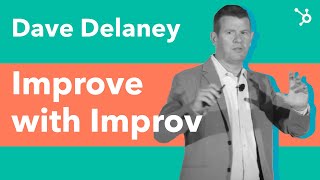
Dave Delaney applies improv rules to networking and personal growth. The core lessons: say yes and build on what others offer, listen harder through eye contact and paraphrasing, and stop fearing failure. He shares a live story about slides advancing on their own to show how acceptance beats panic.
Chapters
Okay. Hey, everybody, thank you for having me here. I'm super excited. I'm Dave Delaney, as he just said. Thank you, davedelaney, Ca and avedelaney on Twitter, if you'd like to say hello. Love to hear from you. So I'm gonna talk about improv, but before that, I wanna tell you a little story. A few years ago, my book. A couple years ago, I guess my book came out, New Business Networking. And I was invited to present on networking and using LinkedIn. I do a lot of training on LinkedIn and things, so I was invited by a healthcare company, a huge healthcare company, to come and present on LinkedIn and networking. That's not me in the photo, by the way. Just so you know. So, yeah, so I go there and they hand me the remote, and as a speaker, and I do a fair amount of speaking as a speaker. You tend to try to use your own equipment when possible, because sometimes. Sometimes things happen. So they tell me, okay, so use this remote. And I'm looking at it like, oh, my God. Okay, I hope it works. And by the way, you're going to be talking to 250 management in this auditorium, but you're also going to be talking to 20,000 employees streaming live to them. No pressure at all. So. So they hand me this remote, I start my presentation, and I asked the audience, I wanted to, like, introduce. I wanted to start with LinkedIn. So I asked. I asked the audience, how many people do you think use LinkedIn? Every hand in the audience goes up. I'm like, whoa, these people really know LinkedIn. They've done their homework here. This is amazing. And this guy right in the front row goes, 225 million. And I'm like, what? How do you guys know this? And then I noticed my slide had advanced on its own, and then the next slide advanced on its own. So the remote had, like a timer to it. I had no idea how to work the thing. So I had to just go with the flow here, right? By the way, the number's like 360 million LinkedIn users now. But I use this slide because this is actually from that deck. So, yeah. So the slides started going on their own. I had to go with the flow. I had to keep. You know, I had to keep going, right? I just did it a little faster. But everybody, you know, the feedback was great. Afterwards, they even left me a nice recommendation on LinkedIn, which is. Which is nice. And so I get home that night and I'm sitting back over a nice stiff drink, kind of Reflecting on the day, reflecting on what had happened. And. And I'm trying to think, like, how. How did I pull that off? Like, how did I not run off the stage crying and screaming, right? And I realized it was my training and work in improv many years before. That was the reason why I pulled it off. So back. I'm from Toronto originally, and I trained improv, or I learned, sorry, improv, at Second City. Anybody from Toronto? Cool. Any Chicago? Okay. Oh, Second City. Nice. Anybody do improv? Just curious. Sweet. I'll look at some of you. Oh, nice. Awesome. My peeps. So, yeah, so I learned improv. I trained at Second City in Toronto, graduated that performed in Toronto, and then I performed in London. I moved to London for a little while, and then I moved to Ireland, to Galway, Ireland, specifically. Any Galwegians? Thought I'd ask. Okay. Anyway, so I lived in Galway and I created an improv troupe there, and we performed every Thursday night. It was great. Lots of fun. Learned a lot of things, failed a lot. And that's what I want to talk about, right? Improv teaches us three things, and these are not just, you may not perform improv, right? You may not go on stage, that's fine. But these are things that are applicable to your life and even your experience here at Inbound that will make your experience way better. They are acceptance to become better listeners and not to fear failure. So I want to talk a little bit about this stuff. So improv teaches us acceptance. And when I. So Second City was interesting. So my first. I'll put the chickens up. So my first class at Second City, the instructor tells us all to be chickens. He's like, okay, I want all 30 of you who don't know each other, who have just gotten off work. It's the evening, you're probably tired. I want you all to cluck around the room like chickens. So we're like chicken, you know, chickens walking around the room, looking at each other just like, this is the most humiliating, embarrassing thing ever, right? And so you could tell from some of the faces, too, that they would not be back for the next class. Like, they were just. It wasn't going to happen, right? But he was teaching us a really important rule in improv. And the important rule is. Is the yes and rule. And if you know improv, you're nodding. Some of you are nodding already. Yes. And the idea with improv is to accept what's given to you in a scene and then add upon it to continue the scene so the scene will keep moving forward. Right. So if somebody said, you know, be a chicken, you say, yes, and here comes Colonel Sanders, or, yes, and let's find a way out of this cooperation or something. Right? So you come up with ideas and you improvise that way. But the point of yes, and. And the point of acceptance is that even at inbound here, you may be waiting in a long line to go to a keynote or something, and somebody may say, this line's too long, you know, and I'm starving. You could say, yes, and let's go get lunch. We can watch it later. Or yes, and I'm buying drinks. You know, it's a great way to network with people by accepting opportunities that come up to you. I can tell you from all the conferences I've gone to, the best experiences were always. I mean, many great presentations, but a lot of great experiences in the hallways. Right. And so accept those opportunities that come up. So, yeah, so with improv, you get an object. So can somebody give me an object really quickly? No, not really. Like a basketball. Great. Okay. Thank you. Not a real object. Yeah, I should have been more specific. Okay, okay. So. Okay, so he just gave me that great basketball, right? This is an awesome basketball. I don't play basketball very well. Sorry. Okay. I don't play basketball very well, clearly. I'm just going to put this down for a second because that's just really embarrassing. But you would take the ball and say, yes, and let's play a game of basketball. Or yes, and. But, you know, I don't know how to play basketball, but let's do it anyway. And you continue to the scene. So. Yes, and improv teaches us to be better listeners, Right. This is so important. And it's important, obviously, on stage, offstage, whatever. Improv teaches us to be better listeners. And in my book, I talk about this as well. And this is sort of from. This is actually from my book, New Business Networking. But I'm gonna walk you through how to listen effectively. The first step is to look interested, right? So when you're. And you do this while you're here. This is the point, right? Pay attention. Do this while you're here. Look interested. So when you're talking to somebody, look them in the eye. Don't stare at them and freak them out, but, you know, really. But look them in the eye. You know, look interested, nod, smile. Great. Right. Involve yourself by responding. And so that's. Yes. Really? No kidding. So what happened next? Wow, that's amazing. You know, tell me more about that. And then what happened? Stay on Target. And the target when you're speaking to somebody is them. So you let that person do the bulk of the talking. We're all guilty. I mean, my wife would be the first to say, like, yeah, it's so true with me that I do too much talking. Stay on target and let the person do the bulk of the talking. And by talking to them and asking them follow up questions, you don't want to question them and make them feel weird, but stay on target, the target is them and test your understanding. Right. A good way to do this is to repeat what they say or repeat the instruction you're given. So let's say your boss comes in the office Monday morning and says, hey, I need this basketball shipped to New York by 5am Monday. Then you say, okay, so what you're saying is. So what you're saying is you need this basketball shipped to New York 5am Monday. Is that what you're saying? And she'll say, yeah, that's right. By repeating it. What's great about it is that they trust you, they believe in you. And this works really well with your spouse too. Trust me, it works great. But just repeat it. And the other good thing about this is when you repeat it, you actually retain that information better by repeating it so you remember it. Evaluate the message, right? Evaluate the sentiment of the message. Evaluate what they're saying to you. Maybe they're talking confidently to you about something. Confidentially, that's great. But just evaluate the sentiment of the message and treat it accordingly. And then neutralize the feelings. And so that means, like if somebody says something that you just kind of rubs you the wrong way or it's kind of offensive or whatever, you gotta neutralize the feelings and you know, okay, and politely excuse yourself, I've gotta go to the bathroom, sorry. And then walk away, unfortunately. Now, all of you who will meet and talk after, I hope in the halls will probably, like, one of you will have to go to the bathroom and you'll be like, no, no, it's not you, I swear. I really have to go. So improv teaches us not to fear failure. And obviously this is a common theme. We talk about failure a lot. Don't fear failure, right? And when I think about this, Whose Line Is It Anyway? That's a great example of improv, right? But the thing is, Whose Line Is It Anyway has failures? You just don't see them when you watch the show. And now those guys are like the best in the world. No doubt. But the show is edited, right? You're not Watching a complete show. So no, like, Whose Line Is It Anyway? Is a great example of improv performance. But understand that failure happens, right? And you can't be afraid of failure, right? I think of improv more like jazz, right? Where like, if you're in a band, in a jazz band, and you're on stage and you're doing your thing, let's say you're playing bass. You are accepting the song that you're playing. You're listening to your bandmates who are playing. And then you're not fearing failure when they give you that nod, like, it's your turn to shine, it's your turn to do the solo. Clearly, I don't play bass. Be better playing the basketball here. And improv's like punk rock, man, right? It's about, like, having fun. It's about getting out and doing stuff I love. Like, Henry Rollins is such a good example. I love this quote. He says, for the last 30 plus years, I've been doing one long, uninterrupted improv. So true, right? Don't fear failure. You can imagine, like, punk rock, there'd be nothing if they feared failure, right? And, yeah, they work together as bands, right? They listen to one another. They accept it, you know? So don't fear failure. Especially don't fear failure. You know, when your slides start to advance on their own, right? That can happen. I want you to, like, think about improv every day. Seriously, think about it whether you perform it or not, whether you've taken a class or not. I encourage you to take a class, but not everybody will, and that's fine. Think about every day. Think about improv every day. Accept it. Accept the circumstances around you. Accept the opportunities around you. Become a better listener, right? Just really focus on listening to the people that you meet here. Really listen to them. Not, don't look at your phone when you're talking to them. Don't look over their shoulder to see who else is in the room. Really look them in the eye and listen. And don't fear failure. And that means going up to someone that you really respect. Oh, my God, I can't believe that's so and so. I got to go over and say hello. Don't fear failure. A lot of times you might be shy about that. Don't do that, because you will improve with improv. I promise. Guys, I've made a little booklet. It's a little ebook. It's absolutely free for you guys if you want to download it. My friend Daniel Rossi did some amazing illustrations, so you can grab it at that website with the code inbound to download a copy. I'm Dave Delaney. Say hello on Twitter and we'll talk later. Thank you so much, everybody.
More from Patrick



A NEW BREED OF PARTNER: The Partnership Ecosystem Model Journey of Patrick Biddiscombe, Part 1








Customer Success Workspace: Never Lose Sight Of What Matters Most | HubSpot Spotlight