INBOUND 2015 BoldTalks: Kelsey Tainsh "There is No Such Thing as Normal"
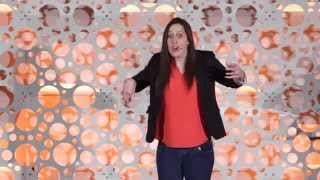
Kelsey Tainsh survived a brain tumor at 5 and a stroke at 15 that left her paralyzed. She walked again through years of rehab and learned that normal doesn't exist. Her message: your differences are your strength.
Chapters
Here's to the crazy ones. The misfits, the rebels, the troublemakers, the round pegs and the square holes. The ones who see things differently. They're not fond of rules, and they have no respect for the status quo. You can quote them, disagree with them, glorify or vilify them. In fact, one of the only things you can't do is ignore them. Because they change things. They push the human race. And while some may see them as the crazy ones, we. We see genius. Because the people who are crazy enough to think that they can change the world are the ones who do. Who would have known that in 1997 when Steve Jobs and Apple came out with the Think Differently commercial, that they were talking about me? I was only seven. In fact, I believe that they were talking about all of us. You see, I believe that deep down inside, all of us want to change the world. Some of us are just afraid to say it out loud. As some of you may have already noticed, as I walked up here, I walk a little different, and I don't look exactly normal. And this is because when I was just 15 years old, I had a stroke. Now, I'm sure you all already know what it means to have a stroke, but can you imagine having one at just 15? You know, I faced a lot of challenges in my life. You see, I'm actually a triplet, and I have older brother and sister who are twins. So my parents had two, and then they wanted one more and got three. In fact, everybody's favorite joke growing up was, what's next? Quadruplets. We didn't find that very funny in my family. Not at all. In fact, they almost named me and my triplet sisters Hope, Faith, and Charity. What a disaster that would have been, right? But I faced a lot of challenges, and I also had a lot of support. And this was really good, because what I haven't told you yet is not only did I have a stroke when I was 15, but when I was 5, I was diagnosed with a brain tumor and I almost died. I underwent surgery and radiation treatment, and then my life started to get back to normal. In the next 10 years, I excelled in athletics. By the time I was 13, I was ranked third in the world and second in the nation for girls wakeboarding. Then in high school, I became a varsity lightweight cheerleader. I'm totally kidding. Can you imagine? It wouldn't work out very well, would it? But seriously, I actually did not become a cheerleader. We all know that wouldn't work. I became a varsity lightweight rower and it was around the time that my team won the state champion rowing competition for the state of Florida that I found out that my brain tumor had come back after being gone for 10 years. And while I thought that I would just go and have surgery and that would finally be the end of it, this ended up not being the case. Sometime during or after surgery, I suffered from a complete right side stroke. I woke up to find the entire right side of my body completely paralyzed. I was just 15 years old. And it was at this point in life, and I believe that it's a point that we all face at different ages where we have to decide if we're going to give up or keep fighting, that I have to make the most important decision in my entire life. And the decision that I had to make was, was I going to allow myself to sit in a hospital bed and in a wheelchair for the rest of my life, or was I going to fight back and relearn to use the right side of my body? And that is the decision that I chose. So while I started in a wheelchair and spent what seemed like forever in that wheelchair, months and months and months in a wheelchair, very slowly I moved to a walker and then to a cane. And now it's been nine years and I can walk on my own. In order to survive, succeed, be happy, help others, be a high achiever and a great leader, I would need to learn that in life there really is no such thing as normal. In fact, recently I went to go speak to a bunch of policemen. And not the kind that you see at Dunkin Donuts, but the kind that are big and muscular and walk around with police dogs. So I was already really nervous because, well, they're big and muscular and walk around with police dogs. And so I started to walk inside. And as I walked inside, I noticed that one of the policemen walking inside walked funny like I do. He walked with a limp. This meant that we immediately had something in common. And because we had something in common, I decided to approach him. And as I approached him, I introduced myself and I said, I hi, my name's Kelsey. I noticed that you walk funny like I do. You walk with a limp. I had a stroke when I was 15. What happened to you? And he said, well, actually, I stepped in dog poop about five feet back. And I'm just trying to get off my foot. Boy, did I feel different. But be assured that in life, we all feel different sometimes, right? And we all have challenges, but in life, we have the power and ability to see our challenges and differences, as well as the challenges and differences of other people differently. In fact, it was at the age of 17, less than two years after I had a stroke, that I wrote the following poem. This poem has actually gone on to be published and gives a very clear definition of how different I felt and how hard the challenge was for me after I had a stroke. This poem is called the Aquarium. I do not really care for fish, she said when asked if she wanted to visit the aquarium. Being paralyzed is like being a member of another species. She was just like those fish, stuck in a place where she did not belong. How scary it was to be trapped, trapped in an aquarium. Her fingers no longer moved. Her hand could no longer write. Her wrist could no longer go up and down. In fact, she no longer had a hand in her arm. Her arm was now a finger. Her paralyzed arm, just like a fin, the kind that has been hit by a boat. How scary it was to be trapped. Everything taken away from her, just like the fish in the aquarium. Her legs were like flippers. She only truly had one. And while she may have been able to swim, she could not walk, she could not run, just like the fish in the aquarium. Where do you want to go today? What do you want to do? But choosing to stay in one place was the only true freedom she knew. But it's the largest aquarium in the world. No, she did not want to go look at creatures in their unnatural environments as long as she was living in one of her own. At the age of 15, when I woke up to find the right side of my body completely paralyzed. And even at the age of 17, and for many years after that, I couldn't have felt more different. It was the hardest challenge I've ever faced in my entire life. What I want you all to know, what I want you all to understand from this poem is that when you're going through a struggle or you feel odd, or you feel like a fish out of water, just keep swimming. Sometimes in life, when we're struggling and we don't know what to do, we just have to keep swimming. Justkeepswimming. In fact, it was at the age of 15, less than three months after I had a stroke, that I went back to school. And I went back to school still in a wheelchair. You know what happened, guys? I immediately lost all of my friends. You see, I was different, and they didn't know how to treat me. It seems as though in high school and middle school and even as we go on into the business world, that if we don't fit in, we stand out. And boy, did I stand out. But as soon as I got out of that wheelchair, moved past that walker and past that cane, and could finally walk on my own, I realized something. If I wear sweatshirts or jackets like this and I stick my hand into my pocket, it was almost as if no one seemed to notice or care that I was different. And for the longest time, I kept my hand in my pocket and tried to hide my disability and my differences to fit in. What I was really doing is I was trying to hide my differences and my challenges so that other people would like me, so that they would think that I was normal. You see, I felt normal if I could stick my hand in my pocket. So when I hid what happened to me, I thought that others might accept me. Have you ever felt like that? See, I was trying so hard to be normal that I would stick my hand in my pocket and try to hide my disability and my differences to try to be normal. I would wear sweatshirts and jackets that covered my arms and my hands to try to be normal. In fact, I would carry books with just my left hand and hide my right hand to try to be normal. You know what I realized over time? There's no such thing as normal. Normal is just another word for average. In fact, you know what normal is? Normal is just a setting on a dryer. And it was once I stopped trying, once I stopped trying so hard to be normal and literally took my hand out of my pocket that my life changed forever. That I began to love who I was before I had a stroke and who I am now, even though I'm different and that I realized that we're all different and there's no such thing as normal. What about all of you? What are you hiding in your pocket so that other people can't see what's really going on with you, so that they think you're normal. Do you want to use it as a strength or hide it as a weakness? You see, the first, most important step in accomplishing our goals and in life is to look past our losses and our challenges to the talents and abilities that still remain. After all, how many young stroke patients does it take to screw in a light bulb? Just one. Haven't you all been paying attention? I can totally do it myself. What I hope you all have been able to learn from our time together today is that in order to survive, succeed, be happy, help others, be a high achiever and a great leader, we need to realize that in life there's no such thing as normal. The misfit, the rebel, the troublemaker, the round peg and the square hole. Which one are you? Aren't we all? Not normal, I believe. Deep downside. Each and every one of us wants to change the world. Some of us are just afraid to say it out loud. But the people who are crazy enough to think they can change the world are the ones who do. Thank you.
More from Patrick



A NEW BREED OF PARTNER: The Partnership Ecosystem Model Journey of Patrick Biddiscombe, Part 1








Customer Success Workspace: Never Lose Sight Of What Matters Most | HubSpot Spotlight