INBOUND 2016: Ashu Garg "Why a 10x Increase in Martech Spend is Ushering in the Decade of the CMO"
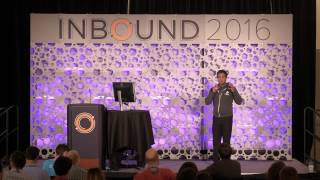
Ashu Garg argues CMOs will lead this decade as martech spend climbs tenfold to $120B annually, driven by fragmented media, empowered consumers, and non-linear buying. He cites shifts like YouTube stars replacing traditional celebrities and outlines five key martech investment areas including programmatic buying and attribution challenges.
Chapters
Thank you. Thank you. So, thank you for coming here. I guess you're all upped your years in lead management, pipeline management, lead nurturing, growth, hacking, I think is the new buzzword of the year. Have you had enough of that stuff? Well, let me do the following. I'm going to take a step back from some of that stuff and talk a little bit about the future of marketing and why I believe it's such an exciting time to be both a marketer and a vendor of marketing technologies. But before I do that, let me very quickly introduce you to myself and the firm I'm part of. You know, you've got to get a quick infomercial. After all, we are marketers. So I'm a jail partner at Foundation Capital. We, we're an early stage venture capital firm. We've been investing in marketing technology for the large part of the last two decades. And it really started with our investment in Netflix, which isn't a marketing technology company by any means. But when we invested in Netflix in the late 90s, what we discovered was that the vast majority of their engineering resources were actually going and building marketing technologies. They had a proprietary email marketing system, they had proprietary systems for display advertising and so on and so forth. And it struck us that while Netflix could build these in house, it was highly unlikely that most of you would want to build all of those systems on your own. And that insight really led to our original investment in the sector in a company called Responsys, which was one of the early providers in email management. We built on that with a series of investments including Tea Leaf, Mark Monitor, Freewheel and others. And over these decades, we've really had the privilege of being part of over three and a half billion dollars in outcomes. So it's been a sector that's been very fruitful for us and we have a great portfolio. I'm still on the board of TubeMogul, which for those of you who saw the press, got acquired earlier today by Adobe. But we're also investors in Agrol, Locallytics here in Boston, Yozio, Kastora, spotsart, and a host of companies across the sector. And so the thesis that I will present to you today is really born out of the work that we see with some of these companies that we have the privilege to work with. So let me dive in. Why do I think this is the decade of the cmo? Well, if you take a step back and look at every decade in the history of software, you'll find that there is a senior executive in the C suite that has really driven software spend in corporate America. In the 80s, that executive was the CFO. In the 90s it was the VP of Sales and Customer Support. 2000s were the years of consolidation and we saw CIOs really rule the roost. And this decade, we believe is the decade of the cmo. Why is that? Well, we'll talk a lot about sort of the underlying changes, but let me start with a couple of just data points. Gartner, which does a lot of service in this space, did a survey of over 400 CEOs last year. And when they asked these CEOs what are the top priorities for you from a technology standpoint, what are the four or five key initiatives that cut across the entire corporation that you as a CEO are focused on? Number one was digital marketing, number two was E Commerce, and number three was customer experience management. All priorities that you would typically think of as being in the realm of the cmo. Gartner did another survey and they do a bunch of these. They did another survey that asked CEOs who do you look to when you look for leadership in cross company digital initiatives? So these are your priorities. Who do you want to drive, lead the charge? And surprisingly, especially for Gartner, which really is a CIO and IT focused organization, surprisingly, CEO said that I look to the CMO to drive cross functional IT initiatives as often as I do to the cio. And so that's really the heart of the transition that is going on in the C suite in the conscious of technology spread. If you look at other surveys around, who do CEOs look to as future CEOs? Who do CEOs look to as people to drive these initiatives? Survey after survey suggests that CMOs are increasingly the center of the digital transformation that is underway across every major corporation in the world. So what's really driving this? This is being driven really by the fact that technology spend by cmos is going to grow tenfold over the next decade. I believe that CMOs and their marketing organizations will collectively spend over $120 billion a year on software. And this is not media spend or people associated with purely in terms of software. There's a tenfold growth that I believe we are collectively seeing happen in the years to come. And what's driving this tenfold growth in software spend? Well, it really, like most things in marketing, boils down to fundamental changes in consumer behavior. I'm going to talk through each of these changes, but at some level they're pretty obvious, especially in a group like this. We all live these changes ourselves in our personal lives. Let me take a couple of anecdotes to illustrate them, because I do think we all tend to underestimate the cumulative impact of these changes. So first, I have a question for the group. How many people here know the chewing gum sales? Gum sales fell more than 10% in 2014. Did anyone know that? Does anyone have a guess on why? So chewing gum, it's a product that's been around for over 100 years. It grows at typically 1 or 2% a year, just around population growth. Good shot, but not exactly Another try? Nope, you're pretty close. So it is related to cell phones, but it's less about spare time. I'm trying to find my phone. Think about where you buy gum in the checkout aisle. What are you doing these days in the checkout aisle? You're looking down at the phone. Just the fact that most of us are looking at our phones as we check out in a store has meant that chewing gum sales fell more than 10% in a year. In an industry like that, that's disaster. Like the fundamental economics of the gum industry have been turned upside down. The only reason I bring the example up is I think the revolution that is underway is going to change industries like steel and minerals and metals and mining, things we don't really think about as industries that are going to be impacted by mobile and digital marketing. Second anecdote. Actually, two years ago, Variety magazine did a survey and they asked American teenagers, who are the celebrities in your life? Who are the most influential figures that you look up to? Who are the people that you think you idolized? Any ideas on who was number one? 2014? Not Kim Kardashian. PewDiePie. PewDiePie was three. So who was one? Smosh. Smosh was one. Fine Brothers was two. PewDiePie was three. One, two, and three are all YouTube stars. Kim Kardashian was not on the top five list, nor was anyone else that most people here in this room would think of as celebrities in the traditional media context. So that's how profound the change is when you look at the next generation of consumers that's emerging. So those, again, are anecdotes. But let me step away from the specific anecdotes and talk through the macro shifts in buyer behavior that we all live today. The first is the change in how we both consume media in terms of the infinite choices we have and the infinite number of devices we're starting to consume it on. As I was growing up, I would read the newspaper. I would listen to the news on the radio. We don't do that anymore. We consume music on Pandora, Spotify, Apple Music, and dozens of other alternatives. We consume video content not on one or two or three TV channels, but on hundreds and hundreds of different alternatives. And really, it's that fragmentation that has changed how consumers interact with marketers. The second major change is the shift in the dynamics between consumers and corporations. Think about it. If a few years ago, if 10 years ago, you and I had a problem with United Airlines, what would we do? We might write to the Small Business Bureau. We might write to some government regulator. You might even try and call 180, 800United Airlines if someone would ever pick up the phone. Today, what do you do? I mean, all of us here in this room, we tweet, we post on Facebook, we blog about it. We create a storm. And we have an outsized voice as individuals in that conversation. The power dynamics between United Airlines and each one of us has changed. Now try to extrapolate that to what's happening more broadly in all of your businesses and the world around us. The fundamental dynamics of communication between consumers and enterprises is changing. And what we see today is just the beginning. The third major change is the change in expectations that consumers have of each of us as brands and marketers. Historically, think about it. I use Rogaine. When I first started buying Rogaine years ago, I looked to it and said, hey, this is a product that's going to give me my full head of hair. And Rogaine would market to that. It was a product market on vanity. Today, when you buy Rogaine and I look at the ads, so you should try them, too. When you look at the Rogaine ads, they do appeal to your vanity. But they also cite tons of clinical studies giving evidence that Rogaine will stimulate hair growth. You could pick product after product. The same is true for a lot of beers and alcohols and a variety of other products that you wouldn't associate with informational needs. Fundamentally, what's changed is that as consumers, we want brands to connect to both our emotional as well as our informational needs. We want them to appeal to both sides of our brain. And that's changing the way we all market to consumers. And when I use consumers, I'm talking about both B2B and B2C consumers, because, frankly, the lines between those is really blurring. The last major change in consumer behavior is a fundamental change in how we think about the marketing funnel. When I went to business school many years ago, the fundamentals of Marketing. And I studied, I studied from a book called Kotler many, many years ago, was all around the marketing funnel and you went, you know, that was the basis for everything we learned today. There is infinite paths to purchase. 60% of consumers have made a decision about what brand and what product to buy before they have any contact whatsoever with that brand. Think about, just think about one of the most considered purchases. Buying a car. When I bought my first car more than 20 years ago, what did I do? I saw some TV commercials. I picked the arty brand. I then went in the newspaper every Sunday. There'd be a classified section. I would find a couple of ads. I'd go do a test drive at whichever dealership had a deal that week, negotiate, haggle, blah, blah, blah, Go buy the car. I bought a car recently. What did I do? I posted a question on Facebook. I asked my friends, here's what I'm looking for. I took a short list. I then posted a series of very detailed questions on Quora with very, very detailed feedback. I then checked out the car on a couple of car websites. I had a friend who had a similar car. I test drove it and then I bought it online on BP.com at no point did BMW ever get the opportunity to even have any communication with me as their prospective customer. Now extrapolate that to everything that you're doing and how your customers are making these decisions without ever engaging with any one of us as marketers or salespeople in that process. So these, I think, are the fundamental changes in consumer behavior that are happening, and they're influencing all of the tectonic shifts that underlie the shift to software in the marketing process. So fundamentally, the way to connect with consumers, I believe, in this new world is going to be based on the use of software across a variety of digital channels, and that will lead to this tenfold growth in spend by marketers on software. Now, in addition to the changes that are happening in consumer behavior, the other shift that's happening is, is a fundamental shift in the mix of spend from media to technology. Why is that? Let me illustrate that with an example. If you think about wanting to reach 20 million American women in the 18 to 49 demographic on television, 10 years ago, you'd probably buy a couple of spots Morton Morton family. Twenty years ago, it was probably Desperate Housewives. Pick your favorite TV show, you could buy in the upfronts a handful of spots, and that would give you the appropriate exposure. And when you did that, you spent a ton of money up front and you probably spent 1 or 2% indirectly through the media provider on technology, because content in the context and audience associated with that content is really what drove your purchase decision today. And going forward, as you think about buying actually the same demographic at the same scale, you don't need to do it in an upfront anymore. You can buy that audience in audience segments using Tubemogul and Freewheel or other video buying platforms. And when you do that, you typically end up spending 20 to 25% of the total spend on technology platforms. And still you get a much better overall ROI because you get much more targeted audiences. You end up paying less on a per view basis. But in that process, you've driven a very fundamental shift from 2% of the spend going to technology providers to 25 to 30% of the spend in the case of video going to technology providers. Now, if you extrapolate that example across all of the media spend, and remember, by 2025, all media will be digital, you're going to see this, this transformation of how marketing budgets are spent. And when you look at that number, the 120 billion number I talk about, to put it in Context, it's roughly 10% of total marketing spend on a global basis marketing spend, it will be roughly a trillion point two at that point. And it's going to grow from what's roughly 1% last year to 10% of marketing spend over this coming decade. So given that so much money is going to be spent on technology, where is this all going to be spent? Well, we have a framework for that. There's really, you know, when we started thinking about this problem, and I spent a lot of time as someone who used to be a marketer. I started my career at Procter and Gamble many, many years ago to someone who now invests in marketing companies. I asked myself, what's the framework that I can use to understand the thousands and thousands of companies in this sector? And what I ended up with is a framework that also explains how each one of you should think about the tech stack that you're building. The relative priorities will be different depending on your business, depending on where you are in the evolution, depending on your strategy. But I do really believe this notion of the five keys is a very useful underlying framework to think about your tech stack at its most fundamental level. So what are these five keys? Well, the first one really to me is about roi. We all talk about it like, you know, for as long as I've been in marketing, and it's been a few decades now, we've talked about Measuring the ROI of marketing spend. I think what is now increasingly beginning to happen is that there is software available that will enable marketers to be in control of the plane. You can increasingly sit in the cockpit and you will increasingly be able to model the business impact of every campaign, every impression, every click that's made, be able to measure attribution of context of one campaign in the context of other things that you're doing in the marketing ecosystem. Some of that might sound like nirvana today, and I know all of you are trying bits and pieces of this in the things you're doing, but really the integration of the data sets is happening as we speak. And I'm seeing both large companies and startups increasingly getting their arms around this. In fact, you know, the acquisition of Tubemogul by Adobe is in large part a bet on this. The ability to connect first party data with sort of the media buying capabilities of a platform like Tubemogul. But again, that's one example. There are many, many other examples of this happening. But this comes with its challenges. Challenges that many of you I'm sure live every day. Attribution is hard. Think about it. I buy a pair of Nike shoes in a store, but I may have started my journey online. I may have looked at an ad on television, I may have seen a billboard. And how do you connect my online search? That ad on tv, the billboard with the actual physical purchase that was made in footlocker. So those connections are hard to make today with today's data sets, identity and unifying that identity across devices is still being solved. And bridging the online offline experiences I talked about in the Nike case is a challenge. The second major key is the shift in how we buy media. Of the trillion dollars of marketing spend, roughly half of it is spent on paid media of some shape or form. And while that's changing and paid media is in a secular decline, it's still a very large part of marketing spend. The fundamental change is really that media is going to be bought like any other category that is purchased by a large corporation. It's going to be bought using software, it's going to be bought using technology platforms. Sorry about that. And it will enable marketers at the very essence to think about media buying as a quantity quantitative process as against something that's bought over three drinks in a bar, preferably martinis. At least in my case, I'm trying to lose some weight. So what are the challenges? I mean, buying media online is not a new idea. Why is it then that still only 5 to 7% of all media is bought using technology platforms. It's really that programmatic media buying still has challenges around transparency and brand safety. How do you make sure that the ad that you're buying is not going to be positioned next to a story about isis? If you're a procter and gamble, that's a big deal. How do you make sure that you can actually buy programmatically? The scale and scope of impressions that you need across a particular campaign. Most online media that's bought programmatically is still bought on spot markets. But if you're a large marketer with very large budgets, you're looking to get guaranteed commitments, sometimes over months. And how do you get that kind of volume in digital markets? And lastly, the agency world still lags behind. And while they are moving kicking and screaming, most agencies lack the skills required to be able to make this shift. And so there are vested interests slowing this down. That said, I believe that this change is fundamental. I think by the end of this decade, all media, billboards, tv, radio, to the extent that radio exists as we know it, to every digital form of media, will be bought programmatically using software and will be tracked and measured quantitatively. The third major change, one that folks in this audience and in this conference I think are very familiar with, is the notion of publisher perish. I believe every brand today is a publisher. Think about this consumer shift that I talked about, the infinite path to purchase. Well, if you're in a world where each consumer has their own individualized path to purchase, how do you get their attention without being available wherever they are making that decision and how do you do it In a way that they are both entertained and appeal to emotionally, but also informed. If you're going to do those things, you need to make a shift to content. Now in B2B marketing, and I suspect a lot of you are in that world. You know, this is table stakes and you're doing it. I think the challenge is when you move to the world of B2C marketing, most B2C marketers still struggle with how do I deal with the notion of content? How do I make a shift to becoming a newsroom? Take a brand like Dove. Dove is actually, and I'm using Dove as an example because they actually do amazing content. Dove has had great content for more than a decade. They were a decade ahead of every other major consumer brand. However, their content was in video form. Now they have to deal with the fact that their three minute videos or six minute videos have to be translated into vines. They have to deal with Twitter, they have to deal with Facebook, they have to deal with Snapchat. The.
More from Patrick



A NEW BREED OF PARTNER: The Partnership Ecosystem Model Journey of Patrick Biddiscombe, Part 1








Customer Success Workspace: Never Lose Sight Of What Matters Most | HubSpot Spotlight