INBOUND Bold Talks: Jarrett Barrios "Mile: 25"
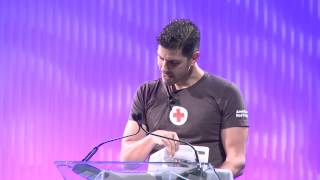
Jarrett Barrios trained for a marathon while managing a thyroid lump diagnosis, got injured during the race, and was near the Boston Marathon finish line when bombs exploded at 2:48pm. He describes the chaos after, struggling to reach his son, and the Red Cross's response feeding runners and first responders.
Questions this video answers
November 6, 2013
About 2:48pm
26
A lump in his thyroid that had to be removed (thyroid cancer/thyroid lump)
Chapters
Hi, can you hear me in the back? Hi. I don't do marketing, except I do marketing. I guess I'm though here to talk about kind of a personal hard moment. The kind of moments that we remember for the rest of our lives. I don't know if any of you have ever run a marathon. Perhaps in a weak moment or a cavalier one. You agreed to join a friend and didn't realize what you were agreeing to. I didn't really realize what I was agreeing to. It started for me last October. It was kind of innocent at first. There was like this four mile run. Oh, I can do it. A five mile run. Then I was doing eight miles on hills and ten miles through blizzards. I would dive into snow banks and stuff my mouth with snow. I would get so thirsty. And then there was the sweet goopy stuff the muscle heads at the gym would call nutrition. And when I started craving it, I. I knew it was all downhill from there. Before I knew it, I was doing 20 mile runs. And I couldn't quite actually believe the day I did 20 miles. It was. The day I won't forget was the day after my doctor told me I had a lump in my thyroid and that it had to come out. I considered whether I'd keep doing the marathon at that point. I'd been training six months. He said to me, you can still run. Thyroid cancer moves really slow. When race day came, it was sort of this interesting experience. Team Red Cross. There we were in these big pens that they kind of lift up and then you go kind of like cattle to the slaughter or lemmings to the cliff. After that you go over asphalt, mile after mile of it. You, your ipod, mile after mile, little kids slapping you five mile after mile, water stations, Gatorade stations, drunk college students cheering you on sort of mile after mile, mile after mile of Red Cross first aid stations, all 26 of them, mile after mile. Don't get me wrong, I'm not saying that repetitiveness is bad. It's actually kind of Zen. When you run a marathon, it's part of this whole mind over body experience, this mini inquisition that is a marathon. It's just you breathing, focused, steady, you by yourself. And when the pain comes, and it comes, you remember what you learned in all those practice runs, that your mind controls your body and that you will finish. For me, a leg injury right at the end of March meant that I was going to be in pain a little bit sooner than most. A lot of Advil helped. But by mile 13, I was hurting. And by mile 15, I was in a first aid station. I stopped for a bit back on the road by mile 21, which is right about here, I stopped or I didn't stop. I sort of was going, and I was only going because of willpower. I said to myself, I don't think I'm going to make it much further. My limping had gotten so bad that there were people along the side offering to carry me to an ambulance. There were. I told myself, well, I'm at least going to make it to mile 23, because I had to meet Heidi there. And I did something because at mile 23 was Heidi. I'd asked Heidi, who had run several marathons before, to meet me there to be my bandit runner. A bandit is somebody who runs without a number and to accompany me to the finish line. And, well, at the time, it sounded like a good idea. But my left legs pain was excruciating. My right foot was a little bloody. Every step I took was sort of extraordinary just because it brought me one or two feet closer to the finish line. Heidi, I said, I am not going to finish. Heidi kind of looked at me. You can see she's got that personality. Said Jarrett. We're going to keep moving. I'm going to tell you about my trip to Tanzania. Do you know how many rhinoceroses I saw? And she drags me along down Beacon Street. You know, they're endangered. There we go, through Coolidge Corner. Pretty soon I was spellbound by her story of the Serengeti. Down Beacon street, through Audubon Circle. Somewhere in Brookline. My mind had stopped believing I would finish this race. And it was Heidi's job to get my mind from telling that to my body. Cross Kenmore Square. The Sox game had just gotten out. People were still sort of trailing out to their cars. It was about 2:48pm Six blocks from the finish line. My years in cross country had trained me as I went under the Charles Gay Bridge. I was approaching that underpass under Massachusetts Avenue, for those of you that know the area. And I knew it was time for my kick. I started to speed up. Heidi smiled. We were going to finish the race. As I began to speed up, waving at me were all these people in yellow shirts yelling things. I was confused. What was all I could say? I kept moving forward until I literally ran into the mass of other runners in front of me. They had pulled these impromptu barriers across Massachusetts Avenue so that we couldn't pass. There was nothing that made sense about it. Jarrett, Heidi said to me, we're Going to wait for a minute right here. Then there were the rumors. A building exploded. Something collapsed near the finish line. No. No. It was a bomb. I became aware in that moment of the keen sound of ambulances. The finish line was so close, my body wasn't listening. I pushed past the barrier, across the runners. I crossed Mass Avenue. There was a policeman saying something to me, waving at me. I couldn't understand him. He's saying something about a bomb. I was so close. Javier, my older son, was waiting for me at the finish line. I had to tell the policeman that. I had to tell him. He would understand there was a bomb. I knew that he would understand that Javier was waiting for me. And it wasn't just Javier. Three of my dear friends who I worked with were right there too. What I didn't know, what I couldn't know then, was that. Loretta. I'm going to try this pointer. Loretta and Valerie up there and Joyce from the New York Times photo. They'd all made it out okay. But all I knew at the time was that ambulances were blaring and I was standing with nothing to do on Comm Ave. Heidi found a marathon party in a brownstone that wasn't much of a party at that point. She guided me in. She asked, can we use your phone? The guy said, well, you know, our cells are all down, but maybe you want to try texting me to Heidi? Javier, Heidi, to me. Jarrett, call Javier. This man is going to lend us his cell phone. Javier, I said, finish line safe. Heidi to me, it's dead. Jarrett, let's try texting. What's his number? It's. And my mind drew blank. I have his phone number programmed into my cell phone. I didn't know his number. I didn't know his brother's number. I didn't know my mother's number. I couldn't think very clearly. I did know that there were ambulances. I couldn't think of anyone's number except one. And it made me wince. It was my ex husband's number. I knew his number, but my fingers couldn't dial it. All of the baseball games I had missed, the family dinners that I had to bow out of because of work. And now I'd lost my son at the finish line of the marathon and there were bombs. I did dial him, but his number had been changed. I actually don't remember what I did next. I had to call Heidi and she said, jarrett, somebody handed us a BlackBerry and we emailed people. I thought to myself when she handed me the BlackBerry people still use blackberries. And so we emailed somebody, everybody, to call Javier, if you had his number, and to give him our number. And he called. And Javier was safe. Javier was safe. Loretta and Valerie were safe. And before I knew it, I was beyond the ambulances and thinking about what came next. See Red Cross responds to disasters large and small. We were there on marathon day. Our volunteers were on the scene. In the minutes that followed, we set up operation centers because we're in it for the long haul. We had work to do that rest, that day, the rest of the week, and in the weeks that followed, the disastrous response I knew would be getting into gear right then. I don't know if any of you have ever faced that demon amid all the loss and the confusion and the hurt. There's a need to do whatever it is that you do. And in that moment, the only thing that mattered for me was getting back to work. Everybody had been reported in safe. Javier was fine. I had to get to the office. We were working. And it turned out to be the largest Red Cross response here in Massachusetts since the Blizzard of 78. We immediately were feeding runners, runners who had no place to go, and first responders. In the weeks that followed, we provided relief services to thousands. We also provided mental health support. There were folks there who would spontaneously show up on Boylston street, where you're going to be tonight, or at one of almost 80 memorial services where we were there to lend a hand, emotional support and counseling. In the immediate aftermath, we fed thousands of runners. We helped them navigate their valuables, get back home. We cared for the criminal investigation teams and the first responders. And then in the days that followed, we did a mental health awareness campaign, Subways and shelters. We worked with the city of Boston, established a family assistance center there. We worked with family members of those who had been maimed, those who had family members who died, to help them navigate the system. How to get victim assistance, where to go for rehab, how to put a ramp in your house, how to get a placard, because now your family member was disabled. Now, months later, I'm actually going to hold that slide. Months later, my limp is gone, my thyroid is gone, and the memory of this very good, very bad day is starting to fade. But I've never been prouder to be a Bostonian. I've never been prouder to work with the people who I do and of what I do. And as for the marathon, as they say in Boston, there's always next year, and that's it.
More from Patrick



A NEW BREED OF PARTNER: The Partnership Ecosystem Model Journey of Patrick Biddiscombe, Part 1








Customer Success Workspace: Never Lose Sight Of What Matters Most | HubSpot Spotlight