Judd Apatow on Providing a Platform For Women In Hollywood
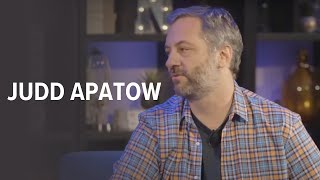
Judd Apatow talks about mentoring Lena Dunham and Amy Schumer, his Netflix shows Crashing and Love, and why he's focused on giving women and underrepresented voices bigger platforms in Hollywood. His management philosophy: don't be a dick.
Chapters
All right, and now we're actually live. Thank you, everybody, for joining the Inbound Studio. My name is Laura Moran. I'm the host, and we're here with Judd apatow@inbound 2017. Thank you for joining us.
Good to be here.
Here to do comedy this evening, but figured we'd get started with a quick little.
A little hello. Yeah, why not live on Facebook? Live to Russia too, I guess. Ye. Are we influencing an election right now?
I hope so. So producer, director, comedian, writer, Any of those a favorite?
A favorite? That's a good question. I really like doing stand up comedy. I started out as a comedian, and then I didn't do it for a long time. And about three years ago, when we were doing Trainwreck with Amy Schumer, she seemed to be having so much fun that I got jealous. And I one night I said to her, I'm gonna go on stage tonight just to, like, amuse you, just so you could see what it was like when I used to do standup, and I went up at the Comedy Cellar in New York and had a good set. And then they were like, hey, if you ever want to come back, we'd put you up whenever you want. And so the whole time we shot Trainwreck, every night after the shoot, I would go to the Comedy Cellar and do stand up. And then I just got the bug again.
And you've been doing it ever since?
I have. I have a special coming on Netflix in December and tonight. There's a lot of people here.
There are expecting, like a thousand people here.
That's a lot. I can only really play at about 18. I don't know how you play to 21,000 people. That seems challenging. What do you think, Kevin Hart? What do you think? What's happening?
Has that taken precedence over writing for the time being, or how does that work?
Well, I do it concurrently. I mean, it's just a fun thing to run out and do, do at night. A lot of the work was to get ready for this Netflix special. And now, you know, we're working on the second season of Crashing, which comes on in January, and the third season of Love comes on, which is on Netflix. So we're busy, like, getting those seasons ready right now.
So a lot of your work does a really nice job of balancing, like, emotional stories and storylines with funny, you know, elements, which is, you know, can be unique and not everyone. Sometimes it's one or the other. So how do you think about that? How important is that to you in your storytelling?
Well, I'M always trying to work in, like, a Barry Levinson, Cameron Crowe, Garry Shandling, James Brooks tradition of human comedy. And then I'm a big fan of Stripes and Animal House and movies like that. So I think what we've tried to do is, like, find a way to combine Terms of Endearment with Ghostbusters.
I don't even know what that means exactly.
You know, big comedy with real emotions. And so that's the fun part for us, trying to figure out how we can walk that line where we're telling a credible story but get to some really big laughs.
Another thing that's a relatively common theme in your work is your actual family being a part of it, or incredibly close friends that probably feel like family at this point. So what's it like working with them? And, you know, why is that? Why are those the people that you choose to work with?
Well, generally, it's fun not having to meet new people. So, like, on Love, my daughter Iris is on Love, and she's so funny. Like, she's a really great actress and she's hilarious. But I also didn't have to meet someone else's weird kid, so I'm very lucky. My wife is a brilliant actress and. And she's a real collaborator in the writing and the development of everything that we do. And I think she's been a real muse for me in the style that I work in. And when you work with people that you like, you always think, when can I do it again? Because if it's fun, you try to figure out a way to keep working together.
Is it difficult to. Or do you have to force yourselves to stop talking about work at home? Or is it just one big mishmash of it? Never. The balance just always exists or never ends well.
When we're in the middle of, like, a project, we're talking about it, but that doesn't happen too often, that it's engulfing our lives. But we haven't done one for a few years, so it's been quieter. Now we can just focus on the problems of teenagers all day long. Women are emotional. Have you found that women are emotional? They have very strong emotions. When I was a kid, I didn't even have emotions. Just sit in my room, watch the Mike Douglas show. I never really, like, talked about what I was feeling. But when you have daughters, they tell you everything. You're getting a full play by play every single second of the day.
Does that influence, like, have you learned things that you're like, oh, this would work in Something that you're working on.
I learned that my parents should have asked me how I was feeling. That never happened my entire childhood. Like, how are you feeling?
I guess speaking of that, you also are, you know, you've done a lot to work with people like Lena Dunham. And you know, you've been a mentor to a lot of people in the industry and have worked with them to co produce things. And so do you enjoy. I would imagine you do. Do you enjoy your role as mentor?
And yeah, I mean, it's fun because if I mentor someone like Lena because she's so much more talented than me, I look good. People are like, you're so nice mentoring her, but she's so much better than me that it's like, yeah, like I get all this. Nice people think, like, I'm a nice guy, but really I'm a leech. Just a leech to talented people.
Who are your mentors?
Well, Garry Chandling was my main mentor. I wrote for the Larry Sanders show and I directed the Larry Sanders Show. He gave me all my first big breaks. And I'm actually directing a documentary about Gary that will be on HBO in March.
Do you have favorites or times and reasons why you like to do film versus television versus a documentary? Things like that?
You know, it used to be that I would do a TV show, it would get canceled, I'd be depressed and I'm like, I'm going to make movies now. And then my movie would bomb. I'm like, I'm going back to tv. And it was just, I would just fail back and forth the whole time. But it really just based on if I have a good idea. And I like TV because my movies are a little long. So it's like I get to make six hour movies, which is like my dream. But I'm looking to make another movie hopefully in the beginning of next year.
We had Brit Marling up here earlier. She was at the event today as well. Shows like Girls are on hbo, the platform for television is changing. Netflix is doing things with things come all at once, you know, are produced all at once. How does that affect you as a creator and a storyteller when you have to think about how your content is being consumed?
Well, we think about it because, for instance, when we do love on Netflix, we're aware that most people will watch the whole series, like all 12 episodes in two or three sittings. So we try to think about the stories not being too repetitive stylistically. We're trying to kind of pull you from one to the Next. But then when we do Crashing on hbo, which is about, like, a young, not good comedian yet in New York, it's a little bit more like individual movies. So there is a story for the season, but it's not as much of a soap opera, in a sense, because we know most people aren't binging it. Although I guess a lot of people just wait till the whole show's on. And once they've. People get annoyed. They have to wait now, right?
Yeah, I think so.
They're, like, furious.
Like, Game of Thrones is over. It's gonna.
Yeah, well, that's the big thing about being, you know, watching all these shows that stream is you watch all of them, then they're gone for a year, and when they come back, you forget everything about the show. So, like, I remember season two of Narcos came back, and my wife and I were watching the first episode, and we were like, is Escobar a good guy or a bad guy? We were watching the show Broadchurch. You ever seen that show, Broadchurch? We got eight episodes in, and we turned to each other and went, we watched this already. It took eight hours.
Every episode of Law and Order, I'm like, 45 minutes in now. I know what happened.
Our brains aren't built for this much content.
Let's switch gears a little bit to your sort of management style on set. You have got a lot of experience with that. How do you sort of run a team? How do you create a culture? What do you do to make a positive environment for the people that you're working with?
Well, the first job I ever had, I worked for the Ben Stiller show, which was a sketch show on Fox. And I think I was 24 years old, but I was running the show with Ben, and because Ben was acting all day, I was running the writers in the office. And I used to sit in my office reading these Stephen Covey leadership books, trying to figure out how not to get the staff to hate me. So I've actually read all of those books, and I think there's a very simple rule to all management, which is don't be a dick. You know what I mean? Like, if you're nice, I mean, you want people to want the whole organization to succeed. I mean, that's really the best advice, which is, if it's a selfish endeavor, then people hate their mean boss. But if, like, you're all in it together and everyone feels like they're part of the success of what you're trying to do, it seems to work better and if you really care about people and you listen to them and listen to their needs for how they work, because everybody works differently, especially writers. Some people write really fast. Some people are, like, tortured for months over every comma. You know, if you're sensitive to them, they tend to do better work.
When you're. When you're choosing projects to work on that are not ones that you're necessarily creating, what do you look for? Like, what are the things that you're like, yep, that's something I want to get involved in. Are there sort of, like, little white flags that you're like, if this is a part of it, I'm in.
Well, we have a movie now that just came out on, like, streaming and Apple. I mean, like, itunes and stuff called the Big Sick that was out this summer. And, like, for that one, I met Kumail, and I didn't really know him that well, but he just seemed like a winning guy, like someone you would like. And then he said, I got some ideas for movies. And I was like, all right. And I don't think I was, like, that excited. I just. He seemed like a really smart, funny person, and I wonder what he's thinking about. And then he told me the story of how he met his wife and how she got sick and had to be put into a coma, and how he had to hang out with her family in a hospital waiting for her to wake up. And it was a very interesting story about family and about culture. And I thought, I've never seen that before. And I kind of feel like if I don't make it, no one will. And that's usually what I think, which is, will this only come out in its best possible form if I'm the one doing it? If I think someone else can do it, I usually don't do it. Sometimes I get asked to direct episodes of TV shows, and I usually say no. Like, I never directed an episode of Girls because I thought all these directors already are so awesome. They don't really need me to do this. So I always look for things where I think, oh, my participation will make this the strongest version.
Speaking of Girls, and since Lena is such a vocal activist and supporter of.
Girls, I disagree with everything she says. It's a lot of tension.
As a man in Hollywood, as a, you know, a successful producer, is it important to you to sort of help provide a platform for women to do what they do in an industry that's struggled with that a little bit?
Well, my wife would always get sent all these terrible scripts, and so for years, that was my exposure to what it was like for female actresses in Hollywood, just how underwritten the parts were, and they were just kind of getting guys from A to B. And so I was just aware, oh, guys do a crappy job at writing for women, and there's not enough women writing for women. Like, this is all messed up. So I tried to be more aware of that, but I realized that I only can do it well when I have very strong partners. So I don't think people are looking for me to personally, by myself, write the great female lead movie. But I can work with someone like Amy Schumer or Lena Dunham or Kristen Wiig and Annie Mumelo and bring my experience and support to them. Because it's ridiculous that there are less movies made by women or for women than men. I mean, I believe women are 51% of the population, so it's odd that you just get one Wonder Woman. Shouldn't there be all sorts of characters, not just superheroes in all genres? So. So it's fun for me to do, but it's also fun to work with someone like Kumail because he was saying, like, I don't feel represented in movies. And then the movie did really well because there's all these underserved communities.
Absolutely. We're running towards the end, so I'm going to ask you a couple quick ones.
Okay.
Easy ones.
I voted for Trump. What? What?
Say that directly into the camera. What's your favorite curse word?
My favorite curse word, I think when I get mad at, I say two. I just go fuck cock. Like, I do random ones together, you.
Know, bring them together, make a new one.
Yeah.
All right. If you weren't doing this, what would you be doing?
I probably would be. Maybe a teacher.
Any specific subject matter?
You know, something like writing, like. Or English, maybe.
And what does inbound mean to you?
Inbound means. What does it mean? Is there a reason why you guys called it inbound? Because I've been Googling this for, like, six weeks. Like, what is this? The people come, they want to be entertained? Do they want to learn? Are they trying to connect? Is it about business? What?
I think you got it right there.
It's all about.
Thank you so much for being here. This has been fantastic. We're super excited to see you on the main stage for Inbound Rocks tonight. And thanks for stopping by the studio on your.
Thank you. Thanks, everybody.
More from Patrick



A NEW BREED OF PARTNER: The Partnership Ecosystem Model Journey of Patrick Biddiscombe, Part 1








Customer Success Workspace: Never Lose Sight Of What Matters Most | HubSpot Spotlight