Neil Patel’s 5 Solutions To Marketers' Biggest Challenges
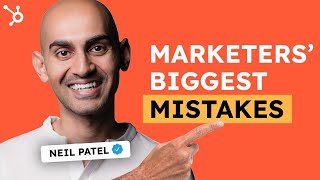
Neil Patel tackles five marketing problems from a survey of 1,000 marketers: growing globally (62%), privacy rules (56%), pivoting after events (53%), measuring ROI (51%), and generating leads (47%). His fixes include localizing content for new markets, aligning compliance with regional laws, keeping execution teams small and agile, tracking actual revenue instead of vanity metrics, and building omnichannel strategies for sustained growth.
Chapters
Foreign this is Caroline Forsey. And welcome to another episode of Marketing Minds where we interview thought leaders across the industry to help you stay ahead of the competition and create a winning marketing strategy. Today we are joined by Neil Patel and we're going to discover Neil's solutions to marketers. Five biggest challenges. Welcome, Neil, anytime.
Thanks for having me.
For some context, we surveyed 1,000 marketers and asked them about their five biggest challenges that they struggled with in 2022. So I'm going to read each challenge to you and I would love your answer as to why it's such a big challenge for marketers. And one tip you have for overcoming.
That challenge that works. Let's do this.
Challenge number one. 62% of marketers say that growing a global audience means was their biggest challenge this year. Why do you think it's such a problem for marketers and how would you combat that challenge?
You know what's funny is I've created a, a global audience. And what I've also found is once you create a global audience, it's also even harder to monetize that global audience. But the biggest reason that we see marketers struggle to grow a global audience is they typically focus on one language. Believe it or not, people either start off in English or Spanish or Portuguese, or they pick a popular language like Hindi or Mandarin. But keep in mind, the majority of the world doesn't just speak English or Spanish or Mandarin. They're speaking tons of different languages. And the real strategy and way to not only create a global audience but be able to monetize it is you got to translate and transcribe. So here's what I mean by that. You can go find people on places like Upwork or whatever forms you can within that region or even within your local community. But you need to find people who are experts within your industry or know it enough, but live in that country. And you got to pay them to translate and transcribe because adjusting the words from English to the other language doesn't always work. Sometimes you got to adjust it for cultural differences. And then the reason you also want someone within that local region is they need to help market that content. The website, the product, the service, whatever you're trying to build community wise within that region. I hit up other sites to get backlinks, hit up other social profiles and connect with them and set up interviews for you. You got to actually have feet on the ground. And again, you got to translate and transcribe and that solves it. But without doing that, sure, you can still Build a global audience, even if you stick to one language, like, let's say English. But they're not going to be as engaged because not everyone within those regions speaks English.
Challenge number two. 56% of marketers say that updates to privacy regulations is their biggest challenge right now. Why do you think it's a challenge for marketers? And what's one tip for overcoming that challenge?
The reason markers have issues with privacy changes isn't because they don't like or they like them. It's more so every country has their own rules. So you got to adapt to them from a legal perspective. And sure, lawyers can work on terms of service and privacy policies, but you got to actually adapt your marketing. So for example, in California, at least during recording of this interview, you have to have a do not track option for specifically California. Some of the other states may require or may not require it, but as marketers, you got to adjust what you show people based on their regions that they're coming from. The solution to this is personalization. Think about personalizing experience. If someone has dogs, you don't really show them products for cats, right? Because you know they have a dog. The same goes when someone comes to your website from a specific region using the GoIP. You can, you know if it's country based or state based. If you're in the United States, you can end up adjusting the marketing messages a little bit here and there, but you will need to connect with a legal team or outsource law firm just to make sure that the marketing campaigns are running are compliant for those regions or countries.
Challenge number three. 53% of marketers say that pivoting their marketing strategy due to major global events like the pandemic, recession or political turmoil is their biggest challenge. What's one tip you have for overcoming that challenge? And why do you think that pivoting a marketing strategy in the first place is so difficult for marketers?
It is very hard to adapt when it comes to major events like Covid or pandemic or one country going to war with another country and it affecting the global economy. What I recommend companies do is most of them try to say, all right, all hands on deck. What can we do? And that's great, and you should. I'm doing that. But think of the Facebook rule. If they're trying to build a product, the amount of engineers that they have should be able to be fed off of one large pizza. So when you have too many cooks in the kitchen, in other words, things actually move slower. So what you want to do is figure out who on your team is agile, can move fast and have a small circle. Doesn't mean that you don't update everyone else on what's happening and changes they may need to make. But you need a few people who can just focus on executing and adapting and changing. Because if you have everyone trying to focus at the same time, yeah, it's great and there's nothing wrong with that. But it just tends to move slower because you find a lot of people go into meetings and discussions about it versus actually doing. It's really hard to get a thousand people to all adjust at once. But you can get the leaders on board and a few people underneath them who are really quick at executing. It doesn't have to be that they'd be managers, it could be lower level people, but just people that you know that can move fast. Once you get a lot of the systems, processes change or some of the steps or any improvements you need to make, then you just, just need to distill that information to arrest the team and have them follow suit.
And just as a quick follow up, what can marketers do to stay up to date with trends that are happening in the industry and knowing when to pivot on those?
People will have a lot of statements saying like personalization is dead or SEO is dead or paid advertising is too expensive. The way I look at it is keep up with the news. There's a lot of marketing sites that have 10 news. You guys do a HubSpot. We do@neilpatel.com and there's a lot of other sites that haven't used like Search Engine Land. Keep up with that. But the bigger thing is just because you read something doesn't mean it won't work anymore. So constantly experiment within your organization and use it for the best it is. And here's example of that. Oh, people have been saying for years Facebook Reach is dying. Just because Facebook Reach is dying doesn't mean that there's no revenue to be made from Facebook Organic. Maybe not as much as before. Maybe you don't put as many resources behind it, maybe you repurpose content so it's not as expensive. But that doesn't mean Facebook Organic doesn't work. Doesn't mean that you should stop. It just means, hey, Facebook, it's winding down on how much ROI you can actually generate organic. But use it for the most you can. And whatever it is, as long as it's profitable, keep doing more of it, right? Maybe it's not as good as it used to be. But something's better than Nothing.
Challenge number four. 51% of marketers say that measuring their marketing efforts and their marketing ROI is their biggest challenge. Why do you think that is? And what's one tip for better measuring your ROI in 2023?
The reason 51% of marketers say they struggle to measure markings ROI is they focus on vanity metrics. So everyone knows there's Google Analytics. You can pay a consultant to set it up for you. You know, at NP Digital, we help companies with that, but that's not really the issue. There's actually a bigger issue on hand. Look at HubSpot, you can send out emails and it converts. The money's in the list. You know, people call it the digital atm, but what people do is they focus on things like visitor counts and oh yeah, we're going to set up conversions and, you know, Google Analytics, we're going to look at first touch, last touch, attribution. But what they're doing is they're like, oh, did our traffic increase? Great. Yeah, that's awesome. But if your traffic increased in, your revenue didn't, who cares? What we're seeing is companies aren't focusing on what channels, what keywords, what audience type, et cetera are driving the conversions and they're not focusing on getting more of those. So when you set up your marketing campaigns and your analytics correctly, you actually need to pinpoint what's driving the most ROI and double down on that. And it's okay if your revenue doubles and your traffic goes down by half. It's not a big deal if your traffic goes down by half or even 5x, if a lot of that traffic was irrelevant, your revenue went up. So people start focusing on these vanity metrics and want them to increase when they don't matter as much like we see so many companies do. Like, oh, my bounce rate is going in a worse direction. But your revenue and EBITDA went up by 20%, so who really cares?
Finally, challenge number five. 47% of marketers reported that generating traffic and leads was their biggest problem this year. Why is generating traffic and leads such an issue for so many marketers? And what's one tip you have for generating better traffic and leads in the future?
Yeah, so Andrew Chen once said, all marketing channels eventually go to shit. At least all good ones. Why? Because they become competitive, sacrificing, saturated, more expensive, it's harder to squeeze a ROI out of them. There's a great advantage from being an early adopter, but sometimes if you're early adopter on Channels. I wasn't an early adopter to Clubhouse and I didn't believe in it because I was like, well, you only get value from it if you're on there. And if you're not on there in the right time, it's useless. I'm like, this isn't time efficient. I'm like, this isn't going to last. People don't have these kind of attention spans to be on this for like hours a day. The real solution for marketers, it's always going to be hard, but the real solution, and this is really the only solution, is to take an omnichannel approach. So what I mean by omnichannel approaches, you got to do paid advertising. Not just Facebook and Google, but Bing, Reddit, Pinterest, TikTok, you got to try them all out, Snapchat, you got to do SEO. Not just SEO on Google, but there's also Bing. If you're in the hospitality space, getting your listing for your home higher on Airbnb is considered SEO as well. These are all examples of SEO. When you're capturing someone on your website, you got to do phone number, you got to do push notifications, you got to do chat, you got to do email. You actually offer a lot of these products, which is great. And it works. And people always say, oh, no one opens up email. Email is dead. It's not dead. Email sent and received per day was 319 billion emails per day. Like, just think about it, if it's dead, why are that many people sending emails still? So in essence, you got to take an omni channel approach with all those channels, including social media, repurposing, content creating, and you got to do it long enough and be consistent at it. Don't expect results in two, three months or six months. You got to do it for a long time. There is no server bullet, There is no one channel. Facebook grew with the invite flow, Dropbox Blue through Twitter and get more space. Just using one channel isn't effective anymore because they're all crowded. You got to test, adapt, be consistent, do it in the long run and use multiple channels.
Awesome. Well, those are all my questions, but I do want to leave it open if there's anything you want to add when it comes to marketing challenges in 2022 and as we segue into the.
New year, last thing I would say is just stick at it. Be consistent, continually experiment and learn from your mistakes and adapt. There is no silver bullet, takes a lot of time. No good big company was built overnight. If you look at organizations like HubSpot Dharmesh once had a post I believe I could be wrong on this. I don't know if you guys were a unicorn before you went public, but for all the years you were public, your market cap increased by at least $1 billion. In essence, the point he was trying to make is slow and steady guys have done well. It just takes a very, very long time. Anything that's worthwhile, right? Like if you want to build something amazing, it takes time to recruit amazing people, build up amazing products and services. Good things don't happen overnight. You look at Elon Musk and how well he's done. SpaceX and Tesla are roughly 20 year old companies. It.
More from Patrick



A NEW BREED OF PARTNER: The Partnership Ecosystem Model Journey of Patrick Biddiscombe, Part 1








Customer Success Workspace: Never Lose Sight Of What Matters Most | HubSpot Spotlight