NotebookLM is INSANE! How to Use Google’s AI Tool for Marketing In 2024
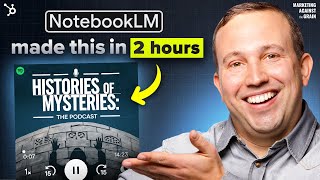
Google NotebookLM turns research into audio and text automatically, with inline citations. A creator built a 10-episode podcast in two hours using NotebookLM for synthesis, ChatGPT for topics, and Ideogram for art, then shipped it to Spotify. The tool handles messy data and generates personalized content, but quality depends on who's using it.
Chapters
On today's show, I'm going to show you an amazing podcast that was created in two hours with AI. And it's the prime example of why engineering led marketing is about to be the future. It's because AI encoding and prompting are coming together to change how we research, get insights and tell stories. And I'm going to break that all down for you all on today's show. Let's get into it. Hey, everyone, I got a fun one. Today I'm talking to you about engineering led marketing. I'm not a web developer or an engineer, but I'm here to tell you that they're going to be a bigger and bigger part of your marketing team or just how you get your marketing work done. This idea came from a message that I saw. One of the co founders of OpenAI is a gentleman named Arjun Kapathy. And he posted on X something that I thought was really fascinating and I wanted to kind of share it today as kind of a setup, but for what we're going to talk about. So if you look at this, in the time of two hours, he curated a new podcast of 10 episodes that he called Histories of Mysteries and he got it all uploaded on Spotify. We're going to look at that in a second. And what you have here is very interesting. He did a full season of a podcast with 10 episodes about different historical mysteries. The lost city of Atlantis, the Roanoke Colony, the last Bronze Age collapse, Mary Celeste. There are a bunch of fascinating topics. And so what do you actually do? Well, he used artificial intelligence and his skills as an engineer to create media, which I think is a big shift in how all media is going to be built and be created. And marketing again, at its core is storytelling and media. So this is why you're like, hey, what is, what is one of the best AI programmers in the world doing creating a podcast about historical mysteries? He's using skills that he has to do what would have previously taken months to do in two hours. It's pretty incredible, right? And so if you walk through what he actually did, he used ChatGPT, Claude and Google to research topics that he thought was gonna would be interesting for this podcast series. Once he picked the topics, right? So he basically used AI and search to pick the different, the 10 different topics. Then he linked NotebookLM, which is one of Google's AI products, to the Wikipedia entry for each of these topics and used a NotebookLM from that Wikipedia entry, generated podcast audio. Then he also used NotebookLM not just to generate the audio, but to write the episode. Descriptions and the podcast descriptions and everything you need to do when you upload a feed of audio files to a service like Apple Podcasts or Spotify. Then he used Ideogram, you could have used Recraft or Midjourney or a bunch of different things to create digital art for the episodes and the podcast. So NotebookLM created all the text based content, Ideogram created all the digital art for the episodes and the podcast. And then he hosted everything on Spotify. And what he basically says is, hey, I did this as an exploration of the space of possibility unlocked by generative AI and the, and the leverage afforded by the use of AI. The fact that I can as a single person in two hours curate, not create, but curate a podcast, I think is kind of incredible. I also completely understand and acknowledge the potential and immediate critique here of all AI generated slightly slop taking over the Internet. I guess have a listen to the podcast when you go for a walk or drive and see what you think. This is to me going to be one of those moments that we look back on a year, two, three years from now where we say, oh, marketing changed that day. And it changed that day because we realized so much of the work that we had to do we could do through code and AI. When in terms of storytelling and creating media, I agree that the core concern here is a bunch of slop and a bunch of bad content. And this is not automating humans out of storytelling. But what I think it is is empowering our very best people to create more, right? Where one person could have done all the research, picked all these topics and then gone and interviewed all these experts, taken months and months to build and craft a show. They could probably do 2, 3, 4, 5 shows similarly with the help of AI. And I think that is the future. Not endless like AI generated slop. And you know what? I've listened to part of an episode. I think it's pretty good. Let's go in. And I'm very fascinated by the story of Atlantis. So I want to listen to listen to a little bit of that one, the Lost City of Atlantis. So these are also very short episodes. 8 minutes, 10 minutes, 13 to 15 minutes. What I think is very interesting with, with especially like a tool like Notebook lm. Let's say you're prepping for a board meeting or a big conference or big sales call. You can take all Those documents, have NotebookLM generate a personal podcast for you, right? A podcast that is just for you that you can then listen on your walk, on your commute. Wherever it may be, and be fully prepped in a personal way that you just wouldn't have been able to do before. Let's listen to kind of the quality here.
Today we're diving into the legend of Atlantis, not to find out if it really existed, but to understand why this idea.
I think the audio quality is good.
Has such a powerful hold on us. And we're going deep on this one. I'm ready to dive in.
It's remarkable how a story. So they acknowledge the source content as Wikipedia. They have multiple voices to make it seem like a host, like a co hosted show. That's a very proper lead in. It's not boring. It's not like just a regurgitation of Wikipedia. Right?
Right. I mean, we've all heard whispers of this advanced civilization swallowed by the sea. But what's really fascinating is how this story, this myth has evolved over time. So let's rewind to the source. Plato's dialogues, Timaeus and Critias. What? Exactly.
So what's interesting is they are they have taken all the lore about Atlantis and actually packaged a fresh story and they're using Plato's original telling of the story of Atlantis as like the intro for this podcast. You know what? Like, is it amazing? No, it's not amazing. Is it much better than I thought it would be? Like, I think so. To me, what is interesting about this is he did this just using Wikipedia as source material. Right. If he had gone and done a bunch of custom research and done some different academic papers, Wikipedia and really like brought a broader set of research together, I think we would think it was amazing. You know, like, it's still interesting with this one source material. But he did that to make it very quickly. But if he had uploaded audio video of other, you know, primary sources, other research in addition to Wikipedia, you could see being able to have like really deep and enthralling 20 to 40 minute episodes. I think at the same time, like, I listen to this and I don't see the Internet getting full of bad podcasts. Right. Like, that's not where my, my mind on this goes. My mind goes to those two things, goes to more better podcasts. Again, the personal podcast side, it's like, I can now, like, cool, I have a board meeting and I want prep for this board meeting. I want to take all of these materials. And obviously you need your own enterprise version of NotebookLM and you gotta have confidentiality and data privacy and all those. But in that world, let's assume all those things are true. Like I can just have a personal podcast of prep for everything, right? Like that to me is wild. And it also shows that we're ushering in content that is going to be inherently more one to one or one to few, in addition to making our kind of more mass market content much higher quality, which I think is, is incredible. But I love the, I think the audio quality and I think his choice to have two hosts and to do it in that style was pretty brilliant and makes a lot of sense there. There's a lot of marketers out there using AI. Most of them are just kind of copy and pasting ideas around. That's not the right way to do it. The smartest marketers are going to use AI to transform their marketing. At HubSpot, we've used AI to turn videos from one language to multilingual in minutes, not days. AI has completely changed the game for us and it can change the game for you. In fact, we just dropped a 12 page guide of AI prompts that are going to turbocharge your marketing. And if you're somebody who's trying to get started with AI, wants the right prompts to kind of push you in the right direction and outline the best use cases, this is the guide for you. So click that link in the description and go check out our free prompt guide. The last thing I will share is NotebookLM. We haven't talked a lot about Notebook LLM yet on this pod. It's one of, I think Google Shining AI achievements so far. It's an experiment, it's a separate team and it's using Gemini 1.5 Pro, but with like a more focused front end. And they're basically positioning it as NotebookLM is your personalized AI research assistant. And so you'll see with NotebookLM that you can upload a whole host of information and then ask it what you want to know about the type of documents you uploaded, whether that be videos, whether that be text files, Whether it be PDFs, things from Google Drive, like it can then take and synthesize information really well and help you get those insights from all that unstructured data. And it can make tables of contents, FAQs, study guides. They really built this product as a research assistant, which I think is really, really great. It's so research assistant focused, it's like it has inline citations, which is like you kind of heard in the podcast because it quoted Wikipedia right away. Right? It even created that citation as kind of an audio version in addition to the text based version. And so anytime I think of research assistant. I think about business use cases of research and I saw a great tweet from friend of the pod, Nathan Barry. We need to have Nathan Berry. He's the founder of ConvertKit. Just did awesome rebrand to kit. Congrats to Nathan and team and he said hey. After using a few AI models for analyzing customer research, I found that ChatGPT4O was the worst of the three. It's often wrongs and struggles to process very much data will lie to you and say it processed much more than it has. Claude 3.5 Sonnet better at importing data, is honest about what is actually the answer to your question, but it's still very confidently wrong. Google NotebookLM, which is what we were just talking about actually really good clear examples, cites, its sources, processes, all the data. I have talked to lots of folks who have used NotebookLM to upload customer feedback, emails, NPS comments and everything. And you can create basically a custom podcast of your customer NPS and in 10 minutes get the best summary ever of what your customers do and don't like about your product. Like, that's fricking remarkable. You can even have a proxy for mps. Like let's say you don't run a Net Promoter score survey, which is where your customers rate you on a score from 1 to 10, 10 being the highest and 1 being the lowest. You could take your support tickets, your phone calls, recordings, those things, put them into NotebookLM for example, and have it basically approximate a Net Promoter score with reasons based on that information. Like we are getting to the point where AI is so helpful at us processing and automating the processing of information, especially unstructured information research, which by the way is the foundation of storytelling. Anytime you're going to do a podcast, make an amazing video, write an amazing article, what's the first thing you have to do? Well, what am I going to talk about and what's everything I know about that and do I have the depth of research to talk about that in the way that I want to? And AI is turbocharging how quickly we're able to do that. And this is why I think that marketing is going to become much more engineering led is because we're going to use AI and engineering to automate a lot of the manual work that quite frankly, no human likes to do. Nobody likes writing podcast descriptions, right? What a human likes doing is coming up with what's the topic for the podcast? What are people really going to like about it? Honing that intro to get people hooked up right? Off the bat, right? That's where a human wants to spend their time. And I think we're going to get to the point where we're able to do that more and more because of these tools. And so in the show today, what I really wanted to break down for you is AI is getting close to being ready for prime time for helping you automate a lot of your storytelling and content creation. I think that is a leading example of how AI and engineering are going to become a primary skill of marketing, whether for you as a solo marketer or if you're on a team of marketers across your team, like that is certainly going to be a big part of it. The quality is much better than anybody thinks. And the last thing is, we've got some interesting validation that NotebookLM for research focus purposes, especially for customer research or storytelling research, is a really great tool to help you bring everything together, get a deep understanding, and then output summaries and audio or text to really get a condensed understanding of what's going on. That's the show today. I hope that you all learned a lot. Shout out to Arjun Karpathy for that tweet, which I think really got my head spinning. And I hope, I think it got all of yours spinning as well. And thanks to Nathan Barry for sharing kind of his experience with using LLMs for customer research. We'll see you really soon. All market against the grain.
This data is wrong every freaking time.
Have you heard of HubSpot? HubSpot is a CRM platform where everything is fully integrated. Whoa.
I can see the client's whole history. Calls, support, tickets, emails. And here's a task from three days ago. I totally missed HubSpot Grow better.
More from Patrick



A NEW BREED OF PARTNER: The Partnership Ecosystem Model Journey of Patrick Biddiscombe, Part 1








Customer Success Workspace: Never Lose Sight Of What Matters Most | HubSpot Spotlight