OpenAI Launches The ChatGPT Store
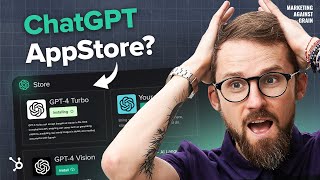
This YouTube episode (host + guest Kieran) reviews OpenAI Dev Day announcements: the ChatGPT/GPT Store (a marketplace for AI assistants/GPTs), GPT creation for non-developers (average creation time ~16 minutes), new model GPT‑4 Turbo (cheaper/faster with ~128k token context), multimodal GPT Vision API and new audio/video (text‑to‑speech) APIs (audio models claimed 10–20x cheaper than competitors), integrations with Zapier/Canva, and business/marketing implications (data as a competitive asset, global reach via natural language, shift to natural‑language UI, faster product iteration, and growth of small niche AI businesses). The hosts discuss branding concerns, potential "data wars," and predictions for smaller, more agile teams.
Questions this video answers
16 minutes (stated by host).
128,000 tokens (spoken as "128,128,000 tokens" in transcript; likely meant 128k tokens).
100 million weekly active users (stated by speakers).
2 million developers using the API (claimed in discussion).
10 to 20 times cheaper (speakers' claim).
Chapters
It is OpenAI Dev Day this week and they announced a ChatGPT marketplace, Agents for Everyone, a Vision API. We're going to talk about how all of these tools can be used in your marketing and in your business strategy. Let's get into today's show. Okay, we're excited. OpenAI had their first developer day in San Francisco and it was pretty amazing. And Kieran, I wanted to start off with what I thought was a very good and funny tweet that you will love. I saw this Sam Altman, who is the founder of OpenAI, in 2008, he'd built an app for the Apple App Store called Loop. And so this guy was like, hey, 2008, build an app in 2023, build an app store. Because that is what happened at OpenAI's Dev Day is they launched an app store for GPTs. Kieran, can you explain to everybody, like, what does that mean? What are the implications? Like, how does it work? Give everybody the real.
So let's break this down. The first thing we're really going to talk about is what OpenAI are releasing to consumers of all sorts is the ability to not just create these AI assistants and we'll get into the technicalities of that, but actually for you to buy and sell AI assistants on a store now, we could just kind of gloss over the fact they have tried a store before. We covered it in depth. It was the plugin store. It did not really work. They'd never really found product market fit for that store. I think the GPT store is the better version of what that was potentially going to be. And so what is the GT store? Olay? Let's give an example. These AI assistants are going to help you create these mini tools. We talked about this before where they can create these micro apps. And the reason they're going to be so impactful is because you can personalize it around a specific use case and then give it proprietary data to reference to actually solve that use case. So this is Rohan Chan. He has access to it. It seems already pretty jealous about that. I don't think most people get an access until Rowan runs a big AI.
Newsletter called the Rundown. They totally hooked him up.
He has created a AI assistant to be able to optimize when he should actually post on X and how to fine tune his post next. And so what he's done is he downloaded all of his Twitter post data from Twitter analytics again. He's got propriety data. Data is a new goal. We'll get to that later. Then he can provide specific custom instructions to the AI assistant to complete tasks and then it can actually go off and do these things for him. So where we are going to go and where I've always thought we're going to go and what I've actually seen speaking to a lot of AI founders who have started with LL LLM models, like trying to build some sort of LLM model that they train and want to get into enterprises, is a drag and drop layer on top of that that allows you to build these kind of AI assistants based upon that large language model and can complete task view. So one future is we as knowledge workers are all going to be probably measured in the future by hey, tell me about the AI assistance you've built for yourself. I can actually see that being an interview question, right? Hey, like tell me about your AI assistants. Take me through them, let me see them. How do they do work for you? Like how efficient are you in actually doing that? And then the store is just accelerating that because we can buy these like cool AI assistants that other people have created and it opens up a whole new category for entrepreneurs to be able to take these under monetized data sets and there's a lot, there's just a lot of data flowing in the about their under monetized and then we can create these real AI assistant applications on top of it and sell them through the store. So this to me is as big of a release as the original ChatGPT for consumers and for actually getting more AI use cases and functionality in the hand of consumers.
Kieran, the way I think about this is when Apple released the App Store for the iPhone, it was a revolutionary app store for developers, right? It enabled developers to build and package apps and monetize their code in a far better way for these new mobile use cases and access to the camera, gps, new data and features that they didn't have before. Now we are going to get a brand new app store that is for everyone. You don't have to be a developer for this app store. And Kieran, we got a friend of the pod, a friend of the POD named Greg Eisenberg and he had a great tweet on this, said hey, today OpenAI announced that they are releasing the ChatGPT store, an app store for ChatGPT and it says the Shopify app store has 33,000 apps and over $500 million in revenue. The app store for Apple has 1.8 million apps, almost $1 trillion in revenue, $910 billion. The Chat GPD store zero agents zero revenue. There will probably. He's like, there probably be millions of agents, billions in revenue. And hit the point. He's like, I wish I would have created an app for the Apple Store. I wish I would have created an app for the Shopify store. Tons of opportunity today to build for the chat GPT store. I think this is a very good point that there will be a gold rush if we can get to product market fit on this. My biggest concern, Karen, this is a marketing show. We're marketers. I hate the branding.
Oh, GPTs is awful for consumers.
They're calling instead of agents assistants, copilots. They're. They're calling them GPTs, everyone. And I tweeted about this. But I'm, I'm just really sad about the branding.
Right? They have not hired a marketing team.
Yet care about their work. Sam could have sent us a quick email. We would have said, sam, can we, can we please urge you to do something different there?
Yeah, the GPT store is awful naming and I actually do think names do matter in this case because they totally do. OpenAI this is not just to be really clear for everyone listening to this show, this LLM model to AI agent is one of the hottest, most competitive spaces or the space that is heating up the most in this kind of AI category, which is like in the future there will be an AI agent platform. I call them assistants, but I think for the most part people call them agents. For some reason sound decided to call them GPTs. But there are these mini AI assistants, these micro AI assistants that you can train on certain data and then you can actually customize to go and complete tasks for you. GPTs, if you want consumers to use this does not mean any of that. So I do think the name matters, right? Like the simplicity, the simplicity of the App Store is like it's apps. People understood what an app is. People do not understand. They do not equate GPT with like the AI assistant part or even the ChatGPT. Like the chat part is actually really important because that's how you actually understand that this is a chat assistant. So I think they could have called it a multitude of different things. It does speak to, I think OpenAI very early, do not have a marketer yet. I think if they want some help, come hit us up. We would be happy to spend some time with the team.
And by the way, the thing that makes me really sad about this before we move on, Karen, is they're the, they're the early mover and the leader. So they could have claimed the great brand in this space and instead they leave the door open for Apple or somebody else to come along and deliver a way better brand experience.
That's what I mean by this is a really competitive space. I think they're going to have a ton of different competitors and in no short amount of time. Google Bard had already done some version of this where it allows bars to connect with your G Suite apps and so you can do a bunch of stuff through that. The one thing I'll just kind of touch on here is, okay, if you're an entrepreneur or any of us who just love this stuff and want to build an AI assistant for the store, I am definitely going to build an AI assistant for the store. I suspect I'm in Europe, so I Suspect sometime in 2027, when the bureaucrats allow me to access tools because they have to make sure that I, you know, they, they feel good about my safety because I can't manage my own safety for myself. I will launch a tool on the. I will launch a tool on the GPT store. But the thing to, to think through here is like, okay, well, like, how does one entrepreneur differentiate their GPT bot from another, the AI assistant from another? It's really going to be the data, right? So what's the first thing everyone's probably learning to do today before everything gets shut down? Scraping data. Like, I think that's probably the number one use case is like, everyone's looking at the AI bots that can scrape data. Because think of it, what I would do is I would go scrape one of the Ryzen subreddits and I would scrape all that data and I would have that data referenced in my AI system and then I could build something like AI assistant, business idea creator, right? And that idea creator is trained on the subreddit data and actually use all that data can tell me very specific business ideas that are applicable to that cohort of people who are all hanging out in this subreddit format. Another one is YouTube transcripts are an actual gold mine.
Goldmind.
I have been using YouTube transcripts to do like, fun stuff in ChatGPT where I. The one that I tweeted that you gave me the idea for was I took Bill Gurley's transcript on regulatory capture, pasted it into chatgpt, then pasted in Biden's executive order and said, hey, like these two things tell us how the executive order is helping to aid in regularity capture. I don't need to do any of this copy and paste now. I can just train the bot to do it. How long do you think it takes for YouTube to close? Transcripts oh gosh.
We are going to be in a data war over the next several years where everybody is going to be trying to protect, acquire, build data assets, right? Like I think we just know that to be true. And I think the valuations of a lot of existing companies could change as data becomes a more valuable asset and that everybody understands the value of of data. And the enterprise use cases along with this ChatGPT app store is kind of, I think, going to be the leading factors there.
The other thing that is like a really amazing thing that is kind of hidden within this or has never been available before is let's say that you figured out how to do something much more efficiently, right? You took your HubSpot data, you trained your AI assistant, you give it some customer instructions and it was able to do something pretty incredible. And the HubSpot data is maybe a bad, bad example because maybe you can't share that externally, but you have some proprietary data that Kip has. Like one of the incredible things about you is you're able to learn things really rapidly. So I remember when you were going through the year that you decided to learn everything there was to know about art. Now let's say you had some propriety data and you were able to customize and build a kit botner art bot that's kind of somewhat automated knowledge, right? You've, you've done the learning, you've automated the knowledge, but you can now share that rapidly with people who can just learn that far faster than you could have because you've done the work, right? Sam Altman demoed this on stage where he built an AI assistant in four minutes. And that AI assistant now can do some form of like automated work and task automated tasks. And I don't even know how that impacts everything. Where we can start to share these automated AI assistants really rapidly with each other. We can take some segment of work and say, here you go, now you can do that to the same degree that I can do that. You just have the bot like I've trained it to do the same thing that I can do. Took me years to do that. It's fine, you go do it now you have the bot to actually be able to do that. So I feel like we're going to get. First of all, your network is really important because I hope I have smart people who can share their AI assistants with me because that's how I get much better. But then I Think we get all much more productive because we're getting such a leg up in terms of being able to share these things with each other.
I sold currently the estimate to create a new GPT assistant. So to to reframe for everybody this new GPT app store, you're going to be able to create an assistant and then you either use it for your own or list it for sale. Right. So that other people can access to it. The time for a non developer to create this new assistant, the Average time is 16 minutes. That's 1, 6, 16 minutes, that is a rapid development time. And so what makes me worry like are we going to have 10 million of these GPTs that are completely useless? Probably for sure. But are we going to have hundreds that are exceptionally valuable? Yes. And something Kieran, that you and I have said on the show over and over and I want to just pat ourselves on the back on it is we said there were going to be more small and micro businesses because of AI and this completely proves it. Oh yeah, you are going to be able to build like a niche business with AI, a one or two person business that can do millions of dollars in revenue.
And I think the incredible thing is we talked about this with Steph Smith on an episode that has likely comes out next week about how you get better at the craft of content. And we talked about the fact that you should start somewhere where you can get quick feedback loops and then like transition to places where you get longer time horizons of feedback loops. A great place to start a business today is going to be create GPT store to prove minimal viable use case and then use revenue to invest into build fully fledged app. And the other thing to kind of note here is the reason we're going to have 10 million GPT bots and most of them for the most part are going to be awful. But some are going to be amazing is because I don't know if you saw the demo as well, that GPT itself can actually build the bot for you, right? You can give it instructions to say this is the kind of bot I want and it will build a bot for you. So now we have AI building AI bots for you. Bananas. This is 2023. I'm saying I feel, I feel like.
The last year has been like a decade of innovation. It is unbelievable. I have this tweet that I thought was pretty, that was pretty interesting just to show everybody that the pace of innovation here, OpenAI didn't have code written four years ago and now today they didn't have like a code base for developers for the API. So their API went from nobody using it and not existing four years ago to now having 2 million developers using that. That API isn't that crazy.
100 million weekly active users.
100 million weekly active users on ChatGPT. So you have a hundred million people a week using ChatGPT. You've got to suspect at least 5 to 10% of them are going to create their own GPTs and then a subset of those are going to list in an app store. So you are going to have a massive flywheel.
Right.
But Kieran, we talked a lot about the GPTs because I think they're the most interesting consumer news. Right. There's some developer and business news that I think is equally important. One, we got a new model, GPT4 Turbo.
Great name, actually. That is a good name.
Yeah, yeah, that is. GPT4 Turbo is a great name for a developer model.
Think Turbo.
Turbo is awesome. I want everything to be Turbo. Why would I ever have a non Turbo?
Yeah, why would you have a non Turbo?
I'm always going to choose exactly the biggest thing that I found interesting about GPT4 Turbo instead of it. It's cheaper, it's faster, all these things. You can now have 128, 128,000 tokens. So you can now upload an entire book to GPT4 Turbo. Which was one of our biggest complaints with, with GPT4 is that it was limited to about 32,000 tokens, I think was the previous limit. So they have exponentially increased what you can actually feed and put into GPT4 Turbo, which is amazing. Right?
The thing I took a note on when I was looking at the like, we should not underestimate the bigger, faster, cheaper part of the story yesterday.
Oh, here. Oh, hold on. On that. I have something really cool to show you. You ready for this?
Is that their strap line. Have they uplifted their. Updated their homepage? They're bigger, faster, cheaper. And I sound like every SaaS company.
There'S new audio video APIs. Did you see this? So they released new audio models, text to speech models on OpenAI that are 10 to 20 times cheaper than 11 labs, which is the big player in the audio API space, in the text to speech space. That is crazy pricing disruption. Right.
They are disrupting so many categories like the multi, the bananas. We haven't even got. We haven't got into the like. I think the thing you're showing is, okay, there's the bigger, faster, cheaper and the thing you're starting to show is they released multimodal API, GPT Vision or Vision.
I think that's. I think the GPT Vision API is what I'm most excited about. Can you tell people a little bit about that? And I got some stuff to show on it too.
Yeah. Let me, let me actually demonstrate in action one of my favorite use cases.
I'm going to see if it's the one that I think you're going to show.
Okay. Like you, you guess and then I'll show because let's see if we know each other this well.
Does it have to do with soccer?
No, but I did see that one. I did see that one. Do you have that one to show? You should show that one. I do. Of course. I'm going to show someone roasting things.
Oh, roast my website. This was going to be my next guest about. I thought soccer was going to trump roast my website. Kieran, we actually did this on our. Our show of different ways you can use AI for your marketing.
I did this.
I just did it manually. We did this exact thing.
Yeah, you inputted the.
Did this exact thing. And they are now using the new API to build an app around it.
So you can do the API. Basically what you're able to do is like build an API. Someone adds your website in the back end. It takes screenshots of the website and is able to parse those things in through the GPT4 Vision, which is available through the API. It's able to analyze the screenshots and then roast it, which is the best part through text to speech API because again they're multimodal. This is the perfect, this is one of the perfect examples. I'm like in the back end getting screenshots of the website and then I'm taking the image, feeding the image in get text and then pushing that back out through the text to speech API. This is bananas because the amount of things you're going to be able to do in your go to market through this like being able to just say, hey, like user, think of customer support. All of those use cases which isn't just turn off your machine and turn it back on again. Like real problems that you have to solve. Think of software support. I can just grab a screenshot of the error, put it into the chat, the chat can parse it and then actually speak it back to me and demonstrate like how to fix that thing. So this is one of.
Software support is going to be become a hundred times cheaper and automated. Most of it automated, almost all completely automated. I don't know if you've seen this. Kieran, our another friend of the pod, Linus Ankinstim, he.
Yeah he did a. I did an awesome rail breakdown.
I wanted to show folks some of my favorites here. There's a sports narrator. So they're using the new GPT4 Vision API and the text to Speech API to basically narrate a soccer game. So what's funny Kieran is you could, you could use this to narrate your favorite team. In your case it's Liverpool in whatever style you want. You could say, hey, I'm Kieran Flanagan. This is what I think about soccer. I want the Liverpool match recording that I'm watching narrated it with my viewpoint of soccer.
I'm doing this. I'm doing this.
Isn't that amazing?
I just need a month of nothing.
You really do. I do too.
To play with these, to play with these toys. They're just toys. Like the amount of things you can do with this technology that we as like non coders me as I should be able to code given I went to like university and spent three or four years coding.
We'll talk about your failed coding experience.
I have started doing Replit's Hundred 100 Day Python course which is actually awesome. I've already, have already stopped. I've already failed sometime. I'm just too busy. I'm so busy all the time.
This is all self inflicted.
I don't have a lot. We should do a show. We should do a show at some point which is just you giving me therapy for oversubscribing myself.
Oh let's put it this way, I'm not much better than you.
Yeah, yeah, exactly. We'll get a AI assistant GPT assistant bot going for CMOs versus grind little therapies bot.
I love that. Okay. This is actually I think one of my favorites.
Kieran. Yeah?
You said the webcam. Did you see this?
I. I got your WhatsApp but I didn't fully grock it.
Okay. So you can use the Vision API, connect it to a webcam and ask GPT in real time what's happening in the webcam. So he's asking what am I holding up?
Oh really?
And he says and it says you are holding a pair of sunglasses.
Oh my goodness. This is, isn't this bananas? This is absolutely equal parts amazing. Equal parts. I'm trying to think through you know the ring, you know the little ring cameras that people have for security. I'm trying to like think of use cases where that we cool that you can actually.
You would know who was at your door, you would know what, what delivery happened. All those things.
Yeah. This you could actually transcript and when a delivery driver goes, you could probably automate some kind of message and say your package has arrived. Like darn. There's just so much. It's created so much more like applicable data, usable data, I guess like capture. Capturing everything and making it usable in some way.
The webcam is one of my favorite. We already talked about Rowan's X monetizer, which I love. There's a travel assistant. There's also another webcam GPT which is somebody's already built a lightweight app to do a similar thing. So the real time webcam use cases of GPT4 Vision. Pretty interesting that I'm seeing like he's actually having GPT4 Vision identify different things on the webcam. Somebody's already billed Landing page optimization GPT.
Yeah. Had this one bookmarked.
So using The GPT Vision API, he built this thing in 30 minutes. It takes a URL, converts it to an image and sends it through vision to respond to with custom landing page optimization suggestions. This is what we've been talking about on the show.
This is the multimodal. Every marketing team should have an AI developer. Like the amount of things you can build through the API, 100% team. Actually. I need to take a note of that for myself. We should actually have AI.
We have a little team of AI developers at HubSpot. Shout out, shout out. Our AI team, they're doing awesome. You know what? Complete sidebar. We meet every week. We go through the use cases. We talk about what's working, what's not, what we iterate. I encourage you, if you're working on AI internally at your business, to have a really tight feedback loop, have high urgency because so much is changing and what is possible is changing so frequently. You want to stay really tight and really connected to it.
Our company does a weekly all hands for everyone building AI where they can come together and talk about stuff. This is the definitely the culture you want to encourage within your business, which is, hey, everyone should be playing with these tools again. I think in the future part of your interview process is going to be someone actually looking through the AI assistance that you've built to like make you better at work, be able to automate more your tasks. So I think that's the. I don't know, that's kind of the. For me that some of the major announcements was the GPT Assessment Store, the multimodal API that We have gone on a lot about. I wanted to do a quick recap of because it was super cool for Zapier. Right? Zapier were actually one of the two.
We're on the stage. I was about to ask you. I won a little behind.
They managed to build pretty fast and rapidly, got into to the. To to the launch and got demoed on the stage. But I want to quickly cover what it was.
It was Zapier and Canva. Shout out to both of you all, you move fast. You developed really quickly. Our friends at Canva are awesome too.
Turns out the best product marketing is engineers building awesome shit.
Awesome shit really quick. The best product marketing.
So I'll turn the sound off, but the reason I wanted to touch on this is because the other thing hidden within this, right, this is the demo they went through where they were showing how you can use Zapier AI actions with the GPT assistant to be able to just automate your work and do work through natural language. So in this example, she actually has AI go through her calendar using Zapier actions. She does some like conflict resolution and then she comes back to Sam via Slack to say, hey, I can't do that time because I'm out trying to get GPUs now. In a world gone by, first of all, you would have just had to do this by hand. Then you have Zapier applications that allow you to automate this. Now you have like Zapier plus these kind of AI integrations that allow you just to use software through natural language. So you and I have talked about this, I think for 12 months or now, and again where we're saying there is a natural language layer being built on top of software, which means you don't really need the software is just backend applications, but you don't need to actually use that software yourself. You can actually just do it all through natural language. Which makes the learning curve for software zero, right? The learning curve goes to zero.
No big deal.
I just tell the assistant what I actually need to do, right? I'm sure in HubSpot you're all thinking through this because the number one reason that people or sales reps don't or CRM gets ripped out of a company is because sales reps hate for the most part using CRM. The reason HubSpot has done so well is because it built a usable product that reps actually enjoy using. But boy, would everyone just prefer to have an agent do that work for them or do it through natural language. This to me again is it's pretty game changing because I still don't have a good answer. What happens to software if the UI layer is natural language? Right. And it makes all of these apps and applications kind of not redundant. Like you still use them, but you don't care about what they are really, as long as they're in the back end doing their job. And I'll just end on the part that we talked about this as well in relation to the phone. So we said, like, the reason it's so incredibly interesting that I, Johnny Ives is building the OpenAI phone is because one of the things he's always struggled with is he built the iPhone and he made it very. It's in a very addictive application and he hates the way that we all have to like spend all of our days looking at the screen. The AI version of that doesn't need a big screen because it doesn't need apps because it can do everything within the feed. Right. It just can do all this stuff for you. It doesn't need to actually click in and click out of these different apps. Very similar to software. Like, why do you have to click in and click into all these different apps if the AI natural language layer can do this for you? So that to me was the other big part of the demo that did not get mentioned too much in terms of its implications to all of us who work in tech.
Yeah. So towards the end of new shows like this, we want to offer kind of a counterintuitive takes. We want to give you the things that people aren't really talking about. Right. One of them is that agents that GPTs that OpenAI is calling with tools like Zapier are going to be able to automate far outside of just what you upload right there in the chat GPT window and are going to be able to automate really pretty complex tasks. And that is a big deal. And that's not something a ton of people are talking about right now. The second thing you're saying, Karen, is because of that, that leads to disruption of how people use software and go from a visual user experience to more of a natural language user experience. Right, Right. Well, let's keep pulling that thread a little bit. If it's natural language, you know what it is, it's global by default because all of these languages are going, you're going to be able to write whatever your natural language is. Not English, could be Spanish, could be Chinese, whatever. And the model is going to change it to whatever language it needs to, and it's going to just move back and forth between languages. So you know what that means? That means somebody can now build a GPT. Not now, but in the near future. Build a GPT in like 20 minutes that could be used by somebody else on the other side of the world. And so they're going to buy it.
Right.
And we're going to have a complete transformation in global commerce in a way I don't think people really understand. And if I were us, Kieran, you and I should have like an off site where we, we, we make some bets. One of them is just like global payment rails. Like that's going to be the holdup in this because we are going to have an explosion of globalization over the next decade that I don't think people actually see coming unless they're paying super, super close attention.
Yeah, language doesn't matter. Natural language doesn't matter. The AI can translate to any language you want. I'm sure we've all used it. It's incredible, incredible at translation. So you can be in any other language, build that thing in that language. But if I want to use it, it's going to be easy to me to use it in any language I want if I'm going through natural language. That is a great point that every single piece of, I don't know if we call them like software, I guess, like whatever we want to call them in this AI era, but every kind of application that you build is global by default. And actually I don't even know what that means for like international marketing teams. Right. Like we, you know, we, we. I build a lot of them. That's where I started my career. We did it. A HubSpot. Like I don't even know what that really looks like. Right. Like, do you need to do anything international if it doesn't really, like I'll mark it in my language and the AI will take care of the rest. Like the translation is going to be incredible.
Well, so let's, let's talk about what international teams do because we're going to riff on this for the marketers who are sticking around to the end of the show. They traditionally do brand marketing, field marketing, they work really closely with sales. A lot of that's going to get disrupted. Yeah, you're still going to need some brand marketing work. Right. And field marketing is very, very disrupted. And we're also going to hypothesize that a lot of the rep work, a lot of the kind of BDR SDR and some of the early stage sales rep work is going to be automated by AI over the next couple of years, right?
Yeah. Smaller teams, more centralized.
Yes, Smaller, more centralized teams. If you take anything away from the business implications of what's happening in the AI market from today's show, smaller, smaller companies, smaller teams, more focused. Because the cost is coming down so low to solve a problem, you can do it much faster and much smaller. And you know who. Kieran, I have a hot take here. You know who's going to win in this next generation? The agile. The pace of business is going to increase by a hundred x.
Right.
And if you are slow and if you are used to waiting weeks and months to get something done, you will die.
Yeah.
If you are willing to increase that velocity and get things done in hours and days, you will win. Right.
Companies need to rewrite their culture to ship fast, learn fast agile. And people who are in those companies who struggle with that are better served going to find a new spot. Because I just think that is the culture that a lot of tech companies need to shift to to survive the kind of transition from where we've been.
Not just tech companies. Any company.
Any company. Oh, well, again, if you're a carpentry company, I do think we should all just maybe you all go back and do like actual real skills.
If you're a carpenter, carpenter company, why are AI models not going to help you cut?
Yeah, they will.
Much faster. All of those things.
Yeah, we're going through a transition. I think everyone has to be up for the. The opportunity versus the problems.
On the positive side, speed could be a real differentiator over the next few years if you really lean into it. And so there's a huge opportunity there. Kieran. I think this is one of the biggest days and this is this the second biggest day in AI history after, after the launch of Chat GPT.
I think this is the second after ChatGPT. I think the plugin store. I thought it was a big launch, it had some cool stuff. It never really took off. This to me is there like it's not just things that we covered. We'll probably tease out some more of this over the next course of the episodes. And there's so much more. But the bigger, faster. Don't, don't underestimate. The bigger the 300 pages that you can naturally use as context, the faster the cost of 2 to 3x cheaper. The Multimodal API, the AI assistant for everyone. The GPT store where you can just buy and sell these things.
Crazy.
The natural language interface to just use software without actually having to use the software. That's only the things that we covered. That's half of the things that they launched.
Oh and by the way Kieran, you know how long it took to do all those things? Less than a year, right? Next year back to our point on the world speeding up all those things got built and live in less than a year. This has been incredible. Hit us up in the YouTube comments if there are specific follow on shows you want around this tech, around the examples, around what you want to learn here. And we will, we'll read those and we'll get those shows in the pipeline. Thank you so much for watching today's episode. We'll see you again real soon. On marketing against the Grain this data is wrong. Every freaking time.
Have you heard of HubSpot?
HubSpot is a CRM platform where everything is fully integrated.
Whoa.
I can see the client's whole history. Calls, support, tickets, emails. And here's a task from 3 days.
Ago I totally missed HubSpot grow better.
More from Patrick



A NEW BREED OF PARTNER: The Partnership Ecosystem Model Journey of Patrick Biddiscombe, Part 1








Customer Success Workspace: Never Lose Sight Of What Matters Most | HubSpot Spotlight