OpenAI's Deep Research Tool DESTROYS Google Gemini (With Proof)
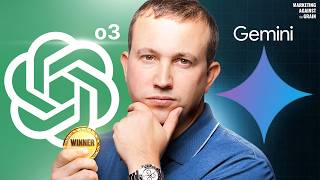
Patrick Biddiscombe compares OpenAI's new Deep Research tool to Google Gemini's version. OpenAI found 28 sources in 8+ minutes with deeper reasoning and PDF parsing; Gemini crawled 252 websites but with less depth. He recommends using both together for the most thorough research.
Questions this video answers
O3 (including O3 Mini High).
28 sources.
252 websites.
"one of the best things OpenAI has ever launched."
Chapters
Foreign. I am pumped today because we have one of my favorite new AI features called Deep Research from OpenAI. Sam Altman, who runs OpenAI, said it's one of the best products they've ever launched. I'm going to take you through a walkthrough of how to use this new deep research within ChatGPT. I'm going to have it today give us a full breakdown of marketing trends through its Deep Research capabilities to see how good it really is. And then I'm going to compare it to Google Gemini. You're going to want to stick around. It's going to blow your mind. Let's get to today's show. OpenAI, they really are bringing the heat. It's clear that all of the innovation and competition that is happening in AI with folks like deepseek and Quinn are really pushing for innovation and these companies to be really, really aggressive. On Sunday night, because the OpenAI team was in Tokyo Sunday night in the US Monday morning in June in Japan, OpenAI released deep research, which is a brand new agent that does exactly that. Deep Research. And what is it? What is it actually doing? Well, what's interesting, and I'm going to show you is that it can take very complex tasks and go and research them independently. And it's not just scouring the web, it's reading PDF, academic reports, case studies, all the different formats of information that you would really utilize if you were like a specialized research analyst. Okay, so this is a video of Sam Altman talk.
This is called Deep Research and we announced it earlier today from Tokyo. I think this is one of the best things OpenAI has ever launched.
Wow, that's crazy. Best thing they've ever launched. They launched Chat GPT, they've launched operator tasks.
That might take 30 minutes, they might take 30 days. It's powered by O3. It's the first time that the world, the outside world, gets to use our O3 model. And it can browse the web, scan text, images, PDFs, much more, synthesize this reason through it and prepare a report for you. It takes a while, it goes off and does all of this work. You can see what it's thinking about as it goes. It's different than ChatGPT, where you instantly get a response. Here you start off a task like you might give a task to a sophisticated coworker. This system that I think can do this is just an estimate of mine, but I think can do a single digit percentage of all economically valued world.
This agent can do a single digit percentage of all economic work in the world. That would be an agent that can do trillions of dollars worth of work in the world. That is a crazy hype statement, like an absurd hype statement. But what he's essentially saying is there's a lot of people out there who do deep research analysis, hire consulting firms, spend a lot of money to get deep and detailed research, and their goal is to replace that use case with an AI agent. So Sam is certainly hyping up deep research. But I want to know, what do people not at OpenAI think about deep research? And one person I trust a lot is, is a gentleman named Dan Schipper. He is. He runs a company called Everything. He's been a great guest here on Marketing against the Grain and he tried it on Friday. So he got a little early preview and he wrote notes to himself. He said, it's fricking awesome. It's a chauffeur stretch limo for the information superhighway. It is a double decker bus tour, but you're the only passenger in the city you're touring is the sum total of human knowledge. What I love about this is, in other words, it's a bazooka for the curious mind. First of all, shout out to Dan. That's some really good writing right there. I clearly he and AI worked together, made something awesome, and it's a bazooka for the curious mind is like the perfect summation of what truly great AI and research can do. And so clearly there's a lot of hype coming around. Deep research. My question for everybody here is I'm an OpenAI Pro member and so I just like literally a couple hours ago, before recording, just got access to deep research. So I want to share my approach to testing it out. First thing I wanted to do is I wanted to use OpenAI's brand new O3 Mini High that's available to ChatGPT Pro users. And I wanted to see how O3 Mini High could write a really good deep research prompt. Because I'm like, hey, if I'm testing this out, I really want to test it out. And obviously I'm a cmo. I do marketing all the time. We talk about marketing all the time on this channel. So I wanted to do a research project on marketing. If you love marketing, you're just trying to grow your business. You love AI. Please hit subscribe on this. We're going to have a ton more videos like this, so please hit subscribe so that you can get notified more when those are coming out. And so what I did is I asked it if it could give me a deep research project on the best marketing strategy and tactics that are new and they're innovative. Right? Like give me, give me the real real. And I wanted oh3 mini high to write a prompt. It took almost 10 minutes to write a prompt which you're like oh, is that why did it take so long? Is because it's right here, breaks down the steps and is showing the different steps and reasoning it's doing to consider what a successful prompt should look like. In this case it's like and you see, I typed a couple sentences, it's doing all this thinking and then it's giving me this research prompt. Assume the role of a world class marketing strategist and researcher. Conduct a comprehensive deep dive analysis on how to innovate a company's marketing approach in today's dynamic environment. Your research should include emerging trends in tech, theoretical frameworks, performance metrics, future outlook and strategic recommendations. So this is the full prompt. We're not even into deep research yet. This is the prompt that O3 mini helped me write. I'm going to say this again and again on the channel that using AI to help you write remarkable prompts is, is a super hack to getting the most out of these AI models. And this is a great, great example of that. So I copy and pasted this prompt and I did this ahead of time instead of live because these research models take a while and they think and so I wanted to give it at least a little bit of a head start to think. And so then I come over and I paste the prompt in to the new to the new O3 mini deep research. And I click the deep research button down here and this is the prompt that we just, we just went through. And what's interesting is before it even started the research it came back to me with some questions. It said hey, what industry are you focused on? What company size for these strategies? Geographical scope, preferred sources, output format. And so I reply back and I'm just trying to be very bare bones here because I want to see what it can do. I, I said industry technology company size. A 25 person company in the United States, you pick the sources and I want a detailed report with an exec summary and said great, I'll conduct an in depth analysis of how a 25 person tech company in the US the research recovered all the things that we outlined in the prompt and it researched for 8 minutes and 28 minutes through 28 sources. And if I click through this, what's Interesting. It will show me the work that the agent has done. So it's not just like here's a report, it's giving you kind of the raw logs of what's happening and it's showing that I'm digging into cutting edge marketing trends. I'm integrating data, highlights, highlights from multiple sources. It's showing you interestingly where it's getting some of these information, some of the domains that it's finding unbounce and Gartner and air cards and very interesting. And it's telling you hey I've got 28 sources. And you can also instead of just seeing what it looked at where you can see the specific articles it used and link out to all of those. I don't know why it wasn't researching HubSpot. That's a whole different conversation. But this is the breakdown of the research it did. 28 sources, 8 minutes worth of research. And it's given me a pretty interesting executive summary about how companies, specifically the 25 person technology company, this example have to be embracing innovative strategies, data driven marketing. This very much reads like a McKinsey Professional Analyst type of report with links and citations and stats that are validating the points that are coming. And then after that executive summary it's giving you a breakdown of AI and machine learning automation. I like that it just did this whole what's trending section innovative best practices, emerging tech in the area. I mean this is a very in depth like we can go when we say deep research. Look at this go like we're just on the first section. You know there were four sections in section one then we're still going through section two like look at how in depth everything at scalability and potential challenges. So there is a massive, massive research project that's happened here as you can see. 2 like very interesting quality. Like obviously we are not going to read through an entire in depth research report here but the executive summary was super helpful and like for example at the same time marketing ecosystem is expanding with influencer marketing and experiential marketing. These are two, as somebody who runs a big marketing team, these are two huge trends of marketing. It got this right, right like it, it's finding the aspects that are very, very good here and bringing them forth to somebody who you know might just be new to marketing or might be looking to take their marketing to the next level. This is really, really helpful information especially if you're at a 25 person company. This is where I go back to Dan's quote like that bazooka for the curious mind. Like I could just, I could imagine myself spending days on end reading research reports. It's unbelievable the depth here. And so this is a pretty wow experience. Look, we all love ChatGPT. You've probably used it before and if you haven't, stick around because you're going to want to listen to this. You know, I've used AI a ton. I use ChatGPT for research, for writing. I use Claude to put guides together for whether I'm taking a trip or I'm working on a project at work. It's awesome. Well, I've got something that will make ChatGPT an even better experience for you. We've got this killer Chat GPT bundle that will take your prompting to the next level. It has over a hundred prompts and a step by step guide to integrated across your workflow. It is a total game changer if you want it. I'll drop a link in the description below. Now let's get back to today's show. I had a similar wow experience though, and that was a few months ago when Google relo Google launched Gemini version 1.5 with deep research. And so what I decided to do is take that same exact prompt that ChatGPT wrote for me and I wanted to put it in Gemini to see and compare the two results together. How is Gemini Deep Research compared to OpenAI's Deep Research? I put the same exact prompt in. You can see, here's the same exact prompt that we just use in OpenAI. It what's interesting is that they built Google builds a Gemini builds a research plan that you can then edit and everything before you start your research. So Instead of where OpenAI asks clarifying questions, Gemini creates a detailed research plan. So interesting how they're trying to surface and like help and support you. Okay, next I want, I said, great, let's go ahead and start research. And now it says I've completed your research. And so like I read, I started these at the exact same time. So I think it was pretty similar in terms of how much time it took. But what's interesting is that it did not tell me exactly how much time it took in the same way that OpenAI did. The one thing I do love about Google Gemini and I use Google Gemini a lot, its integration with all the other Google products, the fact that it basically just creates a Google Doc by default and you can just open this in Doc and share it and everything when you're collaborating on research like this is super powerful. Okay, so innovating your marketing approach in today's dynamics. What I can already tell is the quality and depth of research. This is very good, right? Like it's telling you, hey, you need to care about data driven marketing, you need to do targeted advertising, personalized context, campaign optimizations. There's no real great executive summary. This summary isn't very good. There's no data and citations in the way we just saw in Deep Research. We which is pretty wild, right? Like there's a clearly a real depth of information here. And like this is Gemini Deep Research I use all the time and is way better than going out and doing manual research. And they also will tell you go back and point you to where they found these recommendations similar to how OpenAI did. But if you look at the quality of the output, it's just not as good. Like it's clear to me that while Gemini Deep Research is a very good product and it's something I've been using a lot, it's nowhere near as thoughtful and as thorough as the OpenAI product that we just looked through. I mean we're literally comparing these side by side. And the recommendations are more basic. Virtual try ons, interactive games, virtual tours. Well, first of all, OpenAI was smart enough to understand that these things were a subset of experiential marketing and helped me learn about experiential marketing where Gemini is just kind of like putting them in this random bucket, right? And even on its social, the social media evolution here it's like oh, key trends, short form video influencer marketing, social commerce. While those are all right, like it's barely telling me anything about them. Platforms like TikTok and Instagram Reels that popularize short form video content. Well yeah, if you haven't been living under a rock, you know that obviously, right? What do I, what's the context? What do I need to do? How can I go and do it? Like I felt like there was a much deeper quality of answers over there over in OpenAI and you see like it found some cool stuff like blockchain advertising, voice search optimization, virtual events. This is definitely a little bit more progressive in terms of what it found. I'll be really honest with you, if I were doing this, I would probably take both reports, then give it to either Claude 3.5 Sonnet or O3 mini and have it do a detailed summary and breakdown because it's clear that Google's finding some things in its research methodology that OpenAI isn't. You know why? Because it searched 252 websites where OpenAI searched 28 websites, which is a massive difference in where you get that information. Clearly to me, in looking at these two together, Google's Google Gemini Deep Research is really excelling at the things you would expect it to. Its integration with Google Docs and Google's other products and it's Google's ability from search to crawl the web and index the web information, really great. And to use that, to pull all that information in 252 websites is a ridiculous amount of context to search. But because it's just searching websites and not images and PDFs and everything as much as OpenAI is, I think that and the fact that clearly O3, which is the model that Deep Research is running with OpenAI is just a much better and more thoughtful model than 1.5 in Gemini. It's very clear I'm going to pull the OpenAI version up again. Pull the OpenAI version up here. It's very clear that OpenAI has built a product that is much more like again, like a McKinsey analyst. Like if you were like, hey, I want to do a complex mapping of a market or competitive analysis, I think if you could just do one, you would do, you would do OpenAI just because of its ability to reason through the information. It's finding what I would likely do. And let's, let's see if we can do this now. I wonder if I can go here to Gemini and copy all of this and have OpenAI integrate it. So I think this is probably the path forward where you're going to want to use multiple models for really, really important tasks. And this is a good example where I'm having it take the Google information and add it in and integrate it into its additional recommendation, its initial recommendations and this integrated blueprint combining insights from both our previous research into Google Gemini analysis provides a comprehensive roadmap for innovating your company's marketing strategy. It's written like, again like a McKinsey or Bain or BSG analyst would write a research report. Right. And, and my take is if you're just gonna use one or if you're a really pro OpenAI chatgpt user, use Deep Research. If you are like I am looking for the most comprehensive version of a product of a, of a problem in research, I would use both together to make sure you are covering every angle. That's my takeaway. So what did we cover today? Covered a brand new agent from OpenAI called Deep Research and it's very good and you can see the reasoning from the O3 model front and center and I highly recommend it for any of the major research projects that you're doing. It's rolled out to pro users now it's getting it's getting rolled out to plus users and enterprise users soon should be available to most hardcore ChatGPT users. If you are looking for a free product and or you love the integration with the Google suite, you're going to want to use Google Gemini Deep Research again. My best bet, and guess for everybody, is you're going to want to use both of these in parallel because O3 has got better reasoning, but Google has still got better crawlability and indexing of content online in terms of sourcing the best information. So that's the breakdown. Go give Deep Research a try. Leave a comment down below what you think, how you're gonna use it, I wanna know. Hit subscribe. We'll be with you real soon. On the next episode of Marketing against the Grain.
This data is wrong every freaking time.
Have you heard of HubSpot? HubSpot is a CRM platform where everything is fully integrated. Whoa.
I can see the client's whole history. Calls, support, tickets, emails. And here's a task from 3 days ago I totally missed HubSpot grow better.
More from Patrick



A NEW BREED OF PARTNER: The Partnership Ecosystem Model Journey of Patrick Biddiscombe, Part 1








Customer Success Workspace: Never Lose Sight Of What Matters Most | HubSpot Spotlight