Sell Like A Pro Closing More Deals With AI in Sales Hub | INBOUND 2024
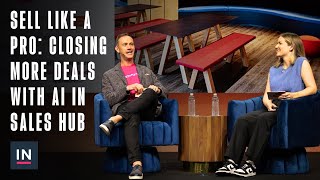
Bridget Gabris and Beau Brooks discuss how AI tools in HubSpot's Sales Hub drive results. Teamwork.com saw a 10% jump in win rate and 18% increase in average deal size after two years using the platform. They cover predictive forecasting, deal scoring, and call analysis, plus how to avoid rep burnout when adding AI to workflows.
Questions this video answers
A little over two years.
Approximately 10% increase in win rates.
Approximately 18% increase in average selling price.
Month in, month out, within a 5% margin of error on their forecast.
Cork, Ireland (with offices/teams in Denver and Poland).
Chapters
Oh, that's bright. Hello, everybody. Thank you so much for coming to our session today. My name is Bridget Gabris, and I am a director of product here for SalesHub at HubSpot. I'm so excited to be here today with all of you talking about closing deals, AI and sales and how you can help take your sales teams to the next level with HubSpot and AI. I am thrilled to be joined today by Beau Brooks, VP of Sales and Customer Success at teamwork.com. bo, could you take a minute to introduce yourself? And for those who may not be familiar, tell us a little bit about teamwork.com sure.
Hi, everybody. Bo Brooks. I lead sales and customer success as bridget shared@ teamwork.com so teamwork.com, if you're not familiar, is a professional services automation tool with excellent project management capabilities. We help companies like SmartBug and Salted Stone do simple things like track time, manage their employee staffing, and then turn that into financial insights, profitability, utilization, and deep reporting inside of their business. So we're actually based in Cork, Ireland. I don't have an Irish accent. I'm in Denver. We have a presence, a big presence in Cork, Ireland. You can see behind us an office in Denver and then an engineering team in Poland as well. So we're going like crazy. It's been a success story since our founders, who ran an agency for eight years, decided they didn't have the tools they needed to be efficient in running their business. So they built the product that they needed, and it's been a success story ever since.
Awesome. I love it. Thank you so much, Beau. I'm so excited to get into the meat of our discussion today. We'll talk about AI applications, both effective and not, and the ways that your team is really of charging forward in this new era of sales. But first, we're actually welcoming you back to the inbound stage this year. You were last year here with us in 2023. Who here in the audience was also here in 2023 last year? Inbound, show of hands, number of folks. Awesome. Hopefully many of you got a chance to see Beau's session. I thought he gave such a great analogy about how HubSpot has really helped you transform your team from firefighters to surgeons. Love that. Maybe for those who are not familiar or didn't get a chance to see last year, can you tell us a little bit about Teamwork.com's success over the last year? How your sales process has evolved with HubSpot and some of the results that you've seen.
Yep. So We've been on HubSpot for a little over two years now and it's been a tremendous experience. I put some numbers up to share, but we've seen big growth. A 10% increase in win rates, I guess, 18% increase in average selling price. And I attribute a lot of that to the work we did inside the sales hub with the team to make it effective. A lot of it boils down to efficiency in how the team operates. Rather than working out of spreadsheets, doing manual updating and forecasting in Google sheets, we're able to do it all inside of one system where they're coordinated with the managers. The leadership team has a better understanding of how deals are progressing and that's actually led us to the last point, which I think our RevOps team is the most proud of. Month in, month out, we're within a 5% margin of error on our forecast through and through because of our ability to tightly control deals and how they flow through. I don't know if anybody else uses it, but the quoting tool was very helpful to us inside of HubSpot right when. When reps are working their deals and they're ready to go to the final stage and send over a proposal that can go through an approvals process. So not only did it make it more efficient, but our CFO is happy because our discount rate has gone down simply by reviewing all their quotes before it goes out to the customer. So it's been a great experience inside of HubSpot.
That's amazing. That is some incredible results in the last year, especially that win rate, tighter forecasting numbers. We'd love to see that. Also in the last year we have really seen AI just like completely reshaping the sales and success landscape in such a short period of time. Obviously, with the launch of ChatGPT in late 2022, AI has really just accelerated at lightning speed. How has AI impacted your teams and the way that you operate both in sales and success?
It's a big scary topic, but AI has helped us in a few key ways. I already mentioned the efficiency piece, but it's definitely true. So we went from manually running task plays every day by the sales reps to a place where we could do it in HubSpot in their tasking system, which is more prompted to a rep. And now with the introduction of AI, we can automate a lot of what they should be working on. My team hears me say this all the time, but one of the most important things we can do as sales leaders is remove the question, what should I work on next? That's, that's the most difficult thing and a low value effort of thinking that a rep puts in anything. So with AI, we're allowed to apply that to the efficiency measures that we're taking inside of the system. Better predictability in forecasting has been tremendous. I think a lot of us in this room are probably used to years and years of doing forecasting based on what the rep tells us and trying to maybe listen to calls or feel out where it's at in the pipeline and make a judgment call. Now we can balance that against AI generated forecasting. So leadership all the way up to the board have a better confidence measure in what's being called by the reps. But we can, we're able to now flip the coin on that and say what should we be doing on these t on these deals to increase the likelihood that they can close. That was also a bit of a guesswork process in the past. On the customer success side, we can do a lot of AI interpretation of product usage and is that effective? Are people getting into the product enough? And if not, the system can tell us in advance where we need to take action and maybe where we don't. We've also learned where false triggers are by having all having AI evaluating our product usage. The other side to the AI coin, which doesn't get talked about as much because there's a lot of excitement behind, creates a lot of noise, right? It's very confusing for reps. For managers, it's exciting, but it's overwhelming. If you think about what I've just talked about, AI helps us remove a lot of the basic work that a rep does every day. You hear Reps talk about 50% of my time is spent on manual work. We're able to cut that down to a very low rate, but we're replacing that 50% of time with difficult thinking, with higher value thinking. Where they have to be considering what do I need to do with this buyer in order to move it forward. That's exhausting. Like, I see reps now at the end of the day that are more tired than they were in the past because they're not doing some of that casual work that they did. They're now having to jump right into a deal analysis or a mutual action plan and it fills up their entire day. So that's, that's the challenge that sales leaders, that revenue leaders, across the board, leadership. We have to solve, we have to figure out how do we balance what's coming in with AI with not overburdening our sellers totally.
I mean, it's safe to say there's a pretty significant impact that AI is having on your teams right now. Are there some standout ways that you really see in particular tools, maybe predictive deal scores, health metrics, chatbots? What are some of these tools that you're seeing really have significant benefit for your teams right now?
Yep. There's a few things that we've used in the AI space that have helped a ton. One, raise your hand if you're using the predictive deal score that HubSpot's rolled out on the account object. Yeah, it's excellent. So it's AI generated. It uses the information that's in your CRM to determine the likelihood of a deal to close. And we look at that on a regular basis to understand. The rep is telling us that this deal looks really good. It's going to. It's going to close in the next two weeks. Contracts out. HubSpot is telling us this deal is a 45 out of 100. There's a bunch of actions that have not been taken that we didn't have before. So by having the predictive deal score, it helps managers and reps have a more meaningful conversation as to what's going on inside of a deal, and it also suggests actions. So if you've seen it, you're familiar with it, but it'll tell the rep what's not gone well and why the deal score is low. And they can try, they can take action to reverse that. So it may say you haven't had contact with this customer in five days, or the customer hasn't responded to one of your emails in two weeks. You change your behavior as a rep based on what the system is telling you, where historically, that's not been possible. And this is brilliant because with AI, with things like sales, hub reps can do a lot more than they did in the past. They're more efficient, so we can put more on their plate, but that makes them have to think about a lot more things. Right. So by having these suggested things in the predictive deal score, it aligns what we need them to do with what the system is recognizing they haven't done.
Right.
So that's one thing.
Yeah. And it sounds like deal scores are really kind of giving your reps that extra layer of accountability, you know, giving them that guidance that they're looking for. Are there any patterns that you've seen with the deal scores themselves that are maybe changing the way that you're coaching.
Or guiding reps. Definitely, as I mentioned, a misalignment between where a rep thinks a deal is and where a manager might think a deal is. We've started to see that come together and they become more aligned. So when we first did this and a rep would say a deal looks great, manager says this does not look great. Based on the system, the rep would start to understand why and they would start to take the actions necessary to fix the deal before it became a problem. So a good example is multi threading on a deal. So if you're not familiar with multi threading, it's adding additional contacts and touch points onto a deal. We know at teamwork if we have three or more contacts on a deal, the likelihood of it closing goes up by 50%. It's a lot stronger. So historically we would have to talk retroactively to a rep about adding more contacts, trying to get more people pulled into a deal. But by them seeing this more frequently that it's a gap in their sales process, they're proactively bringing these things up. So we have the majority of our deals now inside the system multi threaded, which has taken up the potential for us to close really overnight. And it takes a lot of pressure off of the managers too to have to be looking at every single deal. Right. So it helps build patterns that weren't there before by leveraging the HubSpot AI to tell us what to do.
Awesome.
A few other things that I throw up there. So for any of you that are GONG users out there, like there's some great tools out there. We use gong. GONG has rolled out some pretty interesting things over the last six months with AI as well. One is the chatbot that lives on deals. So as, as a sales leader, I always have the problem. I can't listen to every call. The sales directors can't listen to every call. So when do we ask a rep what's going on with the deal? We're relying on them to give us good information. The chatbot now that exists in there is a large it's natural language that you can prompt it with a question of what's going well with this deal, why is this deal potentially not going to close? And it'll scrape call transcripts of every engagement that the rep has had with the customer and tell you here's where your risks are, here's where your challenges are. And that's helped us significantly. We have probably product jumping in and asking it questions of why deals are not working out, why we may have lost something or why we won something as well. It's been game changing for us. It also helps with mutual action planning and pre call planning for your reps. It's much easier to plan for a call that you have coming up if you can just pop in what happened on the last call and how can we improve it for the next one. And then the last thing I'd give you, we use Tatango for predictive health scores. So we've loaded up and mapped in all of our product data and we now have a real time sense of how a customer is doing. Our customer success managers are reporting back to us. When I talk to somebody I know with much more confidence whether they're doing well or not doing well, because the AI can tell us how they're performing, are they engaging enough? Is the usage that they have inside the product in the right areas and where do we need to increase the amount of people that are getting into the product? So AI is changing the way that we think about selling and then engaging with customers in a meaningful way.
Awesome. I love to see it. And you really mentioned, you know, a mix of tools here, right? Some on the HubSpot platform, some on other platforms. With so many AI powered solutions hitting the market these days, how do you actually go about evaluating the tools that are really gonna make an impact for your teams versus which ones are gonna be just noise?
Yeah, some of them work out really well and some of them don't. Raise your hand if you're thinking about how to use AI in your sales process today. Most people are. Raise your hand if you've tried something and it completely failed in your sales process.
Nice. Nice.
Not as much. Or at least people are afraid to admit that they tried something and it didn't work. So we've had a few of those. We actually had a pretty tough one five figure product that we purchased, we spent months implementing and it crashed and burned pretty much immediately. There's a lot of risk out there as well. So some of the things I would say is talk to your reps. I think one thing we don't talk about enough is reps are afraid of AI, for one thing, because they think it might take their jobs. And two, if you've talked to very many sales reps, we think we know better than everybody else how to do our jobs. So they don't like to be guided on what to do. We have a responsibility to help them get there. So work with your reps to understand what their workflows look like, what wants to look like, and then put AI in that workflow. Where we failed on one of the tools is we went to a point solution and that was generally it was email email automation effectively doing, doing research and writing emails for us. But it wasn't inside of HubSpot and it was a standalone channel. So we had the reps leaving HubSpot to go work on the email automation, coming back in to do things like LinkedIn, Sales Navigator and making calls and having meetings and it was disconnected and it broke the flow of a rep in their day to day. So they were even have to go in and log the emails in HubSpot just to show that they had done it. Not efficient. So don't discount the importance of having it in the flow of a rep because if they don't adopt it it might fail just because you had a bad setup in there. Another is do peer reference calls. It burned us still the product that we bought which was around the email automation we did a lot of peer calls and it was so early that everybody thought that it was working great. And it took us three months. A lot of work warming up IPs, getting emails ready and then it failed. So as best you can, talk to people who are deep into use of these tools and make sure that they're not standalone channels that it's going to roll into the system that you're using to make sure you're not going to make it a bad experience for the reps.
Totally. I think that's such a key point is really about how do you fit within the reps workflow. Not just creating change for the sake of change, but actually really figuring out how can I help make my reps more efficient, how can I make their work easier?
More from Patrick



A NEW BREED OF PARTNER: The Partnership Ecosystem Model Journey of Patrick Biddiscombe, Part 1








Customer Success Workspace: Never Lose Sight Of What Matters Most | HubSpot Spotlight