State of HubSpot 2024: How The Best Do It Different | INBOUND 2024
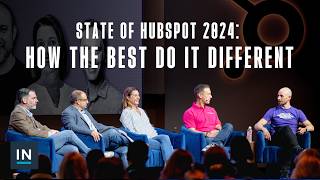
Panel session 'State of HubSpot 2024: How The Best Do It Different' (INBOUND 2024). Jonathan Berg (New Breed) leads a panel with Sam Jacobs (Pavilion), Pete Caputa (Databox), Jill Rowley (Stage Two Capital) and others to discuss results from the State of HubSpot research (surveyed ~1,600 sales/marketing/customer success/rev-ops leaders). Key early findings: only 10% of respondents reported inbound as their primary go-to-market motion; the most common GTM combinations were inbound + sales-led growth, followed by customer-led, ABM, product-led and ecosystem-led growth; 96% agree HubSpot effectively supports their GTM strategy; top investment reason in HubSpot is to manage data. The panel emphasizes combining inbound and outbound (omnichannel), the rising importance of authentic storytelling in an AI-flooded content landscape, and focusing on durable growth metrics (net revenue retention and profitability).
Chapters
Here we are.
All right, welcome everybody to the state of HubSpot 2024 how the best do it different. My name is Jonathan Berg and I am the SVP of Revenue at New Breed, the top tech enabled solutions provider in the HubSpot ecosystem and the lead researcher for the State of HubSpot research report. We surveyed 1600 sales, marketing, customer success and revenue operations leaders around the trends, challenges and insights of what they're within the HubSpot ecosystem and we slice the data on how the best are doing it differently. And I could not be more honored to be joined by this top notch panel here. Some of the brightest and best minds in the HubSpot ecosystem. We have Sam Jacobs. He is the CEO of Pavilion, the top revenue leadership community in the industry. If you don't know Pavilion, I highly recommend you get on it and join the community. Today we have Pete Caputa. He is the CEO of Databox, a growth analytics platform and he founded the HubSpot Solutions Partner Program. So we have a lot to thank. For Pete, we've got Jill Rowley. She is an LP at Stage two Capital and she was an early employee at Salesforce, an advisor for Marketo Eloqua and HubSpot. That experience. Thank you, Jill. Welcome. And we have, and we have Bo Brooks, who is the CRO of teamwork.com, which is a global professional services automation tool. And he was also the winner of the Modern Salesperson Award for HubSpot last year. So thank you and welcome everybody. Yeah. All right. People are filing in. You know, this crowd, it makes me realize how passionate you are about HubSpot, about the ecosystem and about doing things differently. And you know, we're forced to. Right. I thought like there was a lot of change going on and now I find myself in this absolute crazy world of complete disruption around technology capabilities, buyer behavior, go to market strategy, all underpinned by AI. Right. And it, because of that research, it really forced me and forced many HubSpot executives and other executives in the ecosystem to ask a very big question, which is, I feel obligated to ask that question right now. And is inbound dead? All right, just saw some, like, saw some faces and some laughs up here. Only 10% of survey respondents said that inbound was their primary go to market strategy when we asked them to rank their primary and secondary go to market strategy. So I've learned a ton from the Pavilion community, Sam. And, and one of those things around go to market alignment. I'd love to get your reaction to this stat.
Well, I, I Guess for me, the short answer is no, inbound is not dead. The other short answer is outbound is also not dead. I don't know that there's any one single go to market motion that's quote unquote dead. What I do know is that it's harder than ever to get somebody's attention and that it's. And this is a problem, I think, fundamentally with attribution as a concept when it comes to marketing, which is that if you think logically about how humans make decisions, we don't make it just because of one thing, we make it because of a preponderance of things. So we make it because of brand and the trust that we have with the brand, which is largely driven often and was popularized by HubSpot through content marketing. But we also make decisions because somebody persuasively tells us how a specific problem will be solved by a specific solution. So when I think about what's the right way to go to market, I think about really omnichannel is the way that I was thinking about it. I would think about combining outbound and inbound with a brand promise that people can trust. And I think the last thing I'll say is relevant to what we're going to be talking about in AI, I think now more than ever. First of all, Pavilion is almost entirely driven by inbound. So it's hard for me to say that inbound's dead when we're having one of the best months we've ever had in terms of growth. And all we do is effectively organic, social, primarily, often driven by me. And so what I think, you know, know my. I don't know that it's a hot take, but what I will put out there to the audience is that I think we are entering an era where modern, authentic storytelling will become more important than ever before because AI is going to flood the channel even more with generic banal copy oftentimes. And so if you are able to tell an interesting, compelling story on some, a platform like LinkedIn or YouTube or anywhere, I think you're going to be differentiated and that's what people are going to crave is authenticity.
And.
But fundamentally, is inbound debt? No, not at all.
Yeah, and that's in line with our research as well. We found the top combination was inbound and sales led growth. That was followed by customer led growth, ABM product led growth, and ecosystem led growth. And Jill, you know, you've been an evangelist for the near bound movement. And what's your take on sort of Those follow up go to market motions.
Yeah, like Sam, I don't think it's one single motion. I think it's a combination of different motions. And I would say that the motions need to be reverse engineered through the lens of who you serve, whose problem you solve. And the near bound is we've moved from the what economy. There's plenty of information and even insights available out there for buyers and for customers. And we're living in the who economy. And Sam, you say most of Pavilion is inbound. I would argue that it's both inbound and near bound and member led to the point of it's a combination. If we think about, you know, I don't actually go to Google anymore, I go to ChatGPT and the reason I do that is because I get context on the problem. The question I'm trying to answer and today as buyers, raise your hand if you're leaning on your peers and other people, like analysts with research and data to actually help you become aware of and then make decisions and then continue to work with the vendors. I hate the word, but I really think that we're influenced more by people and their stories. So your customer stories are the ones that you want to pull to the front of everything you are doing. Your partner stories pull them to the front and it's the stories that they tell about you that is your brand.
I love that. So if anything, inbound is more alive than ever and the focus on customers is more important than ever before. But the tactics that deliver against inbound methodologies have to evolve, right? They have to change in this AI era and, and HubSpot is evolving as we're all working to find go to market fit. In fact, 96% of respondents agree that HubSpot is effectively supporting their go to market strategy regardless of the combination of those. And that really brings us to why we all came to this session, why we got, why we got a packed crowd here. It's because we want to learn how to do things differently. We want to learn how to evolve. And that's what we did. So we analyzed the best. We sliced and diced and looked at the data to understand the companies that are seeing the most growth, have the lowest customer acquisition costs and are hitting their revenue targets. What are they doing differently? And we found some really interesting findings this year. The best organizations are focused on durable growth. So when asked what are the most important metrics, the top revenue leaders said net revenue retention and profitability complemented by but not overshadowed by new business revenue growth. I've taken nearly every C level university course at Pavilion. And if I had to say, like the number one takeaway, it's balancing this. And it's hard, it's balancing this. So Sam, can you, can you give us some thoughts on this finding here?
Well, I hope, I hope it's not, you know, mind boggling that people are focused on net revenue retention. I gave a talk yesterday, foundations of profitable efficient growth. What are the tenets? Basically, we've moved from a world of growth at any cost where 0% interest rates meant that a dollar in 10 years was worth the same as a dollar today, which meant that literally you could invest in any way to achieve that dollar in 10 years and it would redound to the benefit of your, of your enterprise value. And obviously we're not in that world today. Now, today, marginally, capital is a little bit more available after the Fed cut interest rates yesterday. But fundamentally, you know, if we're going to build long term sustainable businesses, we need to. And if we're going to build recurring revenue businesses, as the name implies, we need that revenue to recur. The way to deliver recurring revenue is recurring impact. And that's why, you know, my friend Jocko Vandercoy from Winning by Design has popularized this concept of the bow tie. Because there have been too many people that have focused exclusively on the left side of the funnel, so to speak, which is how do we acquire new business, how do we close new business? And when we talk about sales and marketing alignment, we're really just talking about those two departments working hand in glove to achieve that endpoint of a sale. But for the customer, for all of us as customers and as buyers, that's not the end of the journey, that's the beginning of the journey. And the fundamental premise of any kind of recurring revenue business, the fundamental premise that underpins SaaS is we can spend more on sales and marketing because we know that the customers are going to stick around for a long time. And all of that is predicated on the customer sticking around for a long time. So if the customers don't stick around, then the entire SaaS business model breaks down. And that's why we have to be relentlessly focused on making sure that we're delivering ongoing recurring impact and that will drive recurring revenue. I would say that one of the things I try to tell people through CRO, School of Pavilion and through the other courses we teach is your customer fundamentally decides whether you're in a subscription or not. Your contract does not determine determine whether or not you're in a subscription because you call it ARR, because you put an auto renewal clause into your services agreement. That does not necessarily mean that they agree that they're in an ongoing relationship. The way to make them agree that you're in an ongoing relationship is to find ways to deliver ongoing recurring value to the relationship so that they want to become a recurring revenue customer. So I don't think that this is radically different. What I will say, you know, in closing is yes, the Fed lowered, you know, interest rates 50 basis points yesterday, but we're still a long way away from the 0% interest rates that we saw from 2008 to 2022. And so I would just caution everybody, we're not going back to 2020. There's not going to be a world, maybe one or two companies, if they put AI at the end of it, you know, they can raise $100 million on a million in revenue. But for the most, for the most part, and for most of us on this stage, we have to be focused on building enduring businesses. It's not white knuckling it until everybody gets stupid again. And we can sell our business for 100 times what it's worth. It's really about how do you build long term sustainable businesses. And that really, it's not rocket science. It comes from focusing on the customer. If you focus on the customer, they will stick around and that enables all of the other things that you're trying to do around growth. So that's what I would say.
So Sam, not, not in this presentation, but the second highest investment was coming customer led growth. So focus on the customer. So you just gave the Cliff Notes for probably about two and a half hours of content that Sam and I delivered yesterday around creating durable growth. The next stat that we've got is, I believe, one of the most important stats in the entire project. And that is that the number one reason that organizations are investing in HubSpot, the number one reason is to manage data. And what better person to comment on this stat than Pete Caputa, CEO of Databox. So what's your reaction to this, Pete?
Yeah, HubSpot's data has just grown over the years, right. So When I joined HubSpot in 2007, it was basically SEO, some SEO data and some analytics data later on was lead capture. And so but now the, the amount of data that HubSpot captures about how you're running your business is just massive. So no surprise that HubSpot, number one, the number one reason why customers choose HubSpot is to manage their Data and we've, we've actually gathered a lot of data, as you might imagine, about how customers, how HubSpot customers use the product. And when we look at the features they use the most often, it's the things that really allow them to manage data like CRM tracking or contact management, things like that. So no surprise at all in terms.
Of, and I had a talk earlier with Google and been thinking a lot around first party data strategies. But Jill, you also have a take on the world of data right now as well.
Yeah, I believe data is the foundation of finding your ideal customer profile, finding your ideal partner profile, and that can change over time. Your business evolves, the market evolves. My point about data and I could go on and on, but there's so much data that we actually don't even have access to that actually has a greater impact on buyers finding you and selecting you and working with you and advocating on your behalf. And it's the data that sits outside our walls that is in communities. And so at pavilion at the event, there could be marketing leaders, a marketing roundtable, and someone mentions, oh, we switched from Pardot to HubSpot because it wasn't meeting our needs anymore and it wasn't actually integrated and interoperable with other pieces of our tech stack. That person who hears that story, story, it's not captured in your lead form. And so that data is sitting outside of your walls. The other thing is that I talk about is, well, influence is the new inbound. And that's to that point of people learning about you in communities, learning about you on podcasts, learning about you through maybe videos that you can't actually track and measure. But the other thing I talk a lot about is the ecosystem and your buyers and your customers ecosystem. And who are the people that they're already working with, what solutions partners, what tech partners are they already working with? And really that's an untapped data source and we call it second party data. And it's the ability to compare your CRM data with your partner's CRM data and see where you have joint customers and overlap and putting together a better together story so that buyers are actually buying a more complete solution rather than a single piece of software or a single piece of hardware or a single piece of their health and nutrition. So there's a whole lot data that we need to unify, but there's a lot of data that we have to remember external to our tracking systems.
All right, so Jill, after a session on just that topic, you and I were chatting outside in the hall.
More from Patrick



A NEW BREED OF PARTNER: The Partnership Ecosystem Model Journey of Patrick Biddiscombe, Part 1








Customer Success Workspace: Never Lose Sight Of What Matters Most | HubSpot Spotlight