Steph Smith Reveals How To Grow A Top 1% Tech Podcast
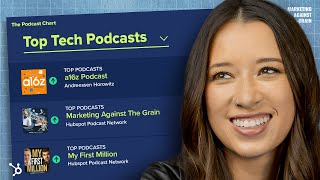
Steph Smith treats Twitter like a public sketchbook to test ideas before they're fully formed. She argues creators should focus on having a consistent voice and way of thinking rather than picking one lane, and use fast feedback loops to iterate. Taylor Swift's reinventions show how this works over time.
Chapters
On this episode of Marketing against the Green, we're going to go behind the scenes with one of the best creators in the world, Steph Smith, and she is going to tell us how she's been so successful in content, the six principles that she's used, and how we apply all of this to growing the the Hardest thing in the world. A podcast. Let's dive into today's show. Hey, Steph. Welcome to the show. We're happy to have you back on again on Marketing Against Screen.
I'm stoked to be here.
Sorry, I sound like a radio teacher.
We're keeping that in.
Are you having a rough day?
I don't know what I'm doing there. Hey, Steph. Okay, sorry. All right, Steph, you've grown all kinds of content, right? We. We worked together briefly at HubSpot. You were set up the creative program, have done all incredible stuffs in your career, all kind of through the lens of content. You're an incredible creat. What we want to try to do in this show is teach people how to be like Steph and then convince them whether they should actually apply those things to launching a podcast. Because podcasts are really hard, and we want to see if any of the skills that we have learned as content creators have applied to us growing a podcast. So we're doing marketing against the grain. You're doing the A16 and Z podcast, which is incredible. And a subscriber, and so that is the show. You think it's a good show, Steph, because you're a podcast?
Well, I'll make one modification. We don't want people to be like me, but I will try to share what I know about the content sphere because it is. It is tough.
I don't know, Steph. You're, like, one of the most interesting people I know.
Really?
So, like, yeah, you, like, you have such a broad range of knowledge and experience. Like, you're like, you're super interesting.
Don't tell yourself, marketer.
This comes back to. This comes back to. We had a Greg Eisenberg on, and we were going through, like, how people can build a business through content, like starting at video newsletter, going to community, paid community. And actually the very first topic we talked about is, like, you have to be interesting, like, in today's world. I know that sounds simplistic, but you have to be interesting. Your Twitter feed is really interesting because it's pretty diverse in the things that you cover. So why don't we start there? Like, did you. You as an interesting person, do you have to cultivate that. And do you believe that's true to be great at content?
Yes, I do. Loaded question. I do. I think if anyone doesn't think they're interesting, they're probably something's going on, they got to reorient their life. But yeah, I think I started with Twitter a while ago. And Twitter to me was just this outlet for me to share the things that I wanted to say. Like, I had this deep urge to say, like I was learning to code and to let people know and to also like scream to the rooftops that other people should do the same. And so it really started as not a distribution mechanism for like some future business, but really just for my inner need to say something. And then what over time happened is because I never really had to utilize Twitter as a platform to actually go make money, it was able to evolve with me. And that's why you see all these like sporadic, disparate things surface. Whether it's like used to be coding, then it was at one point like really centered around remote work, then it was trends, and now it's, you know, a whole bunch of other things. But most creators do get stuck at that stage, right, where they become the ex guy or ex girl, and then they never leave that. And then I think to your point about whether it's curated, I think on the back end, I do need to a lead an interesting life. But I also like, am very, very specific about what I read. The newsletters I subscribe to, the podcasts, I listen, and I guess the way I spend my Internet time. So I don't know if that answers your question, but yes, I do think that your outward Twitter feed is inevitably a reflection of the way that you spend your day to day.
I think it's also a little bit even more than that. Steph. I saw over the weekend that in Florence there's a new exhibit. They found this cavern under one of the buildings in Florence that was basically Michelangelo's drawing room that he would just like sketch drawings of different statues he's considering and everything. It just. So you've all these kind of random half completed sketches all over that. And I think if you're going to make stuff, you have to have like a testing ground I have to take. You have to have a sketchpad. The beauty of something like Twitter is that you actually get feedback on it versus it being in a metaphorical cave or in a notebook or anything like that. And so when I look at your Twitter feed, I look at it a little bit like that. I'M like, oh, this is a, like kind of Steph sketchbook where she's working through ideas in public that then might show up on a podcast, might show up some place else. Is that kind of how it feels or not?
Yes, definitely. I mean, I think one of the fundamental amazing aspects of the fact that we live in 2023 is the fact that we can get that bidirectional feedback. Twenty years ago, you would ship a blog post and you'd be one of the first to do that and you'd get such simple data, if any. And then prior to that phase, 20 years before that, if you wanted to publish something in a newspaper, all you would know are the like raw sales of that newspaper, right? Like, to everyone. You wouldn't know exactly what articles they're reading. You wouldn't know how far they got along. You wouldn't be able to test, as you just spoke to, the idea for an article that you maybe would want to invest in. And so today it's just this incredible ecosystem where you can post something not just on Twitter, on Reddit, there's tools where you can see what people really care about. And so you can not only test your own ideas, but you can also borrow other people's ideas that are pre vetted. And these like pipes of the Internet are incredible. And it's surprising to me that more people don't use that testing ground.
This is actually really fascinating. So one of the things I've been spending some time on recently is going back and just looking through personalization through the ages. Like start starting with first ads. And Kip had a really good example, the cowboy delivery.
The original Pony Express ad is like one of the best.
Yeah, one of the best. The Pony Express ads right from the 1860s. And just like going back through time of like how you got feedback on the content that you put out. And one of the things that has happened, right, is that we have this reduced feedback loop. And you could actually make a case that it's. There's a lot of pros and cons to that. Some of the, some of the cons are actually that you switch up things really fast based upon the feedback you get and things become much more polarized because you get feedback so quickly. You're like, oh, geez, I need to need to be more like this or more like that. But one of the lessons within there I kind of wanted to come back to because it's a, I think it's an important first lesson if someone is trying to start out a content or Be better at content is kind of this idea of picking your lane, right? You called it like being the X guy or the ex girl or they call themselves on Twitter, but having like your niche, right, Having your thing. And I think one of the. One of the reasons I would have always sucked at being a creator is because I've always found it really hard to stick to a single thing. Like, I remember when HubSpot, when we did the product led growth thing, and I learned by creating content. People think I create content just because I want to get engagement, but I actually need to distill it into writing and put it out in the world. That's how I kind of learn about things. And so when I was doing the product led growth thing, that was the first time I got a ton of traction. Like, everything was blowing up in my inbox. I could feel it like, this is. I was one of the few people creating content about it. I could feel like this whole swell, tons of, tons of consultant advisory asks, all these different asks. And as soon as there was like, I think it was like creator economy. Like, I got fascinated by that. I got Fascinated by White Web 3. I switched lanes, like really quickly. I was like, oh, I'm on to the next thing. Like, there's a bright shiny object over here. I need to go learn about that. So how do you think about that? If we're giving advice to people who want to excel at content today, do you have to stay in your lane, like, to cultivate that audience? How have you thought about that?
No, I actually don't think you need to stay in your lane. And I think there are a few tried and true creator pieces of advice. One of them is like, always be consistent. Another one is, yeah, like, pick a lane and stick to it and become known and known for that and the top tier expert for it. And those do work. Like, there's a reason people share those pieces of advice, advice. But if you especially are an independent creator, like you're not trying to build some massive business in a specific industry, like, you know, fashion or travel or something like that, then I think actually what is more compelling is people adhering to the way you think. And so you should be able to, no matter what topic you're talking about, describe the way that you share your content. So some people are really approachable. Actually, that's what a lot of people tell me is they're like, oh, my gosh, when you were talking about learning to code, I saw myself in you. Like, I. All of a sudden, all these other People who are really technical, they've been saying it for years, never struck chord. The way that you package things is approachable. Other people are just, like, really, really unfiltered. And that appeals to a certain group of people, right? They're like, you're telling it like it is. Finally. I've been looking for someone like you forever. And, you know, other people are super technical, right? So, like, there's different ways that you share content. And if you think about the people who don't just have these growth spurts that disappear on a platform like Twitter, it's because you've grown to like them more so than, you know, any slice of the content they shared for a period of time. So I actually think that if you have this really long time horizon as a creator, you absolutely can and probably should evolve because your audience is also evolving, right? If you take. I mean, she's all over the news, but, like, if you look at Taylor Swift, her tour is literally called the Eros Tour because she reinvented herself so many times over. And look at where she is versus the people or the musicians that came out with one album. It hit. They forever reproduced that album, and then they lost their audience because they're like, we. We already know that we need something new, right?
You pick Kip's favorite marketer.
Come on.
She's an incredible marketer.
Billionaire. Well, the other thing that I would just say that I think T. Swift's good at, I think all the really good creators are they're very good on taking and acting on feedback, right. I think.
More from Patrick



A NEW BREED OF PARTNER: The Partnership Ecosystem Model Journey of Patrick Biddiscombe, Part 1








Customer Success Workspace: Never Lose Sight Of What Matters Most | HubSpot Spotlight