Surviving The Tech Tornado | INBOUND 2024
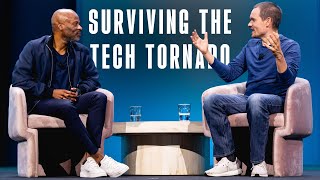
Tope Awotona of Calendly and Wade Foster of Zapier talk product strategy, scaling, and AI. Calendly is moving beyond scheduling into relationship outcomes. Zapier learned to keep teams small and build founder-type leaders. Both discuss balancing core product investment against new bets.
Chapters
Hello, everybody. You guys enjoying Inbound so far? There we go. I'm Topawatana. I'm the founder and CEO of Calendly. It's a pleasure to be here today. It's my first time at inbound, and I could not think of a better way to be doing it. So excited to be here.
What's up, folks? I'm Wade. I'm the co founder, CEO of Zapier, and I think this is my second Inbound, but it's a lot bigger than the last time I was here. We were in a much smaller room. I think it was like a couple tables, honestly, the last time I was here. So. Soaked beer. Yeah.
Yeah. And before I get started with the questions, before, you know, we were walking out of the green room. Brian Halligan from HubSpot told us not to eff it up, and so we're going to try our best not to do that. Anyway, Wade, you and I, we've known each other for about seven years now. You remember how we met and you care to share with everybody?
I barely remember. I assumed it was through the partnership, but then I actually went back and looked, and our first CFO that we hired, Ginny Bloom is down in Atlanta, and she was the CFO at mailchimp. And mailchimp bootstrapped Zapier almost bootstrapped Calendly almost bootstrapped. And so Jenny here at the center of all this stuff is like, hey, you and Tope should meet. And I think soon after we got the partnership going and things like that. And that's sort of been off to.
The races since then, and it's been a great friendship. So Wade is really, really humble, but he's just been. He's just a great, thoughtful CEO and smart CEO and very, very engaged. And he's just been really generous with his time with me over the years. I call him all the time for advice on everything from hiring to org design to how do you do remote. Really well. So just a great human being here.
Yeah, I mean, same. Maybe to. Maybe to kick it off. I'd be curious. You know, Calendly has seen this explosive growth. And we were talking actually backstage, everybody's building scheduling stuff. How do you, like, what are your. How do you keep ahead of the curve when you've got every big company under the sun also building the things you're doing? And yet Calendly still seems to be the thing that everybody, you know, everyone's like, send me your Calendly link. Send me your Calendly. How do you Stay on top of that.
Yeah, it's a really good question. And you know, as cliche as it sounds, it's really about listening to our customers and really observing the trends around us, including increased competition and a lot of lookalikes. But you know, going back to our customers, like they've been experiencing a number of trends over the last few years. They're seeing where virtual meetings are dominant. Right? Most of their meetings are now virtual. They have tighter resources, tighter budgets and fewer resources. And of course there's AI. And so what they're really looking for is they're looking for practical ways to adapt to these trends and bend them in their favor. And that's really what we made our strategy is about. Let's help our customers with those different things. And so we are evolving from being a scheduling platform into a company that helps our customers make the most out of their meetings and making them really effective and making them really efficient. And so we're going from really treating meetings as discrete events to thinking about them as interactions within the context of relationships and the desired outcomes of those relationships. So we want to help our customers meet the right customers at the right time and with the right context. And so to put that into, to make that more specific about how we're doing that. And so I'll describe the way we've evolved and the way we'll continue to evolve over the next few years. Years. You know, take a B2B company, a prospect lands on their website. That company determines that the prospect is a high value prospect, calmly allows them to serve up high, high availability to that customer. And so what that does is we know that win rates improve. The sooner that the, sorry, the sooner the prospect can connect with the company. And so right then and there, we're helping them improve conversion rates. But then the work continues to leading up to that meeting. We make sure the, the rep that's going to take that meeting has the right context to make that meeting successful. So we prepare them with a brief that includes, you know, summary of past conversations, information about the company they're meeting with, information about the individual that they're meeting with. And then during the actual meeting, there's an AI assistant present that's gonna help with follow ups and helping with follow ups, not in a generic way, but in a way very specific to that company's sales process. So it'll help extract things like what's the budget, what's the authority, who's making the decisions. It could be a different sales framework that a company uses. It'll also be able to support that. And then it just continues to build upon those recaps so that each successive meeting in that sales process has the context of every single thing that's happened prior to that. I can go on and on and on, but hopefully that describes a way in which we are helping our customers, like I said, with meeting the right people at the right time with the right context and leveraging AI as we do.
So.
Yeah. So I guess maybe sort of turn it over to you. You've made some really big bets the last few years, from AI to new product launches. What's the thought process behind those decisions, and how do you evaluate their success?
I think we. I think to make some of those bets, we. We made a lot of mistakes. I think we almost killed the company. I don't think it felt like that. Probably even on the inside, but certainly for myself, for the leadership. I think one of the mistakes we made was we. We stuck. So as we were growing, we were so efficient. And every year we would look at our growth and we'd say, gosh, it felt like we could have grown faster last year. And we looked at our bottom line and realized we weren't quite hiring fast enough. We'd have these big, ambitious goals to go tackle something, and we weren't quite able to get all the headcounts in. And so one year, I said, you know what? We're going to fix this. I'm gonna make sure that this year we actually hire all the folks that we think we need. And we fixed it. But in fixing it, we almost killed the company because we missed, like, an important part, which was all along, as we were bringing people into the company, we always knew what that person's job was gonna be because we'd been doing the job. We knew, this is the thing you gotta go tackle. This is your mission. And it helped us be very efficient as we grow. And Zapier is famously, you know, nearly bootstrap, as is Calendly. But as we solved the hiring problem, we started just throwing bodies left and right inside the organization. You know, I think we convinced ourselves that we were doing it correctly, like, hey, this will unlock growth opportunities. But we didn't actually pay attention to, like, hey, is this actually the bet that's gonna work? And in doing so, we started to just have too many cooks in the kitchen for almost every initiative we have. It turns out you actually want a lot of constraints to try new things, to experiment on new stuff. You want a small group of talented folks who really understand the vision and charter of what that thing should be. And if you put too many cooks in the kitchen, it actually slows things down. Everything gets kind of mucked up. And so for us, the thing that actually enabled us to drive the launch of things like all of our AI initiatives that have happened over the last few years. You know, we have 400,000 customers that have delegated 100 million tasks to AI. Now the launch of tables and interfaces and central, like a lot of that came from saying actually we don't want to focus on growing the team so efficiently. Instead we're going to find these founder esque folks. They may not necessarily have founded companies in the past, but they exhibit a lot of the traits of somebody that could and that they have a deep passion for this pocket of the business that we want to go tackle. And then we're gonna let them go race after it. And then the way we found those things was not too dissimilar from you. It was a combination of listening to our customers, hey, this thing really sucks. This is really annoying. Could you make this easier for me of looking at what everybody else was doing and seeing like, hey, you know, they're kind of doing this thing over there and like that's sort of what it should be, but it's actually not quite right. And then a combination of our just own intuition, like what do we want, what do we think would be an awesome experience? And then going and building that, it's not. You know, I think a lot of folks think that product development is this like purely analytical driven thing where it's like data in outcomes, answer, go build that thing. And it's never worked that way quite for us. Yeah, the data feeds it, but it goes through this very human like almost artistic expression and then out the other side comes a product that people love. And I think, you know, when you look at most of the products that I think we use, a lot of them have come from at least the origins of it come a little bit more from artistry than from science.
I could not agree more with that. And I tell our employees all the time, at the end of the day, we're building the products for humans. So we have to think about, we have to think about that.
Yeah. How do you, so how do you balance the, you know, investing in like the core parts of calendly, the things that you know are working, the stuff that your customers are telling you versus like the new stuff, the thing that you have an intuition about or someone on your team has an intuition about that you're like, yeah, I feel that too. How do you think through, like, when to go all in on this weird side project thing versus, like, when to say, like, you know what, this thing is working. Let's not mess up a good thing?
Yeah, that's a really good question. I don't think that there's a perfect answer. I think it is really looking at maybe a really good model is Apple. So Apple launched the iPhone in 2007 or so, and for the first five or so years of the iPhone's life, they sold, I think they did, something like $200 billion in revenue. And during that five period, five year period, they never offered more than one iPhone model at a given time, yet they were able to generate over $200 billion in revenue. And so the way we think about it is probably sort of similar as I think we try to pick on. Pick big problems. And if you solve big problems, you can go really, really deep. And that depth continues to yield a lot of a solid return on your investment. Conversely, when I think we've gone, we've made very, very narrow decisions. No matter how much we optimize it, it's just kind of capped on the results it can generate. So I think we try to figure out, are we working on a big problem here, Are we working on a small problem? And what is the point of diminution returns?
The funny thing you said there that resonates with me is when you focus on a narrow thing, it wins. The interesting learning I have from Zapier is every time we focus more on what is gonna make a customer go, oh, that's freaking awesome. We've tended to make a lot more money, and every time we focus on trying to make more money, we've actually kind of messed things up. And so it's interesting to see, like, you know, this like, money follows love sort of thing versus, like the inverse. And I think so many companies get that, like, messed up and they actually kind of do mess up a good thing. And we've certainly fallen prey to that.
I think you have the next question.
Talk to us about that. Like.
Oh, I can go. I'm sorry.
Yeah. Well, tell us a little bit about that reinvention spirit inside of count. Like, what is the mechanism? Like, how do you think of when is the right time to go? Do, you know, invest in a new area or a new part of your business? You know, I know you've, you know, big part of your business is like PLG and small business, but you also have, like, fairly large companies like how do you think through, like, when is it, like, hey, we actually do want to press an advantage here versus, you know, stay where we're at.
Yeah. So I think generally like when we think about invention, you know, one stat about calendly is about 50% of our employees have been there for know, less than two, three years. And so we get a lot of fresh ideas, we get a lot of fresh energy. You know, they are not content to coast off Calendar's past successes. They want to put their own thumbprint on the company's history. So there's just a lot of really good ideas that sort of bubble up. But for us, like, it's also really knowing about who our ideal customers are. And for us there's no, we've thought a lot about it over the years and what we find ourselves to be most successful, where we have a lot of great domain expertise is in serving external facing teams, salespeople, customer success people, recruiters, product researchers, those types of people. And so we then think about like, what are the big problems those people are trying to solve and in their day to day, like, how are they successful in their roles? A salesperson wants to generate more revenue, A customer success person wants to retain more customers. And so we just really use that as sort of like the guiding process for what are the things that we have a right to do, we have a right to solve for our customers.
Yeah, makes sense.
Yeah. As you think about Zapier's evolution, like one lesson, what's one lesson on reinvention you wish you knew sooner?
I think when you think about reinvention, I think somewhat counterintuitively, like the best time to go try something new is actually when it's going really, really well. You know, we had, you know, the early years are obviously like quite a grind, but probably somewhere around year four or five, like Zapier caught a wave where we just sort of like, we had it locked in product market fit. We knew our customers were, we knew how to grow and things were really moving. And I think a mistake we made during that period is we felt like, oh, let's put all the chips on this thing that's really, really working. And that was probably 95 or 99% the correct move. But it turns out that like 5 or 1% or whatever is like a pretty big mistake where because it was going well, that meant we could have much more easily, I think carved off a small slice and said, hey, we're gonna go start plotting what Act 2 needs to be for Zapier, whether That's, you know, the next product line or the next customer segment and we could have incubated it fairly effectively. And the reason to do it, I think at that time is because you have all this momentum, you have all this inertia and it would not be that big of a risk to say, hey, will grow slightly bit slower, just a little, little bit slower to go fund this tiny little thing over here. And the reason you want to do it then is because new things just take time. Like, it's not something that you can just snap your fingers and say, hey, you know, we've got this great new product, we've got this great new customer base to sell to and like, it's going to be off to the races even for well established companies. And so you want to, like, when things are going well, you want to start that muscle and get that itching. And the way I think you do that is to find like, you know, one of these founder types. Again, doesn't necessarily have to be a founder, but exhibits like a lot of the traits that you care about inside of your organization. Who cares about this, like adjacency to your business. And that I think is something that we have started to do more recently is to always have something in the hopper that's like going to keep pushing on it. And I think it's, you know, it's more important. I think we've all learned that lesson. Now with, you know, ChatGPT launching two years ago, it sort of was like, oh crap, there's a big paradigm shift happening and there's a version of that where it changes the whole industry. But there's a version of that where, hey, this is a huge opportunity for us. Like, look at all the things we can build. And if we're willing to jump on some of those waves, we can build some incredible experiences for our customers. But it requires you to, you know, do some things that don't always look like the right thing, quote unquote on paper.
I think that is really interesting because when I also reflect on, you know, some of the biggest mistakes that I've made at calmly, I think some of those biggest mistakes have not have been not starting those second and, you know, second, third and fourth bets soon enough. We're doing them now. So like the story I described earlier is a, is an example of how we're consolidating a bunch of products our customers are buying from multiple vendors into just one vendor with calendly. But I wish we would have started that sooner.
Why do you think you didn't start.
Earlier because I think that this is a real question. I haven't thought about that. You know, I think maybe I thought that. Maybe I thought that there were things in the first product that I don't think we got right. I want to. I wanted to land the plane on those before I moved to other things. I famously have a short attention span. And when I have a short attention span is when I actually tell myself, hey, maybe this is your attention span telling you it's time to move on. And so I actually wish I would have listened to my short attention span much earlier than I did. The other thing I find fascinating in how you've gone about expanding your product suite is you've really sort of leveraged these phenotypes, people, founder type people that you've brought into the business. What I've done, and it'll be, you know, I need to learn more from you on this. What I've put on is actually whatever the next bet is that we're working on that is becomes 90% of my job. So I've. I've taken those things as my. As my primary responsibility. And up until now, that's actually what I'm. I spend a lot of my time doing.
I think that's like. I think that's a pretty good approach. Yeah. I want one of the lessons learned from. There's this guy, Ravi Gupta, who used to be the COO at Instacart. He gets asked all the time, as companies are growing, how do you make planning better inside? And I think everyone sort of hopes to hear this, like, oh, here's this great system, this set of okrs, this set of just implement these process and rituals, and now your company will. Everything will work better if you do that. And when I was talking to him about this, he was like, it never works that way. It just doesn't. He's like the way in which if you really want to go get something done, the best way to do it is walk up to a whiteboard, write the number one most important thing down, and then take the person in the company who is best at that thing and put their name next to it and say, your job is to go figure that out. Our job is to give you everything you need. And so in your case, if that's the most important thing for calendly to figure that out, you're the best person to do it. It kind of seems like it could work pretty efficiently.
I tend to agree.
Brian asked us this good question backstage, and I'm Gonna put a twist on it, which is. He asked, like, who is on your Mount Rushmore of CEOs. Maybe I'll put a twist on it, which is, who do you think you've learned the most from? Whether it's a CEO or not? Who's your mountain rusher? And you're like, man, I wish I. Like, every time I'm making a decision, I have them on my shoulder.
Yeah. And it is probably not going to be the. It's none of the usual suspects I learned the most from. How do I say this? Like, just everyday normal people. Everyday normal people. Right. Because I think that one of the things I want. I thought. I think one of the reasons Calendly has been really successful is that prior to Calendly, there were a lot of scheduling tools on the market. But, you know, maybe a lot of them you've probably never heard of. And I think the reason you never heard of them is they build these products for the most. The most technical users, the most. The savviest of all users, the productivity, you know, devotees. Right. Whereas I think. And I think, you know, those people are important customers. But I think there, for every one of Those, there are 10 more people in the market that you can sell to. And I get more excited by solving problems for those. For that, you know, for that. For those 10 people, as opposed to just the single person who's just going to spend all day in their product. In your product. And so I like learning, like, what are your challenges? What are the things that you. You wish you could do better? And I find that very, very inspiring. Yeah. I also think about, you know, like, I'm in my dream job. I feel so lucky to have this job. And there are many people who maybe haven't quite found their dream job yet. And I still see how they push really hard in spite of that, and that just motivates me. So that's why maybe I take a lot of inspiration.
Have you always loved your job?
I've always loved my job. I don't love every single day of.
My job when it's not going, when it hasn't gone well. What. What has enabled you to get back to the part that's, like, now I feel like I'm back in my sweet spot.
Yeah. So I think one of the things that's helped me is way before I started Calendly, I was in sales. And in sales, you don't win every single deal. As a matter of fact, you don't need to win every single deal to be successful. In sales. And so I've always had this mindset of playing for the odds. Before I started calendly, I had four failed businesses, and then the fifth one took off. And so I generally know that if you. I generally believe that if you follow a certain strategy, you know, you have a certain hit rate. And it doesn't mean that it's going to happen and it's going to be evenly distributed, but over time, you'll have a certain hit rate. And so that's sort of what I go back to.
What do you think separates the fact that you had five failed businesses? Like, why. Why did you keep going? A normal person would not have failed five times and then said, you know what? The six one. This is going to be the famous saying, six one's a charm. Like it doesn't exist for a reason.
It's kind of like I'm going to use this analogy because I'm a new parent. It's kind of like when parents have new kids, they forget about what it was like to what the last child was like. I think it's kind of like that. I think it's a little bit of having a short memory. And I think the other is just like, for me, I found no other. Nothing else was acceptable. There's nothing. I was. I was gonna be happy trying indefinitely to, you know, to, you know, to start and scale a business. And, you know, I would have been okay with that. Indefinitely.
Yeah. My. My co founder Brian shared a clip with me recently that made me smile on this dimension. He's a little bit of a movie buff, and I guess Quentin Tarantino, famous director, is. He's pretty famous for. On his sets, like, at the end of the day, everybody's tired, everybody's exhausted, and he'll be like, okay, let's shoot it one more time. Everybody's like. He's like, but why do we do it? And then the whole crew will say, because we love making movies. And I think there's a little bit of that for this stuff where it's like, well, what else would you do? Like, you actually love it and you love it. On the worst days when it's really bad, you're like, you know what? This is still like 10 times better than anything else I could be doing.
I mean, in the grand scheme of themes, I'm. I think of myself as the luckiest man alive. What pushes you?
You know, I think it's. I think it's that it's just really fun, you know, early on, when I. When I. Before we Started zapier. My wife's a, my wife's a teacher and when she was a first year teacher, we got married right out of school. She, she would go, she's, she's very hard worker. She would go to school at like 6am in the morning to get ready for everything and she like writing papers, getting it all done after school. And so she would, you know, sometimes stay till like 9, 10 o', clock, you know, finishing those papers up. And I had a pretty traditional job and so I would end, you know, in my day at 5, come home and this was like Netflix and discs era. So like I just toss in a disc and watch the whole thing in one night. And I did that for like three, four weeks. And at first it was like, this is pretty awesome, like this is way better than school, like grinding. And then after a few weeks I'm like, is this really it? Is that all this is gonna be? And that's when I started saying like, you know what, I don't, I need something that's gonna engage me much more intellectually. And started like learning how to code, learning a lot more Internet marketing, things like that. And business just ended up feeling a lot like the best version of a video game where it's like, oh, this is like all sorts of problems, multifaceted. You know, on one hand you're trying to learn this hard technology problem, on another you're trying to figure out how to get customers in. In another dimension you're trying to figure out how to build a team. So you've got this like three dimensional chess thing going on that you know, is really, really fun. And I think, you know, 13 years in now, it just gets like, you just keep having hard problem after hard problem and I can't think of any other thing you could do in life that would just scratch that itch. And so I think for anyone who wants to try like starting a company, you ought to try it because it's just so, it's hard to find any other thing I think will push you in so many different dimensions.
It's the ultimate challenge. Since we've got a few minutes left here, maybe we'll close it on a, on a, on a business note, you're working on a lot of great things as app here. You've been on a tier in terms of releasing new products. What are you most excited about that you're working on?
I think, you know, I think in the next, call it like two to five years. The cost of building software, I'm pretty sure is going to go to zero. And so I think the like implementing things technically is not going to be the hard part of our jobs anymore. And so the fun part I think is going to be well the creative aspect, the ideas aspect is where all the energy is gonna go to. And I think that's a bit of a twist especially you know, from a product management point of view, from a marketing point of view. For the last decade or so, you know, the technical side of the house has been the place where like a lot of the smartest brains have gone into. But I think it's gonna invert again where I think you're gonna see a lot of ideas. And so one of the things that we're working a lot on is how do we help folks understand like where are the best places to automate their business. You may not realize that there's this untapped opportunity. And so, you know, we've been at this 13 years now. So we're going and looking at, you know, the 1% of our customer base that has really pushed the limits that have really innovated in saying how do we take what that 1% has learned and how do we go teach everybody else how to do that same thing and how do we do that not just in like a, you know, one to one setting where the sales team is like educating a new prospect, but how do we actually implement into the product experience. So whether you're you know, a large company or you're just, you know, a startup getting going and you don't know where to go, you don't have any money, you don't have any resources, you can just come into a platform and say like, hey, this thing's gonna help me figure this all out. Because I think that's, you know, when you're starting a company that's the hardest part is you just don't know what you don't know and so you just kind of like you try stuff and if you have a little bit extra guiding hands along the way, I think that's the most exciting thing. And so that like, that like element of like helping people figure out that is, is one of the most exciting things for me. Very cool.
I think it plays your strengths. You brought, you kind of led the way on remote working and you taught the world how to do that. You brought automation to the masses and it's be fun to watch you bring creativity to the masses.
Same question for you. What's your, what are you most excited about for the next few years?
For calendly you know, I'm very excited about, you know, reinventing the company. You know, this is year 11 for us. And I think the next 11 years of calendly will look very, very different from the last, from the first 11 years of calendly. And I could just not be more excited to make that happen. And so earlier I talked about how we're evolving from just a median company into. Into contextualizing those meetings with relationships and driving the outcomes of those meetings. There are many things in that vision that I described that we're doing today. There are many more things in that vision that we haven't done yet and we'll be doing over the next few years and next few months. And I spend 99% of my weekend hours thinking about that, working on that in some form of fashion. And I could not be excited to launch that to the world soon enough. Here.
What's the last 1% of your waking hours that you spend time on?
I look at my kids pictures.
Oh, that's a great one. Awesome.
Yeah. Well, I enjoy doing this with, with, with you, Wade. Hope you'll invite us back in the future.
Thanks.
More from Patrick



A NEW BREED OF PARTNER: The Partnership Ecosystem Model Journey of Patrick Biddiscombe, Part 1








Customer Success Workspace: Never Lose Sight Of What Matters Most | HubSpot Spotlight