Ta Nehisi Coates "Speech given the day after the 2016 Presidential Election"
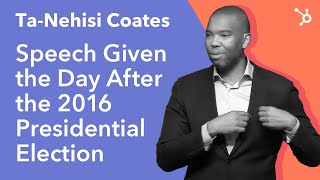
Ta Nehisi Coates speaks the day after Trump's 2016 election win, calling it a normalization of sexual assault and misogyny with serious racial consequences. He traces American racism from colonial law through slavery and Reconstruction to present-day voting suppression, warning that recent gains in justice reform and voting rights are now at risk.
Chapters
Ladies and gentlemen, please welcome TA Nehisi Coates. How you doing, guys? My. I had a keynote I had prepared that I was going to give. Some of y' all know what's about to happen. I had a keynote I was about to give, and I wanted to talk about education. I'm an autodidact myself. I'm somebody who didn't do particularly well in school, and I wanted to talk about the process of self education, and I wanted to talk about the process of writing my book between the World and Me. And I had that all prepared and I had that all together, and I thought it would be a good message for this audience. And then last night happened. Yeah, we got a laugh. To keep from crying. I haven't slept. I haven't slept since last night. And it's not so much that I'm shocked that Donald Trump is elected. Indeed, for the past, I would say, I don't know, four or five years during my time as a writer, I've been writing things that said the election of somebody like Donald Trump would not be out of the ordinary for the history of our country. I'm going to apologize just at the outset for being such a downer today. I was watching a video back there, and you guys were all so excited and you're all so pumped, and I'm sorry that I'm going to have to take the temperature down a little bit, but I don't think we can ignore the events that are going on outside of this assembly here. That was a video for Girls who Code that was on before I came out here. Right. Okay. I couldn't completely hear, but I was watching and I was looking at all those beautiful young girls, and I was thinking about how throughout election, just yesterday, we have effectively sent to the White House, we have sent to the offices of the most powerful figure, not just in America, but really in the world. The leader of the free world is somebody who, through his campaign, was recorded on tape, effectively saying to the world that the lives, the physical bodies of young girls, like that didn't matter. And so I was back there watching that video, and I just got sad. I mean, I felt it last night, but a pit just came into my stomach. I'm gonna talk a little bit about what happened last night, and I'm gonna talk a little bit about the context for what made that possible, if I can. First of all, this was an extreme loss. It's huge. It's bigger than anything that I think we can imagine. We're just beginning to get, you know, our bearings around it. As I said, what we had, as far as I'm concerned yesterday, was first and primarily the normalization of sexual assault, the normalization of harassment, the normalization of degradation of women and girls. There was a moment during the campaign, in the second debate, while I watched the presidential candidate, Donald Trump, threaten to lock another candidate up. And this was right after he had been accused by all these people of sexual harassment, when he had been actually caught on tape. And I watched and I thought, is this happening? And I thought, the rest of the country must see this. And there's no way, even I, somebody who's been accused of being pessimistic before, I thought, it's no way that somebody like this could be sent to the White House. But it happened. Those of us that care about global warming, those of us that are worried about the environment, those of us that are worried about the planet, we're in deep trouble. Because it's not just the White House. The party that is in power in the White House, the party that is in power in the House of Representatives, the party that is in power in the Senate, is not particularly concerned about that. One of the benefits of the last eight years has been a turn away from torture, and there's no guarantee that we'll see that actually preserved. We saw uninsured rates cut by over 8% since 2011. There's no guarantee that that's going to continue. We have a candidate who's ran on the idea of returning to religious tests and mass deportations. I don't know if we have any immigrants in the audience or children of immigrants. I'm assuming we do. But I feel for you right now. Take heart. Take heart. And for me personally, as somebody who wrote a book that really was, I guess, pushed forward by the killing of a friend of mine by a police officer over 15 years ago. To watch the nascent activism that sprung up over the past, I would say, four years or so in the form of Black Lives Matter, to watch the country really sort of shift and pay attention to. To this sort of thing. Last night was a major, major, major blow. We've had an attorney general, and this has kind of been below the radar, that has renewed the fight to go into communities and supervise police departments and attempt to make police departments responsible to the communities that they allegedly serve, and all of that is off the table right now. I spent a lot of time in Chicago, and there was a video that came out in Chicago almost a year ago of Laquan McDaniel, who was a young man who was just shot down, it looked like, for sport. And there had been efforts that were being made by our Justice Department in Washington to investigate Chicago and to figure out what's going on there. We hear a lot about the murder rate there, but effectively, we have an illegitimate police department. And those two things are not unrelated. When you don't believe in the police, there's no reason to call the police. There's no reason to talk to the police, and you end up trying to settle scores by yourself. And so the murder rate that you hear there is is not unrelated to the illegitimacy of the police department. All of that is on the table. And you ask yourself, how did this happen? Was it really only eight years ago that people were crying in the streets and were streaming in the parks and gathering together and feeling that we had really crossed onto this new level by electing a black president for the first time in our history? I had always been pretty skeptical. I had considered myself as a pretty grounded person, but even I got caught up in the emotion. I thought something really had changed. And, you know, something really did change. What Obama proved was that a spectacular black individual in this country can achieve spectacular things. But don't ever lose sight of the fact that this was a spectacular individual. The comedian Sinbad jokes that there are no more black men like Obama. There are no more black men with roots in Kansas, born in Hawaii, who went to Harvard Law School and lived in Chicago. That's just not going to happen again. That's a spectacular individual. But I'm worried about normal folks, those of us who are not spectacular. And unfortunately, unfortunately, it looks like we're in for a long row. One of the things I think we lose sight of is the amount of racism that immediately followed that euphoria and really followed Obama as soon as he declared himself a part of the national conversation. When Obama ran For Senate in 2004, the opposing party imported a candidate to run against him. Another black man from Harvard just imported him, a guy from Maryland by the name of Alan Keys, just because they needed another black man to run against him. When he declared that he was going to be a presidential candidate, photos sprung up of him in Somali garb. Radio hosts took to playing music jingles entitled Puff the Magic Negro. Operatives claimed Michelle Obama could be found on tape yelling, whitey. Y' all don't even remember the whitey tape. Some of y' all was about 10 years old. But it happened when Obama ran against Hillary Clinton in West Virginia. Fully 20% of the people there said that they voted against him because he was black. This was open. This was an actual poll. After Obama secured the nomination, traffic to white supremacist websites increased by as much as 20 fold. And that August, just before the convention, the FBI unmasked an assassination plot hatched by white supremacists in Denver. There was a Republican women's club that dispensed Obama bucks. And on the Obama bucks you can see platters of watermelon ribs and fried chicken. At the Value Voters Summit that year, conventioners hawked Obama waffles, a breakfast cereal featuring a bug eyed caricature of the president. Hip hop lyrics were sprawled on the side. Barry Bling, Barry Bling's waffle ring. Excuse me. And on the top, the same caricature featured a turban tagged with the instruction point box towards Mecca for tastier waffles. That was the beginning of birtherism. And our President of the United States, our new President elect of the United States, effectively ran on that. He ran on the notion that the president, that the prospective president was not an actual citizen. And he succeeded. We're all endangered by this. I think one of the problems with the conversation around racism that I've tried to have, based on the book I've tried to have around the country, is the notion that this somehow only endangers black people. But I'm here to tell you that it endangers all of us. This started, this started as a racist lie about the president and then it expanded into everything else. It moved into slander about Mexicans. It moved into slander about Muslims. It moved into the notion that a federal judge somehow could not do his job because he was Latino. It moved into the devaluing of women. When it endangers one of us, it endangers all of us. Anybody here familiar with the writer James Baldwin? Not enough people, but I hear you out there. Baldwin would be deeply instructive to us in this moment. He wrote a book called. He wrote an essay called On Being White and Other Lies. And the argument Baldwin made was that race was in fact not real. What he noted was that race in fact was always the result of power. That any notion of you being black or you being white was ultimately a result of some sort of power relationship between two people. That doesn't mean that you having blonde hair is not real. It doesn't mean that you having darker skin is not real. It doesn't mean that you having full ellipse is not real. But it means that the categories that we assign to People who are black and people who are white are ultimately based on people trying to take things from other people. They're ultimately based on power relationships. We know this to be true. There is no categorization of black or white that can sustain the test of time and space. I am black, standing here before you in 2016, here in Boston. But if I were in, say, New Orleans 250 years ago, I might be something else. If I were in Algeria right now, I might be characterized as something else. We have something in this country that's called the one drop rule. And there's no reason why. The idea that just because you have one drop of black blood, you would have to be considered black. There's no stipulation, there's no actual biological test that you can take that across time and history can separate black people from white people. It only makes sense when you're having a conversation about taking things from each other. And this idea, this idea that race is somehow wielded, it's somehow beyond that, it's somehow something that should be fought over or should be fought on. This is the very idea that led us to Trump. And it's as old as this country. In fact, older. In 1619, when the first group of African Americans arrived here in chains, they were not the only people who were bonded. They arrived and they found Irish immigrants here who were in a system that is called indentured servitude. The only difference between these two groups of people was one group served longer than the other group of people. It was a real difference. But in general, this group of people cooperated together. They stood together, they fought together, they made love together, had children together, they rebelled together, they drank together, they did all the things that people do when they're social with each other. And over the course of history, basically what you saw was a division. The problem with America early in its history was there was a large swath of land, and what was needed was a bonded class of people who could work that land. And the decision was made that if you could separate two groups of people, if you could make one group of people ascribed as the workers, if you could give them less rights, if you could somehow make them lower than the other group of people, then you could have a system that could work. African Americans were deemed as that group, black people, Negroes, whatever we were called at the time. And slowly you see the foundation of this idea of race. And you can literally see this in the laws. You can see black people in the 17th century being stripped of rights and you can see white people who were not considered white before being given rights. In 1705, for instance, the Virginia assembly passed a law that made it a crime for any black person to defend themselves. At that same time, they passed another law that said the idea or the notion that a child who was born to a white mother and a black father must necessarily be a slave, but not the other way around. That's race being created. That's the idea that we still live with today. We got to the point in the 19th century when the illustrious John C. Calhoun, who was considered one of our greatest senators from South Carolina, said that the great division in our society is not between rich and poor, but between black and white. That is the entrenchment of the idea of slavery. I don't mean to take it back so far in history, but it's very important that we know where these ideas come from. It's very, very important that we know why they still have a hold on us, why we could be in a situation where eight years, after so much euphoria, we could find ourselves faced with a mortal threat, not just to black people, not just to the country, but the whole world. 2016 wasn't the first time we faced a threat like this. It was the idea of whiteness that ultimately brought the country to Civil War. In 1860, I had a period in my life, I guess it's been almost 10 years now. I was deeply interested in the Civil War. It kind of took me over. And I would drive to all these battlefields. I would drive down to Petersburg, Virginia. I would drive to the wilderness. I went into Tennessee and looked at battlefields, and I would drag my wife with me, and I would drag my son with me. And they would get upset and say, daddy, why are you taking us to see all of this history? And what I wanted them to understand is that history was them, that everything about them started in that place. Some 600, 700,000, the numbers are being revised upwards every day, died during the Civil War. And when I would go to these battlefields, people would often say, when I would ask, well, why did they die? They would say, well, you know, it was states rights. They were defending their honor. We were fighting because you came down here. And what I sensed behind that was the inability to talk about what had actually happened. In 1860 in this country, there were 4 million people living below the Mason Dixon line who were living as slaves. They were the majority of the people living in South Carolina. They were the majority of the people living in Mississippi. They were half the people living in Georgia, half the people living in Louisiana, and taken together, and I hate to talk about this like this, but this is what this group of people were. Taken together, this was considered the most valuable property in the country. In 1860, had you taken all the nascent banks, had you taken all the nascent factories, had you taken all the shipping, all the wealth that America had produced, and you put it together in one pile, the enslaved African Americans, valued at some $3 billion, would have been worth more. That's a lot of wealth. In 1840, 60% of the exports out of this country were cotton. They came through the hands of enslaved black people. So slavery was not just an institution that gave money and resources to the South. It was something that the country itself based itself on. Indeed, it's hard to imagine this country without slavery. And after the Civil War ended, after those 700,000 human beings had died, after that, 4 million African Americans were set free. It's not like the country got together and said, okay, you know what? Slavery was wrong. Go on your merry way. What followed was a 100 year campaign of terror. I tell people all the time, you know, we have got into this ritual, and you see it, you know, even today. I went yesterday and I went to vote, and they gave me a very nice sticker that said, I voted. Right? Did you guys get that? I really hope all of you guys got that. I really hope, because then we'll have to have another conversation. But they gave you a nice sticker, said, I voted. And really what it does is it obscures the deep significance of voting, the deep power that is actually in voting. When you vote, you have some sort of say in how your society spends its tax dollars. You actually have some sort of membership. It's your end of the social contract. For 100 years, for almost 100 years, black people living in half this country did not have the ability to exercise that right. That's what followed the Civil War. This is not beyond us. It was only, what, two, three years ago that the Voting Rights act was struck down in this country. It's still with us. The victory that happened in North Carolina did not happen by magic. There was a concentrated effort to restrict the places and times black people could vote. And this goes back to the Civil War. It goes back to our history and slavery. And so black people who came out of the Civil War expecting the right to vote, expecting the right to have some sort of say in a society when you weren't given that, and whenever somebody taxes you for something and doesn't give you the same return on your services. They're plundering you. They're taking something from you. And that was the situation. African Americans lived in this country until the 1960s. That means that there are people in this room. That means there are people here. That means there are people that were voting yesterday. That means there are people in my family who within living memory can recall a time when the government basically existed to plunder them. When Donald Trump assembled his team to run, he went through a number of staff people. One of the last staff people, he added, was a man by the name of Steve Bannon. Steve Bannon is part of what they call the alt right, which is basically a new name for a white nationalist, which is basically a new name for a white supremacist. I mean, it's scary stuff. You should Google these guys if you get a chance. If you haven't. When Donald Trump went before audiences and was talking about Muslims, when he went into Chicago and talked about law and order, when you would see these pictures from the rallies of people being punched, people being beaten, he was appealing to a nascent spirit. Something that was old in us, something that was ancient in us, something that goes back to 16, 19 in 2008, we thought that was dead. That was a huge, huge mistake. We had deeply, deeply underestimated ourselves. We had deeply, deeply underestimated our past. The last eight years have been, you know, I don't know, for me, as an African American, just a period of tremendous pride, but I feel like I took my eye off the ball for a minute. It's easy to forget, and we're going to forget this more, by the way, over the next 10 years when everybody and their mama is going to say they voted for Barack Obama. I guarantee you that's what's going to happen next. It's easy to forget that the majority of not 10%, not 20%, not 30%, the majority of the opposition party, did not believe that the president of the United States was born here, did not believe that he actually was a Christian, was circulating, you know, rumors about him. Obama bucks Obama, all this hateful, racist propaganda, and it came home to roots last night, and we voted for it. What I have to say to you, as I'm sure all of you voted yesterday, is that we have to take responsibility for this. I've been saying this in my writing for the past few years. It was the message that I tried to get across. In between the world and me, we have to take ownership of our history. There's this sort of deep feeling that because we didn't do whatever happened in 1860, because we maybe our ancestors just got here at the turn of the 20th century, that somehow we are not responsible to our history, we are not responsible to our society. This is the worst species of patriotism that you can ever imagine. It is patriotism a la carte because all of us celebrate on the 4th of July even though none of us were there to fight the battle for independence. All of us take off during President's Day. All of us honor treaties and pay taxes for things that we aren't directly responsible for. That extends even into our most painful areas. And if we don't deal with it, if we don't confront it, if we don't become more open about directly addressing it, we won't be looking at just another dark four years. We'll be looking at another dog. 8, 10, 20, 25. Thank you guys so much. Have a great.
More from Patrick



A NEW BREED OF PARTNER: The Partnership Ecosystem Model Journey of Patrick Biddiscombe, Part 1








Customer Success Workspace: Never Lose Sight Of What Matters Most | HubSpot Spotlight