The CEO Who Turned Vimeo Into a Billion-Dollar Company
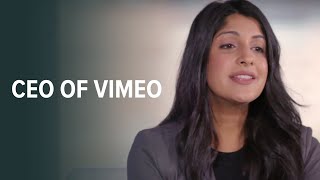
Vimeo's CEO Anjuli Sood discusses launching Vimeo Stock, a marketplace giving creators better revenue share, and explains why video now drives engagement and distribution across platforms. She traces her non-linear path from marketing director to CEO, emphasizing empathy and feedback loops in product strategy.
Chapters
Excellent. Glad to hear it. Oh, wonderful.
We're live.
Hi everyone. Welcome to the Inbound Studio. I'm Lauren Moran, your host and here with Anjuli Sood, the CEO of Vimeo.
Hi.
Thank you so much for joining us.
Thank you. It's great to be here.
I want to jump right in. Vimeo had a big announcement this morning. I'd love for you to share a little bit about that and talk about some of the details.
Yeah, sure. So today, Vimeo launched our latest product feature, which is a new way to help businesses and brands and marketers unlock the power of video. We launched Vimeo Stock, which is a new global stock footage marketplace. It allows anyone to easily search and license some of the most amazing footage that you can use for your social media videos or your website from the best creators in the world, which is the Vimeo community. So we're launching with a collection of exclusive content. We have amazing filmmakers and storytellers who are putting out their footage for the first time. We're offering industry leading pricing and not just for the brands and marketers who want to license footage, but also for the creators who get to keep more money from every purchase than you can anywhere else. And we're just really excited about this. It's really a way for us to just help brands and marketers, especially a lot of the folks here at Inbound, to help you make better videos, which we know is a big pain point and one that we're committed to solving.
Why is video these days in 2018 such an essential part of the marketing mix?
Yeah, so I mean, there's a ton of data around video and why it is such an engaging medium. But I think at the end of the day, there's a couple things. One, you want to tell your brand story, right? And you know to be able to use a visual medium to do that is very powerful. Two, you want people to know about your story. You want to reach an audience. And because we now know that video gets more likes and clicks and engagement on Facebook and YouTube, that's the kind of content that gets surfaced, which means if you want to get eyeballs on your brand or your message, you kind of have to be using video. And so I think we're at the stage now where video is an essential part of a marketer's mix. And the bigger problem is that you now have to create so so much video and the shelf life of your videos gets shorter and shorter. So it used to be that you could hire crew and do a shoot and spend two months perfecting your one minute or five minute short on your brand. Well, now you have to be creating 15 second, six second videos and refreshing them every month. And so I think the reality is that a lot of brands and marketers have felt like in order to do that, they have to compromise on their storytelling standards. And that's not the way it should be. And so I think what we at Vimeo are trying to do with this launch and with many of the other tools that we've put out into the world is we're trying to make sure that that compromise doesn't need to exist. And so hopefully this will be a good step in that direction.
You as CEO have an interesting take on marketing, in my opinion, having been CMO before taking that chief executive role, which is not always the most traditional path to CEO. So can you talk a little bit about your journey and how you went from CMO to CEO at Vimeo?
Sure. So I actually started not as a cmo. I actually started at Vimeo as a director of marketing, believe it or not, four years ago. And I had sort of not always been a marketer. I found marketing after doing a lot of different things. And I really loved marketing as a function because it's such a great balance between being analytical and creative. And I got to sort of exercise both sides of my brain. And so I really loved it. And I came to Vimeo to help kind of build out the marketing function. And ultimately, when I think about marketing, marketing is about storytelling. It's also about empathy. It's about understanding your users, getting to know them, and really putting yourself in their shoes. And I think for me, being at Vimeo and being a marketer, I talked to a lot of our community and I got to understand some of the pain points that filmmakers had or agencies or small businesses. And because I got to hear those pain points, it became a lot easier to develop a point of view and a strategy that went beyond marketing that kind of really touched on what I believed Vimeo should focus on as a platform and as a business. And so in many ways, I think the empathy that good marketers have helped me kind of come up with what I believed was the right business strategy for Vimeo. I was fortunate enough to be able to be given the resources to kind of test that strategy. And then when we decided to double down on it, I was fortunate enough to become the CEO. So I actually think that if I hadn't come in through that marketing lens, through that customer lens, I wouldn't be where I'm sitting today in Addition to.
All of that, I'm sure there were people, maybe mentors along the way that helped you some of that, especially since you have had a somewhat, you know, nonlinear path through your career. What role has mentorship played in the work that you've done?
That's a great question, and one I get asked often. One, I think, partners, mentors, confidants, squads, those things are really important. Everybody has their support system, and nobody gets anywhere on your own. So it's all very important. For me, I don't know that I ever had a lot of traditional mentors in sort of a. You know, I could say, oh, here's the five people who I worked with who kind of mentored me. But I relied really heavily on my family. You know, my dad in particular, who's an entrepreneur himself. You know, I've always had a really wonderful support system where every time I've had a difficult decision to make or I just needed advice about a tough business decision, I had somebody who knew me personally who could give me advice. And so for me, that's been sort of a very effective form of mentorship. But, you know, I think you can get that support from many different ways, but you do need it.
Switching back a little bit to the announcement and the product that Vimeo has and everything. I know you and I, before this, talked a little bit about just, like, how the role of the creator has changed. Can you just talk a bit about that and what you've seen and where it might be going in the future?
Well, so when Vimeo. Vimeo started as sort of a safe haven on the Internet for the independent filmmaker community back in 2004. And so back then, a creator was really a filmmaker, someone who, you know, video was their profession. And what we've seen over time is that technology is lowering the barriers for quality storytelling. And so what that means is you have a much more diverse range of creators. So now it's, you know, every small business, every yoga instructor is livestreaming their classes. You know, there's. Every kid is, you know, experimenting with Instagram stories. You know, there's. There's a much more diverse range of, I think what a creator is. And one of the things I talked about earlier in my. In my talk at Inbound is I think that marketers are creators now. And I actually think if you want to be a good marketer, you have to be a creator. You have to know how to tell good stories. And so to me, all these sort of lines are blurring, and it's all really because of technology. And technology is kind of empowering that and it's really exciting. And it's why I think for Vimeo, we're, we are a creator first platform. Everything we do is through the lens of creators. It's an exciting time for us because sort of like the number of people we can serve seems to be growing exponentially.
As CEO, how do you continue to do what you did as CMO in terms of being in touch with all the different communities and keeping up with the changes that are happening for your market and what could be a growing market or a growing user base?
Yeah, I love that question because it's so important to continue to have a feedback loop. And it's harder, it gets harder as your role changes. But I think at Vimeo, we try and do it in a lot of different ways. One, we do a lot of actual feedback loops and testing surveys. We invest a lot in creator programs and events, whether it's hosting meetups at our hq, going out to festivals, going out to conferences like these, we bring in panels, we have groups of customers and users who we are in regular contact with, who will often show them different prototypes or beta tests of things. And so I think you have to create those sort of more scalable ways. We have millions of users on the platform and so you also have to be careful that you're not kind of in an echo chamber of just talking to a few people. So I think for us it's about those scalable programs and how we can use them to be feedback loops. Of course, there's also data. Right. We are an online platform, so I can see literally in a given day or hour what videos are being uploaded, what features are being used the most, where people are disengaging with the product or the website. So obviously having sort of a very tight hold on that data and using it to glean insights about what our users are actually doing is important. But I do think you have to combine data with gut and with just listening, because at the end of the day, our users are human beings and they're each unique and individual. And so you can't treat everyone like a number on a spreadsheet.
Is that following your gut piece of this something that comes naturally to you, or do you have to force yourself?
That's a great question. That's probably one of the skills I've learned the most in the last year. I think for me, I came from a very analytical background and I always relied on data. Data was like my back, you know, and it was like where I was naturally very comfortable. And it's really, I think only in the last few years that I've realized that it's just one side of the coin and that human side, that gut side, how very important it is. And it's an area that I actively have to work at, you know, making sure I balance and weight. But I'm very sort of sold and convinced that the best businesses, the best brands, the best decisions get made when you really take both into account. Yep.
At the core of it all, what would you say drives the work that you do? What gets you out of bed in the morning?
Two things. One, I even as like a kid was super weirdly ambitious and like wanted to, you know, I wanted to be doing something like this and. But I always wanted to be a business leader because I really believed in impact and I believe that businesses could, I still believe that businesses can positively impact communities. So one of the things that gets me out of bed is feeling like the decisions that I make every day about what Vimeo will invest in, the impact that that can have on the creative community. And so that is something that is really motivating. The other piece for me is, and it's cheesy, but it's true, is the team. I am an internal promotion. So I've literally worked in the trenches with almost every person at Vimeo for years and I know most everyone quit well and so there's also a feeling of we are this little engine that could company in a big world of big platforms and we're really committed to our mission and we're trying to do things differently. We're an ad free platform and there's definitely a piece of it that's also just, I feel a responsibility to my team and I just love working with them and I want us all to, to succeed together.
That's lovely. Looking back at that ambitious teenager, what advice would you give her?
Oh, so this came up in another session. So the advice I would give my teenage self is actually to just like chill and don't stress so much about having the personal perfect career path and achieving everything initially. That's the advice I'd give my teenage self. Because I think when you're a teenager you think what's happening to you is like everything is the end of the world. Right. And I had a lot of little missteps and failures as a teenager and then in my early 20s in my career and I remember every time feeling like I was, I was never going to achieve what I wanted to achieve and I literally many times wake up and pinch myself today because I can't believe that I'm here doing what I love. And I wish I could just tell that little 14 year old it's OK, you're going to have a non linear path and you're going to try a bunch of things and you're going to make some mistakes, but you'll get there. And I know that doesn't happen to everybody, but I do genuinely believe that the past is not prologue and it's never too late to reinvent your career or find the thing that you love. I really do believe that. And I actually think now, especially in the world of technology, you see it all the time. You see businesses that sprout out out of nothing. You know, you see 21 year olds, you know, running billion dollar platforms. Like I really do think a lot of things are possible.
Yeah.
And so I wish I had known that maybe as a, as a young girl. So I didn't stress out so much.
Fair enough. You've been on the ballroom stage here. You've joined us here in the studio. What is the one thing that you hope to leave this inbound audience with, having spent some time with us here this morning?
Morning. I think probably the biggest thing I would want to leave the inbound audience with is I know that most of the people here are marketers or storytellers. Is one to know that myself, I and Vimeo have a lot of empathy for the challenges that you face and that we are really committed to using technology and tools to help you solve them. And you know, today's launch of Vimeo stock is just one piece of that. There's a lot of other things that we will do and have done and will continue to do. But just know that there's a recognition that you have to tell compelling stories and that you need more support to do that well and that we are very committed to solving those problems.
One final question.
Sure.
What does inbound mean to you?
Like the word inbound? Sure. Oh, I guess I would say makes me think of a personal journey. I think the word inbound and it feels like versus outbound, which is more about externally going somewhere. It sort of feels like you're moving and being introspective. And I would actually say today I feel like I've gotten a lot of really thoughtful questions that have probably made me think a lot about my personal journey and be a bit more introspective.
Love it. Thank you so much for joining us here on the studio and at Inbound 2018. It was so great to have you. Thank you for coming.
Thank you.
Thanks, everybody.
More from Patrick



A NEW BREED OF PARTNER: The Partnership Ecosystem Model Journey of Patrick Biddiscombe, Part 1








Customer Success Workspace: Never Lose Sight Of What Matters Most | HubSpot Spotlight