The Most Mind-Blowing 15 Minutes on the Future of AI Advertising
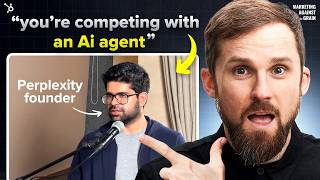
This YouTube episode (host Kieran Flanagan, featuring Aravind and other speakers) explains how AI agents will transform advertising and go-to-market: ads will target agents (which perform research, procurement, and software use on users' behalf) rather than humans, shifting buying decisions to spec-driven agent processes. The hosts illustrate this with examples (travel bookings, Google Deep Research/Gemini, Google Stream Realtime, Claude tool integrations) and argue this will particularly impact B2B procurement and marketers who currently rely on brand/attention-driven tactics. The episode warns that marketers must rethink paid ads, websites, and product design to optimize for agent consumption.
Chapters
Okay, the founder of Perplexity just dropped the best two minute video describing the future of advertising in an AI world. And it really is a must watch. I'm gonna break down the video, tell you what it means for how you do paid advertising in the future. But not just that, break down what it means for people who work in B2B software and how it's going to change all of our roles. You really want to stay tuned for this because the future of how we do our jobs is truly my mind blowing. And this is the best 2 minute video to describe what that future might look like. All of that and more on this episode of Marketing against the Grain. I'm Kieran Flanagan. Let's get into today's episode. All right, so one of the big questions has really been what does advertising look like in an AI world? In particular because of the disruption of search. Search has been the biggest and best advertising platform of all time. Google have really built a printing press machine for money because of advertising. But AI really changes that and we've covered that time and time again on this podcast over the past two years. We've told you that search is changing, that paid is changing, but we've never really articulated how paid might be disrupted. We've talked a lot about how organic search will be disrupted because of AI, but we haven't spent as much time talking about how paid advertising is going to be fundamentally disrupted because of AI. So the founder of Perplexity Aravand actually had a two minute video of how he thinks about advertising in in the future of AI and I think it's really going to blow your mind. So let's get into the video and cover a little bit of that and react to it in real time.
Actually, one thing I've been just hypothetically thinking about is like, how would it look like if the ads are at the level of agents? AI agents, like the user never sees an ad. So unlike Google, the different merchants are not competing.
So the AI agent is the person or the thing actually consuming all of the advertising. The human never consumes the ad in and of itself. So really keep that in mind because that is a theme that I have talked about over the past two years and I want to get into that a little bit more. But let's jump back into the.
They're competing for the agents's attention. That'll be very interesting. Right? I haven't like, it's, it's. Brands need to first like get comfortable doing this. What does it even mean for you to like pay A certain dollar budget for agents that are like you're bidding amongst each other for the agents attention.
So to be really clear, what he is saying is that brands would have to create advertising to figure out how to attract the agent's attention. Now on this podcast I have talked about this explicitly, that in the future I can see an agent going through the full B2B procurement process, going through how to choose software, buy software and actually start to use the software. And I'm going to get into that because I think this theme is bigger than just paid advertising. But what he is explicitly saying here for paid advertising is in the future when you are creating advertising and you are creating these ads and we are trying to attract engagement via these ads, you are actually creating them for the agent. Because the agent is the one that is actually looking through, through all of these adverts to figure out what the best product is. Because the agent is the thing that is doing the procurement on behalf of the user. And that is a huge, huge critical point to make. And I'm going to come back to that at the end of this video but let's jump back in to go through it a little bit more.
So the moment I say, hey, I'm going to go to Rantham board for two nights, plan my schedule, do my bookings.
Yeah.
And the moment on the back end, the agent begins to do that, you will have five travel companies or platforms or airlines competing for the agents attention.
Correct.
And, and that whole advertising economy, I mean, you know, there was probably within bidding for the lowest price or whatever is the setting that I give.
Yeah.
Basically, you know, this is how paid advertising works today. You have a bunch of providers, they do a bunch of ads and they are trying to attract a user's attention. What we're saying here, what they're saying here and talking about is that there will be a more formulaic way that the agent will decide like what is the right ad that attracts their attention. Because there's a pre programmed set of commands that you have given that agent. You have said to that agent, I want the cheapest. You have said to that agent, I want something in this location. You have said to the agent, it needs to have these certain characteristics for me to even be interested in it. And so the agent will be able to distinguish between these different ads and figure out like what is the right ad for the thing that they, the person wants to have. Right. It's like basically has a spec list which is not good for all of us marketers. And I can tell you why at the end of this. But it basically has this spec list that's pre programmed from the user and the user saying I want these certain characteristics. And it goes off and it sees these ads and it says well these three ads have characteristics that I'm looking for so I can go do further research on those.
And the interesting thing is the agent can be pretty, it's, it can spend a lot more compute power, you know, so therefore it can still be aware that all these brands are advertising for my attention and despite that benefit from the advertising revenue. So that would be pretty interesting to consider. And I just want to stay away as a user from all of it.
That is the fundamental point. I as a user want to stay away of this. I used to have to do this stuff and I no longer have to do it anymore because the agent can do it on my behalf. Now what do we do as marketers? We create things to generate engagement, to attract people towards our brands, to get someone to feel something, to choose me over another brand. The future that Aravind is painting here is really a challenging one for marketeers because it reduces everything to a pre programmed list of functional specs. Basically I have these certain characteristics. It's actually how enterprise software is somewhat bought today. It's pretty hard to like do a ton of brand work for really large enterprise sales because they are agnostic of how they feel about you, like how they feel about you as a brand. They have a certain set, a list of functionality that you have to have for them to ever consider you. Doesn't matter how good your cool campaign is, it doesn't matter how warm and fuzzy they feel about you as a brand. If you don't have this spec list, this kind of list of functionality that you need to have to be considered in that procurement process. You don't get bought. And this is basically saying that all software is going to be bought that way, right? That there's a pre programmed list of characteristics that someone wants within the software and that is the. And the agent will take that list and do all of the research and procurement themselves.
Hey everyone, I want to talk about prompting with you today. Being great at prompting is like gives you superpowers. It changes how you can build and work and do everything with AI. And because of that we wanted to make a special guide just for you around how, how to get better at prompting framework for how you actually build prompts. And so we've got this baseline framework that you can then go and build and customize any prompts that you want to, you can check it out in the link of the description below. And right now we're getting back to today's show.
Let's kind of pull the thread here a little bit more. We've talked about this a lot on this show. Honestly, if you subscribe to this podcast, you were really in the top 5% of people who are thinking about the future of the way things are. Because we talked about this probably 18 months ago. I've talked about this forever, which is what's happening. Agents are person pushing all of the things that we use today in the background because the agent is going to be the user of those things. And one of the ones we talked a lot about that was paid advertising. We've talked a lot about organic search, Google's Deep Research model that I covered before on the show, it's part of their launches of Gemini 2.0. Launches is a really good example of this. Right? Previously I would have to go do a bunch of research. This is me researching how do I actually add a chatbot to HubSpot's website. And then how do I personalize that first, first message that someone gets because that actually will increase your conversion rate of chat to actually create a meet and book for your sales team. And deep research basically highlights what's happening, right? So deep research will actually say, well, I'll go and do this for you. It researched set 37 websites right? In the past, that was something that I would have to do. And by doing that, I would actually potentially go to a competitor's website or I would look at other options for me to be able to do that. So I'm actually doing the research and me as a marketer, I can attract that person and I can convince them to maybe try my product to like, maybe see what I have to offer. No longer can I do that because the agent, Google's deep research product, is going to do all of that research for me. And they're doing it based upon a pre programmed prompt that I give it very specific characteristics that I wanted. And then you can see here what it gives me back is I've opened it into a doc to make it much easier to see, right? It gives me a, it gives me a pretty comprehensive tutorial of how to do this. I never have to visit any of these websites again. It actually says the works cited. So one thing you'll see that a lot of AI apps are doing today is starting to show it doesn't matter if it's a search product, like all these products where you're getting data from a CRM, you're getting data from a database. You're getting data from wherever. Wherever the AI is pulling the data from. People feel much more comfortable if it cites the resources so it knows it's not hallucinating. But I'm never going to go and look at any of these because I actually have a pretty comprehensive tutorial, tutorial, and it works really well for me. So we've gone from the paid ads to research in a product that I no longer have to go do all of the research for all of these websites. But the pinnacle of this is actually, do I even really need to use websites? So let's jump into one of my favorites that I've showed you all is Google Stream Real Time. Right. The Stream Realtime actually now gives you a pretty smart partner to guide you through how to use any software. So let's start this up. Going to select video source. We're going to select my screen. Okay, let's jump into Google Stream Real Time. Hey, Gemini, how are you doing today? I am doing well, thank you for asking. How are you doing today? I see that you are on a HubSpot page. Is there anything about it that I can help you with? Can you tell me? I want to add chat to my website, so I want to add chat to my website and I Can you guide me through how to do this on HubSpot? Okay, I can help with that. Is there anything else you need? I'm going to ask you to guide me through the process of adding chat to my website using HubSpot and I can share my screen to show you the HubSpot product. Sure, I can help with that. Please share your screen when you're ready and I'll guide you through the process. So basically, Google, I covered Google Stream Real Time before it can see your screen. So when you're using a product, it can actually guide you around the product. So now we've gone from, you know, the paid advertising is. Is done by an agent. Like it researches it. It figures out the best paid ad where the agent is doing all of the research. So I never have to visit a website. The agent is a partner with me. So it can actually help me use software. So even how I use software is very, very different. But that is not all right, because the agent is now helping me use the software. Right? It's already done the research to help me choose a software. It's now helping me use the software. But that's not all. If you look at Claus Model Context Protocol, it actually gives you a pretty good introduction to where we are heading because it's not just that the agent will be able to or the multimodal agent, in this case Google Stream, Real Time will be able to partner with you to guide you through the product. What Claude is showing here. And I've started to build some of these agents. If you download a desktop app, you can build some of these agents yourself. What it can do is you can actually give Claude tools. So I can give it, for example, I can connect it to Brave Search and that means now it can search the Internet, but you can start to give it access to tools. And because you've given it access to tools, you can ask it to do different jobs within those tools. And so what will happen in the future is that multimodal agent will help to guide me through how to use the software, but it's learning how I use the software. So it's going to ingest that data from the browser and then it will be able to say, well I can just do this for you. Just connect me to this app, connect me to HubSpot, connect me to these other apps, oauth me in and I'll do the work for you. So, so where are we now? Now where the agent is consuming the paid advertising ads to do the research because I've given a pre programmed set of script characteristics, it's doing the research organically, it's signing up to use the software and now it's using the software to actually do the things that I wanted to do. What am I. So I have not touched any of the websites, I'm not even touching the software product. I'm a layer above where I used to be. The agent has taken my place. That is a critical thing for us to keep in mind for all of us marketers and all of us go to market people, is that in the future a lot of the things that we may do may be to service agents. And that is a crazy thing to think about. And that future is a very foggy future. I don't have like the clear guidance and how you do paid advertising for an agent, how you construct your website in a way where an agent makes it easier for an agent to do the research where you create a product where the agent is the primary user. But that is the future that we are heading towards and 2025 is going to bring us further and further down that path. So that's everything you need to know about the future of advertising because of AI agents and the future of go to market in general because of agents. This is your episode. Marketing against the grain. Hope you enjoyed it. I'll see you next time.
This data is wrong. Every freaking time.
Have you heard of HubSpot? HubSpot is a CRM platform where everything is fully integrated. Whoa.
I can see the client's whole history. Calls support, tick emails. And here's a task from three days ago I totally missed HubSpot Grow better.
More from Patrick



A NEW BREED OF PARTNER: The Partnership Ecosystem Model Journey of Patrick Biddiscombe, Part 1








Customer Success Workspace: Never Lose Sight Of What Matters Most | HubSpot Spotlight