The Role Of Reinvention In Company Building And VC | INBOUND 2024
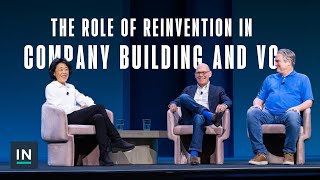
Panel discussion (Youngme Moon moderator; Joel Cutler and Paul English panelists) about the role of reinvention in company building and venture capital, with a heavy emphasis on AI as an agent of reinvention. Key themes: AI’s dual role (efficiency gains and new consumer experiences), industry-specific examples (travel/Kayak, Airbnb, healthcare, education), leadership and founder-driven change as critical enablers, recruiting and team-building in an AI era, and practical advice (use AI as a teacher, poke at new tech, take risks). The conversation closes with human-centered wisdom about team culture (Maya Angelou quote) and a call-to-action that now is a favorable moment to start companies.
Chapters
Foreign.
Good afternoon, everyone. It's just a pleasure to be here. I'm Youngme Moon. I'm here with my two friends, Joel Cutler, co founder of General Catalyst, and can I call you one of the preeminent investors of your generation?
Used to be.
Yeah. Yes. And what's generation in Airbnb? Warby Parker, Lemonade, Oscar, Health. I mean, the list goes on and on. And co founder with this guy, my other buddy, Paul English over there. Co founder of Kayak, of course, way back in the day. And then way back in the day, a ser. Serial entrepreneur and currently founding Boston Venture Studio, an incubator right here in Boston. So it's awesome to be here. Thank you all for joining. It feels intimate enough that this could be a small dinner party. You guys could all come and we could all make this a conversation.
We could have one on one discussion.
Exactly, exactly. So the theme of this conference is reinvention. And so I thought we could start here. The notion of reinvention in the abstract is very compelling and very seductive. But the reality is that reinvention is actually a very messy process in many cases, in part because the ideas that spring out of the need for reinvention can often be so unconventional and strange and weird that it's hard to know what to do with some of those ideas. So I'd like to start by asking you for a story of unlikely reinvention where you encountered an opportunity for reinvention that even you had difficulty ingesting because it felt so unconventional to you.
You go first.
You go first.
Either one of you go first.
Well, one of us has to. I'm having, by the way, we know each other really well, so if we joke, accept it. It's just part of us being together.
Okay.
Yeah. I mean, Joel and I started kayak together in 2004, long, long time ago. And young me's been on my board for a while now and joining my new board, Boston Vent Studio. So we're old friends up here, but for Reinvention, I mean, definitely the theme that you guys have been hearing about at every presentation this week is AI and how AI is given an opportunity to reinvent things. It really is for us. I'm actually back advising Kayak right now. I just started working there just about an hour or two a week with Steve Hafner, my old co founder. Just think about how use AI to reinvent travel. And there's a lot of opportunity to rethink things, rethink customer service, rethink personalization, rethink how to get good content, rethink the role of an influencer in making my decision with travel. So it's all changed. I went on vacation with my son in Peru recently and I was searching on Kayak, you know, being loyal to the old brand, and I sent him a hotel on kayak. My son is like, kayak's for old people. He goes, we use TikTok now to search for travel. So talk about reinvention. That's something new.
Excellent Kill.
It's always hard to follow Paul, but this is the moment to be open to change. This is the time. And every once in a while, new sets of tools come around that make doing something really provocative possible. So today's the day. Like, I'm sure you've heard nothing but discussion about AI this and AI that and everything like that. However, there are two parts of it. One is you can sort of raise the river, you can lower the bridge, you can create more business like all of you do every day. You can make things more enticing for consumers, or you can do the other part of the business and make it far more efficient, save a lot of money, increase gross margin, so on and so forth. But let's talk about the fun stuff. There's nothing that exist in the consumer small business world that shouldn't be better because of the tools that are available to us today. So I think the only thing we can do is throw out the rear view mirror and just sort of look through the windshield and say, like, what would be more fun for people that work with us? What would be more fun for the people that use our services? And so on.
And so do you see this happening in the companies that you're working with? So, for example, the companies at bvs, the companies that you're engaged with right now, are they leaning in fully and already extracting value?
It's amazing. So first of all, like that, let's not talk about the obvious stuff or boring in this room, which would be like customer service enhancements, supply chain enhancements. They're epic. And gross margins are going up all over the place in a way that gives you all more money to spend on marketing and, and things that are far more interesting and exciting in this forum. I think every consumer brand is going to be redone. I think some of the big brands are hard to redo and they're hard to move around like ebay or Amazon or whatever. They're very reluctant to move a pixel. But I think most of the other brands are going to become. They're either going to have to change dramatically or there's going to be a startup that eats their lunch. It's just going to be more interesting, more fun, faster, stronger, better.
Love that.
And it's available. You don't have to create the technology. It's available.
I love that. So Joel has thrown down the gauntlet by offering a prediction about consumer brands. Do you have a prediction? Let's do some predictions about all the ways the way in which we do business, the way in which we live, the way in which we go about our lives is going to end up being reinvented as a result of this latest trend in.
It's going to change everything. I mean, people talk a lot about health care. I'm doing a project, UMass Boston right now where we're teaching every single student at UMass Boston teaches, teaching them classes in AI and how to use AI to be a better student and be a better professional. And we have a nursing School at UMass Boston which is a great school. And think about how healthcare is going to change when a nurse with OpenAI can diagnose better than a doctor who's a professor at Harvard Business at Harvard Medical School. That's coming. So health care is turning upside down. I think it's actually going to create more jobs in health care. Given that AI is going to do a better job diagnosing us, we're going to have more things to take care of earlier. I think life expectancy is going to.
Grow, but on a practical basis you're going to be able to make an appointment, go to a hospital today and need to see three docs. It basically means you have to go back three times. With really basic AI scheduling, you could see one doc, wait a half hour, see another doc, wait a half hour, see another document. This is incredibly doable. So it's not only will we get healthier, it won't be as big a pain in the ass.
Yeah, everything has to be automated.
Yeah, yeah.
It's unbelievable if you think about such a fundamental change in the way we go about doing work. One of the predictions that I would throw out is that some of the most desirable and well paying jobs in the future will be will have job titles that don't exist a day. Would you agree with that?
Explain more.
So what I mean by that is it's not clear to me where the human is going to add the most value in the machine. And as I see it emerging even in education as an example, it's fundamentally changing the role of what you do as a teacher, as an Educator in the places that I see that are beginning to roll out AI pretty comprehensively in their workflows. What they're discovering is that they need a different level of management, a different kind of governance, a different kind of oversight, a different kind of intervention, and that the people who are good at the old stuff are not necessarily the same people who are becoming good at some of the new stuff.
That's an awesome.
And so they're trying to figure out, what do we call this person? What's the title? What's their rank in the organization? How much do we pay these people? And so what I see is companies sort of struggling to figure out where is the human in the machine? Where are they going to add most value, and how can they work in positive synchrony with this new technology. I'm so good at stopping the conversation.
So I think your example is pretty radical right now. And I think today, this incremental movement that's moving pretty fast, and it's like hitting a car and hitting the turbocharger on your car, but it's still us driving the car, and it's still the same car, but we're doing things faster, we're doing things better, we're doing things cheaper, more productive, and so on and so forth. You're talking about, like, this structural change that. I gotta think about it. Like, it's. It's both exciting and a little scary.
Yeah, yeah.
You know, in the world I came from, you could gather all this data and you could say, who's gonna be a good founder As a venture. I was a venture capitalist. I used to work in venture capital. I still do, kind of. And the idea was, I used to say this. People look at me like I was crazy. You should never found a company that doesn't have keyman risk. So, like, the idea with keyman risk was that it limits your. Sort of creates extra risk when you do a business. But the idea is you should never find a company with somebody who's not extraordinary as a reader. You should never find a company that. With somebody who's not really one of one, or in your instance, one of two, or in instance here, one of two. So it's not like these people. You still need these people who are just. Who see the future, who bend the future, who use the tools available to them, who gather the tools available to them, the software tools available to them today, and they make something that didn't exist in the past. But I don't see that yet as a somebody looking for talent. I still think you need an interpreter like that and a manager like that.
Paul, as far as, like I called.
You exceptional, so be nice to.
I mean you're someone who uses the role, like the role of AI in everything you do on a daily basis. And maybe as you answer you should, should give the audience.
I'm running a small company right now called Boston Venture Studio and our job is to create companies. We're working on all our own ideas. All of our companies are created by AI we have a new product, spam strike that came out last week to get rid of your text messages about funding this political campaign. That campaign. That's an AI filter. We have a party invitation system, partyclick.com all the invitations are generated by AI we have a calendaring application that can use AI to decide when's the most commuted time for the three of us to meet. So does Group Calendar. Everything's being done with AI Back at Kayak, we used to run the company for revenue per employee and we did really well. I think we took it public. Is 300 million in revenue with 200 employees. We're very proud of that number. With my new companies, I'm thinking more like millions of uses per engineer. And the reason I like that stat is I want really small teams. I would rather a three person team that's AI powered than a 30 person team. That's not.
Yeah, that's fair.
That makes, totally makes sense. How would you, for people out there who want to get really smart about AI very quickly, what would you suggest they do? How do you go about it? I mean, as an investor, you're constantly having to educate yourself about what new thing you're being presented with. Like what's the best way to get really smart about something.
So the way I got really smart about things was I drafted behind really, really smart people. Like I found people who were provocative, who were forward thinking, who absolutely disregarded the past and only looked at what could be in the future. And, and I think it's kind of that formula. It's also just take a risk, don't worry about screwing up something. Now is a time where you can really do extraordinary work and the tools are available. You don't have to go out and create the tools. That's really the big moment. That's changed between today and five years ago. So take a risk, break some stuff, be provocative, find the really smart person. For me it was always just find the really smart person and let them teach me or listen to them, you know, listen to them in any variety of ways. But I think the first thing is like, getting rid of fear, like, completely. You have to abandon fear of change today or you're screwed.
Yeah. I would also say AI is a great teacher and you can use Genai to teach you how to use AI. So if you want to become a video game programmer and you've never taken a programming class in your life, you can sit down in front of ChatGPT or perplexity or Claude or Gemini and say, I want to write a video game. I want to write a game where there's a little frog who crossed the road and this is what I want it to look like. And it will write the code for you. It'll create a website, it'll create an iPhone app. And if you don't know how to do it, you can ask it, how do I create an app? What do I need to give you? Can you create the graphics? Do you want me to create the graphics? And you really can have a discussion with it, almost like it's a super programmer that's on your team.
Paul, share some a little bit about how it's influenced everything from the way you schedule your day to the planning of your upcoming nuptials.
Yeah, I was telling youngme backstage that my girlfriend and my fiance and I are getting married next year in Ireland. And she said, why Ireland? The food there is terrible. Or something like that. But reason Ireland. I mean, I. It's kind of a funny thing, but my girlfriend Rachel literally went on Chachi and said, what are the most beautiful places to get married in the world? The 10 most beautiful venues. And two of them were in Ireland. So we just went and checked out a couple castles. We found a pretty amazing place. So, yeah, my daily life is changing with AI I have. If you look at my iPhone screen, I wish I could show it up to the audience right now. But the icons on my home screen, it's not Google anymore. It's ChatGPT, Claude and Perplexity. And that's what I'm using every day. I'm using them a lot more than Google and I use it to help make decisions with everything. One of the things I'm really excited about with AI for just my personal use is I just bought the latest version of the Facebook, the meta Ray Ban glasses. And now you literally can talk to AI, but you don't have to have your earbuds in, but you're just wearing your cool Ray Ban sunglasses and you have a conversation all day as you're walking around, you can say, what am I looking at ask it any question. It really changes things for me.
How much search do you do on TikTok?
I do use TikTok for searching. I use it for travel. I travel a lot, as do you, Joel, and I love it. I was in Madrid last week and TikTok helped me find some really good things to do while I was there. So it really depends on what I'm looking for. But TikTok definitely for the younger generation, it's becoming a search engine more than Google.
Absolutely.
Yeah. I find myself, I feel old doing so, but I find myself using it too. When something happens in the moment. Sometimes you can get better updates from TikTok than you can from any other media source. Yeah. Okay. When you think about the adoption curve, we often think about early adopters and the characteristics of early adopters to something new. But yet there's always sort of a tranche of companies that tends to be very sluggish and slow to adopt and they send sort of, you know, they might have missed mobile and been very late to get to mobile or to digitize or whatever. So what are the characteristics? How do you know if you're one of these companies that is susceptible to being a laggard with respect to all of the new opportunity afforded by the new technology were being confronted?
That's a good question. You're really. You ask good questions.
Well, thank you. I appreciate it. I'm glad you noticed. Thank you.
Thank you. I think for a really big company, it's wildly difficult to change. It's wildly difficult to change the way your consumers interact with you. I mean, look at how much change have you ever seen in Amazon or booking.com or some very large consumer platforms today. But behind the scenes you see radical amounts of change. Just enormous, enormous amounts of change. So I think it all starts with this sort of curiosity of people who read it. Like, I guarantee you, Brian Halligan, handsome fellow sitting in the front row, I have to tell you my funny Halligan story before the end of the day, has thought with Dharmesh every day about how this company changes because, because of new technology that's available to it, whether it was AI or something else, because there are always going to be new technologies. There have been in the 15, 20 years that this company's been around. There'll be more in the time that Brian is still a leader here. So I think it just starts with that. But you don't have a company today that we're dealing with that's not radically changing the way it does business. It just may not show you immediately. I have one company that had a huge customer service business, a thousand people in customer service at a 48% gross margin. Two years later it's got a 75% gross margin and 100 people in customer service. You don't see that other than through customer satisfaction because interaction's a lot better. But I think it's just a matter of leadership. I guarantee you Brian is thinking about this every minute with Dharmesh.
Yeah, it's leadership, it's mindset, right? The mindset of the company and the culture that sort of flows from that. Paul, what would you add?
Some people say that leadership doesn't matter when they look into the future of a company. I think leadership matters a lot. When I look at Microsoft CEO present the vision of Microsoft. Two years ago I went on bought a lot of Microsoft stock just because I believed in him. And I thought that his vision for AI was compelling. He was clearly going to bet the company on it. And he was someone that when I watched his presentation, I said those Microsoft engineers, they're going to follow him. And so that turned out to be a great investment just because that was a leader who wanted change. I look at HubSpot, look at Dharmesh, I follow James. He's one of my favorite people to follow online. That's a guy who believes in change, he makes it happen. And he has very provocative things that he puts out there on agent AI and on his platform. And anytime I see a leader of a large company that's willing to say crazy things and change things in a big way, that's a company I want to follow.
I think the other in our world, in this world, companies that are run by founders are going to be more provocative than companies that are run by managers. Now Microsoft's a little bit different, but in a world like this, if you still have founders involved, if you've got these exceptional people that see the future and that dare to break shit, then the company is going to be a lot more provocative and change faster, better.
Stronger, just as a follow up. It's easy I think or easier internally to develop conviction around an idea that is more low hanging fruit or so obvious in the value creation. So you use the customer service example. That's one where the return on that investment is so immediate and it's too easy. Yeah, exactly. But backstage we were joking and laughing and reminiscing about some of the investments that you guys have made over the course of your investment careers that were less obvious even to the point where you made Fun of each other. I mean, I'm thinking of Airbnb, you know, for the ideas.
We're.
We're gathering conviction around the.
As I came home one day from California all excited, I was, like, wildly excited. I met these three guys. They're fantastic. They're doing this thing. It's all about, like, the sharing economy. I'm sure I sounded like a fool. And it was in the travel space. And I call Paul and I say, paul, I want you to talk to this guy. I think we should make a big investment in it. It's a really good idea. You're going to rent other people's rooms and sort of their houses. And I think it's a really good, endearing. I love these two guys. So I asked Brian to call. I asked Paul to call my friend Brian and say, just give me your ideas. And you're Paul, this big guru in the travel business. And the first thing Paul says to him is.
You got to change the name.
That's the stupidest name I've ever heard.
I love brand. And I did not like Airbnb, but that was, you know, $100 billion later, Brian knew what he was doing.
So it just goes to prove, like, you got to go with something who's looking forward and willing to change stuff and do something silly like call a company Airbnb. And not necessarily even Paul, who's, like, the most provocative person one could think of. All right, this is my Halligan story, though. How many of you have met Brian Halligan or know who he is? Just raise your hand a little bit. Handsome fellow sitting in the frontier. Provocative, super smart. Smart enough to get a technical. Co founder who was really extraordinary. First time I met Brian, he comes in and he's asking for money, and, you know, they're going through the like. And he had just come back from another venture capitalist, showed you how smart those guys were. This venture capitalist says to him, brian, I think you've got a really good company here, but we need a much bigger option pool, which is a way to incent new executives. And he looks at me and he goes, like, if you know Halligan, you know this is true. What are you talking about? And they go, well, we need an option pool for a CEO. And Halligan looks at him like, what am I? And so he tells us that story, and all we could say was, brian, how much money can we give you? Because you're the perfect guy to be the CEO of this business. This is about, like, finding people who will call a company Airbnb. It's about finding Brian Halligan and Dharmesh who have found each other and know each other, or Steve and you, who are like completely separate, two sides of a dime almost, and who believe in themselves enough that they're going to do. They're going to do something completely new, make something new out of nothing. Like create this whole brand about inbound marketing that nobody even knew what it was was at the time. But like the idea that somebody was going to make somebody other than Brian the CEO. First of all, it was incredulous to Brian. Like, he was completely incredulous. But second of all, to us, it was just so stupid. So we gave him as much money as he wanted.
Okay, but if I could just double click on this a little bit. Okay. In addition, in order to bend the future in the direction of the vision that you have in your head, it takes more than just a vision. Right? Like, what are some of the other characteristics?
Arrogance, smarts, energy, integrity. Like these are, these sound kind of basic and incredible curiosity. Like the willingness to just be thinking about new stuff all the time, forget about everything in the past. This idea of like pattern recognition, this is the way it was done in the past. It's bullshit. Like, think about the way it should be done in the future. Even if you're wrong, just keep, keep pounding at it and pounding at it and pounding at it. It's the only way to make something new. This company is an unbelievable example of like never paying attention to exactly what was done in the past and only doing things the way they think it should be done in the future. They had this whole new world going on on the Internet and it was, you know, the way things were done just didn't make any sense. It was stupid and inefficient and they made it remarkably efficient and they gave all of you tools to do your jobs remarkably better. And it was just this constant belief that there was a better way to do something.
But did you want to Generic.
Some people are worried about AI automating jobs away, and they think about when they want to start a company. Should I, you know, should I be worried about AI is going to take my job? And I think AI raises the bar for recruiting, which means it's true that you can have companies which in many cases are smaller and number employees. What that means is every employee you hire is way, way, way more important at a smaller startup than it is at a much larger company. So even though we're all going to use AI for all of our companies, our recruiting skills are More important than our AI skills. And can you, you know, can. Can Dharmesh find Brian? Can Brian find Dharmash? Can these co founders get together and try to do something audacious?
Yeah.
I think also the risk is as we get older and we have responsibilities in our job and we have production requirements in our job, we kind of stop poking at new stuff. You know, we've got KPIs, we've got deliverables. So I think the big lesson today is like, poke at new stuff. Like, if you don't poke at new stuff, then you're vulnerable in your job and you're never going to be a leader. It's not complicated.
We have just a few minutes left. Best piece of wisdom you've heard recently.
Tell us yours for the group.
Best piece. Well, you guys go first, but I have a good one. No, no, no, you guys go first. Best piece of wisdom.
Paul, I know you've got best piece of wisdom.
Yeah.
I was at MIT yesterday at an entrepreneurship gathering, and we were talking about, like, what I would tell myself 20 years ago when I was starting Kayak with what I know now. And I said, the best piece of wisdom I've heard from management for running a company is actually a Maya Angelou quote, which is, people aren't going to remember what you said or what you did. They only got to remember how you made them feel. Which means that it's about the team. And if you want to start a company, the wisdom you should look for is how to build a team and how to treat people. AI is going to replace certain parts of jobs, but there's always room for human. I'm going in for shoulder surgery next week. I hope a robot does a surgery. I want a nurse to hold my hand on the way into the OR and say, you're going to be okay.
I like that. I love that.
I can't top that.
It's a good one, huh?
That was. That was wicked good. I'll come back with something, but that was.
Okay, I'll go.
You go.
Okay, I'll go next. So someone said recently we were talking about the notion of curiosity and how, you know, if you lose your curiosity or willingness to lean into things, that then you lose the muscle, the innovation muscle. And someone actually interrupted and said, you know, I think it's so often not that you lack curiosity, but it's just insecurity holding you back. You have the ideas, you actually are curious, you want to go and do it. It's just you're insecure about your ability to do it. You don't want to look stupid. You're just. And I actually think there are more people out there that are curious, want to be innovators, then manifest as innovators and as curious people because there's something in them that's holding them back.
So this wouldn't be the best piece of advice I've ever heard, but I would build on that. You wouldn't be here today if you weren't curious. You wouldn't be here today if you didn't want to learn a better way to do the work that you do and the like. So go for it. This is a moment in time when you really can sort of ratchet up your skills and your capabilities. It's easier today than it was a few years ago that you don't have to make.
Oh yeah, easier for sure.
It's way easier. So I'll build on what you said and yours was very good. Yeah.
The other thing I would say is very good. Strategy is open source now. Like, there are great podcasts. This is my first million. This is how I built this. There's masses of.
I love how I built this.
Yeah, there's a lot of great, great podcast where people are sharing their wisdom. And I do think it's an incredible time to start new companies. And I think it's an incredible time for like, who's going to be the first one person company with a billion in revenue? It's coming, it's going to happen. And so I think now is an exciting time to start things. And again, strategy is open source. We can learn from the great leaders before us.
I'll tell you now, if you have any desire to be an entrepreneur, now's a really good time to come back at it. The venture capital markets opening up like crazy. Ideas are easier to build exactly this capital out there. So if you've got the thought, if you've got an idea of something new and different and provocative, you should go for it. Now's a really good time. The last few years were not. The last few years, Capital was tighter, etc. Etc. Tools are there. You don't have to create the basic science. Every consumer and small business facing application is going to get redone.
Do it.
It might as well be you. It really might as well be you. And the venture capital industry is pretty wide open today.
That was a nice note to end on. Did you do that on purpose? Like with a little extra energy so that we could just put a nice little punctuation mark? I'm looking at the timer. We're just about done. But thank you guys for joining me for this conversation.
Thank you, Youngbi.
Absolutely. Thanks, Gu.
More from Patrick



A NEW BREED OF PARTNER: The Partnership Ecosystem Model Journey of Patrick Biddiscombe, Part 1








Customer Success Workspace: Never Lose Sight Of What Matters Most | HubSpot Spotlight