The Science of Selling with Humor
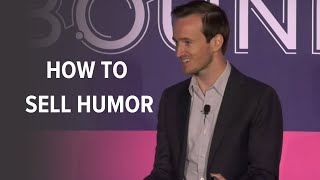
A practical keynote by Andrew Tarvin arguing that humor is a learnable skill that improves sales effectiveness. Tarvin links improvisation techniques to sales — using constraints and inspiration to overcome the paradox of choice — and gives live exercises to demonstrate creativity and trust in instinct. He presents the "humor map" (medium, audience, purpose) and three primary sales benefits of humor: to get attention (incongruity), to improve understanding (association/relatability), and to increase likability (consistent patterned humor). The talk includes examples, brand case studies, shortcuts (incongruity, association, pattern, visuals, story, audio, comic triple), and a call to apply one idea back at work.
Chapters
So I have a confession to make to start off with, which is to say that I am not a salesperson. What I am is a nerd. And if you are wondering what type of nerd, the answer is yes. Computer math, sci fi, Dungeons and Dragons, Star Wars, Star Trek, Starbucks, all of them. But most specifically, I'm an engineer. As a kid, I used to like to take things apart and then put them back together again. Things like clocks and radios and my parents marriage. Never really got that one back together. But as an engineer, I've always been obsessed with efficiency. Ever since I can remember, or really since before I can remember because I was born three weeks early, so apparently even in the womb I was like, I only need a full nine months. I'm ready to go right now. Let's do this. Mom. Yeah. Actually we learned from a video yesterday that that's not how people are born. Actually. A quick round of applause. How many of you have been to Inbound before? By round of applause, how many of you have never been to Inbound? This is the first time. Okay, next, for the people that have been, is it normal to start a presentation with a conception video? Is that weird? Just to me. All right. Anyway, but as an engineer, I've always been obsessed with the. I remember in school thinking that smart for me was getting a 93% in all my classes because the 93% was the lowest grade you could get and still get an A. And it got to the point that if I got like a 94, 95 or worst case scenario, 100%, I was upset because it meant that I did more work than I had to do. Obsessed with efficiency. So I went to the Ohio State University, got a degree in computer science and engineering. Yeah, go Buckeyes. And after I graduated, I started working at Procter and Gamble as an IT project manager. And it was at P and G that I discovered that really no matter what your role is, you are in some form of sales, right? Influencing people to maybe take on a project or convincing people that the way that you do things is the right way to do it, et cetera, right? And sales isn't so much about being efficient as it is about being effective, right? Because you can be efficient with things like computers. You don't need to motivate a computer to work. You don't need to convince it to turn on. It doesn't need a cup of coffee before it starts in the morning, right? But you can't be efficient with humans because humans have emotions and feelings, right? And instead you have to be effective. And sales is part about the effective process of engaging with humans as and as a stereotypical nerd, which I think I meet one of the stereotypes, right? Skinny body, nasally voice, allergy to the sun. As a stereotypical nerd, I didn't necessarily have the skill set that I needed to be effective with people. But luckily for me at Ohio State, I started doing improv and stand up comedy. And what I realized over the years was that the same skills you need to be effective as an improviser are actually some of the same skills you need to be effective as a salesperson or as an entrepreneur or with someone that engages with other people. And so I started to explore that intersection. I proclaimed myself the corporate humorist of Procter and Gamble and started blogging about it internally. Got business cards made, and I assumed eventually someone would come up and stop me. Someone from HR or legal would be like, hey, you can't just create your own job title. But no one ever did. People started referring to me as the corporate humorist. So I started to explore that intersection of humor in the workplace, improv in business, happiness, and productivity. And I fell in love with the work. So I started my own company, Humor that works, in 2009 and left P&G in 2012 to focus on it full time. And now we work with organizations all around the world on how to be more effective using humor in the workplace. And that's what we're going to talk about today, about how we can use humor in sales. And I'm incredibly excited to be here with all of you. I know there's a lot of fantastic options, so I am truly honored and humbled that you're all here in the room today because we are talking about humor. Though it is important to first start with a disclaimer. So we'll see if we can bring up this disclaimer. If I can get this to work. I'm an IT person and don't know how to use a clicker. That's perfect, right? All right, maybe, maybe not. Do I need to turn this on? Hey. Hey, it worked. Look at that. So this is your disclaimer. If you guys could read that and hit I accept that would be perfect. But basically the summary or too long didn't read version of this is basically to say I've never actually been in your roles, right? Unless you were an IT Project Manager at P and G. I've never actually been in your roles. So I don't know what it's like to sit in your day to day. But what I have done is work with over 250 organizations all around the world on how to use humor. And so my challenge to you is to be on the lookout this afternoon for one idea. Maybe it's one concept, one exercise, one slide that you want to take. Whatever it is, be on the lookout for one idea that you would actually implement when you go back into the workplace. Because that's what's important to me as an engineer. Right. My goal for today is one, to convince you of the value of humor, why you want to make the choice to use it. Two is for us to have a little bit of fun. We can laugh through this process. But three, that you have something that you can do differently. Right. As an engineer, that's what matters most to me. Because there are so many tremendous benefits to using humor. It's not about just making the workplace fun. It's about doing things a little bit differently. There's 30 plus benefits to humor backed by research, case studies, and real world examples. And these are some impressive things, right? So humor increases long term memory retention. How many people remember sohcahtoa? You guys know what sohcahtoa is, right? It's trigonometry. Sine equal to opposite over hypotenuse. Cosine equals adjacent over hypotenuse. Tangent equals opposite over adjacent. Right? Sohcahtoa. I haven't used that since high school, but I remember it because it's fun to say sohcahtoa. Does anyone know the mnemonic people don't need to see Paula Abdul? You guys know that one? People don't need to see Paula Abdul. It's the layers of a networking stack. So physical data session, networking program application. Again, I don't have to use that at all, but I still remember because I do know that people don't need to see Paula Abdul. Right? We can use humor as a way to increase our long term memory retention. We can use it for burning calories. In fact, 10 to 15 minutes of laughter burns as many calories as five minutes of aerobic exercise, 10 minutes of dancing, or 15 minutes of milking a cow. So if you guys are milking cows for exercise, you can stop. Or I guess you could actually milk cows and laugh at the same time. Probably get locked up, right? If you do that. But it can burn calories, it also increases the size of paycheck. In one study, they found executives who used humor were actually paid more. And it was positively correlated. The people who used more humor were actually paid More. So you can use humor, you can make people laugh as a way to make it rain. Make it rain. If you use credit cards, make it rain. If you like bitcoin, make it rain. So we can use humor as a way to increase the size of our paycheck. So what we're going to talk about today are the benefits of humor specifically applied to humor and the sales process. We can see this sign in New York City, warm pizza for your cold heart. That's what we're going to try to apply here in this case. But there are three things that you need to know about humor before we jump into how we can use it for sales. The first thing to know is that humor isn't just comedy. Humor is a little bit more broad than that. Because when we think of humor, a lot of times we think of laughter, we think of jokes. But humor is defined as a comic, absurd or incongruous quality causing amusement. So it is something comedic, but it also could be something a little bit silly or maybe something just a little bit different that gets people to pay attention a little bit more. So these are a couple of examples of what I think are effective humor. This first one is from tire discounters, family owned. Shut up. No, you shut up. It's a pretty good sign. This next one was in an improv theater in Dallas. You don't have to be crazy to work here, will train you. I think that's pretty good. This next one was a sign that I saw in a park in Norway. This one is interesting to me because I've never seen a stick figure with a butt before. Just something a little bit different. Last one is from physics textbook. Now this one isn't necessarily like laugh out loud hysterical, but it is something different. If my physics textbooks growing up had problems like these, I might have tried for more than a 93% because I don't care what the force of a random ball hitting a wall is, but I do care what the force of the Batman hitting the Joker is. So when we're talking about humor in the workplace, we're not talking about making the workplace funny per se. We're talking about a way of working that is different, effective and fun. Talking about today, the second thing to know about humor is that it is a skill. And if it is a skill, it means it can be learned. And I know it can be learned because I am someone who has had to learn how to use humor. I've done over a thousand shows as a stand up comedian, improviser, storyteller, spoken Word artist. I've spoken and performed in all 50 states, in 20 countries, and in one planet. This one, right? But what I've learned over time is that this is a skill that we can learn. Because I recently went to my high school reunion and people found out that I did comedy. And they're like, but you're not funny. Because growing up, I was never the life of the party or the class clown. I am very much an introvert. If you know your personality assessments. I am a type A blue square conscientious intj with the sign of Aquarius, which means I am a stubborn, ambitious introvert who likes long walks on the beach by myself. But what I've learned is that we are not our personality assessments. Right? A personality assessment is a single assessment at a single point in time, and it might define our behavior, might give us insight into who we are, might tell us which Disney princess we are. Pocahontas. But it doesn't define us. Instead, we are defined by our actions. And so if we act as a comedian, we can become a comedian. That's what happened to me in college. My best friend wanted to start an improv comedy group. He needed people and forced me to join. And I will tell you, we were not very good, at least when we first started out, because we watched Two's Line Is it Anyway and tried to repeat what we saw. But over time, with practice and repetition, we got better, because that's how you get better at any new skill, is through practice and repetition. And so it is the afternoon, so I want to do a quick activity just to kind of demonstrate this principle. So I want you to turn to the person next to you, and with the person next to you, quickly determine who has longer hair. Should be easy. All right. Kind of close over there. Yeah. All right, so what you're going to do is with the person next to you, what's going to happen is the person with longer hair is going to start. And what they're going to do is they're going to make up a word that does not exist in any language. A person with long hair is going to make up a word that does not exist in any language. So, for example, they might say something like denobi. I don't think denobi is a real word. The other person is going to repeat that word, de nobe, and then give the definition of that word. Okay. They're gonna define denobi. So they might say something like, denobe is the cousin of Obi Wan Kenobi, and he's a plumber on Tatooine. Right. So they're gonna give a definition to it. Right? Then that person, the person that just gave the definition, is now gonna make up a word that does not exist in any language. The other person's gonna repeat that word and then give the definition of. Basically, you're going to go back and forth, alternating between who's making up a word and giving the definition. Does that make sense? Now, I will give you one quick tip for when you are giving the definition, is that these words do not exist in any language. So no matter what you say is the definition, it is 100% correct. Right? All right. So go ahead and begin. All right, excellent. We'll stop right there. We'll stop right there. Clap once if you can hear me. Clap twice if you can hear me. Clap three times if you can hear me. All right, excellent. How's the exercise? Easy, hard, fun, Dumb? All of the above. Yeah. So because of time, I don't want to go too far into it, but I want to talk a little bit about this particular exercise. How many people, by show of hands, how many people thought that it was harder to make up the word? How many people thought it was harder to give the definition? All right, interesting. So for the people that thought it was harder to make up the word, a lot of times we feel like it's harder because we as humans suffer from something called the paradox of choice. Barry Schwartz, a great TED talk on the paradox of choice, which says that when we have too many options as humans, we become paralyzed by all of those options. This is actually a really important thing to understand within sales, because in sales, they say a confused mind says no. If you present too many options to someone in terms of what they might buy, the easier decision for them to say is nothing at all. Rather than picking one of the options you give, confused mind says no. This is also very true in the creative process. If you've ever sat down and been like, okay, go and be funny. Very hard to do. Paradox of choice. What do you actually talk about? What do you actually do? Well, the way around the paradox of choice we learn from improvisation is by giving ourselves some form of inspiration. And inspiration for us can come in many different forms. It can be the world around us. It can be how you look in stand up or in some of my speaking engagements, I'll sometimes talk about who I look like because people tell me that I kind of look like a skinny Hugh Jackman. People always emphasize the word skinny, though, which I'm not sure about like, I've always been skinny. I was born 8.3 pounds and then stayed that way till I was 15 years old. Other people, they'll tell me, no, you kind of look like the intersection of Hugh Jackman and Conan o'. Brien. Sounds good. I did an event once not too long ago, and a woman came up to me afterwards and she was like, I think you look like Justin Timberlake, but from here to here. Cool. It's like the eyebrows or the eyes of jt. I'll take that. Right. We can use inspiration from the world around us, right? We can also use constraints. The other way to get around the paradox of choice is to give ourselves constraint. And so we can give ourselves an improv. We give ourselves constraints in the form of doing short form improv, playing Pacific games, or by doing long form structures like the monocene or the Herald. For us as creators, though, we can use shortcuts for humor. We're going to talk about some of what those shortcuts are, but I'll tell you that using these shortcuts, using these devices, actually makes the process a lot easier. Gets us around the paradox of choice. Now, for the other people that find that it's harder to give the definition, a lot of times people find it harder because they actually have something that comes to mind. Even when you hear a made up word, something comes to mind, but you filter it, like, ah, that's not a good enough definition. Or it's not like it's not close enough to the word. Because the made up word that they said sounded like it was almost like, of German origin. And like, right, we get into this analysis of things, the reality is that to be funny, to be more creative, there's two things that you need to learn. One is learning to trust your creative instinct. And two, refining that instinct over time. And I will tell you, it's the first one that is a lot harder to do. Has this ever happened to you guys? Have you ever had this experience where you've been in a meeting and then like a couple of hours later you thought like, oh, what I should have said was this. Has that ever happened to you? Yeah, right. It's something called staircase wit. You have like something happens here and then in the stairwell a little bit later you have this idea that's actually a good sign because what that means is that you have comedic instinct, right? And then with practice and repetition, you can have that ha ha moment happening from three hours later to only two hours later, to only an hour later to then in the moment Right. Because reflection on the past leads to action in the future. If you just start repeating this process, if you start to look around the world and look for things that are funny and also start to notice when you make people laugh, just being a little bit more conscious about it, you start to improve that skill. The last thing that I'll say about this is that if you did this exercise, you can create humor. That's the process. You all just improvise. You created something out of nothing on the spot. So it is a skill that you can learn and anyone can learn it. And these are important principles as we go through. The last important thing for you to know about humor before we jump into humor in sales is that I love puns. Actually, maybe this is more of a nice to know type thing. Maybe it's not absolutely important to know, but to me, actually, it is an important idea because I first started using humor at PNG because I was in this meeting. And maybe this has happened to you before where you're, like, incredibly bored in the meeting, right? Like you want to be anywhere else, right? You start creating your to do list. You start, like, looking at your nails, you start looking at the paint on the wall and trying to make sculptures out of the mess ups and everything on it, right? Have you ever been in a meeting that boring? I was in a meeting that boring. And the problem was I was the one leading the meeting, right? And I was like, if I am bored while talking, they've gotta be bored while listening. And then I realized I was in control of my own presentations, right? I was deciding what I needed to talk about. And obviously there's certain things that I needed to cover. But I had more control over the process than I realized. And so I started to incorporate humor into my presentation just so I was more entertained. I learned that Hitchcock is in almost every single one of his movies somewhere in the background. And so I started adding pictures of me into my presentations. Sometimes they were subtle. A lot of the times they were just obvious, like kid pictures, all that kind of stuff. And it just became something fun for me. I also include puns in my presentations now because it's fun for me. And I have a question for you guys. Agree or disagree with this statement, you guys shout it out. If you agree or disagree, you are responsible for your own happiness. Agreed. Right? You're responsible for your own happiness. So that means if you dread going into work in the morning, it's on you. If you go into meetings that you despise partially on you. If you hate Your co workers partially on you. Right. It doesn't mean that you are in control of your happiness, but you are responsible for it. You wake up every single day about how going to approach your day. And that doesn't necessarily mean if you hate your job, you absolutely have to find a new one. Right? But instead maybe you start making tweaks on how you enjoy the process a little bit more. Right? So we'll talk a little bit about that as well. I do it with puns, and this is a perfect excuse because I bring this up so that I can share some puns with you guys, because I love puns. I tweet them mostly. That's most of what my social media is. So if you love puns, you can follow me, Drewtarvin. If you hate puns and you just want to, like, comment on them in a flaming way, you can also follow me, DrewTarvin. That's fine. But these are some of my favorite puns of the recent past. The first one, I think the key to being a good ghost is to act supernatural. I think that's pretty good. I want to write a book about aggressive wins, but I can't get past the rough draft. If I had to estimate the number of fist bumps I've given in my life, I'd say a ton, you know, £2,000. Yeah, that's pretty. Groans are just as good, right? I'm on board with groans. That's completely fine. All right. One last thing that we do need to talk about when we talk about humor in the workplace. And this is what's called the humor map. And humor map stands for your medium, audience, and purpose. This is how you can make sure that you use appropriate humor. And one that's actually going to get results is by following the map. Because the map, medium, audience, person, purpose, medium, is how are you going to execute that humor? Right? Is it in a cold email to someone that you're just now reaching out to? Is it in a client meeting, one on one? Is it following up after a purchase when how are you actually going to execute that? Humor is important to understand because certain types of humor work better whether they are presented, say, like, verbally or in an email form. For example, like music. Music requires partially us listening to it, right? These are the lyrics from Rihanna's work. This song was number one in America for nine weeks. It was nominated for two Grammys. Not because of its lyrical content, Right? It's about the music. It's a catchy song. We need to actually hear it. Music can work, though. Visually, sometimes. This next one is an advertisement from Aldi. I think it's pretty good. Like, whoa, we're halfway there. Whoa. Lemon on a pear, right? That's much better than my singing was. That was terrible singing. I've started in my drive for efficiency. I've started listening to, like, podcasts and YouTube videos on one and a half speed, because not only is it faster, but then more people sound like me. Second thing to know is our audience, right? This is who is going to be receiving our humor. We want to know what they need, what they know and what they expect. We also need to know our relationship with them, because you recognize something that we say to, like, say a close friend is going to be very different than the humor that we might use in our first client call, right? So who the audience is is very important because we want to make sure that we speak their language, but they understand it. How many people in here speak multiple languages? Wow. Many of you, wow. I speak one. Not even English, just Merrick. It's not true. I know a little Italian. His name is Tony, but I don't speak any other languages. And it took me going to London to realize that even British English is different than American English. You guys know that, right? It's different. Like, they say lift, we say elevator. They say tube, we say subway, right? I didn't know this. What we call pants, that's underwear to them. I didn't know that I was on the tube. This old lady gets on. She had the coolest jeans on. And I was like, oh, my God, I love your pants. She was like, oh, really? I will say the British and European countries, I do appreciate there that they call them toilets. They say instead of bathrooms, they say toilets. Because that's more accurate, right? You go to the bathroom here, there is no bath, right? So I tried to bring that back. I live in New York, so I went to a Starbucks in New York, and so I went up to the barista, and I was like, excuse me, where are the toilets? And she was confused. She was like, in the bathroom. So it doesn't always work. We need to make sure that we're speaking our audience's language, particularly when it comes to humor. The last reason or the last piece of the humor map is your purpose, and this is the most important one. And this is, why are you using humor? Because humor for the sake of fun is fine, but there's so many more benefits to it that we really want to start to use humor for, and that's what we're going to Talk about now. Specifically why we should use humor in sales. The first way we can use humor in sales is to get people to pay attention. Exit building before tweeting about it. Good thing for you guys to know we can do things to get people to pay attention because the average person sends and receives 112 emails per day and spends up to 80% of their time in some form of active communication. If we want to get them to pay attention to care about what we're talking about, we have to do something a little bit different, right? We have to do something like this sign for a shop hours of operation. It's pretty good, right? It's something just a little bit different. Or the front page of whogivesacrap.org, this is a great site for ordering toilet paper delivered to your door. Well, to your front door, to your bathroom would be creepy. Something a little bit different to get you paying attention. This next one is from a job recruitment ad. Are you in the wrong job? Look at his legs just hanging there, right? If you're flipping through a magazine, that's going to get you to pay attention because it's something a little bit different. We can also use it in email subject lines. So these are just some subject lines that I think incorporate a little bit of humor. First one from a vase retailer. Sometimes all you need is a vase lift, right? Pretty good deals that make us proud. Unlike our nephew Steve, makes you pay attention a little bit more. This next one is from Boston and keep in mind that it was sent at 6:45am 6:45am where to drink beer right now, right? If you're going through your inbox, you're like, oh, I'm suddenly going to pay attention to this a little bit more. Where we can get people to pay attention. This also works in the body of the email. Recently I got an email from someone. It was like kind of a cold email pitch about some services and I didn't like look at it. I got a follow up email a week later and you guys know the Travolta meme where it's just him from Pulp Fiction where he's like looking around like this. The body of the second email was just a gif of that, right? That's good. That caused me to respond, right? It's like, okay, that's interesting. It gets me to pay attention, made me smile and now I wanted to reward the person for making me smile by actually responding. And my response was, I don't need what you're selling, but I Just want you to know. Excellent work, right? Get people to pay attention. Now, I will say there is one caveat with this is, please, please, please stop using clickbait, please. It drives me crazy because it's like, if there was clickbait when Lincoln was around, it would be like, president Lincoln goes to the theater. What happens next will blow your mind. There's like a groan. Is it too soon? Is it too soon for a Lincoln? 200 years isn't long enough. All right, yeah, stop clickbait, please. Right? The next thing to understand or the next reason why we can use humor in our sales process, right? We can get it, one, to get people to pay attention when we're first starting the conversation. Two is to improve understanding, help people learn a little bit more, understand the product. Right? This comes into the consideration phase. This picture here is taken at Caveat. It's a club in New York City. They do fantastic shows. This woman here is an astrophysicist, and she was explaining astrophysicism. Is that a word? Astrophysics. And she was using it using sci fi movies. Or more accurately, she was ruining sci fi movies. Like, for example, she talked about in Star wars how there are no explosions in space because there's no oxygen. You can't see laser beams, and that the Force isn't real. That may be true, but that doesn't stop me from pretending like, the Force is real every time I walk through an automatic door. If you guys aren't doing that, you're missing out on, like, life's greatest joy. It's very, very good. We can use humor. We can connect to things like pop culture to help people improve their understanding of our particular product. Right? There's an example. This is a door to a math classroom, right? That's pretty good. I like that. This is in a dentist's office. You like, don't unsee that picture. You're going to close your eyes later and it's going to be Gollum smiling with all those teeth. But you instantly understand what they do, and you're going to remember that a little bit more. So we can use association as a way to help people improve their understanding. So I want to do another quick exercise. So I want you to turn to the person next to you again, or you can turn to someone else and this time quickly determine who has cooler shoes. All right? And if it's a tie, that's fine. If it's a tie, that's fine. All right, so listen up. All right, listen up. So clap once if you can hear me. Clap twice if you can hear me. Cool. What's going to happen? Is the person with cooler shoes or just random whatever you want to do? What they're going to do is they are going to explain what a cell phone is to the other person, and the other person is going to be someone from Shakespeare's time. All right? We're going to imagine you were transported from Shakespeare's time. You've come here to the US you're here in this moment, and this person is going to try to sell you a cell phone. Right. Not only explain a cell phone, but we'll add the extra caveat is you're going to try to sell person from Shakespeare's time, the cell phone. Shakespearean people will say that you understand modern day English to some extent. Right. You're going to at least have the context so you'll understand the words that they're saying, but you won't necessarily know words like cell phone or satellite, that kind of thing. As Shakespearean people, it's entirely up to you if you want to speak like a Shakespearean person, if you want to use Elizabethan English and all that kind of stuff, entirely up to you. But your job is simply to try to understand what a cell phone is. And if you want one, and the person explaining it, the person with cooler shoes, your job is to try to explain it in such a way that the person would want to buy one. Does that make sense? Any questions? No. Go ahead and begin. All right, excellent. We'll stop right there. We'll stop right there. Clap once if you can hear me. Clap twice if you can hear me. All right, so by show of hands from my Shakespearean people, how many of you are buying a cell phone? Okay. All right, cool. From one of the people right here, can you pop up to the microphone just super quick and tell me why you're buying a cell phone? Yeah, you said you're buying it. Why are you buying a cell phone? He described it as a cell phone stick that you could talk to, and if someone else had another stick, they could talk back to you. Okay. And then I asked him whether it would work when I brought it back to my time, and he said yes. Yeah, if it. Yeah, it would work if you take it back to your time. All right, so it's a stick that you could use to talk to someone else. All right, perfect. Yeah. You, sir, will you share why you're. Yeah. Will you come up to the microphone and share why you're buying a cell phone? He did a good job explaining that If I forgotten something that my wife needed that I didn't have to go back and see her again. Oh yeah, you didn't have to. It saved you. Right? Okay, very good. I like for my Shakespearean people, how many are not buying a cell phone? Who's not A couple of you not buying a cell phone. Okay. Would you be willing to run back there real quick and just and share with us why you're not buying a cell? Curious about this. I may have misunderstood the assignment a little bit because I thought I was Shakespeare. Oh, okay. You know, that's even better. She told me that Romeo and Juliet would have never committed suicide because they would have been able to call each other. And then I said that I would be. Oh yeah, you in the back, you're also Romeo and Juliet. Yeah. Cool. Oh, okay. Yeah, that makes sense. That makes sense. Yeah. Thank you. Yeah. Because Romeo and Juliet is fundamentally a different story if they had cell phones, right? Juliet's in that cave like taking selfies. She's like, hey Romeo, it's me. Hey. It's fake poison, by the way. Don't kill yourself. Lol. Brb. Very different story. Right? So yeah, this is really, really interesting because I think that right. In today's world it is a no brainer to have a cell phone. No brainer. Everyone in this room has a cell phone. And yet, right. Someone comes to modern day, if you can't explain a cell phone in a way that is relevant and relatable to that person, they're not going to buy. The same is true for your products or your services. You might have the perfect product, the perfect service for someone. But if you can't explain it in a way that they understand, relevant and relatable, then they're not going to buy. Right? Because that's effective communication. If you read Made to Stick by Dan and Chip Heath. Great book. Their basic six principles boil down to those two relevant and relatable. Relevance being why should I, Why should I even pay attention to what you're talking about? To Romeo and Juliet or to people in Shakespeare's time. It's like, hey, you know how you like have to write love letters but sometimes they get lost by the friar or whatever happens, right? Imagine you could write to someone very, very quickly. You could communicate quickly, Right? Right. It's relevant. The second piece is relatability. Right? We have to relate things in terms that people understand. Anyone here know what a euphonium is? You guys know what a euphonium is? A few of you, right? So if you know What a euphonium is, you could say it's a series of brass alloys bent into various shapes. It has valves on it. You blow into it and it makes noise. Or you could say it's like a small tuba, right? And if you know what a tuba is, you instantly understand at a high level what a euphonium is because it related it to something you already know. That's effective communication. That's what Thomas Harrell calls verbal fluency, the ability to articulate the intelligence that you have. Verbal fluency, relevant and relatable. Relevant in sales is telling them the things that they need to know, the benefits, right? Explaining the benefit. System relatability can be humor, right? You can connect it to something that they know. If you know they're a Game of Thrones fan, right? Connecting it to Game of Thrones if you know that they went to Ohio State and they're a football fan, relating it to football. Right. Or some type of experience. Humor can be our way to relate that material to get people to pay attention and improve their understanding a little bit longer. Right? So think relevant and relatable. The last way that we can use humor that we'll talk about today is to increase our likability, right. Not only as our individuals, but as a brand as well. So these are some of my favorite brands. So caveat is the theater that I talked about before. The Boring company. I have to like it because it's a pun, right? Nintendo. Nintendo is phenomenal. Do you guys know Nintendo's mission statement? Nintendo's mission statement is to bring people together. Nothing to do with video games. It's all about the fun and bringing people together. They started as a card company in the late 1800s. And you see this with things like the Nintendo Switch, Nintendo Labo Labo, all that kind of stuff about bringing people closer together. How many people here read the Hustle? Few of you. So the Hustle is a daily newsletter, much like the Skim. It's one of the few emails that I open almost every single day. And it's because they use humor. I open workshop inquiries and things like that. I open those right away. Friends, emails. Emails from my mom and then the Hustle, because it is fun. They've created a brand around humor. They have a recurring segment called a startup dictionary. So like startup dictionary, a thought leader is an authoritative voice in a field of expertise. The loudest voice in a field of expertise. Or when you don't have credentials but you do have opinions. Right. Or circle back. We've all experienced circle back is A phrase when you don't want to discuss a task or topic in the current moment or ever again. Right. So this is a recurring segment. It comes back with different examples or every single Friday, they share shower thoughts from Reddit. So if you've seen those shower thoughts from Reddit, they share some of their favorite ones. So, for example, there are two types of hotel guests in the world. Those who ask when tomorrow's breakfast begins, and those who ask when it ends. I'm definitely asking when it ends. Right. I'm one of those people that likes to hit the snooze button two or 300 times. Right. So shower thought, Thinking about the world falling down is the same as being hit by a planet. That's a pretty good perspective, right? If you trip and fall and someone asks, oh, my God, are you okay? Be like, doing pretty okay for getting hit by a planet, right? Pretty cool perspective. This one's weird. The only part of your reflection you can lick is your tongue. It's weird. It is. But I'll tell you, you guys are going to be walking by a mirror later, right? Yeah, I'm going to test that out. Right. So this happens every single Friday. And what happens when you create a brand or a pattern of humor? People want to start engaging in your content. They want to start experiencing what you are putting out there. Because if you had two emails in your inbox and you know that one is traditionally kind of boring, or you don't even know what's in it, and you have one that you're like, oh, I tend to smile or laugh whenever I open it. Which one are you going to open first? This recurring use of humor gets people to want to engage with you. So if you make it consistent and part of your sales, copy right from the very beginning of a cold email or on the website, copy that there's humor. And then in the first phone call that they have a little bit of fun, right? People are going to start to be, oh, okay, I may not even want the product right away, but I'm okay with the experience because it is an enjoyable experience. And if you guys ever bought something from a brand, not so much because you needed it, but because you want it to support them. Has anyone done that? Right. You build that over time through things like humor. It's a process that we enjoy and can experience. Right? And this can be something easy. It doesn't have to be complicated. Right? You can do simple things, like you can ask questions in your meetings, ask questions, get to know the person a little bit Better, because that's one thing that you have to understand is if you want your material to be relevant and relatable to someone else, you have to learn what's relevant and relatable to them. Right? That's part of the research process. That's part of defining your target hue. But you can do that also through questions. So, like, one of my favorite questions to ask in larger groups is, what is something that you think is true for you, that you don't think is true for anyone else in the room? Something that you think is true for you, that you don't think is true for anyone else in the room? In fact, I want you to turn to the person next to you, and I want you to answer this question in just a minute. Something that you think is true for you, that you don't think is true for anyone else in the room. For example, if I was doing this exercise, I might say something true for me is, last year, I did a literal book launch. So I attached my book to a pumpkin and then launched it out of a catapult. Literal book launch. I've also had four milkshakes in one day. Love milkshakes. Right. So that's something that's true for me that I don't think is necessarily true for anyone else in this room. So take, like, 30 seconds real quick and answer to the person next to you. Something that you think is true for you, that you don't think is true for anyone else in this room. Go ahead and begin. All right, excellent. We'll stop right there. We'll stop right there. Clap once if you can hear me. Clap twice if you can hear me. Clap three times if you can hear me. All right, excellent. Very cool. Anyone on the row willing to share what they shared of something that they think is true for them, that they don't think is true for anyone else in the room. Yeah. Join right there. I have flown with the Thunderbirds and pulled seven GS. You've pulled seven GS? Not even like, $7,000, but, like seven GS. And, like, I would have liked that, but, yeah, no, that is. That is super cool. That's amazing. Anyone else, like, super close, wanting to share one? Yeah. In the back, real quick. Jump up real quick so that we can hear something that is true for you, that you don't think is true for anyone else in the room. My family owns a circus. Your family owns a circus. So if you were, like, as a little kid, like, I hate you guys, I'm leaving for the circus. They'd be like, yes, we've been telling you to go work there for a long. That's amazing. That's awesome. Very cool, right? I love this question because you ask people this question, even if you've known them for years, a lot of times you'll find out interesting things about people, right? And you start to create a human connection. I've done this in a lot of different places. I've met a lot of really interesting people asking this question. I met a guy who's a project manager in three different nuclear power plants. I thought that was pretty cool. I met Madonna's first agent this way. I met a guy who competes in the annual wife carrying competition in Norway. Learned that that's like a thing. But my favorite. I was doing a conference for software developers, and there's a guy in the front row and I asked that question. What is something that you think is true for you, that you don't think is true for anyone else in the room? Guy in the front row is like, oh, well, I think I'm handsome. Just called me and everyone else in here ugly, right? But it can be something as simple as that, something as indigorous as that. Just simply asking a question to build a human relationship with someone before you even start the actual sales process. That's the value of humor. You do that as a process, people actually want to engage with you, right? So this is our recap. This is what we've talked about, humor in sales. Three quick shortcuts. One, use incongruity to get people to pay attention. Do something just a little bit different so that they pay attention. Two, use association. Connect to other ideas, right? To create metaphors or analogies so that you can improve people's understanding and that they remember things longer. And three, use it as a pattern. Use it consistently in your process as a per. As a way to create like ability so that people want to engage with you and your content. Now, some of you might be looking at this and say, wait a minute, there's three here. But if you look at the description, it says there's going to be five. And some of you might be thinking, well, that's clear that he wrote the description before he created the presentation. That's true. But the other thing to know is that I also wanted to make sure that I demonstrated things. So maybe I've told you three, but I feel like I've demonstrated the 10 shortcuts, the 10 devices that we talk about on how to use humor to be more effective. So he certainly talked about Incongruity, association and pattern. We've also shown visuals. Right. One of the things that you see here is that you don't always have to be the creator of humor, but sometimes you can be the shepherd of humor. You can find images or videos or things that you want to share out and then just make sure that you don't violate any copyright rule and you give proper credit. But one of the things that I do in a lot of the ins in my emails is that I will send leaks to stand up comedy bits that I really like. Like I love Eddie Izzard. So I'll send out links to like Death Star Canteen or Cake or Death. Right? Fantastic. Stand up bits that people can then laugh at and associate to that particular brand. We can also use things like story, right? Starting out with a story to get people to pay attention a little bit more, to tell a little bit about our background about why we might be here. We can use audio, whether that is music or changing voice inflections. And what we do, we can share jokes, specifically things like a comic triple. So a comic triple is where you have a list of three things and that third thing is something different. So it's basically a B3 or 1, 2C simple ways to kind of add these different devices. That's at least. So we got to six, right? So there's six shortcuts. We've blown past the five that we needed as part of our recap. So the last thing I'll end is on this one. If you are interested more in what we do or in terms of training your organization for the sales process or some of the online resources that we have in terms of being able to use humor. Certainly feel free to email me or just go to humorthatworks.com you can follow me on social media. But the last thing that I'll say is this. The last thing that I'll end with is this is that you are responsible for your own happiness. You decide every single day how you're going to approach your work, how you go into the workplace every single day. So why not choose to be more productive, less stressed and happier? Why not choose to get better results and have more fun? Why not choose humor that works? You guys have been fantastic. I've been Andrew Tarvin, thank you very much.
More from Patrick



A NEW BREED OF PARTNER: The Partnership Ecosystem Model Journey of Patrick Biddiscombe, Part 1








Customer Success Workspace: Never Lose Sight Of What Matters Most | HubSpot Spotlight